
A 30 amp RV surge protector is the only thing standing between your coach and a socket you do not own, cannot inspect and cannot repair. Every campground pedestal in North America is wired by somebody else, maintained by somebody else, and reconnected a few thousand times a season by people in a hurry — and nothing on the outside of it tells you whether the neutral is intact. Of the five units compared here, the one we would fit first is the Progressive Industries SSP-30XL at $51.55, which scores 8.8.
The five products below span the useful range, from a $26.65 unit that names seven separate supply faults to a $126.99 unit that reports live voltage to your phone. They also expose the strangest thing about the category: the joule ratings run in almost exactly the wrong direction. A $29.99 unit here claims 26,000 joules; the one with 5,686 owner ratings, a lifetime warranty and United States manufacture claims 825; and the cheapest product on the page, at $26.65, claims 12,000.
Each pick was judged on its published fault list, its weather sealing and fit, its warranty, its owner base, and whether it merely reports a dangerous supply or refuses it. This comparison is research-based. We did not physically test these products; specifications, ratings and prices are taken from the live listings on the date shown. British readers should start with the US vs UK section, because a British pitch has no 30 amp socket at all.
30 amp RV surge protector — Quick Comparison
| # | Product | Role | Key spec | Best for | Price | Score |
|---|---|---|---|---|---|---|
| 1 | Progressive Industries SSP-30XL Portab | Best overall | 825 joules, lifetime warranty | Almost everybody | $51.55 | 8.8 |
| 2 | Power Watchdog PWD30 Bluetooth Surge P | Live monitoring | Bluetooth app, 3,000 joules | Long stays, busy sites | $126.99 | 8.6 |
| 3 | GEARGO RV Surge Protectors 30 Amp RV C | Best value | Six named faults, IP68 cover | Frequent movers | $35.15 | 8.4 |
| 4 | Kohree RV Surge Protector 30 Amp, Powe | Most thorough diagnosis | Seven named faults, IP67 | Wet climates, seasonal pitches | $26.65 | 8.0 |
| 5 | 30 Amp RV Surge Protector 26000J Overl | Automatic shutoff on a budget | Auto shutoff, manual reset, LED display | Tight budgets, long hook-ups | $29.99 | 7.4 |
- 30 amp RV surge protector — Quick Comparison
- The 5 Best 30 amp RV surge protector Picks in 2026
- 30 amp RV surge protector — Buyer’s Guide
- What the Wiring Rules Require at the Pedestal
- US vs UK: The Same 3.6 Kilowatts, Opposite Plumbing
- 30 amp RV surge protector — Which One Should You Buy?
- 30 amp RV surge protector — Frequently Asked Questions
- 30 amp RV surge protector — Final Thoughts
- Sources and Further Reading
The 5 Best 30 amp RV surge protector Picks in 2026
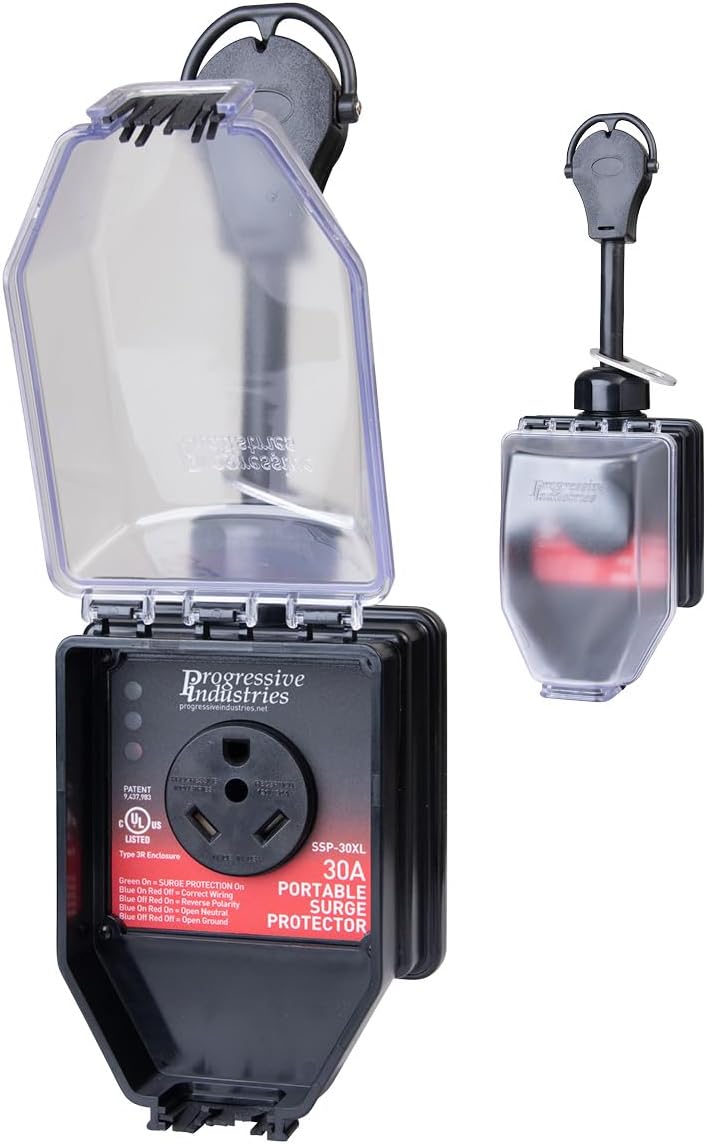
1. Progressive Industries SSP-30XL — Best 30 Amp RV Surge Protector Overall
Price: $51.55 | Amazon rating: 4.7 from 5686 ratings | Role: Best overall | Key spec: 825 joules, lifetime warranty
Progressive Industries publishes 825 joules and charges $51.55, while a $29.99 rival claims 26,000. Once you know a joule figure is a manufacturer’s own unaudited arithmetic, that contrast becomes the most useful signal on this page.
What you are buying is the fault list: over and under voltage, open ground, open neutral, reverse polarity, surge failure and AC frequency problems, reported on LEDs before you commit the coach to the supply. Only one of those is a surge, and the others are what actually destroy recreational vehicles. The Lexan housing, weather shield and locking bracket are included, and the warranty is candid enough to exclude the shield by name.
Best for: Almost everybody. Thirty times the owner ratings of the newest unit here, a lifetime warranty on the electronics, United States manufacture and a complete fault list — on the fourth-cheapest product on this page.
Skip if: You want the supply cut automatically, or watched while you are away. This unit reports faults and leaves the decision to you.
Read the full Progressive Industries review →
Where to Buy — Progressive Industries
2. Power Watchdog PWD30 — Best for Watching the Pedestal From Inside
Price: $126.99 | Amazon rating: 4.8 from 2512 ratings | Role: Live monitoring | Key spec: Bluetooth app, 3,000 joules
The PWD30 streams live voltage, amperage and wattage to a phone over Bluetooth, with user-set alert thresholds. Campground power rarely fails with a bang: it sags when forty rigs switch on their air conditioning, and sustained low voltage is what kills compressor motors.
Its surge module is replaceable rather than sealed — a better answer to the joule question than a bigger number. Two spec fields repay reading, though: Power Plug Type reads “No Plug”, and the Colour field reads “No EPO”. A missing plug and a missing Emergency Power Off, both disclosed in the wrong box.
Best for: Long stays and busy sites. If you leave the rig connected while you are out, this is the only unit here that can tell you the supply sagged at nine in the evening.
Skip if: You want the power cut rather than reported. This variant has no Emergency Power Off — disclosed in the colour field rather than the features.
Read the full Power Watchdog review →
Where to Buy — Power Watchdog
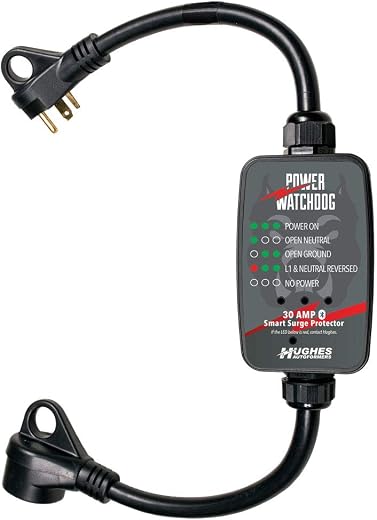
3. GEARGO FC-03 — Best Value 30 Amp RV Surge Protector
Price: $35.15 | Amazon rating: 4.8 from 2430 ratings | Role: Best value | Key spec: Six named faults, IP68 cover
GEARGO publishes the whole diagnostic chart rather than a vague promise: correct wiring, open ground, open neutral, reverse polarity, hot/ground reversed, and no power. The oversized IP68 cover closes over a plug that is already inserted — the detail most covers get wrong — and the right-angle connector stops two pounds levering on the socket contacts.
One claim needs translating. The “Specification Met” field reads FCC, which concerns electromagnetic interference: it says nothing about surge performance or electrical safety. The $29.99 POWGRN unit cites ETL, a genuine North American safety listing — so on certification alone the budget pick reads stronger than the value pick.
Best for: Travellers who move sites often and are present at hook-up. Six named faults, a sealed cover and 2,430 ratings for $35.15.
Skip if: You need the supply cut automatically or monitored remotely, or want more than three years of warranty.
Where to Buy — GEARGO
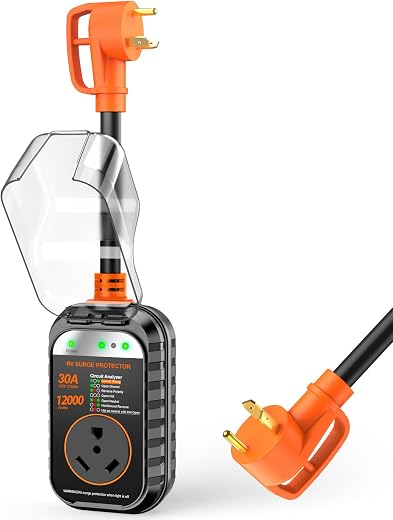
4. Kohree KR6491A — The Most Complete Fault Chart Here
Price: $26.65 | Amazon rating: 4.8 from 478 ratings | Role: Most thorough diagnosis | Key spec: Seven named faults, IP67
Kohree’s LEDs name seven conditions rather than six, and the extra ones are the dangerous ones: open hot, hot/ground reverse, and hot on neutral with hot open — the fault that leaves a coach energised through what should be the return conductor. The IP67 enclosure is a real, comparable claim.
Then the listing oversells. It claims spikes are absorbed “within 1 ns”, a figure no consumer surge standard expresses and no buyer can check, and it cites two United States design patents — which protect how a product looks, not how well it works. All on the shortest warranty on this page.
Best for: Wet climates and seasonal pitches, and anyone who wants the longest fault list available at this size.
Skip if: Warranty length matters. One year at $26.65 sits beside a lifetime warranty at $51.55, so a shorter warranty is what you trade away for the longest fault chart here.
Where to Buy — Kohree
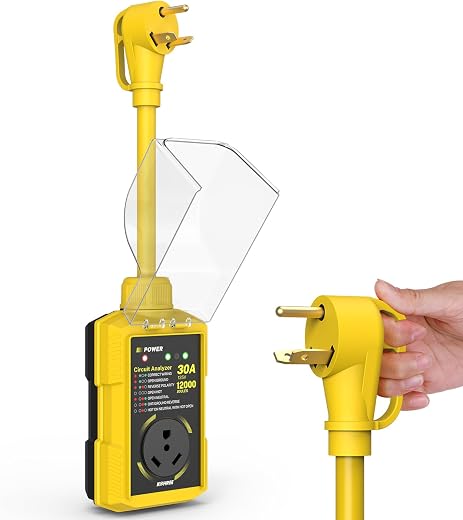
5. POWGRN 26000J — The Only 30 Amp RV Surge Protector That Cuts the Power
Price: $29.99 | Amazon rating: 4.3 from 179 ratings | Role: Automatic shutoff on a budget | Key spec: Auto shutoff, manual reset, LED display
Every other unit here is an indicator. This one acts: on a fault such as low voltage or overheating it disconnects and stays disconnected until somebody resets it by hand. That is the correct design, because a device that restores power automatically will cycle a compressor against a sagging supply all night. POWGRN’s own bullet makes the comparison explicitly, and on the narrow point it is right.
It also has the best certification claim of the five, citing ETL alongside FCC, plus a large LED screen showing live voltage, current and power for a quarter of the Bluetooth unit’s price. What it lacks is evidence: 4.3 stars from 179 ratings against 5,686 elsewhere. Buy it for the relay, not the number.
Best for: A rig left connected at a seasonal pitch on a tight budget. Automatic disconnection, a live display and an ETL listing for $29.99.
Skip if: You want accumulated evidence. 179 ratings, and no warranty term published anywhere on the listing.
Where to Buy — POWGRN
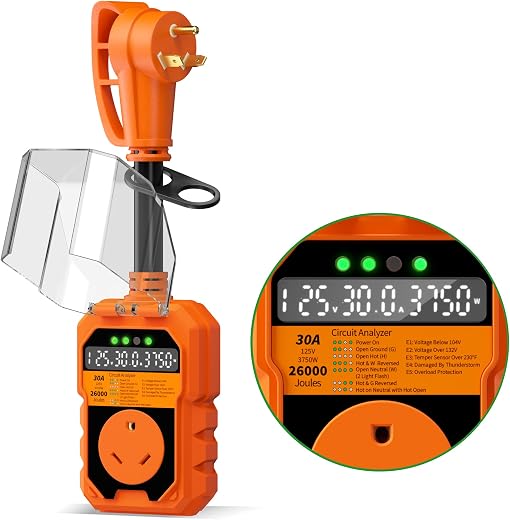
30 amp RV surge protector — Buyer’s Guide
What Every 30 Amp RV Surge Protector Claims in Joules — and Why to Ignore It
Across these five listings the claimed surge ratings are 26,000, 13,000, 12,000, 3,000 and 825 joules — and they correlate with price, owner satisfaction and warranty length almost inversely. No safety standard requires a joule figure, defines how it is calculated, or audits it.
The standard that does govern these devices is UL 1449, and it marks a surge protective device with a Voltage Protection Rating obtained on a 6 kV, 3 kA combination wave generator, together with a nominal discharge current rating verified over fifteen surges at levels such as 20 kA or 10 kA. Those figures are comparable between products; joules is not among them. Not one of these five listings quotes a Voltage Protection Rating, and that shared silence says more than their headline numbers.
What a 30 Amp RV Surge Protector Actually Does: Three Different Jobs
The category name hides three jobs. A surge protector absorbs a transient. A circuit analyzer inspects the pedestal and lights an LED for open ground, open neutral or reverse polarity. An electrical management system measures the supply continuously and disconnects when it goes out of range. Most products sold under this heading are the middle one wearing the first one’s name.
Which you need comes down to one question: will you be standing there? An indicator is enough if you arrive in daylight and read the lights. If the rig sits connected for a fortnight while you are elsewhere, an indicator is decoration, and you want automatic disconnection or a remote alert. Only one product here disconnects, only one reports to a phone, and they are not the same product.
Why a 30 Amp RV Surge Protector Cannot Give You More Than 3,600 Watts
A North American 30 amp pedestal socket is a TT-30 outlet: three pins, one hot conductor, 120 volts, and a hard ceiling of 3,600 watts. The air conditioning and the microwave cannot run together. It also matters that a TT-30 looks close enough to a domestic 240 volt dryer socket that it has been wired as one — a mistake that destroys everything in the coach at once, and one no amount of surge absorption prevents. Only a fault chart catches it.
Fit, Weather and Theft: Where a 30 Amp RV Surge Protector Fails First
Three unglamorous things decide whether a device survives its second season. Leverage: two pounds cantilevered off a socket in a crosswind is the commonest failure, so prefer a right-angle connector. The cover: it must close over a plug already inserted, which is why the oversized hoods on the GEARGO and Kohree units are worth more than their IP digits suggest. And theft, because these sit unattended on a post in a public field.
None of these devices self-checks. The absorbing components are metal-oxide varistors, they degrade with every event they clamp, and they can fail open — quietly, leaving a unit that lights up normally and protects nothing. Assume a replacement every few seasons.
What the Wiring Rules Require at the Pedestal
The strongest argument for owning one of these is not about lightning. It is that American wiring rules deliberately leave the socket most recreational vehicles use without ground-fault protection.
The National Electrical Code addresses recreational vehicle parks in Article 551. Its ground-fault requirement, 551.71(F), reads: “All 125-volt, single-phase, 15- and 20-ampere receptacles shall have listed ground-fault circuit-interrupter protection for personnel.” A Tentative Interim Amendment to the 2020 edition then states the exclusion explicitly — “GFCI protection shall not be required for other than 125-volt, 15- and 20-ampere receptacles used in recreational vehicle site equipment.” Read those two sentences together and the position is clear: the 20 amp convenience outlet on the pedestal must have ground-fault protection, and the 30 amp socket your coach actually plugs into need not.
That is why a fault chart is the feature worth paying for: nothing upstream is required to notice an open ground on a TT-30 outlet, so the only instrument that will is the one you bring. The failure to fear most is an open neutral. When the return path opens, the two halves of the service sit in series across whatever is plugged in — lightly loaded circuits float upwards, sometimes past 200 volts, and everything electronic is damaged at once.
The underlying problem is not trivial. The National Park Service, citing the National Fire Protection Association, states that “nearly 2,000 RV fires occur annually”, and its advice runs to the supply cord: “Ensure that the power cord for connecting your RV to a campground’s electricity supply is in good condition and of suitable gauge wire to handle the electrical load.” It also warns that “circuit breakers don’t always prevent overloads from starting fires.”
US vs UK: The Same 3.6 Kilowatts, Opposite Plumbing
A British caravanner has no 30 amp socket to protect, and the two countries reach almost identical power by opposite routes. Britain gives every pitch one connector: a blue BS EN 60309-2 industrial plug rated at minimum 16 A at 230 V. The Camping and Caravanning Club puts the arithmetic plainly — “Power (in W) = voltage (in V) x current (in A), so for a 10A hook-up, 230V x 10A = 2300W” — so a 16 A pitch offers about 3.68 kW against the American TT-30’s 3.6 kW.
The regulatory divergence is sharper. Under BS 7671 Section 708, each pitch socket-outlet “must be protected individually by an RCD having a rated residual operating current not exceeding 30mA”, no more than four socket-outlets may be grouped in one enclosure, there must be at least one per pitch, and it must sit within 20 metres of the vehicle. So Britain mandates 30 milliamp residual-current protection on every single pitch socket, while the American code specifically exempts the socket most rigs use. The device this page is about is, in effect, a private substitute for a public requirement Britain already imposes.
Two things follow for British readers. Hook-up leads are specified rather than assumed — “PVC/PVC flexible cable, with three cores, each core being 2.5mm² cross sectional area” — and British tourers carry a polarity tester for continental sites, because “if the live wire is presented to your electrical connection on the neutral side, this is known as reversed polarity”. That tester is the nearest European equivalent to the products above. Britain says hook-up, caravan and pitch where America says shore power, RV and site.
30 amp RV surge protector — Which One Should You Buy?
Under $60: the Best Value 30 Amp RV Surge Protector
Buy the Progressive Industries SSP-30XL at $51.55 — the best product here, and the lifetime warranty settles it even though four of the five now cost less. For six named conditions behind an IP68 cover, the GEARGO FC-03 at $35.15 is the cheapest way to read the pedestal before you commit the coach to it. The POWGRN 26000J at $29.99 remains the only unit on this page that disconnects the supply by itself, and the Kohree KR6491A at $26.65 is now both the cheapest here and the one naming the most faults — which is the sharpest illustration on this page that price tells you almost nothing about how much of the supply a unit will actually report.
If your coach has a 50-amp inlet rather than a 30-amp one, none of the picks above is the right purchase — the socket is a different shape and the electricity behind it is a different arrangement, two 120-volt hot legs sharing a neutral instead of one. We compare that side of the shelf separately in our best 50 amp RV surge protector guide, where the same manufacturers appear with different models, different joule claims and a price spread running from $32.99 to $205.
Above $100: the Premium 30 Amp RV Surge Protector Tier
Only one product is left in this tier: spend it on the Power Watchdog PWD30 if you leave the rig plugged in and want to know what the pedestal is doing while you are away. Remote monitoring is the one capability on this page that nothing cheaper reproduces — the Kohree KR6491A, which used to sit alongside it here, now sells for $26.65 and belongs in the tier above.
The honest answer for most people
Buy the Progressive unit and read its lights every time you connect. If you park for a month and go walking, add automatic disconnection rather than a bigger joule number. Absorption is rated in a unit nobody audits; refusal is rated in volts.
This is the site’s first vehicle-electrical guide and it deliberately does not overlap our existing power coverage. Our desk charging station guide covers delivering power inside a building you control; power outage essentials covers the supply failing altogether; and tent camping essentials covers having no socket at all. This page is the only one about a supply that is present, live and possibly wrong.
30 amp RV surge protector — Frequently Asked Questions
Is a 30 Amp RV Surge Protector Really Necessary?
Yes, though not mainly for surges. What damages recreational vehicles are wiring faults and sustained voltage problems at the pedestal — and American code exempts the 30 amp socket from the ground-fault protection required on the 20 amp one beside it.
How many joules should a 30 amp RV surge protector have?
This is the wrong question, and these listings prove it: claims run from 825 to 26,000 joules with almost no relation to price, warranty or owner satisfaction. Compare the fault list, the warranty and the owner base instead.
30 Amp RV Surge Protector vs EMS: What Is the Difference?
A surge protector absorbs a transient. An electrical management system measures the supply continuously and disconnects when it goes out of range. Most units sold as surge protectors are really circuit analyzers: they light an LED and leave the decision to you.
Can I use a 30 amp surge protector on a 50 amp RV?
Only through a 50 to 30 amp adapter, and you are then limited to 3,600 watts however much the pedestal can deliver. If your rig is 50 amp, buy the 50 amp version of the device.
What does EPO mean on these listings?
Emergency Power Off: the function that disconnects the supply automatically on a fault. Check for it explicitly — one product here records its absence in the colour field rather than among its features.
Will a 30 Amp RV Surge Protector Detect Reverse Polarity?
All four indicator units here name reverse polarity, and two also name hot/ground reversed. Both leave a coach that appears to work perfectly while metalwork sits at mains potential.
How Long Does a 30 Amp RV Surge Protector Last?
Plan on a few seasons. The absorbing components degrade with every event they clamp and can fail open without any outward sign, and none of these units self-checks.
30 amp RV surge protector — Final Thoughts
The most useful thing this comparison turned up is that the number printed largest on the box is the number that predicts least. A 30 amp RV surge protector claiming 26,000 joules costs $29.99 and has 179 ratings; one claiming 825 costs $51.55, carries a lifetime warranty, is made in the United States and has 5,686. The joule race is a marketing artefact, and the standard that would let you compare these devices properly — UL 1449, with its Voltage Protection Rating — is cited by none of them.
So buy on what can be checked: how many faults the unit names, whether it acts or merely reports, how long the maker will stand behind it, and how many people have already lived with it. On those criteria the Progressive Industries SSP-30XL wins comfortably, and the POWGRN unit is the surprise of the page for doing the one thing the others will not.
Sources and Further Reading
- NEMA Surge Protection Institute — UL 1449: Surge Protective Devices
- NEC 551.71(F) GFCI protection for recreational vehicle parks
- US National Park Service — RV Fire Safety 101
- The Camping and Caravanning Club — Campsite electricity
- BS 7671 Section 708 — caravan and camping park electrics
- BS 7671:2018 Sections 708 and 721
Affiliate disclosure: we earn a commission on qualifying purchases made through links on this page, at no extra cost to you. Prices and ratings were read from the live Amazon.com listings on the date of publication and change without notice. British readers should note that UK pitches use a 16 A BS EN 60309-2 hook-up rather than a 30 amp TT-30 socket.