
A house is a building with five utilities plumbed into it: running water, refrigeration, a hob you can light, a light switch and a drawer with tools in it. A campsite is the same house with all five disconnected. That is the entire problem, and it is why a list of tent camping essentials is not really a list of camping products at all — it is a list of replacements for services you stopped noticing years ago. Get the replacements right and a weekend under canvas is relaxing. Get them wrong and you spend two days walking to a tap block with a washing-up bowl.
This guide to tent camping essentials covers seven products the site has reviewed in full, each chosen because it puts back exactly one disconnected utility: the tap, the fridge, the freezer, the ignition, the worktop, the light switch and the toolbox. Nothing here is a tent, a sleeping bag or a camping stove, and that is deliberate — those are fit-and-preference purchases, and in the stove’s case a genuinely dangerous one to recommend across two countries whose gas fittings do not interchange. What follows is the boring infrastructure that decides whether the trip works, judged on whether it survives wind, rain, a car boot and a field with no sockets in it.
Every product was assessed on four things: does it work with no mains power, does it pack down small enough to be worth carrying, does it survive being wet, and does it still make sense the second time you use it. Prices and ratings for all seven tent camping essentials were taken from the live listings at the time of writing.
All shopping links go to Amazon.com and carry our affiliate tag; British readers can search the same model names on Amazon.co.uk, where most of these products are sold under the same brand with different pack sizes. Where American and British practice actually differs — and on camping it differs more than on almost any other subject this site covers — there is a full US vs UK section below with the official guidance for both.
Tent Camping Essentials — Quick Comparison
Seven products, seven disconnected utilities. Scores are our own; prices and Amazon ratings were taken from the live listings at the time of writing.
| # | Product | Role | Key spec | Best for | Price | Score |
|---|---|---|---|---|---|---|
| 1 | SereneLife Hand-Washing Station | The tap | 19 L (5 US gal) tank, hands-free foot pump, soap dispenser, drain hose | Family camps and group cooking | $74.99 | 7.9 |
| 2 | Ninja FrostVault 45 qt | The fridge | 45 qt (42.6 L), 68-can capacity, sealed dry-storage drawer, all-terrain wheels | Car camping and long weekends | $299.95 | 8.8 |
| 3 | Cool Coolers XL Slim Ice Packs | The freezer | Four XL flat packs, quick-freeze, reusable, sized to stand upright in a cool box | Making any cool box actually work | $12.99 | 8.4 |
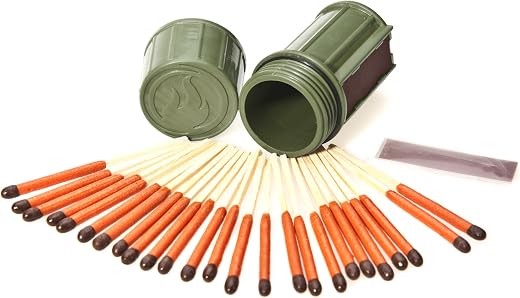
| 4 | UCO Stormproof Matches | The ignition | Waterproof floating case, 25 stormproof matches, 3 replaceable strikers, ~15-second burn | Lighting anything in bad weather | $7.49 | 8.7 |
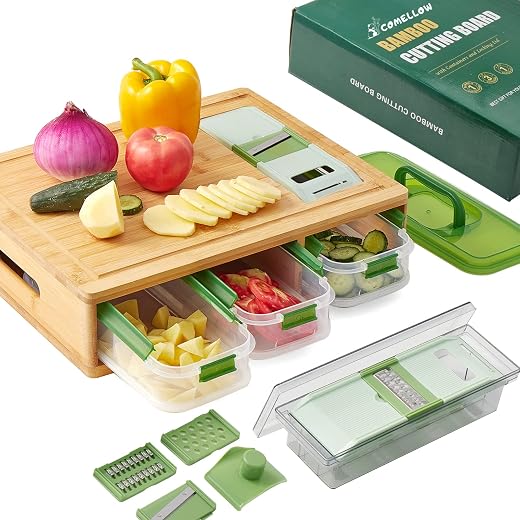
| 5 | Comellow Bamboo Prep Board | The worktop | Large bamboo board, stackable containers with locking lid, built-in graters | Prep with no counter and no sink | $65.55 | 8.0 |
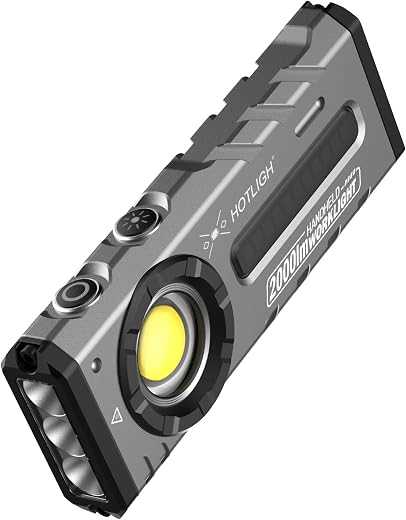
| 6 | ZF8313 Magnetic Torch | The light switch | 2,000 lumens, magnetic base, RGB and UV modes, USB-C rechargeable | Hands-free light with no hook | $23.99 | 8.4 |
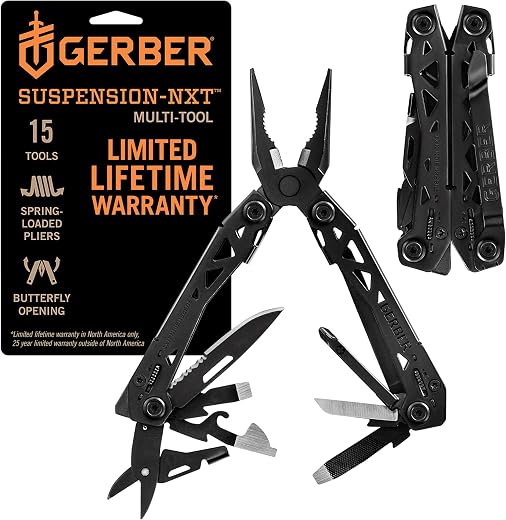
| 7 | Gerber Suspension NXT | The toolbox | 15 tools, spring-loaded needle-nose pliers, wire stripper, blade, pocket clip | Repairs that end or save the trip | $41.18 | 8.7 |
- Tent camping essentials — quick comparison
- The 7 best tent camping essentials in 2026
- Buyer’s guide: what to look for
- US vs UK: what changes when you go tent camping
- Which one should you buy?
- Water, fire and food safety under canvas
- Frequently asked questions
- Final thoughts
- Sources and further reading
The 7 Best Tent Camping Essentials in 2026
Each entry below covers what the product replaces, how it performs in the field, and who should not buy it. Full reviews of every product are linked from its entry.
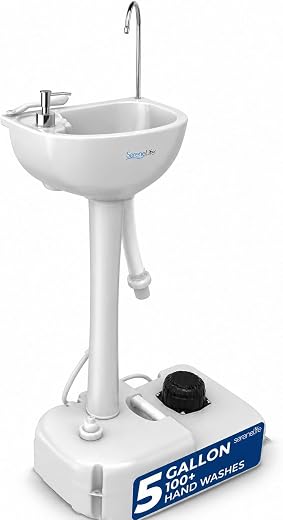
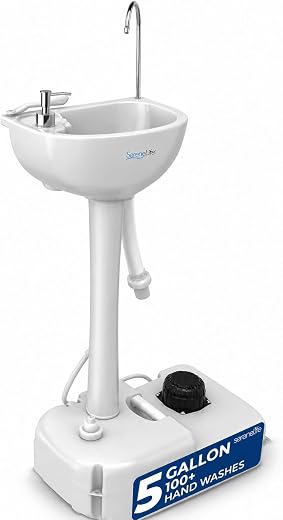
1. SereneLife 19 L Portable Hand-Washing Station — Best Tent Camping Essential for Running Water
Price: $74.99 | Amazon rating: 4.4 / 5 from 3,678 ratings | Role: The tap | Key spec: 19 L (5 US gal) tank, hands-free foot pump, soap dispenser, drain hose
Ask most people which utility they miss first in a field and they say electricity. They are wrong. You can live without a socket for a weekend without noticing; you cannot prepare a meal for four people without somewhere to wash your hands between the raw chicken and the salad. A serviced pitch usually has a tap block somewhere on the site, which is fine until it is a hundred metres away in the dark and you are holding a colander. This is the one item among our tent camping essentials that removes a walk rather than adding a convenience, and it is why it opens a list of tent camping essentials rather than closing it.
The mechanism is the point. A 19-litre tank sits in the base, a foot pump sends water up to the spout, and your hands never touch the unit — which matters, because the moment you touch a pump handle with dirty hands you have contaminated the thing you are about to touch again with clean ones.
The soap dispenser is built in, the drain hose lets you route grey water into a bucket rather than the grass, and SereneLife’s own figure of 100-plus hand washes per fill is roughly right in practice if you are not filling pans from it as well. At 19 litres it is a little over four imperial gallons, so a full tank weighs about 19 kg and wants filling where it stands.
The reason it earns its place ahead of a bottle of gel is that hand sanitiser does not do the job people think it does. The CDC’s own guidance is that sanitiser “may not be as effective when hands are visibly dirty or greasy”, and that soap and water are more effective at removing norovirus and Cryptosporidium — the two organisms most likely to turn a campsite into an outbreak. At a campsite your hands are visibly dirty essentially all the time. Of all the tent camping essentials here this is the least glamorous and the most likely to prevent something genuinely unpleasant.
Best for: Family camps, festival crews, allotments, boat trips and anywhere you will be preparing food more than fifty metres from a tap.
Skip if: You are backpacking or cycle-touring — 19 litres of water is 19 kilograms — or your pitch is within sight of a serviced tap block and you are cooking for one.
Read the full SereneLife Hand-Washing Station review →
Where to Buy — SereneLife Hand-Washing Station
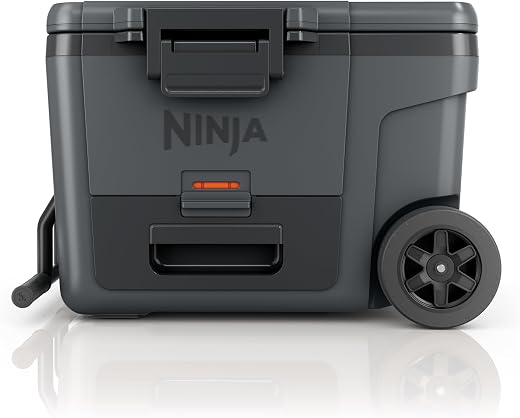
2. Ninja FrostVault 45-Quart Cooler — Best Tent Camping Essential for Cold Storage
Price: $299.95 | Amazon rating: 4.4 / 5 from 719 ratings | Role: The fridge | Key spec: 45 qt (42.6 L), 68-can capacity, sealed dry-storage drawer, all-terrain wheels
The cooler is the utility replacement everybody buys and almost nobody buys well. A cheap cool box does not fail because it stops being cold; it fails because everything inside it ends up floating in four inches of meltwater, and by Sunday the cheese is a sponge and the bacon packet has gone opaque. The FrostVault’s answer is a sealed dry drawer beneath the main chamber, which keeps the things that must not get wet physically separated from the things that must stay cold. Among tent camping essentials in this price bracket it is a genuinely good idea rather than a marketing one.
Forty-five quarts is 42.6 litres, Ninja quotes 68 cans, and the all-terrain wheels are the difference between loading the car boot and carrying a full cool box across a field. The temperature performance matters more than the headline hold time: the USDA’s advice for a packed cooler is simply to check it “reads 40 °F or below” and to keep it full, because “a full cooler will maintain its cold temperatures longer than one that is partially filled”. Britain’s Food Standards Agency sets the outer limit differently, at 8 °C for four hours, dropping to two hours in genuinely hot weather. Both are achievable in this box; neither is achievable in a supermarket cool bag.
It is the most expensive item on this list by a wide margin, and it is fair to ask whether a $300 cooler belongs among tent camping essentials at all. The answer depends entirely on how you camp. If your car parks within fifty metres of your pitch and you go out four or five weekends a year, this is a ten-year purchase that pays for itself in food you did not throw away. If you pitch at the far end of a field with a barrow, the wheels stop being an advantage and the weight starts being one.
Best for: Car campers, families and anyone who shops before the trip rather than at a village shop halfway through it.
Skip if: You carry gear any real distance, camp on soft ground where wheels sink, or only need cold drinks for a single night — a $13 set of ice packs in a soft bag does that.
Read the full Ninja FrostVault 45 qt review →
Where to Buy — Ninja FrostVault 45 qt
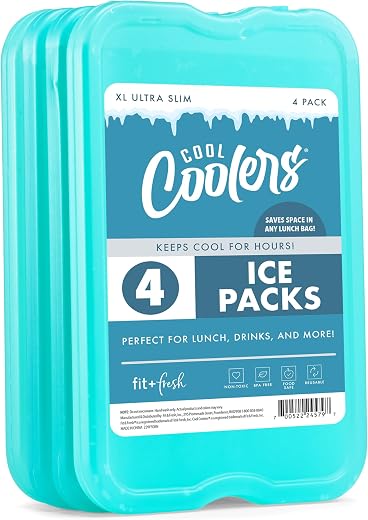
3. Cool Coolers XL Slim Ice Packs (4-Pack) — Best Value Tent Camping Essential
Price: $12.99 | Amazon rating: 4.6 / 5 from 49,962 ratings | Role: The freezer | Key spec: Four XL flat packs, quick-freeze, reusable, sized to stand upright in a cool box
A cool box is an empty insulated shell. What makes it cold is whatever you put in it, and this is the part people improvise with a bag of supermarket ice that has become a bag of water by lunchtime on day one. Four flat freezer packs at thirteen dollars is the cheapest meaningful upgrade in this entire guide to tent camping essentials, and with just under fifty thousand ratings behind it, it is also the most heavily used product in the site’s catalogue.
The shape is what matters, and it is worth being precise about why. The Food Standards Agency’s picnic guidance says to “distribute ice packs throughout the box or bag, not all at the bottom so that all the contents can be kept cold”. You physically cannot do that with a block of ice or a chunky moulded brick; you can do it with flat slabs, standing them upright between layers like dividers. Cold falls, so packs sitting only on the base of a cool box chill the bottom third and leave the top warm — which is exactly where people put the things that spoil first.
The limits are honest ones. These are water-based packs, so they thaw in roughly a day in a warm car and need a freezer to reset — which means on a three-night trip without a site freezer they are a day-one and day-two solution, not a day-three one. They are also XL, which is generous for a lunch bag and correct for a 45-quart box. Among tent camping essentials this is the item most likely to be bought last and appreciated most.
Best for: Anyone who already owns a cool box, plus lunch bags, day trips and topping up a large cooler between shopping runs.
Skip if: You need multi-day hold with no access to a freezer — block ice or dry ice lasts longer — or you only ever pack a single small lunch box, where the XL size is wasted.
Read the full Cool Coolers XL Slim Ice Packs review →
Where to Buy — Cool Coolers XL Slim Ice Packs
4. UCO Stormproof Match Kit — Best Budget Tent Camping Essential
Price: $7.49 | Amazon rating: 4.8 / 5 from 9,934 ratings | Role: The ignition | Key spec: Waterproof floating case, 25 stormproof matches, 3 replaceable strikers, ~15-second burn
The highest-rated product in this guide costs less than a pizza. The cheapest of these tent camping essentials is also the highest rated, and the reason is simple. A disposable lighter is a device for making a small flame in still air at room temperature, and a campsite is frequently none of those things: butane loses vapour pressure as it gets cold, a wet flint does nothing at all, and wind blows out the flame at the exact moment you have the stove valve open.
Stormproof matches burn for around fifteen seconds, keep burning in wind, and relight themselves after being dunked in water — which sounds like a party trick until the first time it happens in a rain shower.
The kit is the reason to buy this rather than loose matches. The case floats, seals against water, holds twenty-five matches and carries three replaceable strikers, because the striker is what actually fails first on a damp box of ordinary matches. It weighs almost nothing and lives permanently in a rucksack lid, which is the correct place for it. Of all the tent camping essentials on this list it is the one most likely to be bought twice, once for the car and once for the pack.
Buying it does not license you to light a fire, and this is where American and British practice separate sharply. The Countryside Code is blunt: “Do not light fires and only have BBQs where signs say you can.” On US public land the rules are seasonal and local — the Bureau of Land Management asks campers to use “existing fire rings or a fire pan” and warns that “fire restrictions can vary throughout the year”. The reason both are strict is the same: the National Park Service attributes nearly 85 percent of American wildland fires to people, with unattended campfires named first on the list.
Best for: Every camper, every trip. Also stoves, storm lanterns, barbecues and a power cut at home.
Skip if: You genuinely only ever cook on a piezo-ignition gas stove and camp exclusively where fires are prohibited — although at $7.49 the argument for skipping it is thin.
Read the full UCO Stormproof Matches review →
Where to Buy — UCO Stormproof Matches
5. Comellow Bamboo Cutting Board with Trays and Graters — Best Tent Camping Essential for Food Prep
Price: $65.55 | Amazon rating: 4.3 / 5 from 145 ratings | Role: The worktop | Key spec: Large bamboo board, stackable containers with locking lid, built-in graters
Camp cooking fails at the prep stage, not the cooking stage. You have one flat surface, usually a folding table that flexes, no sink to rinse a board between jobs, and nowhere to put the chopped onion while you deal with the peppers — so it goes in a bowl that blows off the table, or it stays on the board and gets in the way. A board with containers built into it solves a problem that is invisible in a kitchen and obvious in a field, which is why it belongs among tent camping essentials rather than kitchen gadgets.
You chop straight into the trays, slide the trays back under the board, and lock the lid. Nothing is exposed to wind, flies or a passing dog, and there is one item to wash instead of five. The built-in graters cover the jobs that otherwise require a separate tool nobody packs — cheese, carrot, a nub of ginger. It is also the cleanest answer available to cross-contamination without carrying three colour-coded boards: prep the salad first into a lidded tray, then use the bare board for the meat, then wash the board alone.
Two caveats belong on the record. It is solid bamboo with containers, so it is heavy and bulky in a way that only makes sense if the car is doing the carrying, and at $65.55 it is the second most expensive thing here. It also has only 145 ratings behind it, which is a fraction of the feedback volume supporting the other tent camping essentials in this guide — a 4.3 average from 145 people is a weaker signal than a 4.6 from fifty thousand, and it deserves saying plainly.
Best for: Car campers who actually cook, caravan and motorhome kitchens, and anyone who has ever lost a chopped onion to a gust of wind.
Skip if: You are weight- or space-limited, you already own a proper camp kitchen unit, or you want something dishwasher-safe — bamboo is not.
Read the full Comellow Bamboo Prep Board review →
Where to Buy — Comellow Bamboo Prep Board
6. ZF8313 Magnetic Rechargeable Flashlight — Best Tent Camping Essential for Light
Price: $23.99 | Amazon rating: 4.6 / 5 from 999 ratings | Role: The light switch | Key spec: 2,000 lumens, magnetic base, RGB and UV modes, USB-C rechargeable
A tent has no light switch and, more importantly, nowhere obvious to put a torch down. That is the specific failure this entry in our tent camping essentials addresses: the magnetic base sticks it to the car door, the tailgate, a steel roof bar, a stove windshield or the metal leg of a camp table, and suddenly you have a work light rather than something you are holding in your teeth. Two thousand lumens is more than you need for a tent and about right for finding a dropped tent peg in wet grass at eleven at night.
The extra modes are less gimmicky than they read. Red light preserves night vision and does not fill the tent with a wall of white at three in the morning, and the UV mode has two genuinely practical camping uses — checking a hire tent or borrowed sleeping bag for stains before you commit to it, and, in the American southwest, spotting scorpions, which fluoresce under ultraviolet. USB-C charging means it shares a cable with the phone rather than demanding a pack of primary cells.
It is a hand torch, not a head torch, and that distinction decides whether it belongs in your kit or alongside it. If you want light while both hands are busy on a task in front of your face — pitching in the dark, cooking, a midnight walk to the toilet block — a head torch is the correct tool and this is not a substitute for one. As tent camping essentials go it is the one most people already half-own in a worse form: the torch in the glovebox with flat batteries.
Best for: Car campers, awnings, late arrivals, roadside repairs and anyone tired of holding a torch in their mouth.
Skip if: You want hands-free light while walking or working at arm’s length — buy a head torch — or you have no way to recharge over a long trip.
Read the full ZF8313 Magnetic Torch review →
Where to Buy — ZF8313 Magnetic Torch
7. Gerber Suspension NXT 15-in-1 Multitool — Best Tent Camping Essential for Repairs
Price: $41.18 | Amazon rating: 4.6 / 5 from 23,782 ratings | Role: The toolbox | Key spec: 15 tools, spring-loaded needle-nose pliers, wire stripper, blade, pocket clip
Nothing on a campsite breaks in a way you can plan for. A tent pole splits, a guy line frays, a stove jet blocks, a zip pull comes off, a trailer light stops working on the drive home. All of those are five-minute repairs with pliers and a blade and trip-ending problems without them, which is why the toolbox is the last of the tent camping essentials on this list and the one people are most likely to leave in the garage.
The Suspension NXT is the right size for the job rather than the most capable multitool made. Spring-loaded needle-nose pliers do most of the work — they open one-handed, which matters when the other hand is holding whatever you are fixing — and the fifteen tools cover the realistic campsite set: blade, drivers, wire cutters, a can and bottle opener, a file. It weighs little enough to clip to a pocket and, with nearly twenty-four thousand ratings at 4.6, it is a known quantity rather than a gamble.
One legal note that British readers should not skim. In the UK you may carry a non-locking folding knife with a blade of three inches or less anywhere without explaining yourself; a multitool with a locking blade falls outside that exemption and needs a good reason. Camping is a good reason — but the reason has to travel with the tool, which in practice means it lives in the kit bag and not in your jeans on the way to the pub. Among tent camping essentials this is the only one with a legal footnote attached.
Best for: Every car camper and caravanner, plus cyclists, festival crews and anyone towing anything.
Skip if: You fly to your destination and travel hand-luggage only, or you would rather carry a dedicated fixed-blade knife and a small plier set.
Read the full Gerber Suspension NXT review →
Where to Buy — Gerber Suspension NXT
Tent Camping Essentials — Buyer’s Guide: What to Look For
The seven products above are answers. This section is the set of questions those tent camping essentials answer, so that if your camping looks nothing like ours you can still make good decisions. Every rule below comes from the same test: at a campsite, a product either replaces a utility or it is luggage.
Tent camping essentials should replace a utility, not add a feature
The fastest way to cut a shopping list in half is to write down the five things a house does for you — water, cold, heat, light, tools — and buy one item per line. Anything that does not appear on that list is a comfort purchase, which is fine, but it should be bought last and with the remaining money. This is also why the list above contains no tent, no sleeping bag and no chair: those are not utilities, they are fit decisions, and a stranger on the internet cannot size your sleeping bag for the temperature you actually camp in.
The corollary is that duplication is waste. Two torches is sensible redundancy; two cool boxes is a packing problem. When you are choosing between tent camping essentials that look similar, ask which utility each one restores, and if the answer is the same for both, buy the better one and stop.
Tent camping essentials have to work wet, because everything gets wet
Condensation alone will soak anything left on the groundsheet overnight, and that is before it rains, so assume your tent camping essentials will spend part of every trip damp. The practical test is not whether a product is waterproof but whether it still functions after being wet and then being cold: a lighter fails this, stormproof matches in a sealed floating case pass it, a torch with a rubber-sealed USB-C port passes it, and a cardboard box of firelighters does not. Look for sealed cases, gasketed lids and materials that dry rather than absorb.
Bamboo, canvas and untreated wood are the ambiguous cases. They tolerate a soaking and survive it, but they need to be dried before they go back in a bag, or they arrive at the next trip smelling of a shed. Plan a drying afternoon into your kit routine rather than assuming your tent camping essentials will look after themselves in the loft.
Tent camping essentials and weight: decide how you camp before you buy
The single biggest source of bad camping advice is people answering a car-camping question with backpacking rules, or the reverse. A 19-litre water station and a 45-quart cooler are excellent purchases if your boot opens fifty metres from your pitch and absurd ones if you are walking in. Decide which kind of camper you are before you read any list, including this one, because half of what follows changes.
A rough rule: if you are carrying everything on your back, the ceiling for the whole kit is about 20–25 per cent of your body weight, and anything holding water is filled at the destination, never carried full. If the car is doing the work, weight stops mattering and packed volume becomes the real constraint — which is why flat, stackable and nesting shapes are worth paying for in tent camping essentials aimed at car campers.
Buy tent camping essentials for the second trip, not the first
Almost every product that disappoints campers works fine the first weekend. What separates good kit is what happens afterwards: does it need a freezer to reset, a proprietary battery, a cleaning routine you will not do, a cable you own only one of? Rechargeable over disposable is usually the right call because it removes a shopping trip, but only if you can actually recharge it — a USB-C torch on a four-night pitch with no power is a two-night torch unless you also carry a power bank.
The same logic applies to consumables. Ice packs need a freezer. Matches need replacing. Gas needs the right fitting. When you are comparing tent camping essentials, price the second trip as well as the first and the cheap option is sometimes the expensive one.
Judge tent camping essentials on rating count, not just the rating
A 4.8 average from 9,934 people and a 4.3 from 145 are not the same kind of evidence, and it is worth saying so out loud when one of your own picks is on the thin side. Small rating counts on new listings are normal and not disqualifying — every product starts at zero — but they should shift you toward buying from a retailer with an easy returns process and toward treating the manufacturer’s own claims with more scepticism. Where two tent camping essentials are otherwise equal, the one with fifty thousand ratings is the safer purchase.
US vs UK: What Changes When You Buy Tent Camping Essentials Abroad
Camping is the subject on which American and British practice diverge most sharply of anything this site covers. If you buy tent camping essentials on one side of the Atlantic and use them on the other, this matters, and it is not a matter of taste. The law about where you may pitch is different, the law about fires is different, the disease risk is measurably different, the food-safety numbers are different, and even the word “campsite” means two different things. If you camp on both sides of the Atlantic, or you are British and reading an American packing list, this is the section that matters.
The vocabulary trap when you shop for tent camping essentials
In American English a campground is the whole facility and a campsite is your individual numbered spot. In British English a campsite is the whole facility and your individual spot is a pitch. That single false friend causes more booking confusion than any other word in the hobby. The rest of the list is easier: American cooler is British cool box, flashlight is torch, RV is caravan or motorhome, trail is footpath, trash is rubbish, restroom is the toilet block, bug spray is insect repellent, and the American dispersed camping or boondocking is British wild camping. Searching for tent camping essentials on a UK retailer with American words returns very little.
Where you are allowed to pitch is completely different law
Scotland has the most generous access regime in Britain and one of the most generous in Europe. Part 1 of the Land Reform (Scotland) Act 2003 created “a right of responsible non-motorised access for recreational and other purposes, to land and inland water throughout Scotland, with a few exceptions”, and the Scottish Outdoor Access Code sets out what responsible means. Wild camping falls inside that right where it is, in the Code’s words, lightweight, done in small numbers and only for two or three nights in any one place.
England and Wales are the opposite. The Countryside Code states plainly that “for some activities you may need to get permission from the landowner, including: camping”. There is exactly one statutory exception, and it is recent: in Darwall and another v Dartmoor National Park Authority [2025] UKSC 20, decided on 21 May 2025, the Supreme Court held unanimously that section 10(1) of the Dartmoor Commons Act 1985 confers a public right to wild camp on the Dartmoor commons. Dartmoor is now the only place in England and Wales where wild camping is a legal right rather than a trespass tolerated by a sympathetic farmer.
The American equivalent is not a right of access over private land but a vast amount of public land with permissive rules. The Bureau of Land Management allows dispersed camping “generally limited to 14 days within any 28-day period”, asks campers to stay “at least 200 feet from lakes, rivers, and streams” and to “camp within 150 feet of designated routes”. Nothing remotely like that exists in England, and it shapes what goes on an American list of tent camping essentials. It is why an American tent camping essentials list assumes you are self-contained in the middle of nowhere, and a British one assumes there is a shower block and a shop.
Fire and tent camping essentials: banned by default in England, seasonal in America
The Countryside Code’s instruction could not be shorter: “Do not light fires and only have BBQs where signs say you can”, and it adds that you must “always put your BBQ out, make sure the ashes are cold and dispose of them responsibly”. Dropping litter and dumping rubbish, the same guidance notes, “are criminal offences”. Scotland’s approach is advisory but firm — fires are strongly discouraged on peaty soils and in woodland, and if you light one you must extinguish it and erase all trace.
On US public land, campfires are normally permitted in existing fire rings or a fire pan, but restrictions “can vary throughout the year” and change with conditions, sometimes weekly in a dry summer. The justification for all of this is the same on both sides: the National Park Service attributes nearly 85 percent of American wildland fires to human causes, listing “campfires left unattended” first among them. Carry the means to make fire among your tent camping essentials; check the signs before you use it.
Carbon monoxide: the tent camping essentials warning that matters most
Every British summer produces the same avoidable deaths, and the official warning is unambiguous. The Public Health Agency’s advice is that “barbecues should never be used or left inside tents or awnings once they have been lit or after they have been used”, because “carbon monoxide can build up very quickly in enclosed spaces, such as tents and awnings, to levels that can kill”.
The dangerous moment is not the cooking — it is the cooling barbecue brought into the porch afterwards to keep it out of the rain. Symptoms are easy to mistake for tiredness or a hangover: headache, nausea, dizziness, drowsiness, chest pain, palpitations, collapse. No list of tent camping essentials should include a stove or barbecue without that sentence attached.
Water: the American camper treats it, the British camper turns a tap
The CDC’s guidance for hiking and camping is specific enough to act on. Bring clear water “to a rolling boil for 1 minute”, and “at elevations above 6,500 feet, boil for 3 minutes”. A filter with an absolute pore size of one micron or smaller, or certified to NSF standard 53 or 58 for cyst reduction, removes parasites but not viruses or bacteria; 0.3 micron or smaller adds bacteria; only reverse osmosis or boiling handles viruses too. Chlorine and iodine “kill bacteria and viruses but do not work well to kill parasites”, and in every case you should “filter water before disinfecting it”.
Britain has almost no equivalent culture, because almost no British camping happens far from a mains tap: campsites are supplied with wholesome drinking water and even remote bothies tend to be a day’s walk from somewhere with a hose. The practical consequence for kit is that an American list leads with filtration and a British one leads with carriage — how you get twenty litres from the tap block to the pitch, and how you wash in it once it is there.
Ticks and Lyme disease: the tent camping essentials no packing list mentions
This is the difference that surprises British campers in America and terrifies American campers reading British forums. The UK Health Security Agency reports “between 1,000 to 1,500 laboratory-confirmed cases of Lyme disease in England and Wales each year”, with a blood-donor study suggesting roughly 0.5 per cent of the English population carries antibodies. The CDC reports “over 89,000 cases of Lyme disease were reported to CDC by state health departments and the District of Columbia in 2023”, and that other methods suggest “approximately 476,000 people may be diagnosed and treated for Lyme disease each year in the United States”.
Even allowing for population size and very different surveillance systems, those are not comparable numbers. Tick checks, permethrin-treated clothing and repellent belong in American tent camping essentials for good reason, and a British camper heading to New England or the upper Midwest should adopt the American habits rather than their own.
Cold food and tent camping essentials: 40 °F and two hours, or 8 °C and four
The USDA tells American campers to check that a packed cooler “reads 40 °F or below”, to keep it full because “a full cooler will maintain its cold temperatures longer than one that is partially filled”, and that “when the temperature outside is above 90 °F, put perishable food back in the cooler within 1 hour after eating. Otherwise, cool it within 2 hours”. The Food Standards Agency frames the same risk around 8 °C and a four-hour window, shrinking to two hours in extreme heat, and adds the packing instruction that most people get wrong: “distribute ice packs throughout the box or bag, not all at the bottom so that all the contents can be kept cold”.
Converted, 40 °F is 4 °C and 90 °F is 32 °C, so the two regimes are closer than they look; the British number is a legal chilled-storage threshold and the American one is a target. Units are the other running annoyance. A 45-quart cooler is 42.6 litres, a 19-litre water tank is 5 US gallons or a shade over 4 imperial gallons, and 6,500 feet is 1,981 metres. Any American tent camping essentials list you read will be in quarts, gallons and Fahrenheit; convert before you buy, not after.
How campsites are regulated, and what that means for your tent camping essentials
One last structural difference explains why British summer camping looks the way it does. Temporary and pop-up campsites in England operate under permitted development and exemption arrangements descending from the Caravan Sites and Control of Development Act 1960, and the government’s model code of conduct for exempted camping asks organisations to “try not to camp on any site for more than 42 consecutive days or 60 days in any 12 consecutive months”, with waste “not to foul the ground except at designated disposal points”.
That is why a field near a festival can legally become a campsite for a fortnight, and why its facilities are often a row of portable toilets and a standpipe — which is precisely the situation the first product in this guide exists for.
Tent Camping Essentials — Which One Should You Buy?
Three realistic budgets of tent camping essentials, each one a complete kit rather than a shopping spree. Every product named here links to its full review on this site.
Under $50: the tent camping essentials nobody should camp without
Start with fire and cold, because they are the two utilities whose absence ruins a trip fastest and the two you can restore for the price of a takeaway. The UCO Stormproof Match Kit at $7.49 and the Cool Coolers XL Slim Ice Packs at $12.99 come to almost exactly twenty dollars together, and between them they cover ignition in bad weather and keeping a cool bag you already own genuinely cold. Add the ZF8313 magnetic torch at $23.99 and you have light as well, for under fifty dollars all in. If you buy nothing else from this guide, buy these three.
$50–$150: the tent camping essentials that make a weekend comfortable
The middle tier is where repairs and washing enter the kit. The Gerber Suspension NXT at $41.18 turns a broken tent pole from a trip-ending problem into a ten-minute job, and the SereneLife portable hand-washing station at $74.99 is the single item that changes how a family camp feels, because it removes the walk to the tap block from every meal. Together with the budget three, that is around $150 for a kit that restores five of the six utilities.
$150 and up: the tent camping essentials for people who camp properly
At the top the money goes on cold storage and prep. The Ninja FrostVault 45-quart cooler at $299.95 is the biggest single line in this guide and the only one that behaves like a real refrigerator, thanks to the sealed dry drawer that keeps food out of the meltwater. The Comellow bamboo prep board at $65.55 gives you the worktop and the storage in one object. Both assume the car does the carrying; if it does not, spend the money on a better sleeping mat instead and keep the ice packs and a soft bag.
Water, Fire and Food Safety: The Evidence Behind These Tent Camping Essentials
The recommendations above are not preferences. Each of the three tent camping essentials that can actually make you ill if you get them wrong — water, hands and cold storage — has published official guidance behind it, and the guidance is more specific than most campers realise.
Why hand gel is not a substitute in tent camping essentials
Alcohol hand rub is excellent at what it does and useless at what campers need it for. The CDC recommends “a hand sanitizer with at least 60% alcohol”, but adds two limits that matter in a field: sanitisers “may not be as effective when hands are visibly dirty or greasy”, and “soap and water are more effective than hand sanitizers at removing certain kinds of germs like norovirus, Cryptosporidium, and Clostridioides difficile“.
Norovirus is the organism behind almost every campsite and festival outbreak you have ever read about, and it is precisely the one the gel does not deal with. That is the whole argument for putting water and soap among your tent camping essentials and carrying them to the pitch rather than a bottle of gel to the picnic table.
Treating water: the tent camping essentials numbers worth memorising
If you do end up drinking from a source rather than a tap, the CDC’s thresholds are worth committing to memory: a rolling boil for one minute, or three minutes above 6,500 feet, kills viruses, bacteria and parasites including Cryptosporidium and Giardia. Filters are graded by absolute pore size — one micron or smaller, or NSF 53/58 certification, for parasites; 0.3 micron for bacteria as well; neither for viruses. Chemical treatment inverts that: chlorine and iodine handle bacteria and viruses but not parasites, and chlorine dioxide only partly closes the gap. The instruction people skip is the sequencing one: “filter water before disinfecting it”, because suspended solids protect organisms from the chemical.
The cold chain, and why flat ice packs beat a bag of ice
A cool box does not make cold, it only slows its loss, so everything depends on how much frozen mass you put in and where. The USDA’s instruction is to keep the box full — “if the cooler isn’t completely filled, pack the remaining space with more ice” — and to reserve a separate cooler for drinks, “which will be opened frequently, so that your food coolers will stay cold longer”.
The FSA adds the distribution rule quoted earlier. Put those together and the optimal configuration is flat packs standing vertically between layers of food, a full box, and the lid opened as rarely as possible, in shade. It is the least intuitive part of packing tent camping essentials and the part that produces the biggest measurable difference.
Fire, wildfire and using tent camping essentials responsibly
Nearly 85 percent of American wildland fires are started by people, and the National Park Service lists unattended campfires first among the causes, ahead of debris burning, equipment malfunction and discarded cigarettes. That statistic is the reason both countries write their fire rules the way they do, and the reason the correct advice about a fire is about the end of it rather than the start: cold ashes, disposed of responsibly, and no trace on the ground.
On BLM land the same principle appears as “pack it in, pack it out”, with human waste either carried out or buried “6–8 inches deep, at least 200 feet from water and trails”. The Scottish guidance is stricter still on water: urinate at least 30 metres from any burn or loch, bury solid waste well away from water and buildings, and carry used paper out with you.
Tent Camping Essentials — Frequently Asked Questions
What are the absolute minimum tent camping essentials for a first trip?
Beyond shelter and sleep, the tent camping essentials reduce to four things: a reliable way to make fire, a way to keep cold food cold, a light you can put down, and a way to wash your hands. In this guide that is the matches, the ice packs, the magnetic torch and either the washing station or a jerrycan and soap. Everything else on a list of tent camping essentials improves a trip that already works.
Do I need a cooler, or will a cheap cool bag do?
A cool bag with properly distributed flat ice packs will hold safe temperatures for a day trip and one overnight. Past that you want a hard box with real insulation, because the failure mode of a soft bag is not sudden — it drifts above 4 °C quietly and the food looks fine. If you camp two nights or more with meat or dairy, buy the box.
Is wild camping legal in the UK?
In Scotland, largely yes, under the Land Reform (Scotland) Act 2003 and the access code, provided it is lightweight, in small numbers and for two or three nights in one place. In England and Wales, no — camping needs the landowner’s permission, with the single exception of the Dartmoor commons, where the Supreme Court confirmed a statutory right in May 2025. Byelaws can further restrict camping in specific Scottish management zones, so check locally.
Can I light a campfire on a UK campsite?
Only where the site says you can, and usually only in a raised fire pit rather than on the grass. Away from a formal site the Countryside Code’s instruction is “do not light fires and only have BBQs where signs say you can”. Pack your tent camping essentials on the assumption of no unless there is a sign or a warden saying yes.
Is it safe to bring a barbecue into the tent porch to keep it out of the rain?
No, and this is the most dangerous mistake in camping. Official advice is that barbecues “should never be used or left inside tents or awnings once they have been lit or after they have been used”, because carbon monoxide builds up in enclosed spaces “to levels that can kill”. A cooling barbecue is still producing gas. Leave it outside, away from the tent, until it is cold.
How long will ice packs keep food safe?
In a full, closed, shaded hard cooler, a set of frozen flat packs will typically hold a safe temperature for around 24 hours, less in a hot car and much less if the lid is opened often. The safety numbers to work to are 40 °F / 4 °C on the American guidance and 8 °C on the British, with a four-hour outer limit above that — two hours in extreme heat.
What tent camping essentials change if I fly rather than drive?
Anything with a blade, including a multitool, has to travel in checked baggage, and gas canisters cannot fly at all in either cabin or hold, so plan to buy fuel at your destination. Large water containers and hard coolers are almost never worth the baggage allowance; buy or hire them locally. That leaves the matches, the torch and the ice packs as the only items on this list that fly comfortably — and matches are also restricted by airline, so check.
Do I need a water filter for camping in Britain?
For campsite camping, no — site taps supply mains drinking water. For remote wild camping in Scotland a filter is sensible, and if you are treating water anywhere the CDC’s thresholds apply: boil one minute, three above 6,500 feet, or filter to one micron absolute for parasites and 0.3 micron for bacteria.
How worried should I be about ticks?
In Britain, cautious rather than worried: 1,000–1,500 laboratory-confirmed Lyme cases a year in England and Wales. In much of the United States, considerably more — over 89,000 cases reported to the CDC in 2023, against an estimated 476,000 people diagnosed and treated annually. Check yourself, your children and your dog after any day in long grass, and remove ticks promptly with a proper tool.
Are expensive tent camping essentials actually worth it?
Sometimes. The pattern in this guide is that the cheapest items — matches at $7.49 and ice packs at $12.99 — deliver the highest return per dollar, while the expensive cooler earns its price only for people who camp often enough to amortise it. Spend the first fifty dollars on the things that fail hardest when missing, then buy up the list slowly as you learn how you actually camp.
Tent Camping Essentials — Final Thoughts
The pattern in this list is not really about camping. It is that a house does five or six quiet jobs for you, and once you take the house away you have to do them deliberately, in order, with objects. The cheapest tent camping essentials here — a seven-dollar case of matches and a thirteen-dollar set of flat ice packs — restore two of those jobs almost completely, and they are the two that most often go wrong.
The most expensive of the tent camping essentials here restores a job that a soft bag and some ice will do adequately for a night and badly for three. That is the whole calculation, and it is worth doing in that order rather than starting at the top of the price list.
If you take one thing away, make it the transatlantic point rather than a product. American and British camping look similar and are governed completely differently: what you may light, where you may pitch, whether you treat your water, and how likely you are to pick up a tick all change at the border. Read your packing lists with that in mind, convert the quarts and the Fahrenheit before you buy, and check the signs at the site rather than the advice in the guide — including this one. Prices and ratings were correct at the time of writing and change constantly, so confirm both on the listing before you commit.
Sources and Further Reading
- CDC — Water Treatment Options When Hiking, Camping, or Traveling
- CDC — Hand Sanitizer Guidelines and Recommendations
- CDC — Lyme Disease Surveillance and Data
- UK Health Security Agency — What is Lyme disease and how is it diagnosed and treated?
- GOV.UK — The Countryside Code: advice for countryside visitors
- Scottish Government — Public access to land (Land Reform (Scotland) Act 2003)
- Scottish Outdoor Access Code — What is the Code?
- Mountaineering Scotland — Wild camping guidance
- Darwall v Dartmoor National Park Authority [2025] UKSC 20 — case analysis
- Bureau of Land Management — Camping on Public Lands
- National Park Service — Wildfire Causes and Evaluations
- USDA — Chill: How to Pack a Cooler to Prevent Food Poisoning
- Food Standards Agency — Keeping food safe on a picnic
- Public Health Agency — Carbon monoxide poisoning from barbecues
- GOV.UK — Camping and caravanning exemption certificates: model code of conduct
Disclosure: SoftPickr is a participant in the Amazon Services LLC Associates Program. Product links in this guide are affiliate links, and we may earn a commission on qualifying purchases at no additional cost to you. Prices, ratings and availability were accurate at the time of writing and are subject to change. Nothing here is legal, medical or food-safety advice — always follow the official guidance and site rules that apply where you are camping.