
Almost nobody throws food away on purpose. You buy a chicken meaning to get three meals out of it, you cook a pan of chili meaning to eat half now and half later, you buy a loaf on Saturday meaning to finish it by Wednesday. Then the chicken carcass sits in the fridge until it is obviously past it, the chili goes into one enormous tub that nobody wants to defrost, and the last third of the loaf turns into a science experiment.
WRAP’s July 2025 key-facts summary puts UK household food waste at 6.0 million tonnes a year, of which 73% — 4.4 million tonnes — is food we could have eaten. In the United States, the USDA estimates food waste at between 30 and 40 percent of the food supply. Those are not numbers about carelessness. They are numbers about logistics, and logistics is exactly what freezer storage essentials are for.
This roundup is about the seven objects that fix the logistics. It is a page of freezer storage essentials — kit that decides how much food you cook, what shape it goes into the freezer in, how much air goes in with it, how it survives the journey home from the shop, and how it comes back out again without spending four hours in the temperature range where bacteria are happiest. Six of the seven cost under $56. None of them is a freezer, a vacuum-sealing system or an appliance. They are the small pieces of equipment that decide whether the food you already paid for gets eaten.
Every product here has a full review on this site, and every one was judged on four things: whether it removes a real failure point rather than adding a step, whether it works in a normal domestic freezer at −18 °C / 0 °F, whether it survives the dishwasher and the daily-use test, and whether it is honest value at the price.
We have written this for readers on both sides of the Atlantic, because freezing is one of the few kitchen topics where American and British official guidance is genuinely different in wording while landing on almost exactly the same number — there is a full US vs UK section below. All Buy Now buttons go to Amazon.com. UK readers can search the same model names on Amazon.co.uk, where most of these products are stocked under the same brand.
Freezer Storage Essentials — Quick Comparison
Seven products, seven jobs, in the order your food meets them. This is the short version of the whole page: if you only want to know which of these freezer storage essentials does what, the table answers it.
| # | Product | Role | Key spec | Best for | Price | Score |
|---|---|---|---|---|---|---|
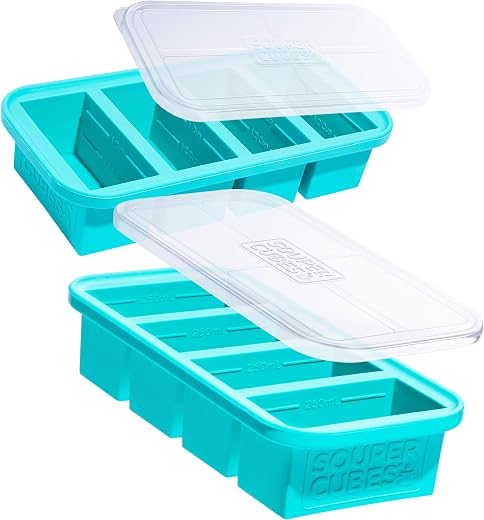
| 1 | OXO Good Grips Kitchen Scale | The portion decision | 11 lb / 5 kg, pull-out display | Cooking the amount you will actually eat | $54.00 | 8.7 |
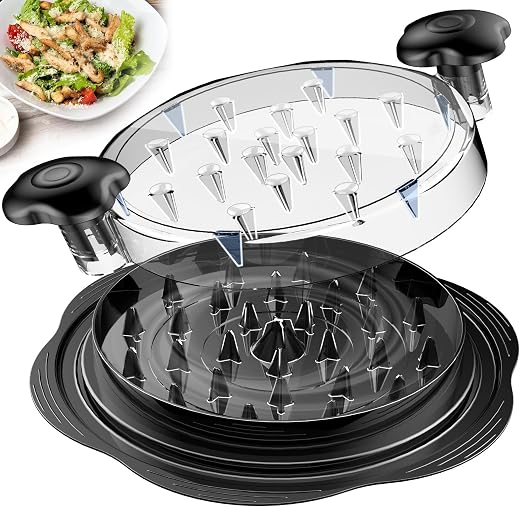
| 2 | SURETIVIAN Chicken Shredder Tool | Breaking the batch down | 9.84″ twist bowl, brush and fork | Getting every gram off a roast chicken | $15.99 | 8.6 |
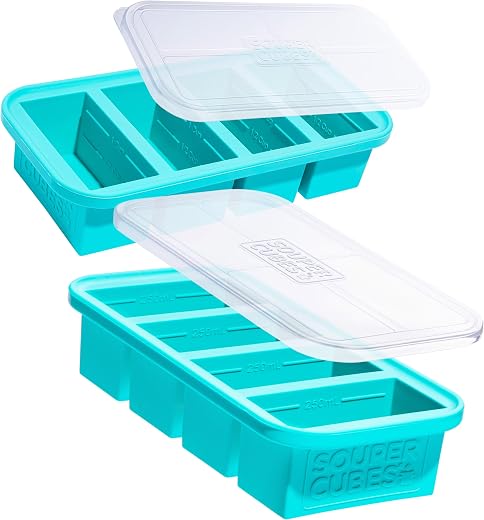
| 3 | Souper Cubes 1-Cup Freezer Tray | The portion container | 4 × 1-cup wells, 2 trays, lids | Freezing liquids in stackable single portions | $55.48 | 8.8 |
| 4 | Karidge Mini Bag Sealer | Sealing out the air | 20 W handheld heat sealer and cutter | Resealing opened bags before freezer burn starts | $9.99 | 7.6 |
| 5 | Cool Coolers XL Slim Ice Packs | The cold chain outside the freezer | 4 flat panels, ~½″ thick | Getting frozen shopping home still frozen | $12.99 | 8.4 |
| 6 | BLAZIN’ THAW Defrosting Tray | The way back out | 16″ × 8″ solid aluminium | Thawing single portions without a microwave | $35.95 | 8.1 |
| 7 | Tafura Airtight Bread Box | The loaf the freezer can’t help today | 5.8 L, airtight lid | Bread — the food Britain wastes most by volume | $19.99 | 7.8 |
The 7 Best Freezer Storage Essentials in 2026
Seven products in the order your food meets them, from the decision about how much to cook through to the moment it comes back out of the freezer. Each of these freezer storage essentials has a full review on this site, linked from its entry.
1. OXO Good Grips Kitchen Scale — Best Freezer Storage Essentials Pick for Portioning by Weight
Price: $54.00 | Role: The portion decision | Key spec: 11 lb / 5 kg capacity, pull-out display, removable stainless platform | Units: oz, lb, g, kg
Nothing on this page prevents more waste than the least exciting object on it. The single biggest reason a freezer fills up with food nobody eats is that the batch was the wrong size to begin with — you cooked for six because the recipe said so, and you are two people. A scale is the only tool in the kitchen that lets you decide the size of a batch before you commit to it, and the OXO Good Grips is the version that does not make you fight it.
Of all the freezer storage essentials here it is the one that acts earliest in the chain. The platform lifts off for washing, the tare button zeroes a bowl in one press, and the display pulls out on a short arm so a wide mixing bowl does not cover the numbers you are trying to read.
That pull-out display is the feature that justifies the price gap between this and a $12 flat scale, and it matters specifically for freezing. When you are dividing a pot of stew into portions, the bowl on the platform is always bigger than the platform. On a cheap scale you end up lifting the bowl to read the number, which changes the number. Here you slide the display forward once and read it all the way through.
The 11 lb / 5 kg ceiling is enough for a whole chicken, a Dutch oven full of ragu or a bulk bag of rice, and the unit conversion between grams and ounces is a single button — which, as the US vs UK section explains, is more useful than it sounds if you cook from recipes written on both sides of the Atlantic.
The honest limitation is that a scale is a habit, not a gadget. It sits on the counter and does nothing until you use it, and there is a version of this purchase where it lives in a cupboard and changes nothing. The way it earns its place among freezer storage essentials is if you use it once per cooking session: weigh the cooked batch, divide by the number of portions you actually want, and label each container with the weight. Do that and every future decision — how long to reheat, whether one bag is dinner or lunch — is already answered. It scored 8.7 in our full review, the second highest on this page.
Best for: A cook who batch-cooks and keeps ending up with one enormous container instead of four useful ones, and anyone following a recipe written in grams when their instinct is in cups.
Skip if: You already own a working digital scale, or you cook entirely by eye and enjoy it — in which case the Souper Cubes tray below does the portioning for you without any arithmetic.
Read the full OXO Good Grips 11-Pound Stainless Steel Kitchen Scale with Pull-Out Display review →
Where to Buy — OXO Good Grips 11-Pound Stainless Steel Kitchen Scale with Pull-Out Display
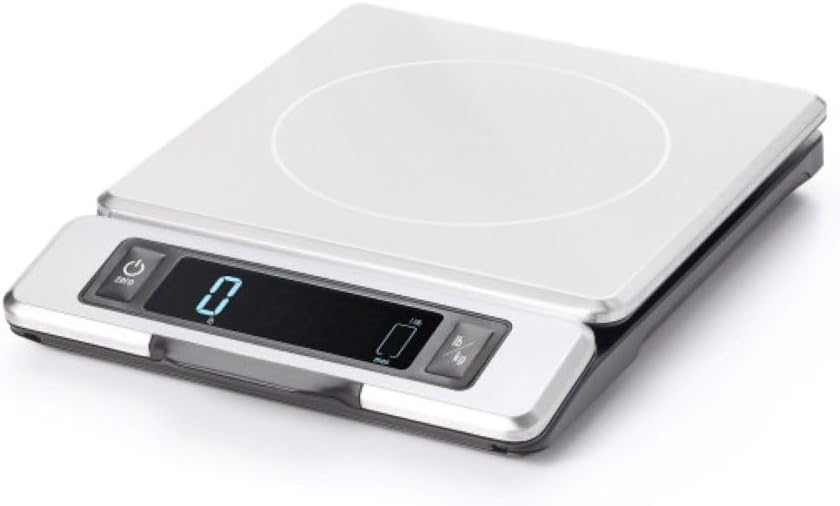
2. SURETIVIAN Chicken Shredder Tool — Best Freezer Storage Essentials Pick for Stripping a Batch Down
Price: $15.99 | Amazon rating: 4.7 from 25,492 ratings | Role: Breaking the batch down | Key spec: 9.84″ twist bowl with brush and fork included
A roast chicken is the clearest example of the gap between what you bought and what you ate. The breast comes off easily and gets eaten. The thighs, the wings, the strips along the back and the meat under the oysters mostly do not, because pulling them off by hand is fiddly, greasy work that you do standing at the counter at nine at night. So the carcass goes in the fridge “for stock”, and four days later it goes in the bin. This tool is a lidded bowl with internal teeth: you drop hot cooked meat in, twist the lid a few times, and it comes out shredded in about ten seconds.
It is a single-purpose object, and it earns its place among these freezer storage essentials because the ten seconds is the whole point. The reason meat gets wasted is friction, not intention, and removing thirty seconds of unpleasant work from the end of a meal is the difference between a bag of shredded chicken in the freezer and a carcass in the bin.
Shredded meat also freezes far better than joints: it cools faster, it packs flat, it thaws in minutes rather than hours, and it goes straight into tacos, a pie, a soup or a sandwich without further butchery. At 4.7 stars from more than 25,000 ratings it is one of the best-reviewed products in our whole catalogue.
Two practical notes. It works on hot meat and struggles on cold, so do it while you are clearing the table, not the next morning. And it is bulky — roughly a ten-inch bowl — so it needs cupboard space rather than a drawer. Among freezer storage essentials this is the one that turns a Sunday roast into four labelled bags, and it scored 8.6 in our full review largely on that basis. Pulled pork and beef brisket work the same way.
Best for: Anyone who roasts a whole bird or cooks a shoulder of pork and wants the leftovers in a form they will genuinely use, rather than a carcass they will feel guilty about.
Skip if: You mostly cook fish, vegetables or ready-portioned cuts, or your kitchen has no spare cupboard space for a ten-inch bowl that does exactly one thing.
Read the full Chicken Shredder Tool review →
Where to Buy — Chicken Shredder Tool
3. Souper Cubes 1-Cup Silicone Freezer Tray — Best Freezer Storage Essentials Pick Overall
Price: $55.48 (2-pack) | Amazon rating: 4.8 from 22,988 ratings | Role: The portion container | Key spec: 4 × 1-cup wells per tray, two trays, lids included
This is the highest-scoring product on the page and the one most likely to change what your freezer looks like. The problem it solves is geometry, which is the problem underneath most freezer storage essentials. Liquids — soup, stock, stew, curry, bolognese, leftover gravy — are the foods most worth freezing and the hardest to freeze usefully, because a tub of soup freezes into a single lump the exact shape of the tub. You cannot take half. You cannot stack it against anything. And thawing it means committing to eating all of it. The Souper Cubes tray freezes soup into four flat one-cup bricks, which you then pop out and bag.
Once the liquid is out of the tray and into a bag, three things change at once. The freezer stacks properly, because bricks stack and tubs do not. The portion is decided in advance, so you take one cup or three rather than “a container”.
And the thaw time collapses, because a one-inch-thick brick thaws in a fraction of the time a four-inch cylinder does — which, given that the USDA is explicit that food should never be defrosted on the counter, is the difference between a plan and an improvisation. The silicone is stiff enough to carry full without slopping, the lids keep the surface clean while it sets, and the markings on the well walls let you freeze half-cup portions for babies, sauces or single servings.
The price is the sticking point and we will not pretend otherwise: $55.48 for two trays is a lot next to a stack of plastic tubs, and there are cheaper silicone trays that do roughly the same thing less rigidly. What you are paying for is a tray you can carry across the kitchen full without it folding in the middle. Of all the freezer storage essentials here this is the one we would buy first, and at 4.8 stars from nearly 23,000 ratings the market broadly agrees; it scored 8.8 in our full review.
Best for: Anyone who makes soup, stock, stew or sauce in quantity and currently freezes it in tubs — and anyone whose freezer is full but somehow has no usable space in it.
Skip if: You freeze mostly solid food such as bread, meat and vegetables, where a tray adds a step; or the two-tray price is simply out of proportion to how often you cook liquids.
Read the full Silicone Freezer Tray review →
Where to Buy — Silicone Freezer Tray
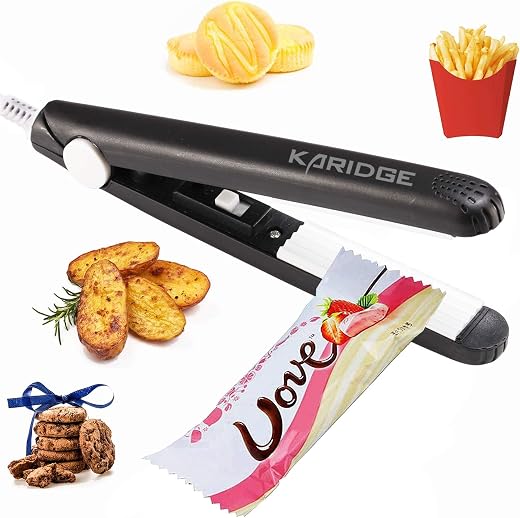
4. Karidge Mini Bag Sealer — Best Cheap Freezer Storage Essentials Pick for Sealing Out Air
Price: $9.99 | Amazon rating: 4.3 from 5,657 ratings | Role: Sealing out the air | Key spec: 20 W handheld heat sealer with integrated cutter, 7.87″ long
Freezer burn is the single most common reason people throw away food that was perfectly safe. The USDA is unambiguous that it is a quality problem rather than a safety one — “freezer burn does not make food unsafe, merely dry in spots” — but that distinction does not survive contact with a bag of grey, crystalline chicken thighs.
What causes it is moisture migrating out of the food and into the air trapped in the packaging. Less air in the bag, less freezer burn — which is why sealing is the quiet job half the freezer storage essentials on this page are really doing. This ten-dollar tool welds the top of a plastic bag shut in about three seconds.
It is a heating strip in a plastic handle: you run it along a folded bag edge, it melts the two layers together, and a small blade on the side cuts the excess off. It is not a vacuum sealer and does not pretend to be — it removes no air by itself, so you still have to press the bag flat before sealing.
But it costs a twentieth of a vacuum system, needs no proprietary bag rolls at $15 a time, and works on the bags you already have: cereal liners, frozen-veg bags you opened last week, coffee, crisps, a half-used bag of chips. That consumables point is the entire argument. A vacuum sealer is better; a vacuum sealer that you stop buying bags for is worse than a ten-dollar tool you actually use.
Set expectations honestly. At 4.3 stars it is the lowest-rated product on this page, and the complaints are consistent: the seal is only as good as your technique, thick or gusseted bags need two passes, and it is corded rather than battery-powered so it lives near a socket. It scored 7.6 in our full review, the lowest here. It is included among these freezer storage essentials because it is the cheapest meaningful intervention available against the most common cause of freezer waste, not because it is the most polished object.
Best for: Anyone whose freezer contains half-used bags rolled over and clipped, and anyone who wants the freezer-burn problem addressed for the price of a sandwich.
Skip if: You already own a vacuum sealer and happily buy the bags for it, or you want a genuinely airtight, liquid-proof seal — heat sealing a folded bag is not that.
Read the full Mini Bag Sealer review →
Where to Buy — Mini Bag Sealer
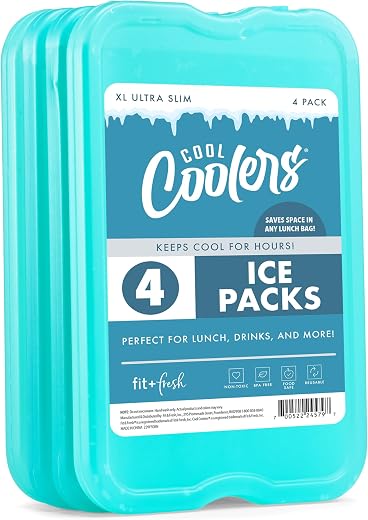
5. Cool Coolers XL Slim Ice Packs — Best Value Freezer Storage Essentials Pick for the Cold Chain
Price: $12.99 | Amazon rating: 4.6 from 49,977 ratings | Role: The cold chain outside the freezer | Key spec: 4 flat XL panels, roughly ½″ thick, freezer-to-bag
There is a gap in every home freezer system that nobody plans for: the forty minutes between the supermarket freezer aisle and your own freezer door. Frozen food that partially thaws on the way home and is then refrozen loses texture immediately and quality permanently, because the second freeze forms large, disruptive ice crystals — the USDA notes that “slow freezing creates large, disruptive ice crystals” while rapid freezing avoids them. In hot weather, or on a bus, or when the shop is the third errand of the afternoon, that gap is where a week of frozen meals quietly degrades.
These are the fix, and they are the best-value item on the page by a distance — the cheapest of the freezer storage essentials here to leave a visible difference. Four extra-large panels, each about half an inch thick, at $12.99 for the set. The flat profile is the whole design argument: a chunky brick-shaped ice pack sits in the middle of a bag displacing food, while flat panels line the walls, so cold comes at the contents from both sides and almost no usable volume is lost. Four of them make a functioning cold chain rather than a token gesture, which is exactly the failure mode of the single ice block most people own.
They are also the most reusable object here. The same four panels do the shopping run, a packed lunch, a picnic, a barbecue and the transfer of a freezer’s contents when a fridge-freezer is being replaced or the power is out. At 4.6 stars from nearly 50,000 ratings they have some of the strongest social proof in our entire catalogue, and they scored 8.4. Among freezer storage essentials they are the item most likely to be used weekly rather than monthly, and the one we would recommend without hesitation to someone spending under $15. Pair them with an insulated bag or a proper hard cooler for longer journeys.
Best for: Anyone who shops for frozen food weekly, carries a packed lunch, or lives more than fifteen minutes from the supermarket — especially in summer.
Skip if: You drive five minutes each way to a shop with a car boot that never gets warm, or you need cooling that lasts more than a day, which is a job for dry ice or a powered cool box.
Read the full Cool Coolers XL Slim Ice Packs review →
Where to Buy — Cool Coolers XL Slim Ice Packs
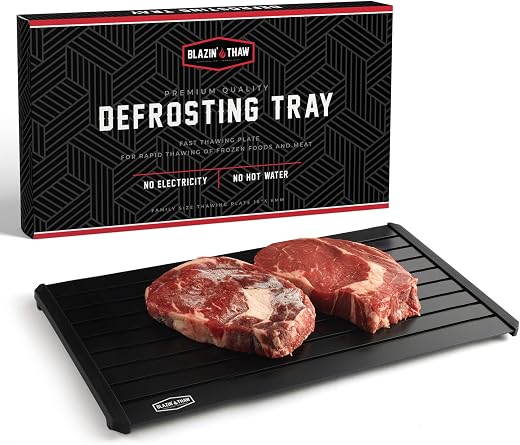
6. BLAZIN’ THAW Defrosting Tray — Best Freezer Storage Essentials Pick for Getting Food Back Out
Price: $35.95 | Amazon rating: 4.4 from 2,344 ratings | Role: The way back out | Key spec: 16″ × 8″ solid aluminium plate, 0.23″ thick
Everything above this entry is about getting food into the freezer well. This is the only one about getting it out, and it is the stage where most household food-safety mistakes actually happen. The USDA lists exactly three safe methods — “in the refrigerator, in cold water, or in the microwave” — and is blunt about the alternative: “never defrost foods… out on the kitchen counter”. British guidance says the same thing more mildly: defrost in the fridge “so that it doesn’t get too warm”. Almost everyone ignores both, because fridge thawing takes most of a day and you decided what to eat at six o’clock.
It is the only one of these freezer storage essentials that works in reverse. A defrosting tray is a slab of aluminium that conducts heat out of the room and into frozen food far faster than still air does. It is not magic and it is not a heater — it has no power source, and any product marketing that implies otherwise is overselling it.
What it does is halve or better the thaw time of a thin item at room temperature, which is precisely why it belongs in a system built around thin portions. A one-inch Souper Cubes brick or a flat-packed bag of shredded chicken on aluminium is a different proposition from a whole frozen joint: it is out of the freezer for a shorter time, so it spends less of that time in the range where bacteria multiply.
Two honest caveats keep this at 8.1 rather than higher. It is the second most expensive item here at $35.95, which is a lot for a metal plate, and it is 16 inches long, so it needs real counter and cupboard space. It also cannot substitute for planning: the safest thaw is still the fridge overnight, and the tray’s proper role among freezer storage essentials is as the tool for the evenings when you forgot. Used that way it is genuinely good, and it is far better than the two things most people otherwise do, which are hot water and the counter.
Best for: Households without a microwave, and anyone who freezes in thin portions and regularly decides what to cook after five o’clock.
Skip if: You plan meals a day ahead and always thaw in the fridge, or you would rather spend $36 on the tray that makes the thin portions in the first place.
Read the full BLAZIN’ THAW Defrosting Tray review →
Where to Buy — BLAZIN’ THAW Defrosting Tray
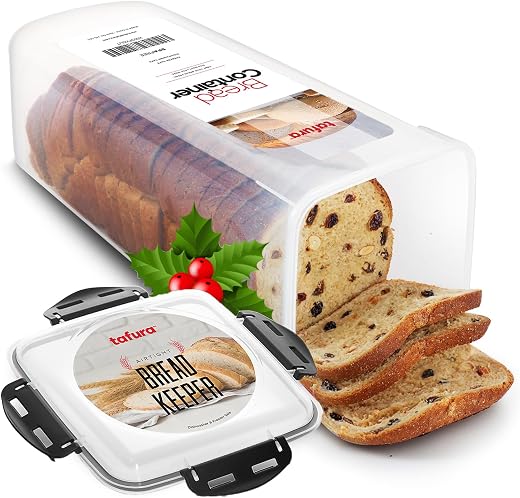
7. Tafura Airtight Bread Box — Best Freezer Storage Essentials Pick for the Food You Waste Most
Price: $19.99 | Amazon rating: 4.6 from 2,412 ratings | Role: The loaf the freezer can’t help today | Key spec: 5.8 L capacity, airtight lid, dishwasher and freezer safe
The seventh item is not a freezer product and that is deliberate. Bread is one of the foods British households waste most by volume — WRAP’s key-facts summary puts it in the top three alongside potatoes and carrots, at roughly 960 tonnes a day, on the order of 1.2 million loaves. Bread is also the food people most often try to solve with the fridge, which is exactly wrong. University of Wyoming Extension puts it plainly: “Never store your bread in the refrigerator! Refrigeration shortens the bread’s shelf life… it speeds up the staling process faster than anything else.” Cold above freezing accelerates staling; freezing stops it.
So the correct handling of a large loaf is a two-part answer, and of all the freezer storage essentials on this page this box is the half that is usually missing. Freeze the portion you will not reach in three days — sliced, so you can take two slices and toast them from frozen — and keep the rest at room temperature in something airtight, which is what stops a cut loaf drying out on day two.
The Wyoming guidance gives frozen bread one to three months and fresh soft-crust loaves about three days at room temperature in a sealed bag or box. A 5.8-litre container takes a standard large loaf plus a packet of rolls, and the airtight lid is the actual working part.
It is the least sophisticated object on this page, and at 7.8 it scores accordingly — a plastic box with a good seal is not an engineering achievement. It is here because the food-waste data says the most-wasted foods are cheap staples rather than expensive ones, and because it completes the logic of the other six freezer storage essentials: the freezer is for the half of the loaf you are not eating this week, and the box is for the half you are. Do both and a loaf stops being a race against time.
Best for: Anyone who buys large loaves, bakes their own, or throws away the end of a loaf more than once a month — which, statistically, is most households.
Skip if: You buy small loaves you finish in two days, or your counter space is at such a premium that a 5.8-litre box is not a trade you would make.
Read the full Tafura Bread Box review →
Where to Buy — Tafura Bread Box
Freezer Storage Essentials — Buyer’s Guide: What to Look For
Before you buy anything, it is worth knowing what a freezer actually does and what it does not do, because most bad purchases in this category come from expecting the wrong thing. These are the five questions that decide whether a piece of kit belongs in your kitchen.
Freezer Storage Essentials Rule One: Thin Beats Big
Almost every advantage in this category comes from thickness. A thin portion freezes faster, which means smaller ice crystals and better texture on the way out; the USDA notes that “rapid freezing prevents undesirable large ice crystals from forming” while slow freezing creates them. A thin portion also stacks, so your freezer holds more. And it thaws far faster, which shortens the only genuinely risky part of the process.
This is why the strongest freezer storage essentials on this page are all shape tools rather than storage tools: the Souper Cubes tray makes one-inch bricks, the bag sealer lets you flatten a bag and close it in that position, and the defrosting tray only shows its advantage on something thin. If you buy nothing else, change the shape of what you freeze. It costs nothing and it improves every stage afterwards.
Freezer Storage Essentials Rule Two: Air Is the Enemy, Not Time
Frozen food does not go off. Held constantly at 0 °F / −18 °C, the USDA is explicit that “frozen foods remain safe indefinitely” and that “freezer storage is for quality only”. What degrades is texture and flavour, and the mechanism is moisture leaving the food and condensing elsewhere in the packaging. That is freezer burn, and it is caused by air, not by the calendar.
So when comparing freezer storage essentials, judge them on how little air they trap rather than how thick the plastic is. A thin bag pressed flat and heat-sealed beats a rigid tub half full of air every time. It is also why you should decant: the bag a supermarket sells frozen peas in is fine sealed and poor once opened and rolled over. Anything you have opened and intend to keep for months deserves a proper closure.
Freezer Storage Essentials Rule Three: Label, Because You Will Not Remember
Unlabelled frozen food becomes anonymous within about three weeks. Brown liquid in a bag could be beef stock, gravy, chili or bolognese, and the natural response to not knowing is to leave it there. This is the quiet mechanism by which freezers fill up with food that will eventually be thrown away, and it is why so much household food waste is technically edible — WRAP puts 73% of UK household food waste in that category.
None of the freezer storage essentials above fixes this on their own; a marker pen does. Label with three things: what it is, the date it went in, and the weight or portion count. The third is the one people skip and the one that saves the most, because it turns “a bag of something” into “two portions”. A kitchen scale makes that trivial. If you are already weighing to divide a batch, writing the number down is free.
Freezer Storage Essentials Rule Four: Buy for the Failure You Actually Have
The seven products here address five different failure points, and most households only have two or three of them. If your problem is that you cook too much, the scale is the answer and the tray is optional. If your problem is that the freezer is a solid block of unusable tubs, the tray is the answer and everything else can wait. If your problem is bags of grey chicken, the sealer costs ten dollars.
Diagnosing before buying is worth more than any individual product on the page. Spend a week actually looking at what you throw away — not what you think you throw away — and the correct purchase from these freezer storage essentials is usually obvious within a few days. That approach also stops you buying the two items you were never going to use.
Freezer Storage Essentials Rule Five: What We Deliberately Left Out
Three categories were left out of these freezer storage essentials on purpose. No vacuum sealer: they work better than anything here, but they are $80–$200 plus a permanent consumable cost in proprietary bag rolls, and the failure mode is that people stop buying the rolls and the machine goes in a cupboard. If you already use one, keep using it.
No chest freezer, because that is an appliance purchase driven by your floor space and electricity tariff rather than by a roundup. No compost caddy either, and that omission is deliberate: composting is the second-to-last tier of the EPA’s Wasted Food Scale, well below prevention, and this page is about the top tier. And no smart fridge cameras or food-tracking gadgets — a whiteboard on the freezer door does the same job for nothing. If you want a temperature tool for the cooking side of the problem instead, our wireless meat thermometer review covers that ground.
US vs UK: What Changes When You Freeze Food on the Other Side of the Atlantic
Freezing is one of the few areas of home food safety where the two countries agree almost exactly on the physics and diverge sharply on the paperwork. The number is the same; the law around it is not.
The Same Temperature, Written Two Ways
British guidance says your freezer “should be around −18°C”. American guidance says 0 °F. These are the same temperature: the FDA writes it out as “the freezer at 0° F (-18° C)” in the same sentence. Every one of the freezer storage essentials above works identically at either number, and there is no conversion to do — if your appliance reads in the other unit, set it to whichever of those two numbers your dial shows and you are correct in both countries.
Where the two systems differ is how you know your freezer reaches it. British and European appliances carry a star rating that has no American equivalent: one star is about −6 °C and holds food for a few days, two stars about −12 °C, three stars −18 °C for storage of up to about three months, and only a four-star compartment is rated to actually freeze fresh food down rather than merely keep already-frozen food cold.
If you are in the UK and using the small icebox at the top of a fridge, check the stars before you assume you can freeze a fresh batch of stew in it. American buyers get no such marking and have to rely on a thermometer.
The Use-By Date Rule Britain Has and America Does Not
The most useful single piece of British guidance for anyone shopping for freezer storage essentials, or simply trying to waste less, is that you “can freeze food right up until midnight on the ‘use by’ date”. That is official FSA advice published on GOV.UK, and it converts a hard deadline into a reprieve: the chicken that expires today is not a decision you have to make today. British guidance adds that food should be used “within 24 hours after it’s been fully defrosted”, and that you “can freeze food again once cooked, but you’ll only be able to reheat it once”.
The United States has no comparable framework, because outside infant formula there is no federal date-labelling rule to hang it on. American guidance goes the other way and starts from the freezer: “food stored constantly at 0 °F will always be safe”, and the USDA even permits refreezing without cooking — “once food is thawed in the refrigerator, it is safe to refreeze it without cooking, although there may be a loss of quality.” British guidance is more conservative about the second freeze. In practice: an American reader may refreeze a fridge-thawed item, a British reader is told to cook it first.
Thawing: Identical Advice, Different Tone
Both countries say the same three things about thawing and one says it much louder, which matters for the last of the freezer storage essentials above. The USDA lists the safe methods as “in the refrigerator, in cold water, or in the microwave” and then forbids the alternatives by name: “never defrost foods in a garage, basement, car, dishwasher or plastic garbage bag; out on the kitchen counter, outdoors or on the porch.” The FSA simply advises defrosting in the fridge “so that it doesn’t get too warm”. Same rule, and worth knowing that the American wording is the one that spells out every tempting shortcut.
One reason both take it seriously: freezing does not sterilise anything. Freezing works “by slowing the movement of molecules, causing microbes to enter a dormant stage”, and the FDA notes of Listeria monocytogenes that “freezing will not eliminate or reduce the pathogen” and that unlike most bacteria it “can grow at refrigeration temperatures”. Whatever was on the food when it went in is on it when it comes out, wide awake.
What Happens to the Food You Waste Anyway
Here the two countries diverge completely. From 31 March 2026, English local authorities must collect the core recyclable waste streams from every household, “including introducing weekly food waste collections” — a national, statutory, universal duty. There is nothing like it federally in the United States. The closest analogue is state-level: California’s SB 1383 “requires jurisdictions to provide organic waste collection services to all residents and businesses”, aiming at “75% less organic waste sent to landfills” and “20% of unsold, still-edible food sent to food recovery organizations”. A Californian and an English household are converging on the same system; a household in most other US states is not.
Vocabulary, for Anyone Shopping Across the Atlantic
American product listings say freezer, British ones often say freezer compartment or icebox for the small one. Americans buy plastic wrap and aluminum foil; Britons buy cling film and tin foil. A US cooler is a UK cool box; US ice packs are UK freezer blocks. Americans buy ground beef, Britons mince.
A US Ziploc is a British freezer bag, and Saran wrap means nothing in a British shop. Recipes are the bigger trap: American ones measure in cups and a British one in grams, which is why a scale with a units button is more useful than it looks when you are shopping for freezer storage essentials from either country’s listings.
Freezer Storage Essentials — Which One Should You Buy?
Under $20: The Freezer Storage Essentials Starter Set
Buy the Karidge mini bag sealer at $9.99 and the Cool Coolers XL slim ice packs at $12.99. As a set of freezer storage essentials, twenty-three dollars covers the two most common failure points — air in the bag and a broken cold chain on the way home — and both get used weekly rather than occasionally. If you can only spend ten dollars, the sealer addresses the more expensive failure. Add the chicken shredder at $15.99 if you roast a bird more than once a month.
$20–$40: The Freezer Storage Essentials Sweet Spot
This is where the Tafura bread box at $19.99 and the BLAZIN’ THAW defrosting tray at $35.95 sit. The bread box is the better buy for most households, purely because bread is wasted in such volume; the tray is the better buy if you have no microwave. Adding either to the starter set gives you the input and the output of the system covered for well under $60 in total.
Over $40: The Freezer Storage Essentials Long Game
The Souper Cubes 1-cup tray at $55.48 and the OXO Good Grips scale at $54.00 are both genuine multi-year purchases that change how you cook rather than how you store. Buy the tray if your freezer is full of tubs; buy the scale if your batches are the wrong size. If you are buying one product from this entire page and you cook liquids at all, make it the tray — it is the highest-scoring item here at 8.8 and the one whose effect is visible the first week. Cooks who batch on a bigger scale should also look at our Ninja FrostVault cooler review and the magnetic measuring spoons for the prep side.
The Food-Waste Numbers Behind Every Item on This Page
It is worth seeing the scale of the problem these objects address, because the figures are larger and more domestic than most people expect. This section is the researched half of the page and every number in it is linked in Sources.
The UK Numbers
WRAP’s July 2025 key-facts summary estimates total UK food waste at 10.2 million tonnes a year, of which households account for 58% — about 6.0 million tonnes. The part that matters for a page about freezer storage essentials is the breakdown: “almost three quarters (73% of the total) is food we could have eaten”, which is 4.4 million tonnes. That works out at roughly 70.8 kg per person a year and around £1,000 a year for a household of four.
The House of Commons Library briefing on food waste puts the same picture slightly differently, at 10.7 million tonnes of total UK food waste in 2021 with households responsible for 60% by weight, valuing the edible part of household waste at £17 billion — “equivalent to £250 per person each year, or £1,000 for a family of four” — and attributing about 18 million tonnes of CO2 equivalent to UK food and drink waste. The two estimates use different vintages and methods; the conclusion is the same either way.
The US Numbers
The USDA estimates American food waste at “between 30-40 percent of the food supply”. Its 2010 baseline put retail and consumer-level food loss and waste at 133 billion pounds and almost $162 billion, and the EPA expresses the same baseline per person as 218.9 pounds of food waste per person sent for disposal. In 2015 the USDA and EPA jointly set a goal “to cut our nation’s food waste by 50 percent by the year 2030” — which in EPA’s per-capita terms means getting to 109.4 pounds per person.
Both figures are the reason a page of freezer storage essentials is worth writing at all. Per person per year: roughly 70.8 kg in the UK against 218.9 lb (about 99 kg) in the US on the disposal measure. The measures are not directly comparable, but neither number is small, and in both countries the majority of it is food that was bought to be eaten.
Why Prevention Is the Only Tier That Counts
The EPA replaced its old Food Recovery Hierarchy with the Wasted Food Scale, which ranks twelve pathways from most to least preferred. Prevention sits at the top, above donation, upcycling, feeding animals, anaerobic digestion, composting and landfill. The EPA’s wording is unusually direct: “Preventing food from going to waste in the first place is the most environmentally beneficial option on the Wasted Food Scale”, because it avoids wasting “all the resources that went into producing, processing, distributing, and preparing that food”.
That ranking is the reason this page recommends a $10 bag sealer and not a compost caddy. Composting is nine rungs down. The USDA makes the same point in plainer language: “the best approach to reducing food loss and waste is not to create it in the first place”, and it lists storage, shopping and cooking methods as the levers. Every product in this set of freezer storage essentials is one of those three levers made physical.
What Actually Gets Thrown Away
The most-wasted foods in the UK are not luxuries. WRAP’s figures put potatoes at the top at around 480,000 tonnes a year, followed by carrots and bread — bread at roughly 960 tonnes a day, on the order of 1.2 million loaves. An earlier WRAP release named “potatoes, bread, chicken and milk” as the commonly wasted items and called potatoes “the UK’s most wasted food item”.
Read that list next to the seven freezer storage essentials above and the logic of the page falls out. Bread has a box. Chicken has a shredder and a bag sealer. The cooked-meal category — what WRAP calls “whole meals”, and what the Commons Library flags as the highest-emissions category alongside meat and fish — has a scale, a portion tray and a defrosting tray. These are not exotic problems and they do not need exotic solutions.
Freezer Storage Essentials — Frequently Asked Questions
What temperature should my freezer be?
−18 °C in the UK, 0 °F in the US — and those are the same temperature, written in different units. The FDA states it as “the freezer at 0° F (-18° C)”. Every one of the freezer storage essentials on this page assumes that number. If your freezer has a dial marked 1–7 rather than degrees, use a cheap freezer thermometer once to find the right setting and then leave it alone.
Does frozen food ever actually go off?
Not in a safety sense. The USDA is explicit: “frozen foods remain safe indefinitely” and “freezer storage is for quality only”, provided the food is held constantly at 0 °F. What you lose over months is texture and flavour, not safety. The dates people write on freezer bags are quality reminders, not expiry dates — which is why the freezer storage essentials here are aimed at quality rather than shelf life.
Is freezer-burned food safe to eat?
Yes. “Freezer burn does not make food unsafe, merely dry in spots”, in the USDA’s words — it shows up as greyish-brown leathery patches. You can cut the affected part away and use the rest. Preventing it is the job of the bag sealer above; the cause is air trapped with the food, not time.
Can I freeze food on its use-by date?
In the UK, yes — official GOV.UK guidance says you “can freeze food right up until midnight on the ‘use by’ date”. It is probably the single most useful anti-waste rule the FSA publishes. Once you defrost it, use it within 24 hours. The US has no equivalent federal date-label framework, so American readers should judge by condition and the 0 °F rule instead.
Can I refreeze food after defrosting it?
The two countries answer this slightly differently. The USDA says that “once food is thawed in the refrigerator, it is safe to refreeze it without cooking, although there may be a loss of quality”. British guidance is more cautious: you “can freeze food again once cooked, but you’ll only be able to reheat it once”. Cooking first satisfies both.
Why can’t I defrost food on the counter?
Because the outside of the item reaches room temperature long before the middle has thawed, and bacteria that were dormant in the freezer start multiplying on that outer layer. The USDA names the safe methods — “in the refrigerator, in cold water, or in the microwave” — and specifically rules out the counter, the garage, the car and the dishwasher.
Do these freezer storage essentials work in a small fridge-freezer icebox?
Mostly, with one caveat. In the UK, check the star rating: only a four-star compartment is rated to freeze fresh food down, while a three-star one is for storing food that is already frozen. Trays and bags work in any of them; what changes is whether you should be freezing a warm batch of stew there in the first place.
Is a vacuum sealer better than a heat sealer?
Technically yes, and we said so in the entry above. A vacuum sealer removes air rather than just closing the bag, so it beats a heat sealer on freezer burn. It also costs eight to twenty times as much and needs proprietary bag rolls forever. The heat sealer wins on the metric that matters most in practice, which is whether you keep using it.
How long should I keep things in the freezer?
For safety, indefinitely at 0 °F. For quality, most home cooks find three months is where soups, stews and cooked meat still taste like themselves, and University of Wyoming Extension gives bread “one to three months” before flavour noticeably drops. Label with the date and treat three months as a nudge rather than a deadline.
Which of these freezer storage essentials should I buy first?
If you cook liquids, the Souper Cubes tray — it is the highest-scoring item here and it changes the shape of everything you freeze. If you want the cheapest useful intervention, the mini bag sealer at $9.99. If you throw away bread more than anything else, which the national statistics suggest is likely, the bread box.
Freezer Storage Essentials — Final Thoughts
A freezer does not preserve food. It pauses it — and everything that decides whether the paused food is still worth eating happens in the ten minutes before it goes in and the hour after it comes out. That is the whole argument of this page, and it is why the seven freezer storage essentials above are shape tools, air tools and timing tools rather than containers. A better freezer will not fix a household that freezes soup in four-inch tubs. A one-inch brick will.
The other thing worth carrying away is that the food most households waste is cheap and ordinary: potatoes, bread, chicken, milk, and last night’s dinner. That is oddly encouraging, because cheap and ordinary problems have cheap and ordinary solutions. Twenty-three dollars covers a bag sealer and four ice packs; fifty-five covers the tray that most people would notice within a week. Against a UK figure of around £1,000 a year for a family of four, or an American estimate of 30–40% of the food supply, that is a short payback period for something you buy once.
Sources and Further Reading
- WRAP — UK Food Waste & Food Surplus: Key Facts, July 2025
- House of Commons Library — Food waste in the UK
- WRAP — Food waste falls by 7% per person in three years
- USDA — Food Waste FAQs
- US EPA — Wasted Food Scale
- USDA FSIS — Freezing and Food Safety (fact sheet)
- GOV.UK / Food Standards Agency — How to chill, freeze and defrost food safely
- GOV.UK — Simpler Recycling in England: policy update
- CalRecycle — Statewide Mandatory Organic Waste Collection (SB 1383)
- CalRecycle — SB 1383 short-lived climate pollutants targets
- US FDA — Listeria (Listeriosis)
- University of Wyoming Extension — Storing bread for maximum freshness
- Smeg UK service — What the star ratings mean on a fridge/freezer
Disclosure: this article contains affiliate links. If you buy through one of the Buy Now buttons above we may earn a small commission at no extra cost to you. Prices and Amazon ratings were correct at the time of writing and change frequently. Links go to Amazon.com; UK readers can search the same model names on Amazon.co.uk. Nothing here is a substitute for the food-safety guidance published by the FSA or the USDA, both of which are linked above.