
Mini Bag Sealer Review — Best Handheld Heat Sealer Under $10?
Karidge Mini Bag Sealer Review (2026) — Does a $10 Heat Sealer Really Work?
A bag clip does not seal anything. It folds the top of a bag over and holds the fold, which slows the air down but does not stop it, and anything that goes stale by oxidation — crisps, coffee, nuts, cereal — carries on going stale at very nearly the same rate. That is why half-eaten snack bags are soft two days later even when they were clipped properly.
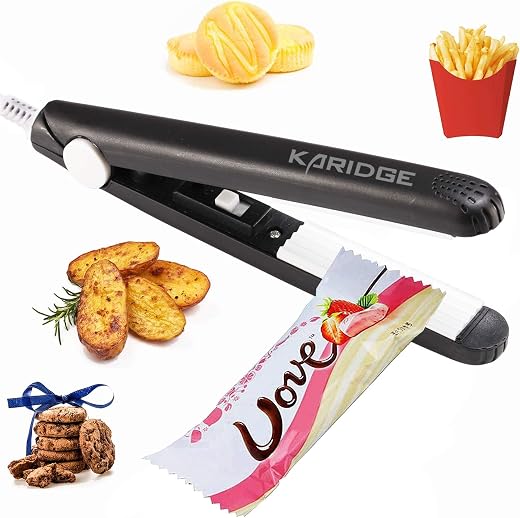
A heat sealer fuses the plastic instead, turning the bag back into a sealed bag. The Karidge is the cheapest honest version of that: a corded handheld unit about the size of a stapler that seals along five heating lines, cuts the excess with a built-in blade, and costs about ten dollars. It has a 4.3-star average across more than 5,600 Amazon ratings, which for a sub-$10 gadget is a genuinely useful sample size.
In short: the mini bag sealer earns 7.6/10 from the Blue Rays Technologies team. The rest of this review sets out exactly how that score was reached.
What is in this mini bag sealer review
- Key Specifications
- What a Mini Bag Sealer Does That a Clip Cannot
- Handling, Seal Quality and the Bags It Struggles With
- Corded Versus Rechargeable, and Where This One Sits
- Limitations and Compromises
- Setup, Cleaning and Safe Use
- Who Should Buy It?
- The Verdict
- Frequently Asked Questions
- Related Reviews
Key Specifications
Published specifications for the mini bag sealer, taken from the manufacturer listing.
| Reviewed model | mini bag sealer |
| Brand | Karidge |
| Type | Handheld heat sealer with cutter |
| Power source | Corded electric |
| Wattage | 20 W |
| Sealing lines | 5 |
| Seal time | 3–5 seconds depending on bag |
| Body material | ABS plastic |
| Dimensions | 7.87 x 2.36 x 1.18 inches |
| Weight | 0.1 kg |
| Colour | Black |
| Cutter | Integrated slide blade |
| Suitable bags | Chip, snack, cereal, coffee, candy, foil and mylar |
| Amazon rating | 4.3 / 5 from 5,655+ ratings |
Everything that follows is based on those published figures for the mini bag sealer, together with aggregated owner feedback from verified buyers.
What a Mini Bag Sealer Does That a Clip Cannot
Sealing is a phase change, not a fold. The heating element brings the two inner faces of the bag above the softening point of the polyethylene liner, and pressing them together while they are soft welds them into one continuous piece of plastic. When it cools you have a bag with a new top, not a bag with a clamp on it.
The practical consequence is oxygen. A clipped crisp packet still exchanges air along the fold every time it is picked up; a sealed one does not, and the fats that go rancid in nuts and ground coffee do so far more slowly. If you have ever wondered why a resealable zip bag keeps coffee better than a clip and worse than the original valve bag, this is the reason — each step is a better barrier than the last.
The other thing a mini bag sealer does is make an odd-shaped bag flat and stackable. A sealed half-bag of pasta or rice takes a fraction of the cupboard space a clipped one does, because there is no clip sticking out and no gaping fold, and that is a bigger daily benefit than most buyers expect.
Handling, Seal Quality and the Bags It Struggles With
Technique matters more than the tool here. The bag has to be pulled taut and fed straight, and the unit has to be held closed for the full three to five seconds without dragging. Done properly the seal is a neat welded band a few millimetres wide that will not pull apart by hand. Done impatiently it is a partial weld with a pinhole in it, and a pinhole is the same as no seal at all.
It handles ordinary polyethylene-lined snack bags easily, foil-lined crisp packets well, and mylar reliably if you go slowly. What it does not handle is very thin produce bags and anything paper-based or non-heat-melting, which simply will not fuse; the manufacturer is explicit about this and it is the source of most of the one-star reviews.
The integrated cutter is the part people underrate. Trimming the ragged top before sealing gives you a clean straight edge to weld, which roughly doubles the first-time success rate. It is also how you open the bag next time without scissors, so the bag can be resealed several times before it runs out of height.
Corded Versus Rechargeable, and Where This One Sits
This model is corded, which is the reason it costs ten dollars rather than eighteen. A cord is a genuine nuisance if you want the sealer to live on the fridge door and get used one-handed while you are still holding the bag; it is a non-issue if it lives in the drawer next to a socket and comes out when you are already at the worktop.
Rechargeable versions add a battery, usually a magnet for the fridge and sometimes a torch, and they are the better product if you seal things every day. They are also the versions with the worst reliability record in owner feedback, because a small lithium cell in a heat-producing device is not a comfortable combination and the failure mode is a unit that no longer reaches sealing temperature.
For occasional use — crisps, cereal, coffee, the bag of frozen chips that never closes properly — the corded unit is the more sensible purchase, and if it dies in eighteen months you have lost ten dollars rather than twenty-five.
Limitations and Compromises
No product is without compromise, and the mini bag sealer has a few worth knowing before you buy.
The build is exactly what ten dollars buys. The ABS body flexes, the slide cutter is stiff out of the box, and the heating element is a consumable — owners who use it daily report two to three years, while occasional users report much longer. Treat it as a cheap tool with a finite life rather than an appliance.
It will not seal every bag. Ultra-thin produce bags, paper bags and any bag without a heat-melting inner layer are outside its range, and no amount of technique changes that. Roughly a fifth of the negative reviews are people who tried it on the wrong bag.
And it is not a vacuum sealer. It removes no air; it only stops more getting in. For freezing meat or long-term storage where freezer burn is the enemy, a chamber or suction vacuum sealer is the right tool and this is not a substitute for one.
Setup, Cleaning and Safe Use
Getting the best out of the mini bag sealer over a long life comes down to a few simple habits.
Give it thirty seconds to reach temperature before the first seal — the most common complaint about weak seals is a first attempt made too early. After that it holds temperature and consecutive seals are quicker.
Melted plastic residue on the heating strip is the main maintenance job, and it is easily dealt with: unplug, let it cool completely, and wipe the strip with a dry cloth or the edge of a wooden skewer. Never use water or a wet wipe on the element, and never scrape it with anything metal.
The usual heat-appliance rules apply. Do not leave it plugged in unattended, keep it away from the edge of the worktop where a cord can be caught, and let it cool before it goes back in the drawer. It is a small device that gets genuinely hot at one end.
Who Should Buy It?
The mini bag sealer suits some households far better than others. It is a clear buy if you recognise yourself here:
- You open large snack, cereal or coffee bags and never finish them in one go
- You buy in bulk and split into smaller portions at home
- You want half-used bags to stack flat rather than gape open with a clip
- You store dry goods in mylar and need a cheap way to close them
- You would rather spend ten dollars on a fix than keep buying bag clips
The mini bag sealer is the wrong purchase if any of the following apply:
- You need air removed as well as kept out — buy a vacuum sealer instead
- You want to seal thin produce bags or anything paper-based, which will not fuse
- You want a cordless unit that lives on the fridge and works one-handed
- You seal in volume every day, where an impulse sealer is the durable answer
The Verdict
Judged as a ten-dollar gadget this does the job it claims, and the job is more useful than it sounds — a proper weld keeps crisps crisp and coffee drinkable for a great deal longer than a clip does. The cutter is the underrated half of the design, because a straight edge is what makes the seal work first time.
What holds the score at the lower end of good is honest cheapness: a flexing body, a heating element with a finite life, a cord that limits where it can be used, and a real list of bags it cannot handle. None of that is hidden, and at this price it is a fair trade.
Review score for the mini bag sealer: 7.6/10. Genuinely useful for the money, with a build that matches the price rather than exceeds it. Blue Rays Technologies researches independently and earns a commission from qualifying purchases, which never affects the score.
Current pricing, colour options and the full set of buyer photographs are on the listing for the Karidge Mini Bag Sealer at Amazon. For what sealing does and does not achieve for food safety — as distinct from freshness — the FoodSafety.gov FoodKeeper guidance is the practical reference on how long opened dry goods actually last.
Frequently Asked Questions
The questions buyers ask most often about the mini bag sealer, answered plainly.
Does a mini bag sealer work on crisp and chip packets?
Yes — foil-lined snack packets are the use case it handles best, because the inner layer is heat-melting polyethylene. Trim the ragged top with the built-in cutter first, pull the bag taut, and hold for the full three to five seconds.
Can it seal mylar bags for long-term food storage?
It can, but slowly and with a second pass on thicker mylar. For serious long-term storage with oxygen absorbers, a mains impulse sealer with a wider heating bar gives a more consistent weld across the full bag width.
Is this the same thing as a vacuum sealer?
No. A vacuum sealer removes the air before sealing; this only closes the bag. For preventing freezer burn on meat you want a vacuum sealer. For keeping dry goods fresh in the cupboard, sealing alone is most of the benefit.
How long does the heating element last?
Owner reports cluster around two to three years with daily use and considerably longer with occasional use. The element is not user-replaceable, so at this price the unit is effectively a consumable.
Related Reviews
If the mini bag sealer is not quite the right fit, these Blue Rays Technologies reviews cover the nearest alternatives.
- Tafura Bread Box review — airtight storage for bread specifically
- Defrosting Tray review — the other half of a freezer routine
- Silicone Freezer Tray review — portioning before it goes in
Last updated: 28 August 2026. Pricing and availability for the mini bag sealer change frequently; check the retailer listing for the current figure.


There are no reviews yet.