
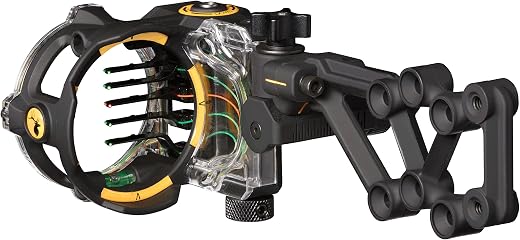
A bow sight is the one accessory on a compound bow that you aim with, making it the component where a specification error costs you an arrow. This comparison puts five of them side by side, from $25.99 to $299.99, and the top pick is the Trophy Ridge React H5 at $147.95 — not the best hardware here, but the only one pairing tool-less adjusters with 587 owner ratings at 4.6, the strongest evidence base here.
The five cover both mechanisms that matter. Two are single-pin sliders, where you range the target and dial the yardage. Three are fixed multi-pin heads, where five pins give five references and nothing to turn. Two of the five fit either hand; three are right hand only. Only two offer third-axis levelling, and they sit at opposite ends of the price range.
This comparison is research-based. We did not physically test these products; specifications, ratings and prices are taken from the live listings on the date shown. Links go to Amazon.com; UK readers can search the same models on Amazon.co.uk, though as the legal section explains, the use these sights are marketed for in America is an offence in England and Wales. One finding shaped the comparison: four of these five publish a structured pin diameter of 0.02 inches while their own copy says .019, and the fifth publishes 0.01 with nothing to corroborate it.
Bow Sight — Quick Comparison
| # | Product | Role | Key spec | Best for | Price | Score |
|---|---|---|---|---|---|---|
| 1 | Trophy Ridge React H5 | Best overall | Five .019” horizontal fibre pins, second axis, rheostat light | Inside forty yards | $147.95 | 8.7 |
| 2 | Trophy Ridge React One Pro | Premium single-pin slider | Single pin, dovetail slider, second and third axis, 10 sight tapes | Steep angles, long range | $299.99 | 8.5 |
| 3 | CBE Tactic Micro | Best ambidextrous build | Five .019” blade pins, reversible bracket, gang micro-adjustment | Left-handed archers | $89.82 | 8.3 |
| 4 | TRUGLO Range Rover | Best value single-pin slider | Single .019” pin, zero-in yardage dial, 80+ tapes, third axis | Treestands on a budget | $129.47 | 8.1 |
| 5 | LWANO LWANO five-pin | Best budget | Five .019” fibre pins, rheostat light, reversible mount, 0.13 kg | A first or spare bow | $25.99 | 7.6 |
On this page
- Bow Sight — Quick Comparison
- The 5 Best Bow Sight Picks in 2026
- Bow Sight — Buyer’s Guide: What to Look For
- What the Rules Actually Say About Sights
- US vs UK: The Same Object, Three Different Rulebooks
- Bow Sight — Which One Should You Buy?
- Bow Sight — Frequently Asked Questions
- Bow Sight — Final Thoughts
- Sources and Further Reading
The 5 Best Bow Sight Picks in 2026
1. Trophy Ridge React H5 Bow Sight — Best Overall
Price: $147.95 | Amazon rating: 4.6/5 from 587 ratings | Role: Best overall | Key spec: Five .019” horizontal fibre pins, second axis, rheostat light
The React H5 is the sensible middle of this comparison and where most buyers should start. Five .019-inch horizontal fibre pins cover every realistic hunting distance, and the horizontal stack keeps the lower pins clear of the target’s bottom edge. Windage and elevation move on tool-less micro-click adjusters, which matters after a knock in the field rather than on the bench.
What holds it below the premium pick is the copolymer housing, the absent third axis and an untrustworthy specification block: pin size reads 0.02 inches against the listing’s own .019, the weight and dimensions describe the shipping carton, and the compatibility field claims the part works with an iPad and a Nook. No warranty term is published anywhere, against which 587 owner ratings at 4.6 is the best-supported average here.
Best for: You shoot inside forty yards and want five fixed references.
Skip if: You hunt steep angles from height, or you are left-handed — this one is right hand only, in three separate fields.
Read the full Trophy Ridge React H5 review →
Where to Buy — Trophy Ridge React H5
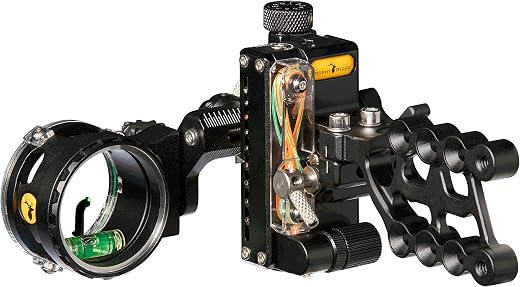
2. Trophy Ridge React One Pro — Best Premium Single Pin
Price: $299.99 | Amazon rating: 4.7/5 from 83 ratings | Role: Premium single-pin slider | Key spec: Single pin, dovetail slider, second and third axis, 10 sight tapes
This is the best hardware in the comparison. The React One Pro runs a single pin on a dovetail slider with both levelling axes. Ten sight tapes and a lens retainer ring come in the box, and the machined aluminium body is stiffer than anything here. Its claim of accuracy up to a hundred yards describes how far the tape travels, not an accuracy figure.
The listing is the worst of the five. The warranty field reads “[30 Days]”, square brackets and all — a template placeholder nobody removed, and the shortest term on the shelf on its dearest item. The UPC field holds two different codes. A 42.5 mm objective lens diameter is published for a lens that is not included. The React bullet promises to adjust “all pins” on a product whose reticle field says single pin. At 83 ratings its shelf-leading 4.7 rests on the thinnest evidence here.
Best for: You shoot steep angles or long distances and want one clean pin on a machined body.
Skip if: Your shots are close and quick, you need a left-handed fit, or a 30-day warranty is a deal-breaker.
Read the full Trophy Ridge React One Pro review →
Where to Buy — Trophy Ridge React One Pro
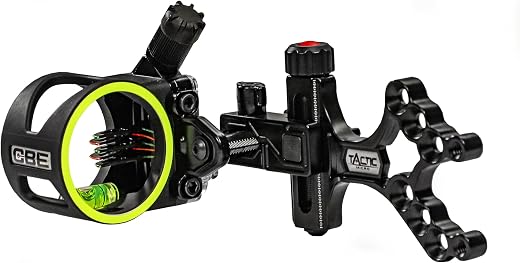
3. CBE Tactic Micro 5 Pin — Best Ambidextrous Build
Price: $89.82 | Amazon rating: 4.5/5 from 127 ratings | Role: Best ambidextrous build | Key spec: Five .019” blade pins, reversible bracket, gang micro-adjustment
Three of the five here are right hand only, so for a left-handed archer this is less a recommendation than a short list. The Tactic Micro ships a genuinely reversible bracket, the cheaper of only two reversible options here. The pins are blades rather than round fibre tips, so the aiming edge is flat. Windage and elevation move as a gang against laser-engraved marks, letting you correct a whole group without re-sighting five pins.
CBE also supplies twelve inches of spare fibre optic and says so in inches — a published quantity of the one consumable that actually fails. The omissions are levelling and accountability: no axis adjustment, a warranty description that is the phrase “Manufacturer’s Warranty”, and an item weight of 9.07 grams for a machined aluminium five-pin assembly. The hand-orientation field is missing while the part number ends -RH, so the ambidextrous claim exists only where a shopping filter cannot read it.
Best for: You are left-handed, or want a machined head with gang micro-adjustment under ninety dollars.
Skip if: You shoot steep angles from height, or want a stated warranty term.
Read the full CBE Tactic Micro review →
Where to Buy — CBE Tactic Micro
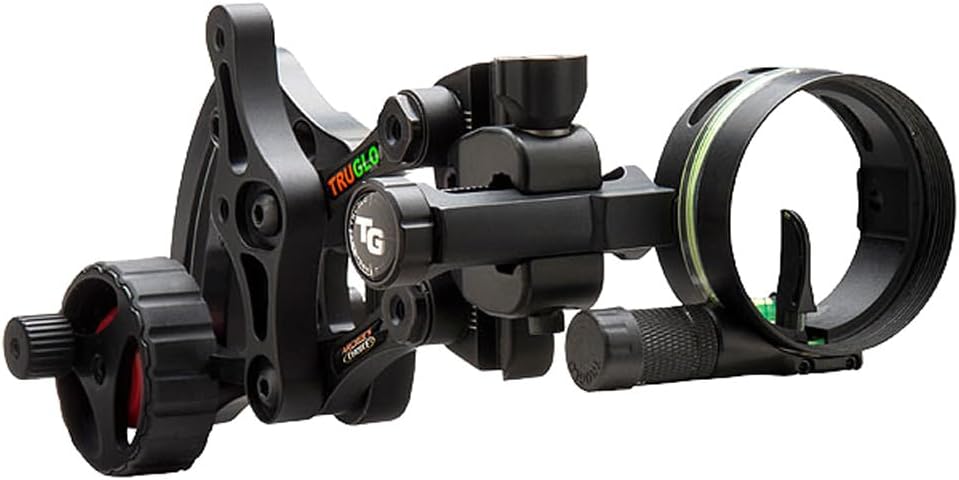
4. TRUGLO Range Rover — Best Value Single-Pin Slider
Price: $129.47 | Amazon rating: 4.2/5 from 304 ratings | Role: Best value single-pin slider | Key spec: Single .019” pin, zero-in yardage dial, 80+ tapes, third axis
The case for this sight is arithmetic. Third-axis levelling justifies the premium end of this category, and the only other product here that offers it costs $299.99. The Range Rover has it at $129.47, with a micro-adjustable zero-in elevation dial, an end-of-travel stop that caps your maximum yardage, and eighty-plus tapes against the ten supplied at the top of the shelf. A glow-in-the-dark shooters ring gives your eye something to centre when the pin has gone dim.
It is also the listing to read most carefully. The title ends “Left & Right-Handed Configurations” while the hand-orientation field, the product-style field and the description’s own specification line all say right-handed — and the style field is misspelled “Righ-Handed”. The material reads Alloy Steel for a 2.72-ounce CNC-machined part. The aperture is quoted as 1.8 inches in one place and a 1.87-inch lens in another, and the included-components field is a browse path, not a parts list. At 4.2 from 304 owners it has the lowest average here on the largest sample.
Best for: You want third-axis levelling and a real yardage dial on a mid-range budget.
Skip if: You are left-handed, whatever the title says, or expected the lens in the box.
Read the full TRUGLO Range Rover review →
Where to Buy — TRUGLO Range Rover
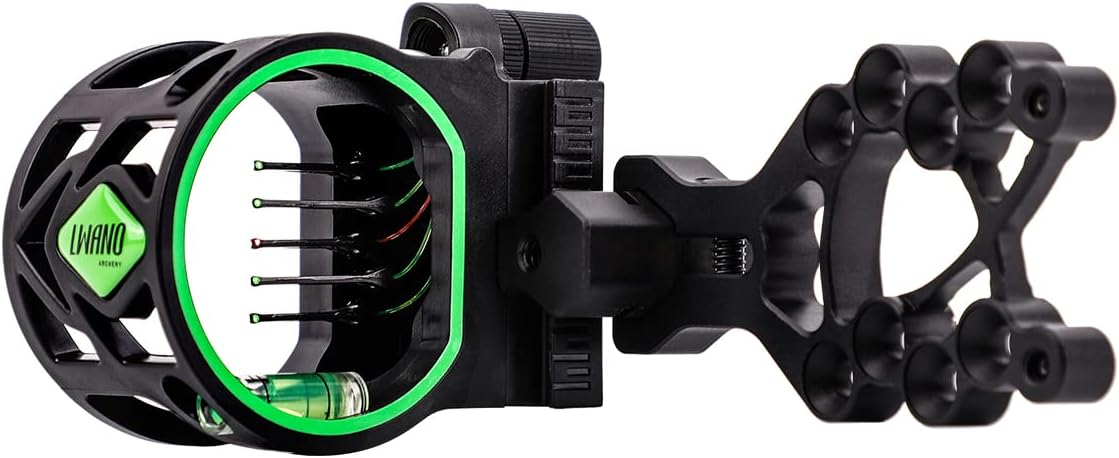
5. LWANO 5 Pin Bow Sight — Best Budget
Price: $25.99 | Amazon rating: 4.4/5 from 301 ratings | Role: Best budget | Key spec: Five .019” fibre pins, rheostat light, reversible mount, 0.13 kg
At $25.99 this is a fifth of the price of the next cheapest sight here, and not a toy. Five .019-inch horizontal fibre pins, aluminium windage, elevation and pin adjustments, a rheostat light, four mounting hole sets and a reversible mount make a complete working setup. The reversible mount makes this one of only two either-hand options here, and four hole sets give more riser clearance than the $147.95 head.
What the money does not buy is levelling, so the housing is squared by eye and a steeply angled shot will walk away from your zero. There is no warranty field, no hand-orientation field and no part code — the model name is given as “5 Pin Bow Sight”, the category used as a designation, so a broken pin means a new sight. The brand is LWANO and the manufacturer field says CUPID Archery. Its 0.13 kg published mass is nonetheless the only believable weight figure on the shelf, and 301 owners rate it 4.4 — more than the $299.99 sight has.
Best for: A first compound bow, a youth setup or a spare — the cheapest either-hand option here.
Skip if: You hunt from height, shoot beyond forty yards, or want recourse after the sale.
Read the full LWANO LWANO five-pin review →
Where to Buy — LWANO LWANO five-pin
Bow Sight — Buyer’s Guide: What to Look For
Pin diameter is the number to check, and the number to distrust
Sight pins come in a handful of diameters, and the usual hunting choice is .019 inches: thin enough not to swallow a vital area at forty yards, thick enough to find in poor light. A .010 pin covers less and suits target shooting; a .029 is easier to see and harder to shoot precisely. Every listing here quotes a diameter twice and the figures disagree: the bullets say .019 on four of the five, while the structured field — the one a filter sorts on — says 0.02 on those same four and 0.01 on the fifth. Rounding .019 to 0.02 erases the distinction the category is built around. Read the bullet, not the box.
Fixed pins or a slider: this is the real decision
A fixed multi-pin head gives a reference for every distance and no decision to make, which is what you want when an animal appears at an unranged twenty-two yards. A slider gives one clean reference and a dial, which is what you want at sixty yards downhill with time to range. Price does not track the split: the cheapest sight here is a five-pin and so is the second dearest, while the dearest is a single pin and so is the mid-priced slider.
Second and third axis levelling, and why only two have it
Second-axis levelling squares the sight’s bubble to the bow when the bow is plumb. Third-axis levelling keeps the pin true when the bow is tilted forward or back, which is what happens shooting down from a treestand. Three of these five have no third axis and two have no levelling at all. On flat ground inside thirty yards you will never notice. If you hunt from height this is the specification to buy on, and the $129.47 slider offers it for $170.52 less.
What the Rules Actually Say About Sights
For a device with no safety standard anywhere, a bow sight is unusually heavily regulated — just not for safety. Three rulebooks govern what you may aim with, and they are written three different ways.
In the United States the rules are state wildlife regulations, and two states show opposite drafting techniques on one object. Utah bans electronics outright and then carves the sight back out: under Utah Admin. Code R657-5-11(1)(d)(ii) the bow must not “include, have attached, or use any electronic device other than” a listed exception, and the first listed exception is “illuminated sight pins”. Utah separately prohibits “a bow with a magnifying aiming device” at R657-5-11(2)(e), while clarifying that “peep-mounted glass does not constitute a magnified aiming device”. Kansas does the reverse. Kan. Admin. Regs. §115-4-4(a)(1)(A) prohibits only a device “that controls the flight of the arrow”, and then publishes a permissive list: “Devices that may be attached to a bow or arrow shall include lighted pin, dot, or holographic sights; illuminated nocks; rangefinders; film or video cameras; locking draws; and radio-frequency location devices.” Kansas does not mention magnification for archery at all.
The only body that writes a rule about a sight’s optics is a sports federation. World Archery’s Rulebook Book 3 permits a recurve archer one sight and no glass: under Article 9.1.5 “a bow sight or similar device is permitted, but at no time may more than one such device be used”, and “it will not incorporate a prism, magnifying lens/lenses, or any magnifying device, level, electric or electronic devices”. Article 9.2.6 permits for compound exactly what the recurve rule forbids, allowing a sight to “also incorporate a levelling device, magnifying lenses, and/or prisms”. Barebow settles it in four words at Article 9.3: “No sight is allowed.” Every sight here ships a rheostat electric light and publishes a magnification of 1x — lawful under both state rules and in compound competition, and unlawful in recurve competition for the light alone.
US vs UK: The Same Object, Three Different Rulebooks
In the United Kingdom none of this applies, because the activity does not exist. Section 4(2)(b) of the Deer Act 1991, which extends to England and Wales, makes it an offence to use “any arrow, spear or similar missile” to take, kill or injure deer. The statute never names a bow and never names a sight: it prohibits the projectile, and so removes the entire American use case for these products. A sight sold in America as hunting equipment is, in England and Wales, target-archery equipment only, governed by World Archery’s rulebook rather than a government’s.
The divergence is one of drafting level rather than of numbers. Utah names the device, Kansas the permitted attachments, England and Wales the arrow, and a sports federation the lens. Four regimes, one object, and not one of them sets a performance requirement. Units differ too: American yardage tapes are printed in yards while UK target distances are set in metres, so a tape bought with the sight is the wrong scale in Britain.
Bow Sight — Which One Should You Buy?
Under $30 — the LWANO 5 Pin at $25.99. Five working fibre pins, a rheostat light, four mounting hole sets and a reversible mount for either hand. No levelling, no warranty and no part code — a coherent position at this price, not a scandal.
$89 to $148 — the sweet spot, with two answers. The Trophy Ridge React H5 at $147.95 is the overall pick: tool-less adjusters, second-axis levelling and 587 ratings at 4.6. The CBE Tactic Micro at $89.82 suits a left-handed archer, or anyone wanting a machined head for less and accepting no levelling. If a third axis is non-negotiable but $299.99 is not, the TRUGLO Range Rover at $129.47 is the most capable mechanism here — provided you are right-handed, whatever its title suggests.
Above $250 — the Trophy Ridge React One Pro at $299.99, for machined aluminium, a long dovetail, both levelling axes and the shelf’s highest rating. You pay $170.52 over the TRUGLO for build quality and sight radius rather than capability, and accept a thirty-day warranty printed in brackets.
This is our second archery shelf and it does not overlap the first. Our archery release aid comparison covers the device that fires the shot, where nobody publishes a trigger adjustment range; this page covers the device that aims it, where the pin diameter is rounded. The two buy different objects for the same bow and share no products. The same failure runs through our 3D printer nozzle and LiPo battery charger comparisons, where a category’s headline number is likewise missing from the listings that sell it.
Bow Sight — Frequently Asked Questions
Are bow sights universal?
Nearly all compound risers use the same two-hole mounting pattern, so heads swap between bows. What does not transfer is the sight tape or pin spacing, both set against the arrow speed of the bow they were sighted on.
How do bow sights work?
A pin or dial gives your eye a fixed reference to align with the target at full draw. A multi-pin head gives one reference per distance; a slider gives one reference you move to the distance.
What is a slider bow sight?
A single-pin sight whose pin travels on a calibrated track. You range the target, dial the yardage and aim with one unobstructed reference. The trade is time: a dial is slower than picking a pin.
Are electronic bow sights legal?
It depends on where you hunt, and the rules are written in opposite directions. Utah bans electronic devices on the bow and then expressly excepts “illuminated sight pins”; Kansas publishes a permitted list including “lighted pin, dot, or holographic sights” and bans only a device that controls the arrow’s flight. Check your state before buying.
How many pins should a bow sight have?
Five is the practical maximum before the stack covers the target at close range. If most shots fall inside forty yards, five fixed pins cover all of them.
Are bow sights ambidextrous?
Most are not. Three of the five compared here are right hand only. The CBE Tactic Micro and LWANO five-pin both reverse, and on the CBE the part number still ends -RH while the hand-orientation field is blank.
What bow sight has the brightest pins?
Brightness comes from fibre length and the sight light, not the pin itself. A long wrapped fibre run gathers more ambient light, and a rheostat lets you turn the pin down as well as up — which matters, because an over-bright pin blooms and hides the spot you are aiming at.
Bow Sight — Final Thoughts
Buy for the mechanism and the levelling, not for the pin diameter in the specification box. The mechanism decides whether you get a reference for every distance or one you dial; the levelling decides whether your zero survives a steeply angled shot. The pin diameter, item weight and warranty are not: four of five listings round .019 to 0.02, published weights vary by a factor of seventy for near-identical objects, and three of five say nothing useful about what happens if the thing breaks.
For most buyers the React H5 is the right answer at $147.95, combining field-serviceable adjusters with the only well-supported owner average here. Left-handed archers should go to the CBE Tactic Micro, treestand hunters on a budget to the TRUGLO Range Rover, and anyone sighting a first bow to the LWANO five-pin, which does more for $25.99 than it has any obligation to.
Sources and Further Reading
- Utah Admin. Code R657-5-11, Archery Equipment — the electronic-device prohibition, the “illuminated sight pins” exception and the ban on a magnifying aiming device.
- Kan. Admin. Regs. §115-4-4, Big game; legal equipment and taking methods — the permissive list of devices that may be attached to a bow.
- Deer Act 1991, section 4 (England and Wales) — the offence of using “any arrow, spear or similar missile” to take or kill deer.
- World Archery Rulebook, Book 3: Target Archery — Articles 9.1.5, 9.2.6 and 9.3 on sights, lenses and levels by division.
This page contains affiliate links to Amazon.com. If you buy through them we may earn a commission at no extra cost to you. Prices, ratings and specifications were read from the live listings on 9 October 2026.