
Nothing in a shared house goes wrong in your bedroom. Your room is the one part of the
building you control, and it is almost never the problem. The problem is the hallway, the bin,
the fridge shelf, the pile of post by the door and the key that three people need and only one
person has. Those places belong to everybody, which in practice means they belong to nobody, and the arguments that end house shares are almost always arguments about them. Good shared house essentials are bought for those places and nowhere else.
This guide covers seven shared house essentials that work on exactly that boundary. They are
the things that reduce the number of decisions a group of near-strangers has to make together,
because every decision a shared house has to make is a decision it can fall out over. None of
them is a piece of furniture and none of them belongs to one person. They are a key box, a
drainage door mat, a four-tier shoe rack, a hand-crank shredder, a touchless bin, a wall-mounted
paper towel dispenser and a set of silicone stretch lids, and between them they cost about
$229 at the prices we recorded on the morning this went live.
Everything here was chosen on four tests: does it work when nobody is thinking about it, does
it survive five people rather than one, is it cheap enough that nobody argues about splitting it,
and does it stop a recurring argument rather than starting a new one.
We have also written a
real US versus UK section, because a shared house is one of the few domestic subjects where the
two countries genuinely diverge in law — Britain licenses the house, America restricts who may
live in it, and the paperwork consequences are completely different. Product links go to
Amazon.com; UK readers can search the same models on Amazon.co.uk, and we flag the two products
where the British version is a different buy.
Shared House Essentials — Quick Comparison
Seven shared house essentials, in the order you meet them walking in through the front door. The comparison
below is the short version of everything that follows; the prices are the ones we read on the
morning of publication and Amazon moves them constantly.
| # | Product | Role | Key spec | Best for | Price | Score |
|---|---|---|---|---|---|---|
| 1 | Master Lock 5400EC Key Lock Box | The key | Holds 5 keys, 4-dial set-your-own combination | Houses where somebody is always locked out | $31.99 | 8.8 |
| 2 | Color&Geometry Drainage Door Mat | The dirt | 19" × 30" (48 × 76 cm), drainage holes, rubber backing | Stopping the hallway argument before it starts | $39.99 | 8.2 |
| 3 | VASAGLE 4-Tier Shoe Rack | The shoes | 4 tiers, 15–20 pairs, 66 lb (30 kg) capacity | Hallways that have become a shoe pile | $32.77 | 8.8 |
| 4 | JIKIOU Mini Hand-Crank Shredder | The post | Strip cut, 2 sheets, 1 L bin, no power needed | Front doors shared with people you did not choose | $15.99 | 7.4 |
| 5 | BestOffice 13-Gallon Touchless Bin | The bin | 13 US gal (49 L), motion sensor lid, stainless steel | Kitchens where the bin is the standing row | $59.99 | 8.1 |
| 6 | GP PRO Pacific Blue Ultra Dispenser | The sink | Wall-mounted, battery touchless, commercial roll | Five people and one soggy tea towel | $40.00 | 8.2 |
| 7 | DAILY KISN Silicone Stretch Lids (12) | The fridge | 12 sizes, silicone, dishwasher safe | Claiming your half of a shared fridge | $8.87 | 7.6 |
- Shared house essentials — quick comparison
- The 7 best shared house essentials in 2026
- Shared house essentials — buyer’s guide
- US vs UK: what changes when you move into a shared house
- Shared house essentials — which one should you buy?
- The law of the shared house: licensing, liability and the post
- Shared house essentials — frequently asked questions
- Shared house essentials — final thoughts
- Sources and further reading
hallway, the bin, the fridge and the front door.
The 7 Best Shared House Essentials in 2026
Seven roles, in the order you meet them coming through the front door. Every one of these shared house essentials was picked because it works on a part of the house that belongs to everybody, which is the part that always breaks first.
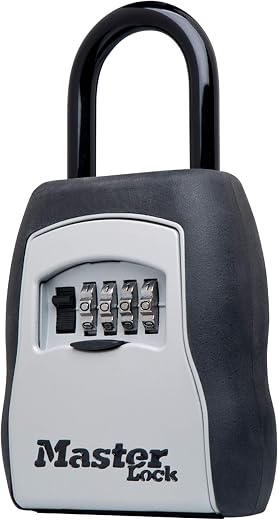
1. Master Lock 5400EC Key Lock Box — Best Shared House Essentials Pick for the Front Door Key
Price: $31.99 | Amazon rating: 4.7 from 25,467 ratings | Role: the key | Key spec: holds up to 5 keys, 4-dial set-your-own combination, weather-resistant metal body, 1.5 × 3.25 × 6.25 in
Every shared house has the same first problem and almost none of them solves it. Somebody
loses a key, somebody else works nights, a housemate’s partner needs to be let in on a
Tuesday and a plumber is coming on Thursday between eight and one. The default answer —
cutting more keys, or one person being permanently on call — is expensive, slow and puts
the same person in charge of everyone else’s movements. A combination key box outside the
door replaces all of that with four dials.
The 5400EC is the version of this product that has been on sale long enough to have an
argument settled about it. It takes up to five keys, which is the number that matters: a front
door key, a back door or mortice key, a spare, and room for the two you have not cut yet.
It is also one of the few shared house essentials that installs in under a minute: the shackle model hangs on a railing, a gate or a downpipe bracket rather than needing to be screwed
into a wall, which is the right call in a rented house where drilling into the brickwork is
somebody else’s decision and possibly a breach of your agreement.
Two honest limits. A key box is a visible object that says “a key is here”, so it
belongs somewhere that is not the first thing a stranger sees, and the combination has to be
changed when a housemate moves out — the one maintenance job this product creates. And a
key box is not a substitute for telling your landlord that somebody new is living in the house.
As the legal section below sets out, handing a key to a person who then
lives there can quietly turn you into their landlord, with duties you did not ask for.
Best for: any house where more than two adults need the same door, where shift patterns do not overlap, or where trades and deliveries arrive while everyone is out. At $31.99 it is cheaper than two sets of cut keys and it never has to be handed back.
Skip if: your tenancy or building specifically forbids an external key safe, you live in a flat with a shared street door you cannot fix anything to, or your household is two people with identical routines — in which case a second cut key is the cheaper answer.
Read the full Master Lock 5400EC Key Lock Box review →
Where to Buy — Master Lock 5400EC Key Lock Box
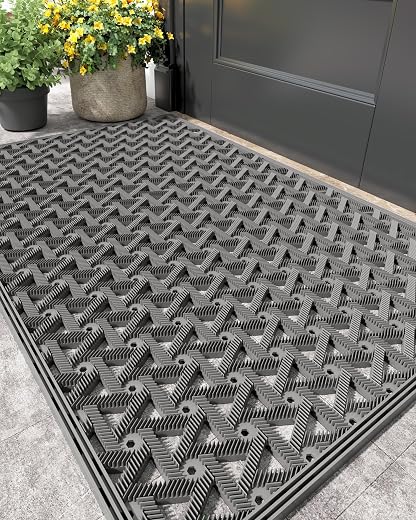
2. Color&Geometry Drainage Door Mat — Best Shared House Essentials Buy for the Dirt Everyone Brings In
Price: $39.99 | Amazon rating: 4.6 from 1,025 ratings | Role: the dirt | Key spec: 19" × 30" (48 × 76 cm), moulded drainage holes, low pile, waterproof rubber construction
A door mat is the least interesting of these shared house essentials and the one that prevents the most
recurring friction, because dirt in a shared house is the purest example of a problem nobody
owns. Five people each track in a small amount of grit and water. No individual contribution is
worth mentioning. The cumulative result is a hallway that needs cleaning twice as often as
anybody thinks is fair, and a rota argument about a mess that has no author.
What makes this particular mat worth $39.99 rather than the $8 one is the drainage. It is a
moulded rubber mat with holes through it, so water and grit fall through to the step rather than
sitting in the pile and being walked back in by the next person. That is the failure mode of a
cheap absorbent mat in a house with five front-door users: it saturates by Tuesday and then acts
as a reservoir. At 19 by 30 inches — 48 by 76 centimetres — it is also long enough
for two full strides, which is what actually cleans a shoe. A mat you can cross in one step is
decorative.
It is genuinely outdoor kit, so it wants to live on the step or the porch rather than inside
the door. That is also the point: the dirt that stays outside never becomes anyone’s job.
If your front door opens straight onto a pavement with no step, this is the wrong product and an
indoor runner is the right one.
Best for: houses with a step, a porch or a path, and any house share where the hallway is the first thing to get complained about. The drainage design is what separates it from the mats that have to be dragged out and dried.
Skip if: your front door opens directly onto a public pavement with nowhere to put it, or you are in an upstairs flat reached through a communal corridor — where, in Britain at least, leaving anything in the corridor may breach the building’s fire management rules.
Read the full Color&Geometry Drainage Door Mat review →
Where to Buy — Color&Geometry Drainage Door Mat
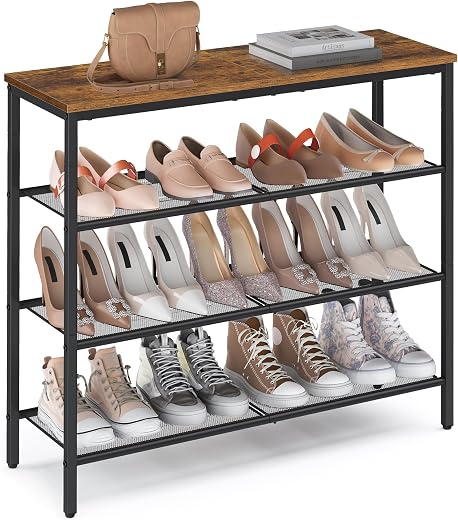
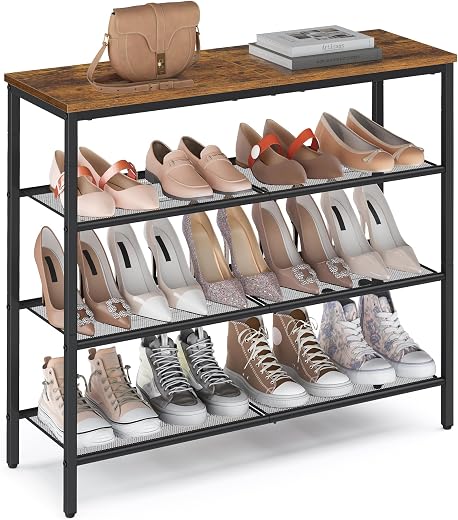
3. VASAGLE 4-Tier Shoe Rack — Best Shared House Essentials Pick for the Hallway Full of Shoes
Price: $32.77 (was $41.99) | Amazon rating: 4.8 from 8,776 ratings | Role: the shoes | Key spec: 4 metal mesh tiers, 15–20 pairs, 66 lb (30 kg) load capacity, rustic brown and black
This is the highest-rated product on our entire site: 4.8 stars from 8,776 ratings, which is
an average almost nothing sustains at that volume. It is also, for a shared house, the single
most obviously correct purchase in this guide, because the arithmetic of shoes in a house share
is brutal. Five adults own between three and six pairs each in regular rotation. That is
somewhere between fifteen and thirty pairs, and the default storage location is the floor
directly behind the front door.
Four tiers at fifteen to twenty pairs is the right capacity for a four or five person house,
and the mesh shelves matter more than they sound like they do: wet trainers and walking boots
dry on a mesh shelf and rot on a solid one. The 66 pound — 30 kilogram — total
capacity is comfortably beyond anything a hallway will put on it, which is the useful kind of
over-engineering in a house where nobody is being careful.
The reason a shoe rack belongs in a legal guide as well as a shopping one is that in Britain
a hallway full of shoes is not just untidy. The Management of Houses in Multiple Occupation
(England) Regulations 2006 require that “all means of escape from fire are free from
obstruction” and that common parts are “kept free form obstruction”. In a
licensed house share, the shoes in the hall are a compliance problem that your landlord can be
prosecuted over, which is why a rack sometimes appears the week after an inspection.
Best for: four and five person house shares with a hallway, and any property where a landlord or council inspection is a possibility. The mesh tiers are the right answer for wet outdoor shoes and the rating volume is the best on our site.
Skip if: your hallway is narrower than about 30 inches of usable width, in which case any freestanding rack becomes the obstruction it was meant to solve, or you each have your own entrance and the problem does not exist.
Read the full VASAGLE 4-Tier Shoe Rack review →
Where to Buy — VASAGLE 4-Tier Shoe Rack
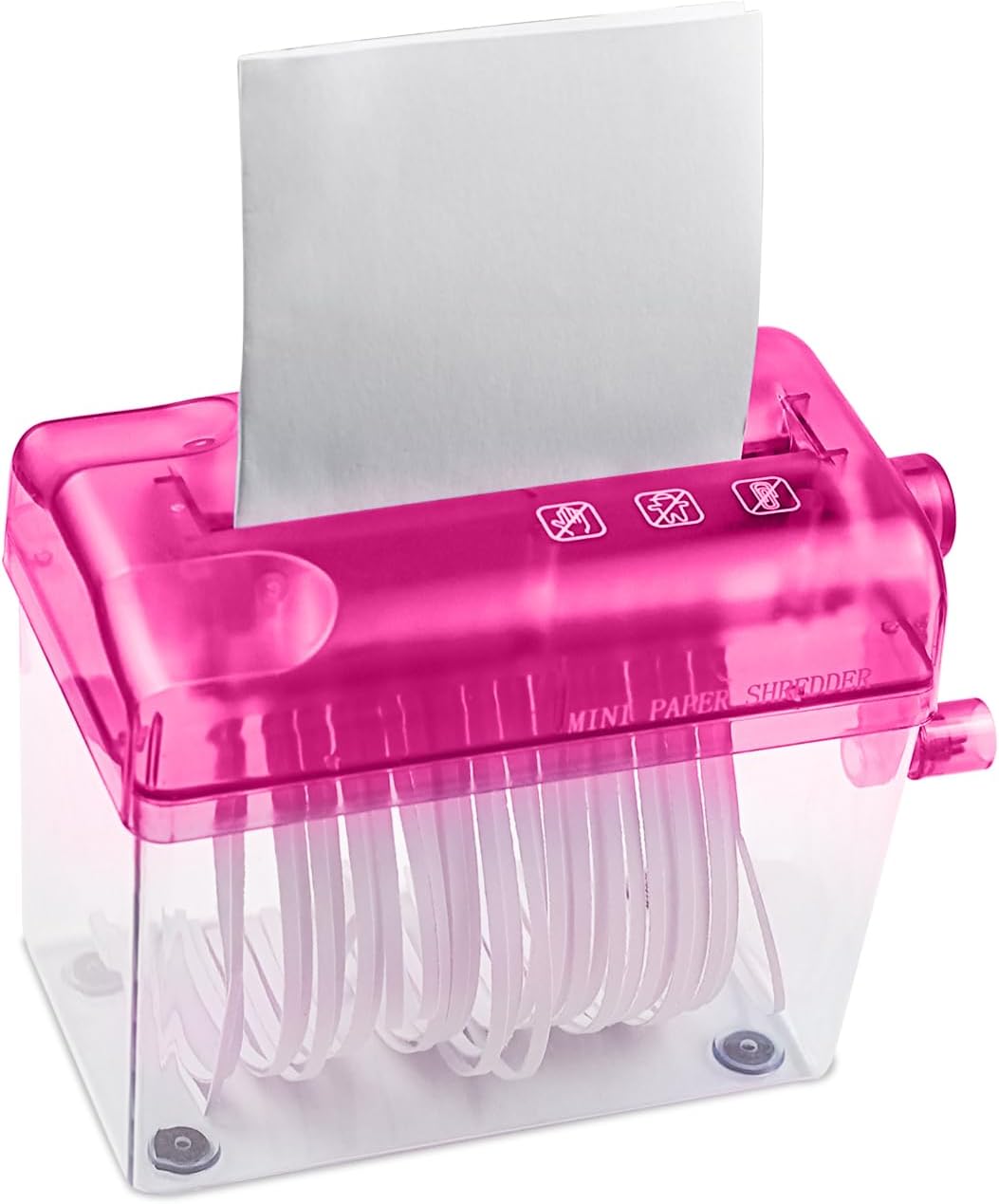
4. JIKIOU Mini Hand-Crank Shredder — Best Shared House Essentials Choice for the Communal Post Pile
Price: $15.99 | Amazon rating: 4.1 from 404 ratings | Role: the post | Key spec: strip cut, 2 sheets at a time, 1 L clear bin, hand powered, 3.3"D × 6.1"W × 5.7"H
The lowest-scoring of our shared house essentials is here for a reason that has nothing to do with how
good a shredder it is. A shared house has one letterbox and a rotating population. Post arrives
for people who moved out two tenancies ago, it sits in a pile on a windowsill that everybody
walks past, and it contains bank letters, NHS or insurance correspondence, payslips and
replacement cards. That pile is the most sensitive object in the building and it is stored in the
most public place in it.
The US Federal Trade Commission’s advice is blunt about the disposal end: “When
it’s time to dispose of documents with your personal or financial information, shred
them.” Its list of what to destroy — ATM receipts, credit and insurance offers,
cleared cheques, credit reports, prescription information and expired identification — is
almost exactly the contents of a house share windowsill after a month. A $15.99 hand-crank unit
that lives in your own room and needs no socket removes the excuse.
Be realistic about what it is. Two sheets at a time, strip cut rather than cross cut, a
one-litre bin, and your arm as the motor. It is slow and it is not high security. But the
alternative in most shared houses is not a better shredder, it is the recycling bin, and strip
cut in a bin bag beats intact in a bin bag by a wide margin. If you are destroying volume rather
than the occasional letter, buy a powered cross-cut machine instead and put it in your room.
Best for: a few letters a week, a bedroom with no spare socket, and shared front doors where post for former housemates keeps arriving. Cheap enough that nobody has to agree to buy it — you can just own one.
Skip if: you have real volume to destroy, you need cross-cut security for anything, or you would rather the household bought one shared machine for the kitchen — in which case this is too slow to be the communal option.
Read the full JIKIOU Mini Hand-Crank Shredder review →
Where to Buy — JIKIOU Mini Hand-Crank Shredder
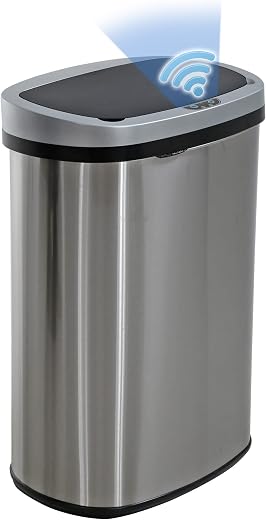
5. BestOffice 13-Gallon Touchless Bin — Best Shared House Essentials Pick for the Kitchen Nobody Empties
Price: $59.99 | Amazon rating: 4.2 from 21,610 ratings | Role: the bin | Key spec: 13 US gallons (49 L), motion-sensor automatic lid, brushed stainless steel, oval
The bin is the standing argument of every house share ever assembled and the hardest of the shared house essentials to get agreement on, and it is worth being
precise about why. It is not really about whose turn it is. It is about the moment the bin is
full: the person who fills it last is holding something dirty, the lid will not close, and the
cheapest action available to them is to balance the rubbish on top and leave the room. A pedal
bin makes that moment slightly worse, because it needs a free foot and a working hinge. Every
house share has a pedal bin with a broken pedal.
Thirteen US gallons is 49 litres, which is roughly twice the capacity of the bin a solo
occupant would buy and about right for four or five people between collections. The motion
sensor is the part that changes behaviour: the lid opens with full hands, so the bin gets used
rather than stacked, and it closes itself, so nobody has to make the judgement call about whether
it is somebody else’s job to shut it. A stainless body wipes down, which matters when the
last person to touch it was carrying chicken packaging.
At $59.99 this is the most expensive of the shared house essentials here and it is the one purchase here that
genuinely needs a household conversation. It is also the one where being in a licensed British
house share may mean you should not buy it at all, because your landlord already has a licence
condition obliging them to provide adequate refuse storage. Ask before you split the cost
— the answer may be that it is not your bill.
Best for: four and five person kitchens, houses on fortnightly collections, and any household where the bin has already caused an argument. The sensor lid is the mechanism that changes the behaviour, not just the appearance.
Skip if: your kitchen has no 13-gallon-sized gap, your council collection is weekly and small, or you are renting a licensed house share where the landlord is already obliged to supply refuse facilities — ask them first.
Read the full BestOffice 13-Gallon Touchless Bin review →
Where to Buy — BestOffice 13-Gallon Touchless Bin
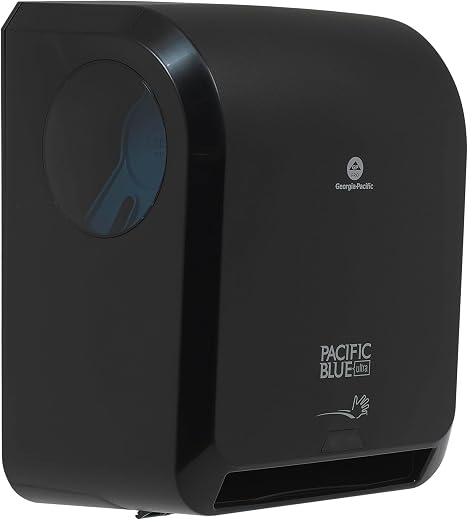
6. GP PRO Pacific Blue Ultra Dispenser — Best Shared House Essentials Upgrade for the Shared Sink
Price: $40.00 | Amazon rating: 4.2 from 2,505 ratings | Role: the sink | Key spec: wall-mounted, battery-powered touchless sensor, 8" high-capacity commercial roll, model 59590
This is a commercial washroom fitting and we are recommending it off-label, which we will say
in the first sentence rather than bury. It belongs in an office corridor. It is in this guide
because the domestic alternative in a shared kitchen — one tea towel, used by five people,
hung on the oven handle and changed when somebody remembers — is the single worst hygiene
object in the building, and nobody ever fixes it because it is nobody’s tea towel.
The public-health case is specific rather than general. The CDC is unusually direct that
“Hand sanitizer does not work well against norovirus” and that it “is not a
substitute for handwashing, which is best”. The UK Health Security Agency says the same
thing in its own words: do “not rely on alcohol gels instead of washing your hands, as
these do not kill the virus”. Handwashing only finishes when hands are dried, and a shared
damp cloth is where a washed hand meets everything the last five hands were carrying.
Practically: it is wall-mounted, so it needs either a permission or a heavy-duty adhesive
plate, and it eats a specific size of commercial roll that you have to keep buying. In a
four-person house that is an ongoing cost of a few dollars a month, split. Whether that is worth
it depends entirely on whether your house has already had a stomach bug go round it, which
— as the section below on norovirus explains — is the fastest-moving thing a shared
kitchen ever produces.
Best for: four-plus person kitchens, houses with a healthcare or hospitality worker in them, and any house share that has already had a stomach bug pass through every room in a week.
Skip if: you cannot fix anything to the wall, you are unwilling to keep buying the commercial roll, or your household would rather solve the same problem with a cheap rack of paper towels and a rule about the tea towel.
Read the full GP PRO Pacific Blue Ultra Dispenser review →
Where to Buy — GP PRO Pacific Blue Ultra Dispenser
7. DAILY KISN Silicone Stretch Lids — Best Shared House Essentials Buy for the Communal Fridge
Price: $8.87 | Amazon rating: 4.1 from 3,142 ratings | Role: the fridge | Key spec: 12 lids in graded sizes, food-grade silicone, dishwasher safe, reusable
The cheapest of these shared house essentials is the one that solves the most common daily irritation,
which is that a shared fridge has no way of saying whose food is whose. Half a tin, a bowl with
a plate balanced on it, a pan somebody put straight in: all of it is anonymous, none of it is
covered properly, and the person who eventually throws it away is the person who did not make
it. Twelve stretch lids in graded sizes turn every open container in the house into a closed one
for under nine dollars.
Ownership is the underrated half of the job. A set of lids in one colour, used consistently by
one person, is a claim: this bowl is mine and it is not up for grabs. That is a lower-friction
system than labels, it does not require anybody else to co-operate, and it is the reason we would
buy these before almost anything else on this list. They also replace cling film — what a
British kitchen calls cling film and an American one calls plastic wrap — which is the
consumable most often bought by the housemate who is bad at saying no.
They are not magic. Silicone stretch lids seal properly on smooth, clean, rigid rims and
sulk on chipped stoneware, oval dishes and anything with a lip. They also do not make a
container airtight enough to change how long food keeps, and no cover of any kind fixes a fridge
that five people keep opening. Treat them as a covering and a claim, not as storage.
Best for: anybody sharing a fridge with people they did not choose, and any household trying to stop buying cling film every week. At $8.87 it is the one item here nobody has to be consulted about.
Skip if: your dishes are mostly odd-shaped, chipped or lipped, or you already own a full set of lidded containers — in which case this adds a second system for the same job.
Read the full DAILY KISN Silicone Stretch Lids review →
Where to Buy — DAILY KISN Silicone Stretch Lids

Shared House Essentials — Buyer’s Guide: What to Look For
Buying for a shared house is not buying for a home. The criteria for shared house essentials are different enough that a
product which is excellent for one person can be actively wrong for five, and the difference is
almost never about quality.
Shared House Essentials Rule One: Buy for the Room Nobody Owns
The organising fact of a house share is that responsibility follows ownership, and the common
parts have no owner. Your bedroom is cleaned because it is yours. The hallway is not cleaned
because cleaning it is a favour to four other people, and favours run out. So the first test for
any of these purchases is whether it moves work out of the “somebody should” category
and into the “nobody has to” category.
That is why a drainage mat beats a nicer mat and a sensor bin beats a pedal bin. Neither is a
better product in a home with one household in it. Both are better shared house essentials,
because both keep working when the person using them is not thinking about the house at all.
Anything that needs a rota to function will eventually stop functioning.
Why the Best Shared House Essentials Need No Agreement to Buy
There is a price above which a shared purchase needs a conversation, and in most houses it
sits somewhere around twenty or twenty-five dollars a head. Below it, one person buys the thing
and the house benefits. Above it, you need consent, a way of splitting the cost, and a rule about
what happens to the object when whoever paid for it moves out.
This is a real design constraint, not a footnote. Four of the seven shared house essentials
here cost under $40 precisely so that they can be bought unilaterally by whoever cares most. The
touchless bin at $59.99 is the one item that genuinely needs a household decision, and we say so
in its entry, because the failure mode of an expensive shared object is not that it breaks —
it is that it leaves in somebody’s car boot in June.
Sizing Shared House Essentials for Five People, Not One
Capacity assumptions are where single-occupant products fail as shared house essentials. A 6-gallon bin
in a five-person kitchen is full every day. A two-tier shoe rack in a five-person hallway is a
shelf with a shoe pile next to it. A mat you cross in one stride cleans nothing.
Multiply by the number of adults, not by the number of households, and then check the physical
dimensions against the space you actually have. Britain complicates this further, because the
same house may be legally required to fit specific minimum bedroom areas — 6.51 m² for
one person over ten — while its hallway is a metre wide. Space in a shared house is
unevenly distributed by law as well as by luck.
Shared House Essentials and the Things That Are Already Your Landlord’s Job
Before you split the cost of anything structural, check whether it is already somebody
else’s legal duty. In England, a licensed house in multiple occupation carries licence
conditions, and one of them is that the landlord complies with “the scheme issued by the
local authority (if one exists) for the storage and disposal of domestic refuse pending
collection”. The management regulations separately require that “sufficient bins are
provided for each household for the storage of refuse prior to collection”.
That is a real saving and almost no tenant knows about it. The same logic applies to smoke
alarms, escape routes and the condition of the common parts. Ask first; buy the things that are
genuinely yours to buy.
Shared House Essentials You Should Not Buy
We deliberately refuse four categories of shared house essentials. Furniture, because a sofa or a
kitchen table in a rented house share is a decision about who owns it in eleven months’
time, not a shopping decision. A shared smart speaker or shared subscription,
because they attach one person’s account to everybody’s behaviour and they are
miserable to unpick. A dishwasher or washing machine, for the same reason as the
sofa and because in a rented property it is usually not yours to install.
And a chore app. There is a whole category of software that promises to fix
shared houses with rotas, points and notifications, and the honest position is that the houses
which need one will not use it and the houses which would use one do not need it. The two best
things you can do for a shared house cost nothing: agree who is named on which bill on the day
you move in, and put the bin day in everyone’s phone. Neither is a product.
US vs UK: What Changes When You Move Into a Shared House
Shared living is the domestic subject where the two countries diverge most sharply, and it changes which shared house essentials are worth owning, and the
divergence is not cosmetic. Britain regulates the building. America regulates who is allowed to
live in it. Almost everything else follows from that one difference.
Roommate or Housemate: the Vocabulary of Shared House Essentials
An American has a roommate even when they do not share a room; a Briton has a
housemate or a flatmate, and “roommate” sounds like
a translation. The arrangement itself is a house share or a
flatshare in British English and a shared apartment or “living with
roommates” in American English. Beyond that: apartment/flat,
closet/wardrobe, trash/rubbish, trash can/bin,
faucet/tap, countertop/worktop, stovetop/hob,
plastic wrap/cling film, dish soap/washing-up liquid, and the
American first floor is the British ground floor, which matters
when a room advert says which floor the room is on.
One term has no clean translation in either direction. British adverts talk about a
double room and a box room; American ones talk about a
master and a den. And the British HMO —
house in multiple occupation — is a legal category with no American equivalent at all,
which is the subject of the next section and the reason the same seven shared house essentials
sit in two different regulatory worlds.
Shared House Essentials Under Two Different Legal Regimes
In England, a property is a house in multiple occupation when it is “rented out by at
least 3 people who are not from 1 ‘household’” who “share facilities like
the bathroom and kitchen”. Once five or more people from two or more households live there
and at least one pays rent, the landlord must hold a mandatory licence. That licence lasts
“a maximum of 5 years”, and you “could get an unlimited fine for renting out an
unlicensed HMO”.
America has nothing like it. What America has instead is the opposite instrument: municipal
zoning that caps the number of unrelated people who may occupy a dwelling at all. The Supreme
Court upheld exactly such an ordinance in 1974, one that defined a family as related people or
“a number of persons but not exceeding two (2) living and cooking together as a single
housekeeping unit through not related by blood, adoption, or marriage”. Those two regimes put the same shared house essentials in two different compliance worlds. Britain licenses
the house and inspects it. America, in many places, simply limits how many of you there may be.
Who Pays: Bills, Council Tax and Shared House Essentials
British house-sharers routinely pay council tax and often do not need to. Where a property is
classed as an HMO for council tax purposes, Shelter states the position plainly: “a tenant
is not liable for council tax if the property is classed as an HMO for council tax”. That
is a several-hundred-pound question that turns on how the property is banded, and it is worth
asking your council rather than assuming.
There is no American analogue, because American residential property tax is levied on the
owner and never appears as a tenant bill. What Americans have instead is the utility account
question: whoever puts the electricity in their name is personally on the hook for it, which is
the US equivalent of the liability trap described next.
Joint and Several Liability: the Rule Behind Half the Arguments
This is the rule that decides who pays for the shared house essentials and everything else. If you all signed one agreement, you are joint tenants, and the consequence is severe. As
Shelter puts it: “You are all responsible for the whole rent even if you pay different
amounts”, and your landlord “can ask you to pay more if other joint tenants do not
pay their share”. The same applies to breakages: “You are all responsible for damage
to the property. Your landlord can choose who they ask to pay for it, even if that person did not
cause the damage.”
Joint and several liability exists in American leases too, and it is why the bin, the mat and
the shoe rack are not trivial purchases. Damage to the common parts is charged to whoever the
landlord chooses. The shared house essentials that protect floors, walls and doors are, in a very
literal sense, protecting everyone’s deposit and not just the tidy person’s.
Voltage, Sizes and Shared House Essentials Bought Across the Atlantic
Two of the seven shared house essentials change when you cross the ocean. The touchless bin is 13 US
gallons, which is 49 litres — British bin liners are sold in litres and the standard
British kitchen liner is 50 litres, so that one happens to line up almost exactly. The
paper towel dispenser does not: it is a US commercial system built around a
specific American roll, and the British equivalent is a different product from a different
catalogue. Buy that one locally.
The remaining five are indifferent to which country they are in. The key box, the mat, the
shoe rack, the hand-crank shredder and the stretch lids contain no mains electronics at all,
which is the quiet advantage of a list of shared house essentials that is mostly mechanical. The
only dimension to check is the mat: 19 by 30 inches is 48 by 76 centimetres, and many British
front doors are narrower than an American one.
Shared House Essentials — Which One Should You Buy?
If you are not buying all seven shared house essentials, buy in this order. The tiers below are built around what a
house share can absorb without a meeting.
Sharing a house is harder when the occupants are on different clocks. If somebody in the house works nights, our night shift essentials guide covers the blackout, noise and timing problems that a shared hallway makes worse.
Shared House Essentials Under $20: Buy These Without Asking Anyone
Start with the DAILY KISN silicone stretch lids
at $8.87 and the JIKIOU hand-crank shredder at
$15.99. Neither needs household consent, neither needs a socket, and both solve a problem that is
yours personally even though it is caused by other people — your food in a shared fridge,
your post in a shared hallway. Together they cost less than $25 and they are the two shared house essentials on
this list we would buy on day one of a tenancy.
Shared House Essentials Under $45: The Tier That Actually Changes the House
This is where the money should go. The
Master Lock 5400EC key lock box at $31.99 removes the
recurring lock-out problem for the whole tenancy. The
VASAGLE 4-tier shoe rack at $32.77 is the
highest-rated product on our site and it clears the hallway. The
Color&Geometry drainage mat at $39.99 and the
GP PRO Pacific Blue Ultra dispenser at $40.00
round the tier out. If a house share only ever buys three shared house essentials, buy the key
box, the rack and the mat.
Shared House Essentials Over $45: Only With the House’s Agreement
One product sits here: the
BestOffice 13-gallon touchless bin at
$59.99. It is the most effective single object in this guide at ending a recurring argument and
it is the only one we would not buy alone. Split it four ways and it is fifteen dollars a head;
buy it unilaterally and you own a large stainless steel object you have to move house with. Ask
your landlord first, for the reason given in the buyer’s guide.
Two products from elsewhere on the site deserve a mention here without making the seven. If
your house share is dark at the front, the solar fence lights we reviewed are the cheapest fix
for a shared path, and if your kitchen bin situation is really a food-waste problem rather than a
capacity problem, our freezer
storage guide is the better starting point. Households that already have the seven above
generally have the hallway solved and the kitchen still arguing.
The Law of the Shared House: Licensing, Liability and the Post
This is the part of the shared house essentials guide that sells nothing. A shared house is one of the most heavily
regulated ways to live in Britain and one of the least regulated in America, and almost none of
the people living in one know which rules apply to them. Everything below is quoted from a
primary source and linked at the end.
Licensing: Britain Regulates the House, America Regulates the Household
England’s mandatory licensing regime changed on 1 October 2018. Before that, only larger
properties were caught; from that date, government guidance records, “mandatory licensing
will no longer be limited to certain HMOs that are three or more storeys high, but will also
include buildings with one or two storeys”. The test is now purely about people:
“The HMO (or Flat in Multiple Occupation) must be occupied by five or more persons, from
two or more separate households.”
The sanction is not nominal. GOV.UK states that you “could get an unlimited fine for
renting out an unlicensed HMO”, and a licence is valid for “a maximum of 5
years”. If you live in a five-person house share in England and your landlord cannot tell
you the licence number, that is a question worth asking before you ask about anything else.
Minimum Room Sizes, and What They Mean for Shared House Essentials
Licensing brought national minimum bedroom sizes with it, and they are specific: sleeping
accommodation must be at least 6.51 m² for one person over ten,
10.22 m² for two persons over ten, and 4.64 m² for one
child under ten. The measurement rule matters as much as the number — it is the
“wall to wall floor area where the ceiling height is greater than 1.5m”, and
“No part of a room should be included in the measurement where the ceiling height is less
than 1.5m”, which is how a sloping attic room that looks adequate can fail.
America has no national equivalent. Bedroom minimums exist in model building codes adopted
locally rather than in federal law, and the binding constraint in many American towns is not the
size of the room but the zoning rule about how many unrelated people may live in the house at
all. It is a genuine inversion: Britain says the room must be big enough for the person; parts of
America say there must not be that many persons.
The Escape Route Is Not a Shoe Rack
The Management of Houses in Multiple Occupation (England) Regulations 2006 put specific duties
on whoever manages a shared house. Two of them are about exactly the space this guide is written
around. The manager must ensure “all means of escape from fire are free from obstruction,
well maintained and sign posted”, and that “all common parts of the HMO are in good
and clean decorative repair, maintained in a safe working condition and kept free form
obstruction”.
Read that next to a hallway containing twenty pairs of shoes, a drying rack and three bikes.
The same regulations require that “sufficient bins are provided for each household for the
storage of refuse prior to collection” and that electrical installations are inspected
every five years. None of this exists in American law for a private shared house, where the
equivalent duties come from a local fire or property maintenance code and vary from city to
city.
Joint and Several Liability Means Everyone Owes Everything
The most consequential thing about a British house share is usually invisible until somebody
leaves. Under a joint tenancy — “you and the other tenants all signed the same
agreement” — the liability is not divided. “You are all responsible for the
whole rent even if you pay different amounts,” Shelter says, and the landlord “can ask
you to pay more if other joint tenants do not pay their share”.
Damage works the same way: “Your landlord can choose who they ask to pay for it, even if
that person did not cause the damage.” This is the strongest possible argument for spending money on shared house essentials that protect the fabric of the building — $40 on a mat and $33 on a shoe rack. Scuffed hallway paint and a ruined floor near the front door
are charged to the household, and the household is whoever the landlord decides to bill.
If You Take In a Housemate Yourself, You May Have Become a Landlord
This is the trap almost nobody sees coming. England’s Right to Rent scheme applies not
only to landlords but to “Occupiers who sublet their accommodation (including those in
social housing), who will be landlords for the purposes of the Scheme” and to
“Landlords or occupiers who take in lodgers to share their accommodation with a licence to
occupy the property”. The duty is broad: “A right to rent check should be carried out
on all adult occupiers before a residential tenancy agreement is entered into, regardless of
whether they are named in the tenancy agreement.”
The penalties are not theoretical either. A first breach is £5,000 for a lodger and £10,000
for an occupier, rising to £10,000 and £20,000 for a repeat breach within three years. Find
somebody on a flatshare website to take the empty room and you may have stepped into a statutory
duty that came with the key. America has federal housing law and state landlord-tenant codes, but
nothing that makes an ordinary tenant an immigration checkpoint.
The Rent a Room Scheme Has No American Equivalent
The other side of the same coin is that Britain gives money away here and America does not.
“The Rent a Room Scheme lets you earn up to a threshold of £7,500 per year tax-free”
from letting furnished accommodation in your own home, and the allowance is available whether or
not you own the property — you qualify as “a resident landlord, whether or not you
own your home”. The threshold “is halved to £3,750 if you share the income with
someone else”, and it does not apply to “homes converted into separate flats”.
There is no American allowance of this kind. Rental income from a room in your own home is
ordinary taxable income from the first dollar, with deductions rather than an exemption. Two rich
countries, the same living arrangement, and one of them has decided that the first £7,500 of it
is nobody’s business.
Opening Someone Else’s Post Is a Crime in Both Countries — at Ten Times the Price in One
Post in a shared house is the most casually mishandled thing in it, and both countries
criminalise handling it wrongly. In Britain, section 84 of the Postal Services Act 2000 provides
that a person commits an offence if, “intending to act to a person’s detriment and
without reasonable excuse, he opens a postal packet which he knows or reasonably suspects has
been incorrectly delivered to him”. The maximum on summary conviction is “a fine not
exceeding level 5 on the standard scale or… imprisonment for a term not exceeding six
months or… both”.
The American provision is far harsher. Under 18 U.S.C. § 1702, whoever takes mail before
delivery “with design to obstruct the correspondence, or to pry into the business or
secrets of another, or opens, secretes, embezzles, or destroys the same, shall be fined under
this title or imprisoned not more than five years, or both”. Same act, same household, and
a maximum sentence ten times longer. Both countries agree it is a crime; they disagree
dramatically about how serious a one.
No set of shared house essentials fixes this one. The practical rule in a house share is duller and more useful: do not open it, do not throw it
away, write “not at this address” on it and put it back in the post. And destroy your
own paperwork properly. The FTC’s list of what to shred — “ATM receipts, Offers
of credit or insurance, Cleared checks… Credit reports, Prescription information for
medicines you no longer take, Expired warranties, Expired credit cards, driver’s licenses,
and other forms of identification” — is a description of a shared hallway windowsill.
Norovirus: the One Thing a Shared House Spreads Fastest
If a stomach bug gets into a house share it will usually get everyone, and the two national
health agencies give near-identical advice for once. The CDC is explicit that “Hand
sanitizer does not work well against norovirus” and that it “is not a substitute for
handwashing, which is best”. The UK Health Security Agency’s public poster says do
“not rely on alcohol gels instead of washing your hands, as these do not kill the
virus”.
They agree on the timing too. The CDC says do “not prepare, handle food, or care for
others” and to “Wait at least 2 days (48 hours) after symptoms stop”; UKHSA
says stay off “until you have not been sick or had diarrhoea for at least two days”.
A shared kitchen is the highest-risk room in a house share precisely because five people prepare
food in it and one of them may be two days too early.
On cleaning, both point at bleach rather than a general spray: the CDC recommends a chlorine
bleach solution left on the surface “for at least 5 minutes”, and UKHSA says
“use bleach-based cleaners to disinfect surfaces” and wash contaminated bedding
“using detergent at 60°C”. That is the whole argument for the paper towel dispenser
and against the communal tea towel, in two sentences, from two governments.
Shared House Essentials — Frequently Asked Questions
What are the most important shared house essentials to buy first?
The stretch lids and the hand-crank shredder, because they cost under $25 together and neither
needs anyone else’s agreement. After that, the key lock box, because a house where nobody is
ever locked out is a measurably calmer house. Those three are the shared house essentials we would
buy in the first week of a tenancy and worry about the rest later.
Who should pay for shared house essentials in a house share?
Anything under about $20 a head, buy it and do not ask. Anything above that needs an explicit
agreement before purchase, including what happens to the object when the person who paid for it
moves out. The single most common way shared purchases go wrong is that nobody decides who owns
the thing, and then somebody takes it.
Is my landlord supposed to provide any of this?
In England, possibly. A licensed house in multiple occupation carries licence conditions
covering refuse storage, and the management regulations require that “sufficient bins are
provided for each household”. Ask before you split the cost of a bin. Escape routes,
common parts and five-yearly electrical checks are also your landlord’s duty, not a
household purchase.
Do I have to pay council tax in a shared house in the UK?
Not always. Where the property is classed as an HMO for council tax, Shelter states that
“a tenant is not liable for council tax if the property is classed as an HMO for council
tax”. This depends on how your specific property is banded, so ask your council and your
landlord rather than assuming the bill is yours.
What counts as a house in multiple occupation?
A property “rented out by at least 3 people who are not from 1 ‘household’”
who “share facilities like the bathroom and kitchen”. A mandatory licence is required
once five or more people from two or more households live there and at least one pays rent. That
licence lasts “a maximum of 5 years” and an unlicensed HMO risks an unlimited fine.
Can I be made to pay my housemate’s share of the rent?
Under a joint tenancy, yes. “You are all responsible for the whole rent even if you pay
different amounts,” and the landlord “can ask you to pay more if other joint tenants do
not pay their share”. Damage works the same way and the landlord chooses who to bill. This is
the single most important thing to understand before signing a joint agreement.
Is it illegal to open a housemate’s post?
Yes, in both countries. In Britain, section 84 of the Postal Services Act 2000 makes it an
offence to open a postal packet you know or suspect was incorrectly delivered to you if you intend
to act to the addressee’s detriment, with up to six months on summary conviction. In the
United States, 18 U.S.C. § 1702 carries up to five years.
Are these shared house essentials any use in a two-person flat?
Some of these shared house essentials do. The stretch lids and the mat make sense anywhere. The four-tier shoe rack, the 13-gallon
bin and the commercial towel dispenser are all sized for four or five adults and are overkill for
two — a two-person flat is a home with a shared kitchen, not a house share, and it does not
have the ownership problem this guide is built around.
Do any of these need to be different in the UK?
Two. The GP PRO paper towel dispenser is an American commercial system built around a US roll
size, so buy a British equivalent locally. The 13-gallon bin is 49 litres, which happens to suit
standard 50-litre British liners. The other five contain no mains electronics and travel fine;
just check the mat against your door width, since 19 by 30 inches is 48 by 76 centimetres.
What is the single cheapest thing that improves a house share?
Agreeing on the day you move in who is named on which bill, which costs nothing. After that,
the $8.87 set of stretch lids, because it solves the fridge without requiring anybody else to
change their behaviour. Most of the value in shared house essentials comes from removing the need
for agreement, not from the objects themselves.
Shared House Essentials — Final Thoughts
Seven shared house essentials, about $229, and not one of them is furniture. That is the argument of this
guide in one line. A shared house does not fail because it is under-equipped; it fails at the
seams between people, and the seams are the front door, the hallway, the bin, the sink and the
fridge. The shared house essentials worth owning are the ones that take a recurring decision away
from a group of people who have no mechanism for making decisions together.
If you take one thing from the legal half of this guide, make it this: find out whether your
house is licensed, and read your agreement for the words “joint and several”. Those
two facts determine more about your year than any purchase here. Then buy the stretch lids and
the shredder this week, put the key box up before the first person gets locked out, and have the
conversation about the bin while everybody still likes each other.
Sources and Further Reading
- GOV.UK — House in multiple occupation licence
- MHCLG — Houses in Multiple Occupation and residential property licensing reforms: guidance for local authorities (PDF)
- Royal Borough of Windsor and Maidenhead — The Management of Houses in Multiple Occupation (England) Regulations 2006: summary of the manager’s duties
- Shelter England — What is a joint tenancy?
- Shelter England — Council tax liability for houses in multiple occupation
- GOV.UK — Code of practice for landlords and their agents: the Right to Rent scheme
- GOV.UK — Rent a room in your home: the Rent a Room Scheme
- legislation.gov.uk — Postal Services Act 2000, section 84 (interfering with the mail)
- Cornell LII — 18 U.S. Code § 1702, obstruction of correspondence
- Cornell LII — Village of Belle Terre v. Boraas, 416 U.S. 1 (1974)
- Federal Trade Commission — Protecting your personal information: which documents to keep and which to shred
- CDC — How to prevent norovirus
- UK Health Security Agency — Stop norovirus spreading (PDF)
Disclosure: this shared house essentials guide contains affiliate links. If you buy through
them we may earn a commission at no extra cost to you, and it never changes which products we
include or what we say about them. Prices and Amazon ratings were read on the morning of
publication and move constantly — check the current figure before buying.
Links go to
Amazon.com; UK readers can search the same models on Amazon.co.uk, but note that the GP PRO paper
towel dispenser is a US commercial system built around an American roll size and is better bought
locally in Britain. Nothing in this article is legal advice: the licensing, tenancy, immigration
and tax rules described here are summarised from the primary sources linked above and depend on
your own circumstances and where you live.