

There is one journey you make that belongs to nobody. Your employer does not pay for it, and both governments have written that down: the United States says in plain regulation that “normal travel from home to work is not worktime”, and British minimum-wage law excludes travel between “the worker’s home… and a place of work” from the hours it counts.
You did not choose the route, the timetable, the weather, the other passengers or the roadworks. You cannot go home for the thing you forgot. And you do it twice a day, roughly two hundred and twenty days a year, for a working life. The commute is the largest unowned block of time most people have, and the only part of it you control is what you are carrying.
That is what this guide is about. The seven commuter essentials below are not a gadget list and they are not travel gear. They are the seven things that decide whether a journey you cannot avoid is tolerable or grim, chosen in the order you meet them: the bag, the weather, the card and the keys, the noise, the time, the food at the other end, and — for the sixty-nine per cent of American workers who drive alone — the tyres.
Each one is reviewed in full on this site, and every entry here links to that review. We picked these commuter essentials on three criteria: whether the product solves a problem that recurs every single day rather than occasionally, whether it survives being carried rather than merely used, and whether it is cheap enough that losing it on a train is annoying rather than ruinous.
We have written this for both markets deliberately, because the commute is one of the sharpest US/UK divides there is. America drives; Britain queues on a platform. America hands commuters $340 a month of tax-free transit and parking money; Britain gives ordinary commuting no tax relief at all — except on a bicycle, where the position reverses exactly.
Every product link below goes to Amazon.com, because that is where our affiliate account sits. UK readers can search the same model names on Amazon.co.uk, and we flag, product by product, the two places in this commuter essentials list where a British buyer genuinely must not buy the American version: mains voltage and pre-set tyre pressures.
Commuter Essentials — Quick Comparison
Seven commuter essentials, in the order the journey runs. Scores are our own expert scores out of ten; prices are the figures showing on Amazon.com at the time of writing and move often.
| # | Product | Role | Key spec | Best for | Price | Score |
|---|---|---|---|---|---|---|
| 1 | BAGSMART Foldable Travel Bag 37L | The bag | Folds to 7×10 in; 37 L expanded; trolley sleeve | The day when one bag is not enough | $21.99 | 8.3 |
| 2 | COOFANDY Packable Rain Jacket | The weather | Hooded, waterproof shell with its own carry pouch | The ten minutes between the door and the platform | $19.99 | 8.2 |
| 3 | Hawanik Slim AirTag Wallet | The card and the keys | 3.3×4.1×0.12 in; 6 card slots; RFID blocking; AirTag pocket | Anyone who taps in and out twice a day | $9.99 | 8.0 |
| 4 | Bucephalus T27 Wireless Earbuds | The noise | Bluetooth 6.0; 40 h total playtime; IPX7; touchscreen case | A loud train or a shared office | $16.99 | 7.6 |
| 5 | Kindle Paperwhite (2024), 16 GB | The time | 7-inch glare-free display; weeks of battery | Turning 55 minutes a day into something you keep | $124.99 | 9.1 |
| 6 | TRAVELISIMO 100W Electric Lunch Box | The other end | 1.5 L stainless steel; 110 V / 12 V / 24 V; 20–30 min | Anywhere with no canteen and a long shift | $39.99 | 8.3 |
| 7 | ANKIA Tyre Pressure Indicator Valve Caps (8) | The drive | Pre-set 2.2 bar / 32–35 psi; green–amber–red | An older car with no factory TPMS | $10.99 | 7.9 |
- The 7 best commuter essentials in 2026
- Commuter essentials buyer’s guide: what to look for
- US vs UK: what changes when you commute
- Commuter essentials: which one should you buy?
- The journey nobody pays for: commuting, the law and your safety
- Commuter essentials: frequently asked questions
- Commuter essentials: final thoughts
- Sources and further reading

The 7 Best Commuter Essentials in 2026
Each of the seven commuter essentials below has its own full review on this site, linked from its entry. We have ordered them by where they appear in the journey rather than by price or score, because that is how commuter essentials actually get bought: you notice the problem at the point it happens.
1. BAGSMART Foldable Travel Bag 37L — Best Commuter Essentials Pick for the Day One Bag Is Not Enough
Price: $21.99 | Amazon rating: 4.5 from 700 ratings | Role: the bag | Key spec: folds to a 7×10 in pouch, opens to 37 L, three compartments, trolley sleeve, water-resistant
Most commuter essentials advice starts with a daily bag, and most people already have one. The bag problem on a commute is not the ordinary Tuesday. It is the Tuesday that turns out to also involve gym kit, a laptop you have to take home, a birthday present and a parcel you are returning on the way in. That day arrives perhaps twice a month, and it is the day you end up carrying a supermarket carrier bag on a crowded train.
This is the product for that day, and it is honest about being it. Folded, it is a 7×10 inch pouch that lives in the bottom of whatever you already carry and weighs almost nothing. Opened, it is a 37-litre holdall with three compartments, an adjustable removable shoulder strap and a trolley sleeve that slides over a suitcase handle. The fabric is water-resistant rather than waterproof, which is the right compromise at this price: it will shrug off a platform shower, not a downpour. At $21.99 with a 4.5 rating from seven hundred buyers, it is the cheapest genuine fix for a recurring problem in this commuter essentials list.
What it is not is a structured daily rucksack. There is no padded laptop sleeve, no back panel worth the name and no way to carry it comfortably on both shoulders. BAGSMART markets it as an airline-approved personal item, and its own listing notes that it is “not a personal item in expanded mode” — which tells you what expanding it does to the dimensions. If you want one bag that does everything every day, this is not that bag and we would not pretend otherwise. If you want the bag that means you never have to make two trips, it is very hard to beat.
Best for: commuters who already own a daily bag and need an overflow bag that costs nothing to carry on the days they do not need it.
Skip if: you want a single structured commuter rucksack with a padded laptop compartment, or you carry a heavy load on both shoulders every day — a soft holdall on one shoulder is the wrong tool for that.
Read the full BAGSMART Foldable Travel Bag review →
Where to Buy — BAGSMART Foldable Travel Bag 37L
2. COOFANDY Packable Rain Jacket — Best Commuter Essentials Pick for the Ten Minutes Outdoors
Price: $19.99 | Amazon rating: 4.4 from 6,464 ratings | Role: the weather | Key spec: waterproof and windproof shell, adjustable drawstring hood, packs into its own pouch, machine washable
A commute exposes you to the weather for a shorter time than almost any other journey, and that is exactly why people get it wrong. Nobody carries a proper coat for eleven minutes of walking. So they carry nothing, get soaked twice in October, and then carry a coat that is far too warm for a heated train for the rest of the winter. The commuter essentials answer to weather is still not a better coat; it is a shell light enough that you never make the decision at all, because it already lives in the bag.
This one packs into a supplied pouch, has a waterproof outer with a drawstring hood, and costs twenty dollars. The 4.4 rating across more than six thousand buyers is the second-largest evidence base of any of these commuter essentials, and for a garment in this category that volume matters more than the average: cheap rain shells fail at the seams and the zip, and six thousand people will find that out faster than any reviewer can. It goes in the washing machine, which sounds trivial until you remember that the thing you wear over everything else in a city in February gets genuinely filthy.
Be clear-eyed about what a budget shell is. It is waterproof, not breathable in any meaningful sense, so twenty minutes of hard walking or any cycling at all will leave you damp from the inside instead of the outside. It is cut as sportswear and will not look right over tailoring. And a drawstring hood is not a structured hood — in real wind you will be holding it. For a walk to a station, a dash across a car park, or standing on an open platform while the rain comes sideways, it is precisely enough.
Best for: anyone whose commute includes ten to fifteen minutes outdoors in unpredictable weather and who will not carry a real coat for it.
Skip if: you cycle or walk briskly for more than twenty minutes — you need a breathable membrane, not a budget shell — or you need something that reads as smart over office clothes.
Read the full COOFANDY Packable Rain Jacket review →
Where to Buy — COOFANDY Packable Rain Jacket
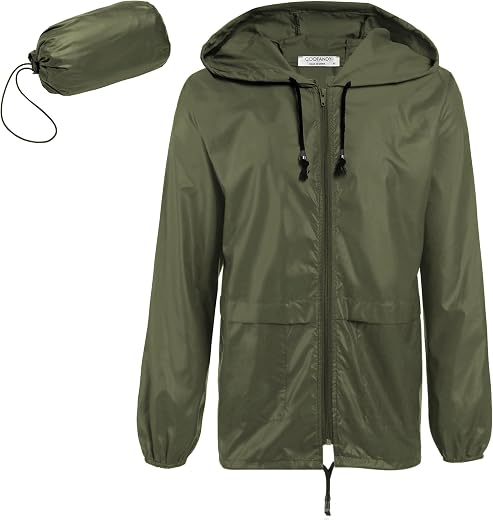
3. Hawanik Slim AirTag Wallet — Best Commuter Essentials Pick for the Four-Second Test
Price: $9.99 | Amazon rating: 4.6 from 5,131 ratings | Role: the card and the keys | Key spec: 3.3×4.1×0.12 in, six card slots plus ID window, button closure, RFID blocking, built-in AirTag pocket
Every commuter essentials list should have one item chosen against a stopwatch, and this is it. A barrier, a bus reader or a parking meter gives you about four seconds before the person behind you starts sighing. A wallet that needs two hands, a rummage and a decision fails that test twice a day, three hundred times a year. A slim front-pocket card holder passes it, which is the entire argument for putting one in your commuter essentials.
The Hawanik is 0.12 inches thick, takes six cards plus an ID in a window, has a button closure so it does not spill in a bag, and blocks RFID so the contactless card you are not using does not argue with the one you are. Its distinguishing feature is a moulded pocket sized for an Apple AirTag — not included — and that matters more on a commute than anywhere else.
The wallet is the object you remove and replace more often than any other, which makes it the one you are most likely to leave on a seat, on a counter, or in the tray at security. A 4.6 average from more than five thousand buyers is the best rating of any of the commuter essentials here.
The compromises are the ones every slim wallet makes, and one that is specific. There is no coin pocket, which is a real omission in Britain, where a surprising number of car parks, lockers and charity buckets still want metal. Six slots is genuinely six, not “six if you stretch it”, so a full set of loyalty cards will not fit and should not. And the AirTag pocket is shaped for an AirTag: Android users wanting a Galaxy SmartTag or a Tile should measure before buying, because Apple’s Find My network is what makes the feature work in the first place.
Best for: anyone who taps in and out twice a day and has ever gone back for a wallet — especially iPhone owners, who get the tracking feature for the cost of an AirTag.
Skip if: you carry coins, need more than six cards, or use Android — the pocket is cut for an AirTag and the value of the whole design is Apple’s network.
Read the full Hawanik AirTag Wallet review →
Where to Buy — Hawanik Slim AirTag Wallet
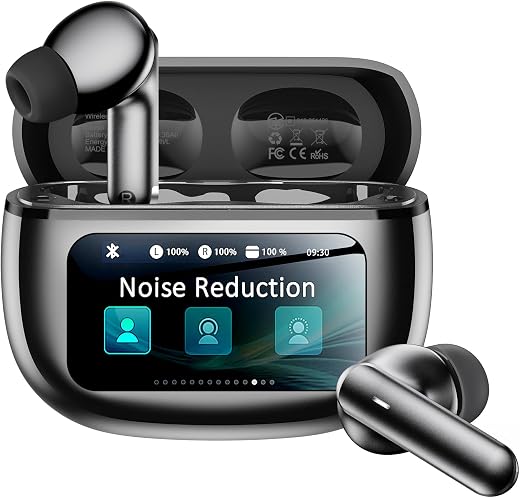
4. Bucephalus T27 Wireless Earbuds — Best Budget Commuter Essentials Pick for Noise and Calls
Price: $16.99 | Amazon rating: 4.1 from 171 ratings | Role: the noise | Key spec: Bluetooth 6.0, 13 mm drivers, dual ENC microphones, 40 h total playtime, IPX7, smart touchscreen case
A commute is loud in a way that is easy to underestimate. NIOSH recommends an exposure limit of “85 A-weighted decibels (dBA) averaged over an eight-hour workday” and halves the permitted duration for “each 3 dBA increase in noise level”. An underground train, a bus with the window down, or a platform as a freight service goes through comfortably exceeds the level at which the CDC’s own plain-English test applies: “If you need to shout in order to be heard, the sound is too loud and may damage your hearing.” The commuter essentials response to that is usually to turn the music up, which is exactly the wrong direction.
These are the cheap, competent option. Bluetooth 6.0, 13 mm drivers, a claimed forty hours of total playtime with the case, IPX7 water resistance that survives rain and sweat, and a small touchscreen on the case that shows charge without opening an app. The dual ENC microphones matter for calls taken while walking, and Bucephalus claims they cut up to ninety-eight per cent of background noise. At $16.99 they are the one item in these commuter essentials you can lose on a train without a bad evening, which for earbuds is a genuine specification.
Two honest caveats. First, ENC is not ANC. Environmental noise cancellation cleans up your voice for the person on the other end of the call; it does nothing to quiet the train for you. If your commute is a loud one and you want it to go away, you want active noise cancellation and you will not get it at this price. Second, the evidence base is thin: 4.1 from 171 ratings is by some distance the smallest sample in this guide, and it is why the score is 7.6 rather than higher. That is a fair price for a fair product, not a bargain on a proven one.
Best for: commuters who want decent audio and clear hands-free calls at a price where loss or damage is survivable.
Skip if: you want genuine active noise cancellation on a loud train, or you drive to work — earbuds in a car are a hearing decision in the wrong direction and, in many places, a legal one too.
Read the full Bucephalus T27 Wireless Earbuds review →
Where to Buy — Bucephalus T27 Wireless Earbuds
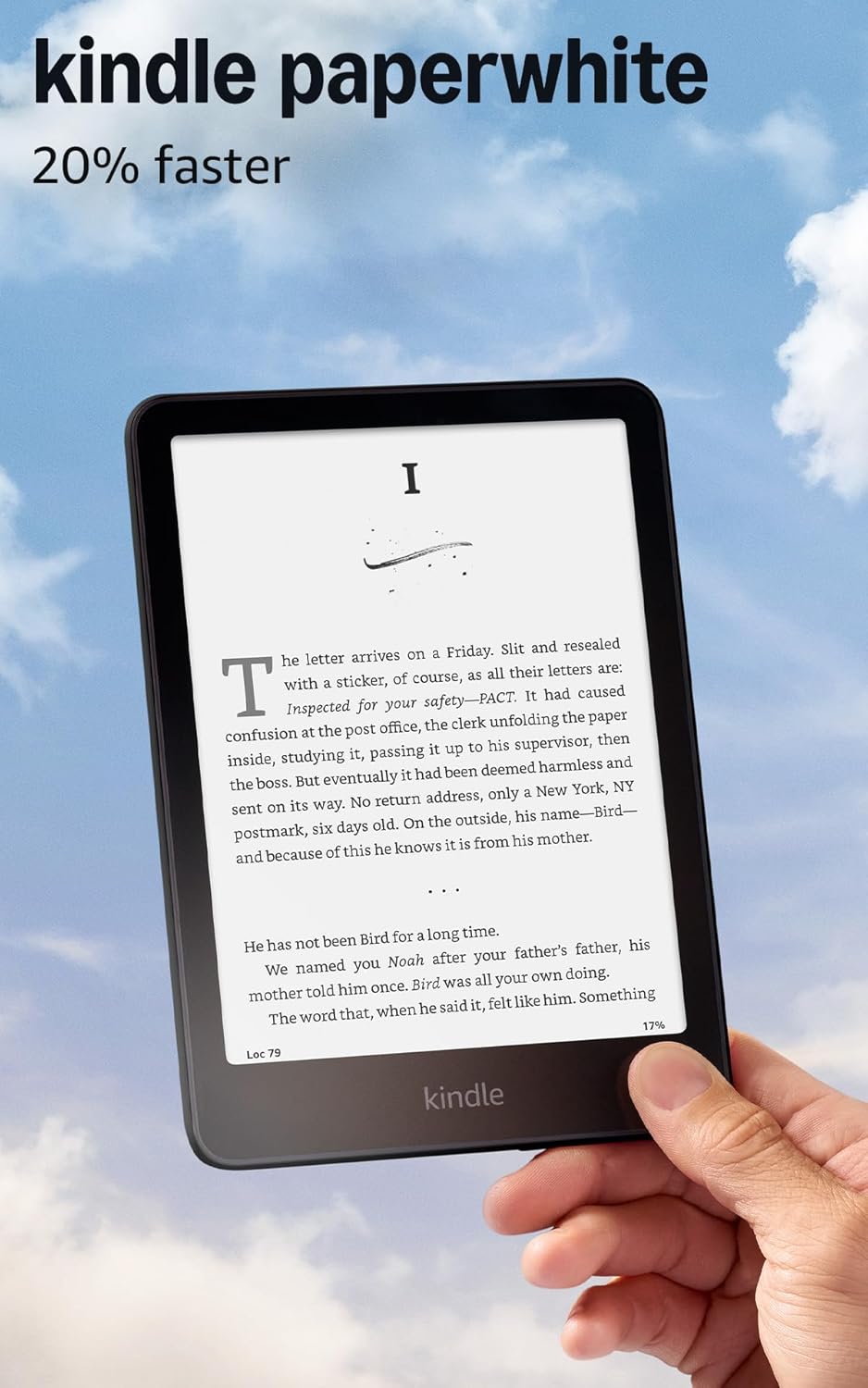
5. Kindle Paperwhite (2024), 16 GB — The Commuter Essentials Pick That Gives the Time Back
Price: $124.99 | Role: the time | Key spec: 7-inch glare-free display, 16 GB, weeks of battery life, adjustable warm front light
The American mean one-way commute was 27.2 minutes in 2024. Doubled and multiplied out, that is something close to two hundred hours a year, and it is time nobody is paying you for. There are only three things you can do with it: look at a phone, sleep, or read. The first is the default and the one most people say they regret; the third is the reason this is the highest-scoring product in the guide despite being five times the price of most of it.
The 2024 Paperwhite earns its place on two specifications that sound dull and are not. The display is glare-free, which is what separates reading on a sunlit train from squinting at a phone with the brightness at maximum. And the battery lasts weeks, which means it is never a charging decision — the single biggest reason a device gets left at home is that it needs plugging in the night before and you forgot. Sixteen gigabytes is more books than anyone will read on a commute in a decade, and the adjustable warm light makes the journey home in winter genuinely comfortable.
We will argue against it twice. If you drive to work, this product does nothing for you and you should not buy it; an audiobook or a podcast on the earbuds above is your version of the same idea, and it costs nothing extra. And if you already read happily on your phone, the honest position is that a Kindle changes what you read rather than whether you read — it is much harder to be interrupted by a notification on a device that has none. That is worth $124.99 to some people and to others it is not, and anyone who tells you the decision is obvious is selling something.
Best for: train, bus and Tube commuters with twenty minutes or more each way who want the time to produce something other than scrolling.
Skip if: you drive, your commute is under fifteen minutes, or you genuinely do read on your phone without being pulled away — in all three cases this is the most expensive thing here and the least necessary.
Read the full Kindle Paperwhite (2024) review →
Where to Buy — Kindle Paperwhite (2024), 16 GB
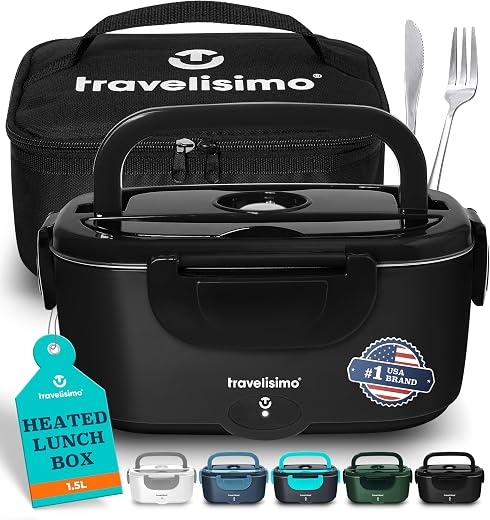
6. TRAVELISIMO 100W Electric Lunch Box — Best Commuter Essentials Pick for the Other End of the Journey
Price: $39.99 | Amazon rating: 4.5 from 24,848 ratings | Role: the other end | Key spec: 1.5 L stainless steel, 100 W, 110 V / 12 V / 24 V, heats in 20–30 minutes, 4.13×5.9×4.13 in
The commute does not end when you arrive. For a large number of people the journey delivers them somewhere with no canteen, no microwave they are willing to queue for, or no fixed desk at all — and the food they carried from home at seven in the morning is still the food they have at one in the afternoon. This is the commuter essentials purchase that makes carrying it worth doing, and with 24,848 ratings at 4.5 it has by a wide margin the largest evidence base in this guide.
It is a 1.5-litre stainless-steel container with a 100 W heating element and three voltage options: 110 V from a wall socket, and 12 V or 24 V from a vehicle. That last detail is why it belongs in a commuter essentials guide rather than a lunch guide. Nearly seven in ten American workers drive alone, and a 12 V outlet is the one power source that commute reliably provides. Plug it in at the start of a thirty-minute drive and lunch is hot when you arrive. It takes twenty to thirty minutes either way, which is a genuine spec rather than a marketing number.
Read the constraints carefully before buying. It warms food; it does not cook it, and it is not a substitute for reheating leftovers to a safe temperature if they have been sitting in a warm bag all morning — that is a food-storage decision made at home, not at your desk. It needs a socket for twenty to thirty minutes, which some workplaces and almost no trains provide.
And the big one for British readers is in the model name: 110 V. Britain runs at 230 V, and a 110 V appliance bought on Amazon.com needs a step-down transformer, not a plug adapter. Search Amazon.co.uk for a 220–240 V version of the same type of product instead.
Best for: drivers, shift workers, site workers and anyone whose destination has no usable kitchen but does have a socket.
Skip if: you are in the UK and were about to buy the US version — 110 V will not work on a 230 V supply — or your commute and workplace offer nowhere to plug anything in for half an hour.
Read the full TRAVELISIMO Electric Lunch Box review →
Where to Buy — TRAVELISIMO 100W Electric Lunch Box
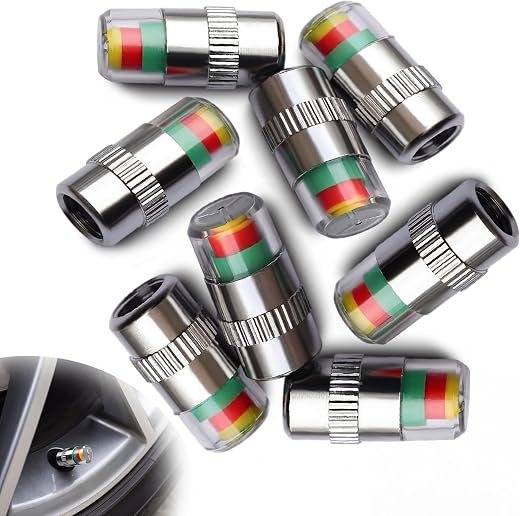
7. ANKIA Tyre Pressure Indicator Valve Caps (8-Pack) — Best Commuter Essentials Pick for the Drive
Price: $10.99 | Amazon rating: 4.2 from 4,681 ratings | Role: the drive | Key spec: eight chromed metal caps pre-set to 2.2 bar (32–35 psi); green, amber at 10% low, red at 25% low
Most commuter essentials guides are written as though everyone takes a train. They do not. In 2024, 69.2 per cent of American workers drove alone to work, and for that majority the commute has exactly one recurring mechanical failure mode: tyres losing pressure slowly enough that nobody notices until the car handles badly, the fuel economy quietly worsens, or a shoulder-of-the-motorway morning happens. The Highway Code is blunt about the fix — “Tyres MUST be correctly inflated to the vehicle manufacturer’s specification for the load being carried” — and NHTSA asks drivers to “check the pressure of all tires, including your spare, at least once a month when the tires are ‘cold’”. Almost nobody does.
These caps replace your existing valve caps and show a coloured band: green for correct, amber when pressure is roughly ten per cent low, red when it is about twenty-five per cent low. That red figure is not arbitrary and it is the most interesting thing about a ten-dollar accessory. The federal standard governing factory tyre-pressure monitoring requires the car to warn the driver “when tire pressure is 25 percent or more below the vehicle manufacturer’s recommended cold tire inflation pressure”. A $10.99 cap and a federally mandated dashboard light are set to the same threshold; the difference is that the cap does not need a car built after 2007 to work.
The catch is in the specification and it is a real one: these are pre-set to 2.2 bar, about 32–35 psi. They are not adjustable. If your car’s door-pillar placard calls for 32–35 psi, they are useful. If it calls for 38, 42 or the split front/rear pressures common on SUVs, light trucks and loaded estates, they will show amber permanently and you will learn to ignore them, which is worse than not fitting them. They are also a visual indicator, not a gauge — they tell you to go and check, not what the pressure is.
Best for: drivers of older cars with no factory monitoring system whose recommended cold pressure genuinely sits in the 32–35 psi band.
Skip if: your placard pressure is outside 32–35 psi, or your car already has a working factory TPMS — in that case these duplicate a system that is more accurate than they are.
Read the full ANKIA Tyre Pressure Valve Caps review →
Where to Buy — ANKIA Tyre Pressure Indicator Valve Caps
Commuter Essentials — Buyer’s Guide: What to Look For
The commute punishes a different set of qualities from the ones product listings are written to sell. Here is what actually separates good commuter essentials from a drawer full of things you stopped carrying.
Commuter Essentials Rule One: Buy for the Journey You Actually Make
Almost every mistake in this category comes from buying for the commute you imagine rather than the one you have. The single most useful thing you can do before spending anything is write down, honestly, the four numbers that define your journey: how many minutes you are outdoors, how many minutes you are seated, whether you drive or are carried, and whether the far end has a socket and a kitchen. Those four answers eliminate most of this list for most people.
A driver with a twelve-minute door-to-door run needs almost nothing from this guide except the valve caps. A rail commuter with fifty-five minutes each way and a four-minute walk at either end should buy the e-reader before anything else and may never need the lunch box. Somebody who changes site every week and eats in a van needs the lunch box and nothing else. The reason most lists of commuter essentials read as interchangeable is that they are written for an average journey nobody actually makes.
Weight Is the Only Commuter Essentials Spec That Compounds
Everything else on a commuter essentials product page is a one-off. Weight is not, because you pay it twice a day for years. Two hundred grams that you would not notice picking up is two hundred grams carried through roughly four hundred and forty journeys a year, and it is the reason good products get abandoned.
The practical test is not “is this light?” but “would I still carry this on a day I am late and irritable?” That question is why a folding shell beats a coat, why a card holder beats a bifold, and why the bag in this guide is chosen for what it weighs when empty rather than what it holds when full. If an item fails the irritable-Tuesday test it will end up living permanently at home, at which point its price per use is infinite.
Commuter Essentials and the Four-Second Test
Anything you use at a barrier, a reader, a meter or a turnstile has to work one-handed, in gloves, in the rain, while someone waits behind you. Four seconds is roughly the budget. This sounds like a trivial criterion and it is the one that determines whether a product survives its first fortnight.
Apply it ruthlessly. A wallet with a zip fails. A phone case that has to be unfolded fails. A bag whose only access is a zip across the top, under the shoulder strap, fails. Earbuds with a case that needs two hands to open fail on a crowded platform. The winning commuter essentials designs are usually the ones that look almost too simple, because simplicity is what four seconds buys.
Waterproof, Water-Resistant and the Commuter Essentials Nobody Reads
Three words get used interchangeably on commuter essentials listings and mean three different things. Water-resistant means a shower will bead and run off for a while — that is the BAGSMART bag. Waterproof means water will not pass through the fabric, which is the rain shell, and says nothing about whether sweat can get out. IPX7, the rating on the earbuds, is a defined laboratory test for immersion, not a claim about rain specifically, and it is the only one of the three with a standard behind it.
For commuter essentials the practical hierarchy is simple: electronics want an IP rating, outerwear wants a waterproof rating plus an honest read on breathability, and bags want water-resistance plus an internal pouch for anything that genuinely must not get wet. Paying for a waterproof bag is usually paying for the wrong thing, because bags fail at zips and seams long before fabric.
What Commuter Essentials Cannot Fix
This commuter essentials guide deliberately refuses four things. It does not recommend a travel coffee cup, because nobody’s morning is fixed by one and the reason people stop using them is washing-up, not capacity. It does not recommend a laptop or a phone, because you already have both and your employer usually supplies the first.
It does not recommend an e-scooter, and that refusal is legal rather than editorial: in Great Britain, as the Department for Transport states plainly, “private e-scooters remain illegal to use on public roads”, and only rental trial scooters — which require a valid driving licence and motor insurance — are permitted. A British reader buying one for the commute is buying something they may not legally ride to work.
And it refuses the biggest one: nothing here shortens your commute. The only interventions that reliably do are moving house, changing job, changing mode, or changing the hours you travel, and all four are decisions rather than purchases. Every one of these commuter essentials is a way of making an unavoidable interval less unpleasant, which is a smaller and more honest claim than most lists in this category are willing to make.
US vs UK: What Changes When You Commute
Commuting is one of the sharpest transatlantic divides in ordinary life, and not only because one country drives and the other queues. The two systems disagree about who pays for the journey, what you may legally ride on it, and what happens when it goes wrong — and on one technical point they agree so exactly that it looks like coincidence.
Vocabulary: The Commuter Essentials Words That Do Not Travel
“Commute” itself is shared, but almost every word around commuter essentials splits. Americans drive to work; Britons get the train. The US subway is the London Tube or, everywhere else, the underground or the metro. A US round trip is a British return; a monthly pass is a season ticket; the schedule is the timetable; the conductor is the guard; a train station is a railway station.
Britons stand in a queue, not a line, take the lift rather than the elevator, walk on the pavement rather than the sidewalk, put the bag in the boot rather than the trunk, fill up with petrol on the motorway rather than gas on the freeway, and car share rather than carpool. And a British commuter names their train by its departure time — “the 07:42” — in a way that has no American equivalent at all.
Before Any Commuter Essentials: Neither Country Counts the Commute as Working Time
This is the foundation everything else sits on, and both countries put it in writing in almost identical terms while arriving there by completely different routes. The American answer is in federal regulation: 29 CFR 785.35 provides that an employee travelling from home before the regular workday “is engaged in ordinary home to work travel which is a normal incident of employment”, that this “is true whether he works at a fixed location or at different job sites”, and concludes flatly that “normal travel from home to work is not worktime”.
Britain reaches the same place through minimum-wage law. Regulation 34 of the National Minimum Wage Regulations 2015 counts travelling for the purposes of time work as hours worked — except where “the travelling is between—(a) the worker’s home, or a place where the worker is temporarily residing other than for the purposes of working, and (b) a place of work”. Same conclusion, opposite instrument: America wrote a rule about what work is, Britain wrote a rule about what it must be paid for.
America Subsidises the Commute; Britain Does Not — Except by Bicycle
Here the two systems diverge completely, and then cross over. In the United States an employer can give an employee a genuinely large sum tax-free: IRS Publication 15-B for 2026 states that “the monthly exclusion for qualified parking is $340 and the monthly exclusion for commuter highway vehicle transportation and transit passes is $340”. That is up to $8,160 a year of commuting cost that never appears as taxable income.
Britain offers ordinary commuters nothing of the kind. HMRC’s guidance is unambiguous: “ordinary commuting” means “any travel between a permanent workplace and: home”, and “an employee cannot have tax relief for the cost of a journey which is ordinary commuting or private travel”. A British rail season ticket is paid for out of taxed income, full stop.
The exception inverts the whole picture. Britain’s Cycle to Work scheme, built on “Section 244 of the Income Tax (Earnings and Pensions) Act 2003”, lets an employer provide a bicycle tax-free provided “at least 50% of the cycle’s use” is for “qualifying journeys, i.e. commuting to work purposes”, with a Financial Conduct Authority exemption where the goods hired do not exceed £1,000.
America used to have a smaller equivalent and has just abolished it permanently: Publication 15-B records that “P.L. 119-21 permanently eliminates the exclusion of qualified bicycle commuting reimbursements from your employee’s income for tax years beginning after 2025”. So America pays you to drive or take the bus and no longer helps at all if you cycle; Britain helps only if you cycle. Each country legislated precisely the half the other ignored.
How Long, How Far and How Many: Commuter Essentials by the Numbers
The two countries also measure the commute differently, which makes direct comparison harder than it looks. The US Census Bureau reports travel time: “the mean one-way travel time in 2024 was 27.2 minutes, higher than 26.8 minutes in 2023”, that “the percentage of workers who drove alone to work in 2024 was 69.2 percent”, and that home working slipped to 13.3 per cent from 13.8 per cent.
Britain counts trips and miles instead. The National Travel Survey for 2025 found that “commuting was the second most common trip purpose in 2025 with 112 trips per person” and that it “accounted for the longest distance travelled on average with 1,031 miles per person” — more than shopping, leisure or education.
The 2024 factsheet adds a split worth knowing: men made “an average of 125 commuting trips per person” and women 98, both sharply down on 2019, with commuting making up 12 per cent of all trips. The practical upshot for anyone choosing commuter essentials is identical on both sides: this is the longest-distance recurring journey in an ordinary life, and it is still shrinking slowly.
E-Scooters: The Commuter Essentials Item Britain Will Not Let You Ride
Nothing divides the two markets as sharply as the last mile. In Great Britain the position is national and strict: “private e-scooters remain illegal to use on public roads.” Only rental machines in government trials are permitted, and even then riders must hold “a valid driving licence” and the scooter must be “covered by a motor vehicle insurance policy”; trial scooters “use the same road space as cycles and EAPCs”, meaning roads except motorways, plus cycle lanes and tracks.
In the United States the answer is set state by state and in most places a privately owned e-scooter is simply a vehicle you can ride. A British reader reading an American commuter essentials guide should treat every e-scooter recommendation in it as simply inapplicable.
Tyres and Tires: The Commuter Essentials Number Both Countries Agree On
The most surprising finding in this whole commuter essentials comparison is that the two countries’ minimum legal tread depths are the same figure written in different units. NHTSA tells American drivers that “tires are not safe and should be replaced when the tread is worn down to 2/32 of an inch”, and offers the penny test: “if you can see the top of Lincoln’s head, replace your tires”.
The Highway Code requires British car tyres to have “a tread depth of at least 1.6 mm across the central three-quarters of the breadth”. Two thirty-seconds of an inch is 1.5875 mm. Two regulators, two measurement systems, one answer to within a fortieth of a millimetre.
The monitoring rules diverge, though, and that is what matters when buying. The US federal standard applies to “all new passenger cars, multipurpose passenger vehicles, trucks, and buses that have a gross vehicle weight rating (GVWR) of 4,536 kg (10,000 lbs.) or less” and requires a warning “when tire pressure is 25 percent or more below the vehicle manufacturer’s recommended cold tire inflation pressure”; NHTSA confirms that “all passenger cars, light trucks and vans that are model year 2008 or newer are required to come equipped with this feature”.
Britain has no equivalent retrofit expectation for older cars, which is why a pressure-indicating valve cap is a more useful purchase on a fifteen-year-old British hatchback than on a recent American one. Checking intervals differ too: NHTSA says monthly when cold, the Highway Code says weekly.
Noise and Commuter Essentials: An Advisory Limit and a Statutory One
Both countries publish numbers for workplace noise and neither of them reaches a commuter, which is the point. The American figure is a recommendation: NIOSH sets an exposure limit of “85 A-weighted decibels (dBA) averaged over an eight-hour workday” and halves the allowed time “for each 3 dBA increase in noise level”. The British figures are law.
Under the Control of Noise at Work Regulations, 80 dB(A) is the lower exposure action value, “the level at which employers must assess the risk to workers’ health and provide them with information and training”; 85 dB(A) is the upper action value, at which employers “must provide hearing protection and hearing protection zones”; and 87 dB(A) is an exposure limit value “above which workers must not be exposed”.
No regulator anywhere protects you from your own commute. That leaves the CDC’s plain-language rule as the only usable test: “if you need to shout in order to be heard, the sound is too loud and may damage your hearing” — and the CDC is equally plain about the stakes, noting that “there is no medical or surgical treatment for noise-induced hearing loss”. The only sane commuter essentials response is to reduce what you are adding to the noise rather than trying to compete with it.
Delays: The One Commuter Essentials Problem Britain Actually Regulates
If a British train is late, compensation is a regulated entitlement rather than a goodwill gesture. The Office of Rail and Road explains that “when passengers are delayed beyond a certain length of time they become entitled to claim compensation”, and holds train operators to it through licence condition 29. The scheme is being consolidated: the Department for Transport announced that under Great British Railways “passengers will be able to claim compensation more directly through third-party retailers like Trainline for the first time”, alongside a change to unused-ticket refund eligibility from 1 April 2026. There is no federal American analogue; a delayed commuter-rail passenger in the United States is relying on an operator’s own policy.
Units and Voltage for Commuter Essentials Bought on Amazon.com
Two practical conversions and one warning. Tyre pressure: 2.2 bar is 32–35 psi, and tread depth 2/32 in is 1.6 mm. Capacity: the 37-litre bag here is about 2,260 cubic inches, and the 1.5-litre lunch box is about 50 US fluid ounces. Distance stays in miles on both sides of the Atlantic, which is one thing that never needs converting.
The warning is electrical and it applies to exactly one product in this guide. The United States runs at roughly 120 V and 60 Hz; Great Britain runs at 230 V and 50 Hz through a fused BS 1363 plug. A 110 V heated lunch box will not work on a British supply with a plug adapter — adapters change the pin shape, not the voltage — and needs a step-down transformer or, far more sensibly, a 220–240 V version bought locally. Everything else here charges over USB or uses no power at all, and travels between the two markets without modification.
Commuter Essentials — Which One Should You Buy?
Three budgets, three honest commuter essentials answers. The ordering assumes you are starting from nothing and want each additional pound or dollar to buy the largest remaining improvement.
Under $25: The Commuter Essentials Starter Set
Spend here first, because this tier of commuter essentials fixes the two problems that recur most often and costs less than a week of parking. The Hawanik Slim AirTag Wallet at $9.99 is the single highest-value purchase in this guide: it passes the four-second test, it is the best-rated item here at 4.6, and it addresses the object you are most likely to leave behind. Add the COOFANDY Packable Rain Jacket at $19.99 and you have covered weather permanently, because a shell that lives in the bag is a decision you make once.
If you drive, swap the jacket for the ANKIA valve caps at $10.99 — but only after checking your door-pillar placard actually calls for 32–35 psi. If you need audio at this budget, the Bucephalus T27 earbuds at $16.99 are competent and cheap enough to lose, with the honest caveat that their rating sample is small.
$25–$60: The Commuter Essentials Step Up
At this level you are solving carrying and eating. The BAGSMART Foldable Travel Bag at $21.99 belongs here rather than in the starter tier because it is the item people most often decide they do not need and then regret on the first awkward day. It weighs nothing folded, which means it is never the reason you left it at home.
The other purchase in this band is the TRAVELISIMO 100W Electric Lunch Box at $39.99, and it is the one with the clearest test for whether you should buy it. If your destination has a decent canteen or a microwave you are willing to queue for, do not. If it has neither and you drive, its 12 V option makes it the most useful forty dollars here. It also has the largest evidence base in this guide by a factor of four, at 24,848 ratings.
Over $60: The Commuter Essentials Long Game
One product, and it is only for people carried by somebody else. The Kindle Paperwhite (2024) at $124.99 is the highest-scoring item in this guide at 9.1 and the only one that changes what the commute is rather than how it feels. Two hundred hours a year of glare-free reading with no notifications is a different proposition from two hundred hours of scrolling, and the weeks-long battery is what stops it becoming another thing you forgot to charge.
It is also the one purchase we would tell a large part of the audience to skip outright. Drivers get nothing from it. Anyone with a commute under fifteen minutes each way will not build the habit. And if you already read contentedly on a phone, the honest upgrade is smaller than the price suggests. Spend the money on the sub-$25 commuter essentials tier twice over instead — and if you want more of the reasoning behind that kind of trade-off, our carry-on essentials guide works through the same question for air travel, where the constraints are tighter and the answers are different.
The Journey Nobody Pays For: When a Commute Stops Being a Commute
The reason this guide exists is that the commute sits in a legal gap. It is not leisure, because you would not be doing it otherwise, and it is not work, because both countries say so explicitly. But the boundary is not where most people assume, and a surprising amount of travel that feels like commuting is in fact paid time that many workers never claim. This section is about where the line actually falls. None of it can be solved by buying anything, which is precisely why it belongs here.
The Default Behind Every Commuter Essentials Decision: Ordinary Home-to-Work Travel
Start from the rule. In the United States, 29 CFR 785.35 says an employee travelling from home before the regular workday and returning at the end of it “is engaged in ordinary home to work travel which is a normal incident of employment”, that this holds “whether he works at a fixed location or at different job sites”, and that “normal travel from home to work is not worktime”. In Britain, regulation 34 of the National Minimum Wage Regulations 2015 excludes from counted hours any travelling between “the worker’s home… and a place of work or a place where an assignment is carried out”.
Both rules are about the ordinary journey, and both have doors in them. Knowing where those doors are is worth considerably more than anything in the shopping list above.
Door One: Travel That Is All in the Day’s Work
The clearest American exception is 29 CFR 785.38, which provides that time spent by an employee travelling “as part of his principal activity… must be counted as hours worked”. The regulation is specific about a very common arrangement: where an employee is required to report to a meeting place to receive instructions or to pick up tools, “the travel from the designated place to the work place is part of the day’s work, and must be counted as hours worked”.
It then draws the line with an example worth memorising. If the work finishes at 8 p.m. and the employee is required to return to the employer’s premises, arriving at 9 p.m., that hour counts. If the employee goes straight home instead, “the travel after 8 p.m. is home-to-work travel and is not hours worked”. The same sixty minutes, in the same van, is paid or unpaid depending on where it ends.
Door Two: The Special One-Day Assignment
29 CFR 785.37 deals with the day you are sent somewhere else. Travel to a special one-day assignment in another city, the regulation says, “cannot be regarded as ordinary home-to-work travel occasioned merely by the fact of employment. It was performed for the employer’s benefit and at his special request” — and is therefore compensable. Even here the ordinary commute is carved back out: “the travel between his home and the railroad depot may be deducted, it being in the ‘home-to-work’ category”, as is the usual meal break.
This is the exception most workers get wrong in their employer’s favour. A day at a client site three hours away is not a longer commute; it is, in the regulation’s own framing, travel performed at the employer’s special request.
Door Three: The British Temporary Workplace, and the Commuter Essentials Nobody Claims
Britain draws its line through the tax system rather than the wage system, and the pivot is the definition of a permanent workplace. HMRC’s guidance states that “a place is a permanent workplace if the employee attends it regularly for the performance of the duties of the employment and it’s not a temporary workplace”. Ordinary commuting is then “any travel between a permanent workplace and: home”, and the consequence is stated without qualification: “an employee cannot have tax relief for the cost of a journey which is ordinary commuting or private travel”.
The corollary is the useful part. Travel to a genuinely temporary workplace is not ordinary commuting, and the cost of it can attract relief. British workers who visit sites, cover other branches or work on fixed-term placements frequently pay for those journeys out of taxed income when they need not. The test is regular attendance at a place for the duties of the job, not whether the journey feels routine.
What No Commuter Essentials Purchase and No Regulator Will Do for You
Two things sit outside every exception, and they are the ones the commuter essentials above exist to mitigate. The first is hearing. No regulator protects a passenger from the noise of the vehicle they chose to travel in; Britain’s statutory 80, 85 and 87 dB(A) thresholds and America’s advisory 85 dBA recommendation are workplace instruments, and a train is not your workplace. What remains is the CDC’s shouting test and the CDC’s warning that “there is no medical or surgical treatment for noise-induced hearing loss”. A commuter who raises the volume to beat the carriage is running an eight-hour workplace exposure argument on their own time, with no employer obliged to intervene.
The second is your tyres. The American federal monitoring standard covers vehicles “that have a gross vehicle weight rating (GVWR) of 4,536 kg (10,000 lbs.) or less” from model year 2008, and warns only at 25 per cent below placard pressure — a point at which handling and economy have already suffered.
Both countries put the ongoing duty on the driver: NHTSA asks for a cold check “at least once a month”, and the Highway Code says tyres “MUST be correctly inflated to the vehicle manufacturer’s specification for the load being carried”. Nobody will remind you. That is the entire argument for a ten-dollar coloured cap, and it is also the argument for a five-dollar gauge and a calendar reminder, which work just as well and which we would recommend just as readily.
Commuter Essentials — Frequently Asked Questions
What are the most important commuter essentials to buy first?
A slim wallet and a packable rain shell, in that order, and together they cost about thirty dollars. Those two fix the problems that recur most often: the four-second fumble at a barrier twice a day, and the ten minutes outdoors you cannot avoid. Everything else on this list is contingent on your particular journey, but almost nobody regrets those two.
Is my commute counted as working time?
Ordinarily, no, on both sides of the Atlantic. American federal regulation states that “normal travel from home to work is not worktime”, and British minimum-wage regulations exclude travel between home and a place of work from counted hours. The exceptions matter, though: travel that forms part of your principal activity, travel from a required reporting point to the job, and travel for a special one-day assignment elsewhere are all treated differently. If your working day involves any of those, it is worth reading the section above.
Can my employer pay for my commute tax-free?
In the United States, substantially yes. For 2026 the IRS sets “the monthly exclusion for qualified parking” at $340 and the same figure for “commuter highway vehicle transportation and transit passes”. In the UK, for ordinary commuting, no — HMRC is explicit that there is no tax relief for it. The British exception is the Cycle to Work scheme under section 244 of ITEPA 2003, which requires at least half the bicycle’s use to be for qualifying commuting journeys.
Do commuter essentials differ for drivers and train passengers?
Substantially, yes, and it is the main reason generic commuter essentials lists disappoint. A driver’s commuting problems are pressure loss, food and audio; a passenger’s are weather, carrying, noise and what to do with the time. Of the seven products here, a driver realistically needs three and a rail commuter needs five, and only the wallet is genuinely universal. Work out which of the two you are before buying anything.
Are e-scooters legal for commuting in the UK?
Privately owned ones are not. The Department for Transport states plainly that “private e-scooters remain illegal to use on public roads”. Only rental e-scooters in official trials may be ridden, riders need “a valid driving licence”, and the machine must be “covered by a motor vehicle insurance policy”. In the United States the position is set state by state and privately owned e-scooters are widely permitted, which is why American commuter essentials guides recommend them and this one does not.
How often should I really check my tyre pressures?
NHTSA asks American drivers to check “at least once a month when the tires are ‘cold’” — meaning the car has not been driven for at least three hours. The Highway Code asks British drivers to check weekly. Either is more often than most people manage, which is the case for a visual indicator that nags you from the wheel rather than waiting for you to remember.
What is the minimum legal tyre tread depth?
It is effectively the same number in both countries. NHTSA says tyres should be replaced “when the tread is worn down to 2/32 of an inch”; the Highway Code requires “a tread depth of at least 1.6 mm across the central three-quarters of the breadth”. Two thirty-seconds of an inch is 1.5875 mm, so the two standards agree to within a fortieth of a millimetre despite being written in different units by different regulators.
Will a 110 V electric lunch box work in the UK?
No, and this is the single most common mistake a British reader makes when buying commuter essentials from a US listing. Britain runs at 230 V; a plug adapter changes the pin shape, not the voltage. You need either a step-down transformer, which is bulky and defeats the purpose, or — far better — a 220–240 V version of the same product bought on Amazon.co.uk. Everything else in this guide either charges over USB or uses no power at all.
Are cheap earbuds loud enough to damage hearing on a commute?
They can be, because the damage comes from what you do with the volume rather than the price of the device. NIOSH recommends a limit of 85 dBA averaged over eight hours and halves the permitted duration for every 3 dBA more. The practical test is the CDC’s: if you would have to shout to be heard over what you are listening to, it is too loud. The CDC is also blunt that “there is no medical or surgical treatment for noise-induced hearing loss”, which makes this the one item here where the cheap option carries a real cost if used badly.
How long is the average commute?
The US Census Bureau put the mean one-way travel time at 27.2 minutes in 2024, up from 26.8 in 2023, with 69.2 per cent of workers driving alone and 13.3 per cent working from home. Britain measures it differently: the National Travel Survey recorded 112 commuting trips per person in 2025 and 1,031 miles per person, the longest average distance of any trip purpose. Whichever way you count it, commuting is the longest-distance recurring journey most people make.
Commuter Essentials — Final Thoughts
The honest summary of this guide is that the commute is a problem you cannot buy your way out of, only a problem you can stop losing at. Nobody pays you for the time. Nobody is obliged to make the carriage quieter, the platform drier or your tyres safer. What good commuter essentials can do is remove the five or six recurring small failures — the fumbled wallet, the soaking, the cold lunch, the flat battery, the slow puncture, the two hundred hours that turn into scrolling — and the total cost of doing all of that is under $250, most of it under $60.
If you take one thing from these commuter essentials, take the wallet, because it is ten dollars and it fixes something you do seven hundred times a year. If you take one thing from the research, take the exceptions: a large number of people are paid for travel they assume is unpaid, and a large number of British workers pay tax on journeys to temporary workplaces that need not be taxed. That is worth considerably more than any product here. We will revisit these commuter essentials as prices and models change, and as always we would rather tell you which three of the seven you can safely ignore than pretend all seven belong in everybody’s bag.
Sources and Further Reading
- eCFR — 29 CFR 785.35, Home to work; ordinary situation
- eCFR — 29 CFR 785.37, Home to work on special one-day assignment in another city
- eCFR — 29 CFR 785.38, Travel that is all in the day’s work
- legislation.gov.uk — National Minimum Wage Regulations 2015, Part 5 (hours worked, including regulation 34 on travelling)
- GOV.UK / HMRC — Ordinary commuting and private travel (490: Chapter 3)
- IRS — Publication 15-B (2026), Employer’s Tax Guide to Fringe Benefits
- Department for Transport — Cycle to Work Scheme: guidance for employers (PDF)
- US Census Bureau — Commuting at a glance, American Community Survey 1-year estimates
- Department for Transport — National Travel Survey 2025: introduction and main findings
- Department for Transport — National Travel Survey 2024 factsheet (PDF)
- GOV.UK — Rental e-scooter trials
- NHTSA — TireWise: tire safety, pressure and tread depth
- NHTSA — FMVSS No. 138, Tire Pressure Monitoring System, final regulatory impact analysis (PDF)
- GOV.UK — The Highway Code, Annex 6: vehicle maintenance, safety and security
- CDC / NIOSH — Noise-induced hearing loss and the recommended exposure limit
- CDC — Preventing noise-induced hearing loss
- HSE — Control of Noise at Work Regulations: exposure action values and limit values
- Office of Rail and Road — Rail compensation for delayed passengers
- GOV.UK — Delay Repay changes under Great British Railways
Affiliate disclosure: blueraystechnologies.com is a participant in the Amazon Services LLC Associates Program. Product links in this guide are affiliate links to Amazon.com and we may earn a commission from qualifying purchases at no additional cost to you. Prices and Amazon ratings were accurate at the time of writing and change frequently — always check the current figure on the product page before buying.
UK readers should note two specific warnings above: the 110 V electric lunch box will not work on a 230 V British supply without a step-down transformer, and the tyre valve caps are pre-set to 32–35 psi and are only useful if that matches your vehicle’s recommended cold pressure. Nothing in this guide is legal, tax or medical advice; the statutory and regulatory material is quoted from the primary sources listed above and you should check the current position before relying on it.