
Every list of road trip essentials on the internet is really two lists wearing one hat. There is the list of things that make a long drive pleasant — snacks, playlists, a neck pillow — and there is the much shorter list of things that stop a long drive going wrong. This article is the second list, written for the version of the trip most people actually take: the one with a dog in the back.
That single detail changes the whole kit. A dog in a car is a legal load in Britain and an unrestrained projectile everywhere, it cannot be left in the vehicle while you eat, it needs water that is still cold four hours in, and it will need walking in whatever weather the motorway hands you.
So the seven products below are organised by job rather than by rank: restraint for the drive, a crate for the destination, cold storage, luggage that folds around the awkward shapes, a rain layer, a tool for the small failures, and a light for the night you break down. We deliberately left out a phone, a sat-nav and a dashcam — you already own the first, and it does the other two.
Every product here has been reviewed individually on this site, and each entry links to that full review. There is a constraint that quietly unifies the whole category and it is worth naming up front: on a road trip the car is your only infrastructure. Nothing you bring can assume mains power, a worktop, or spare space, and anything loose becomes a missile in a hard stop. Prices and links go to Amazon.com; UK readers can search the same models on Amazon.co.uk, and where the two countries genuinely diverge — units, law, official guidance, vocabulary — there is a full section on it below.
Road Trip Essentials — Quick Comparison
Seven road trip essentials, one per job. Product names jump to the full write-up further down the page.
| # | Product | Role | Key spec | Best for | Price | Score |
|---|---|---|---|---|---|---|
| 1 | PetSafe Happy Ride Crate | Restraint in transit | 27 × 19 × 28 in, to 60 lb | Back-seat travel | $159.99 | 8.8 |
| 2 | ZOMISIA Collapsible Dog Crate | Crate at the destination | 36 × 25 × 25 in, to 70 lb | Cottages and campsites | $58.45 | 8.3 |
| 3 | Ninja FrostVault 45qt Cooler | Cold storage | 45 qt, dry drawer, wheels | All-day drives | $299.95 | 8.8 |
| 4 | BAGSMART Foldable Travel Bag | Collapsible luggage | 37 L, folds flat | Boot Tetris | $19.99 | 8.3 |
| 5 | COOFANDY Packable Rain Jacket | Rain layer | Packs into own pocket | Dog walks in the wet | $19.99 | 8.2 |
| 6 | Gerber Suspension NXT | Roadside repair | 15 tools, 8.48 oz | Small mechanical failures | about $41 | 8.7 |
| 7 | ZF8313 Magnetic Flashlight | Work light | 2,000 lm, magnetic tail | Night-time breakdowns | $23.99 | 8.4 |
- Road trip essentials — quick comparison
- The 7 best road trip essentials in 2026
- Road trip essentials — buyer’s guide
- US vs UK: what changes when you drive with a dog
- Road trip essentials — which one should you buy?
- Dogs, heat and the law: what the rules actually say
- Road trip essentials — frequently asked questions
- Road trip essentials — final thoughts
- Sources and further reading
The 7 Best Road Trip Essentials in 2026
Each of these road trip essentials was reviewed on its own first; the links take you to the full write-up.
1. PetSafe Happy Ride Collapsible Dog Car Crate — Best Restraint for the Drive Itself
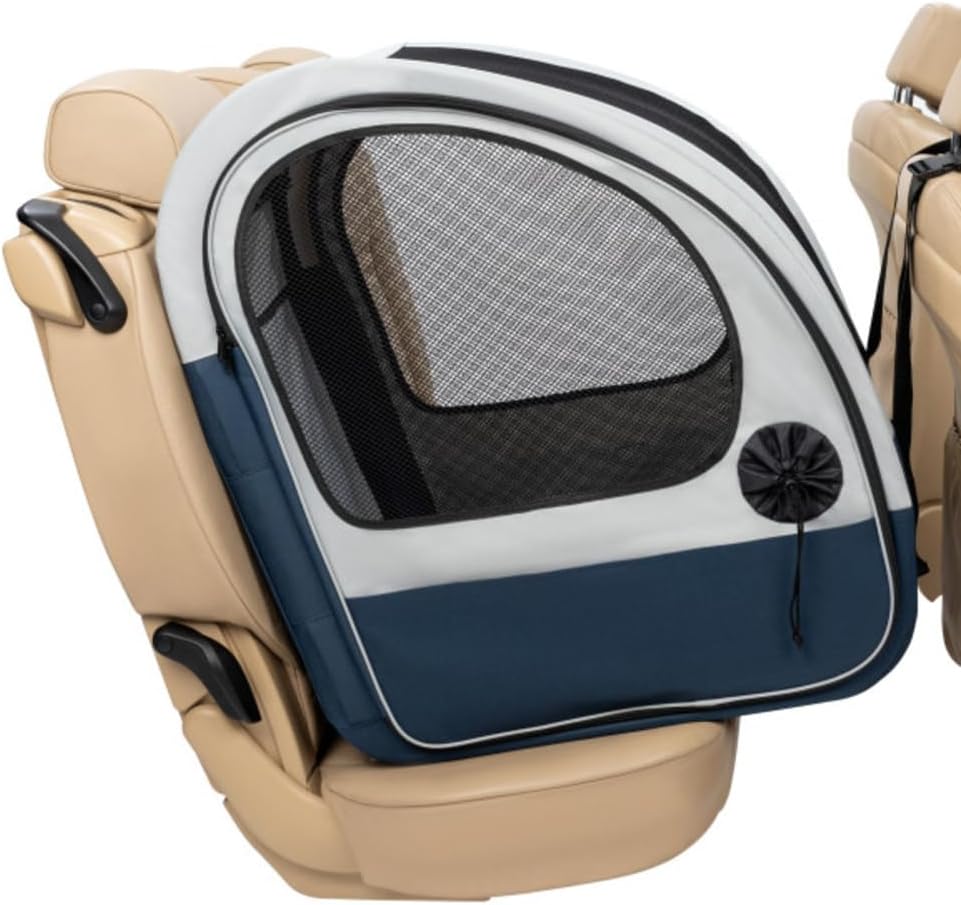
Price: $159.99 | Role: In-transit containment | Key spec: 27 × 19 × 28 in pop-up aluminium frame, dogs to 60 lb (27 kg)
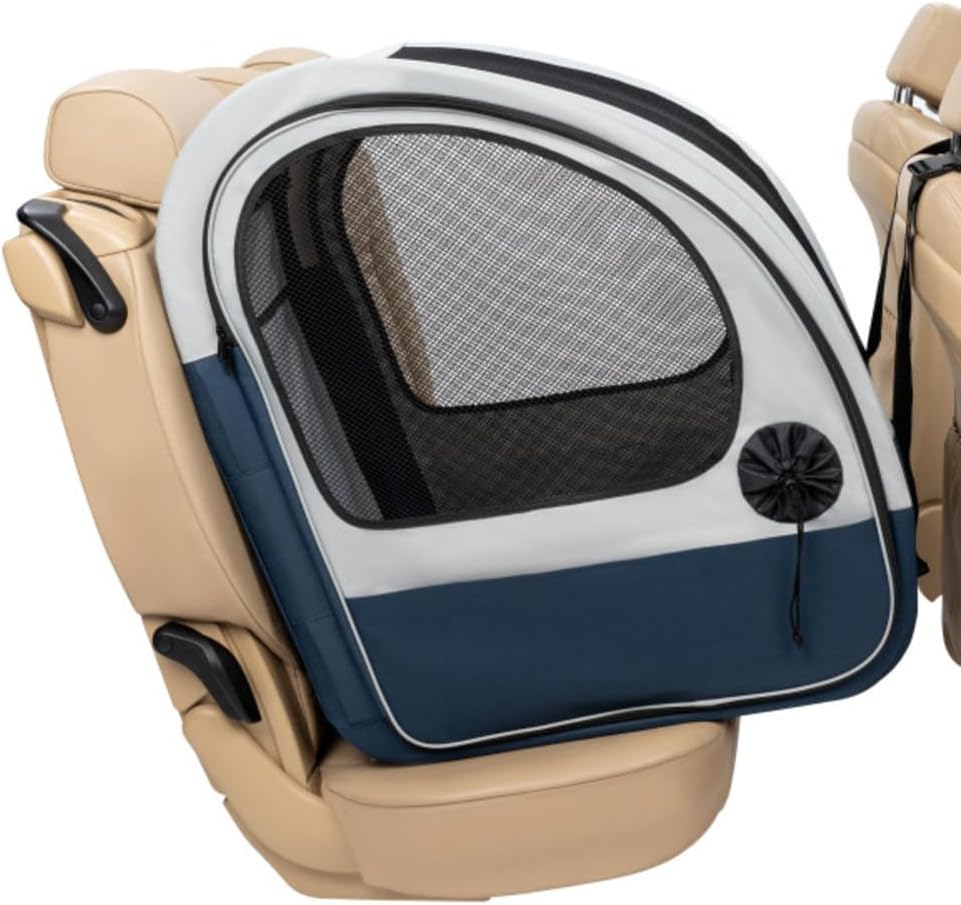
The Happy Ride is the only item on this list of road trip essentials whose job is measured in milliseconds. Everything else here earns its place over hours; a crate earns its place in the fraction of a second after a hard stop.
The American Veterinary Medical Association puts the problem plainly — a loose animal risks serious injury from airbags, from being thrown, or from interfering with the driver’s control — and it recommends a carrier sized so the dog can stand up, turn around and lie down, positioned toward the centre of the vehicle. The Happy Ride is built to that shape rather than to a cargo-area shape: 27 inches long, 19 wide, 28 tall, sitting across a bench seat with the belt run through it.
The frame is what separates it from the £30 fabric boxes it superficially resembles. A heavy-duty aluminium pop-up structure springs into shape the way a camping tent does, so the sides hold their geometry when a 50 lb dog leans on them, and the whole thing folds flat again when you want your back seat returned. Mesh runs across the front and both sides, which does three unglamorous jobs at once: it vents, it lets the dog see the people it travelled all this way with, and it lets you check on it in the mirror without pulling over. The liner comes out and goes in the machine, which after one wet coastal walk stops being a footnote.
Be clear-eyed about what it is not. PetSafe does not publish a crash rating for it, and the Center for Pet Safety — the body most often invoked in this category — states on its own FAQ page that it runs an approximately 30 mph crash simulation but that it does not endorse any product and had not yet launched its certification programme.
So treat “crash-tested” claims in this market with suspicion, whoever makes them. What the Happy Ride reliably does is contain: it stops the dog reaching the footwell, the driver’s elbow or the open tailgate, and containment is the part of the risk you can actually buy your way out of. That is a rational place to start a list of road trip essentials.
Best for: Anyone whose dog travels in the back seat rather than the cargo area, who wants a crate that pops up in seconds, belts in, and folds flat the moment the trip is over.
Skip if: You drive an estate or SUV and load the dog into the boot — the ZOMISIA below is bigger, cheaper and easier to live with at the far end. Skip it too if your dog is over 60 lb, or if it is a determined chewer: this is fabric over a frame, not a cage.
Read the full PetSafe Happy Ride Crate review →
Where to Buy — PetSafe Happy Ride Crate
2. ZOMISIA 36-Inch Collapsible Dog Crate — Best Crate for the Other End of the Journey
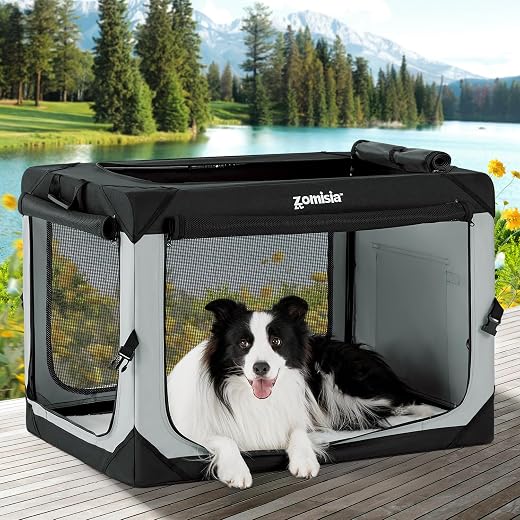
Price: $58.45 | Amazon rating: 4.4/5 (397 ratings) | Role: Containment at the destination | Key spec: 36 × 25 × 25 in, 12.7 lb, dogs to 70 lb, mesh windows, built-in leash
Two crates in one roundup of road trip essentials looks like padding until you have tried to use one crate for both jobs. The PetSafe is sized and belted for a seat; the ZOMISIA is sized for a floor. It is 36 inches long, 25 wide and 25 tall — a genuine large-dog kennel rated to 70 lb — and it weighs 12.7 lb, which is light enough to carry from the car to a first-floor holiday let in one trip. That is the entire argument for owning it: the dog gets the same box in Cornwall or Colorado that it sleeps in at home, and a dog with a familiar box settles roughly a night faster.
It folds the way a pop-up laundry hamper folds, which means setup is measured in seconds and there is no bag of poles to lose. Mesh windows on three sides handle ventilation, a plush pad comes in the box, and the built-in leash clip is the detail that repeatedly proves useful — you can open the zip a hand’s width and clip on before the dog is loose in an unfamiliar room. At $58.45 with a 4.4/5 average from 397 buyers, it is priced like an accessory rather than like the safety equipment above it, and that is the correct way to think about it.
The failure mode is the zip. A soft-sided crate is a containment suggestion for a dog that genuinely objects, and reviewers who report escapes almost always describe a dog that worked at the zipper rather than one that pushed through mesh. If yours is that dog, buy wire. And do not be tempted to promote this crate to the driving job because it is cheaper — the roles are different, the loads are different, and among the road trip essentials here this is the one that belongs at the destination, not on the motorway.
Best for: Holiday cottages, campsites, friends’ spare rooms and anywhere else your dog needs a familiar box to settle in — at roughly a third of the price of the PetSafe.
Skip if: You wanted a crash-worthy travel crate. This is a soft-sided kennel that happens to fold; it is not designed to hold a dog in a collision, and it should not be your restraint on the motorway. Skip it too if your dog resents confinement enough to work at a zip.
Read the full ZOMISIA Collapsible Dog Crate review →
Where to Buy — ZOMISIA Collapsible Dog Crate
3. Ninja FrostVault 45-Quart Wheeled Cooler — Best Cooler for a Full Day in the Car
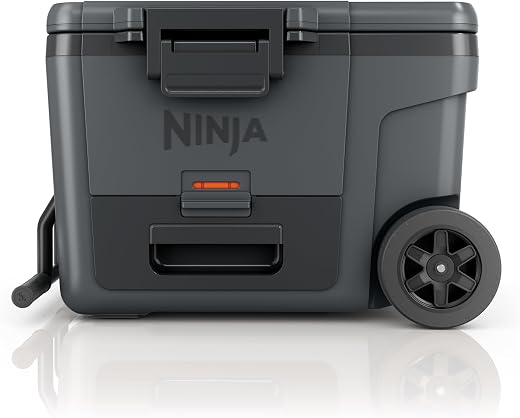
Price: $299.95 | Amazon rating: 4.5/5 (693 ratings) | Role: Cold food, drink and dog water | Key spec: 45 qt / 68 cans, sealed fridge-temp dry drawer, 30.2 lb empty, 5-year warranty
A cooler is where the food-safety arithmetic of road trip essentials actually happens, and the arithmetic is unforgiving. The USDA line is that perishable food is unsafe after two hours out of refrigeration — and after one hour once the ambient temperature passes 90 °F. Clemson’s extension guidance adds the detail most people get wrong: keep the cooler in the passenger compartment rather than the boot, because the boot runs hotter than the cabin you are sitting in. A 45-quart box that holds 68 cans is enough for a family for a full day, and the FrostVault holds a genuine 40 °F or below when it is packed full and left shut.
The feature that justifies the price is the dry drawer. Ninja seals a separate compartment underneath the ice chamber and keeps it at fridge temperature without letting meltwater in, which solves the single most annoying failure in cooler design: sandwiches, cheese and dog food going soggy in a bath of grey water halfway through the afternoon. Everything that must stay dry goes in the drawer, everything that must stay cold goes in the ice above it, and you stop having to bag things twice. All-terrain wheels and a telescoping handle matter more than they sound, because 45 quarts of ice and drinks is well over 60 lb loaded and nobody carries that across a car park twice.
The costs are real. It is 28.58 inches long and 30.2 lb empty, so in a hatchback it competes directly with the crate for floor space, and $299.95 buys a lot of soft cool bags. Ninja backs it with a five-year limited warranty and 693 buyers average it at 4.5/5, which is a reassuring pairing. If your road trip essentials list has to choose between this and the crate, buy the crate — but if you drive all day with food, water and a dog on board, this is the item that stops the day being organised around finding somewhere to eat.
Best for: Long drives where you would rather not stop, families who want lunch out of the boot instead of a service station, and anyone who has ever pulled a swollen sandwich out of melted ice.
Skip if: You are packing light or driving a small hatchback. At 28.6 in long and 30 lb before you put anything in it, the FrostVault takes real space — and at $299.95 it is by some distance the most expensive item here.
Read the full Ninja FrostVault 45qt Cooler review →
Where to Buy — Ninja FrostVault 45qt Cooler
4. BAGSMART 37L Foldable Travel Bag — Best Luggage When the Crate Has Taken the Boot
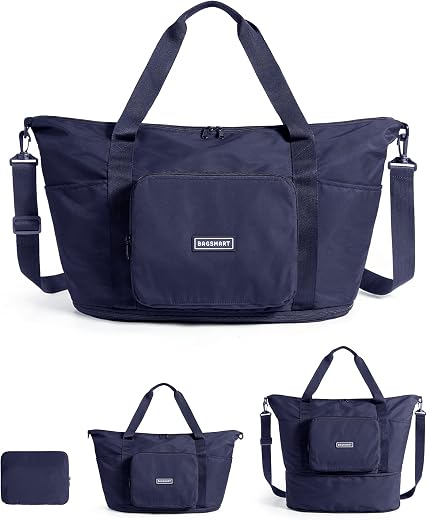
Price: $19.99 | Amazon rating: 4.5/5 (598 ratings) | Role: Soft luggage that collapses | Key spec: 37 L expanded, folds to a flat pouch, trolley sleeve, water-resistant polyester
This is the least glamorous entry in the list and the one that quietly makes the rest fit. Once a crate is in the car, boot space stops being a volume and starts being a shape, and hard suitcases are the wrong tool for an awkward shape. The BAGSMART folds down to a flat pouch on the outbound leg, expands to 37 litres when you need it, and squashes into the gaps around a cooler and a crate that a rigid case simply cannot use. At $19.99 it costs less than a tank of fuel, which is the right price for a bag whose main virtue is not being there.
It has a trolley sleeve, three compartments, a removable shoulder strap and a water-resistant polyester shell, and 598 buyers give it 4.5/5. On a driving holiday its real job tends to be the return leg: the bag you did not pack, holding the things you bought, the wet coats, the muddy towel and whatever the dog destroyed. Because it collapses, it costs you nothing to bring on the off chance — which is the only reason anybody actually brings a spare bag.
It is not luggage in the protective sense. Soft polyester over no frame will not stop a 30 lb cooler sliding into a laptop, and half-packed it slumps. Load it with clothes and soft goods, keep anything fragile in a case, and treat it as the flexible member of your road trip essentials rather than the strong one.
Best for: The overflow bag. It folds to nothing on the way out, absorbs everything you bought on the way back, and squashes into the gaps a hard case cannot use.
Skip if: You need protection rather than flexibility. Soft polyester will not defend a laptop or a camera from a crate sliding into it, and there is no structure to stop it slumping when half full.
Read the full BAGSMART Foldable Travel Bag review →
Where to Buy — BAGSMART Foldable Travel Bag
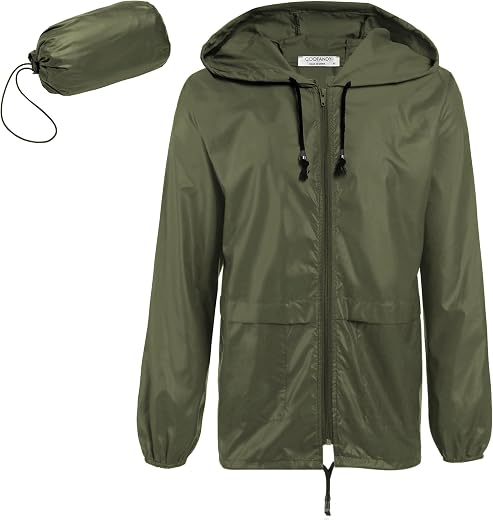
5. COOFANDY Packable Rain Jacket — Best Jacket for Every Stop You Make
Price: $19.99 | Amazon rating: 4.4/5 (6,404 ratings) | Role: Weather protection at stops | Key spec: Hooded waterproof shell, packs into its own pocket, lightweight polyester
Weather is the variable every list of road trip essentials underestimates, because you experience a driving day from inside a heated box and forget that you will step out of it eight or nine times. Fuel, coffee, the dog, the view, the wrong junction. Each of those is a two-minute exposure, and two minutes in horizontal rain is enough to make the next two hours miserable. The COOFANDY is a hooded waterproof shell that packs into its own pocket, so it lives permanently in the door bin instead of being the thing you left in the hall.
At $19.99 with 6,404 ratings averaging 4.4/5, it is the highest-volume product on this page and the expectations should be set accordingly: sealed enough for real rain, light enough to forget, and cheap enough that you own two — one in the car, one in the bag. Sizing runs slim, so most reviewers advise going up one, and the hood is fixed rather than roll-away, which is the right call for a jacket you will mostly wear in a hurry.
It is not a mountain shell. There are no pit zips, breathability is modest, and a sustained uphill walk in it gets clammy inside twenty minutes. But among road trip essentials the relevant question is not whether a jacket performs on a ridgeline; it is whether it is in the car at all when the sky opens over a motorway service area. This one is, because it takes up no room and costs nothing to keep there.
Best for: The dog that still needs walking when it is raining, the petrol stop that turns into a downpour, and the glovebox that has room for exactly one jacket.
Skip if: You want a technical shell. There is no pit zip, the breathability is modest, and a long uphill walk in it gets clammy. It is a rain layer for twenty minutes at a time, which is precisely what a driving day asks of it.
Read the full COOFANDY Packable Rain Jacket review →
Where to Buy — COOFANDY Packable Rain Jacket
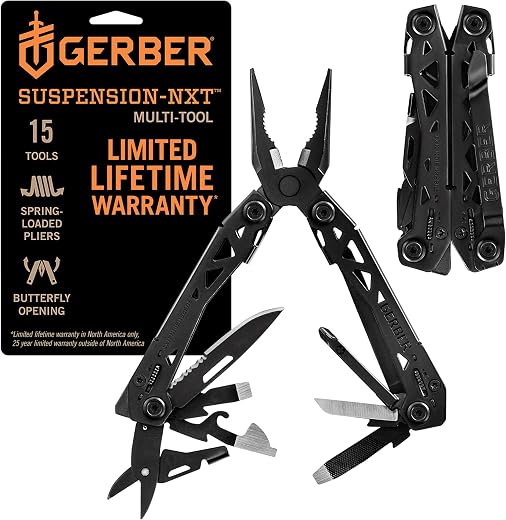
6. Gerber Suspension NXT Multitool — Best Roadside Multitool for the Glovebox
Price: about $41 | Amazon rating: 4.6/5 (23,768 ratings) | Role: Roadside fixes | Key spec: 15 tools, 4.25 in folded, 8.48 oz (240 g), alloy steel, spring-loaded pliers
Almost nothing that goes wrong on a driving holiday is a mechanical failure worthy of the name. It is a trailer strap that will not release, a number plate flapping on one screw, a jubilee clip that has vibrated loose, a crate bolt working its way out, a cable tie that needs cutting, a splinter in a thumb. A multitool is on this list of road trip essentials because those are exactly the failures that a mobile phone and a breakdown membership cannot solve, and they are the ones that actually happen.
The Suspension NXT is the sensible middle of that market. Fifteen tools on a spring-loaded needle-nose plier frame, 4.25 inches folded, 8.48 ounces of alloy steel, and a pocket clip so it lives somewhere findable rather than in the bottom of a bag. Spring-loaded jaws matter more than the tool count: they let you work one-handed while the other hand holds whatever you are fixing. At around $41 and 4.6/5 from 23,768 ratings, it is the most thoroughly reviewed product on this page by a wide margin, and that volume of feedback is itself a form of quality control.
Two honest caveats. The knife blade is short and sits at the shallow end of what a dedicated folder gives you, so if you already carry one this duplicates a little. And 240 grams is real weight in a door pocket. There is also a legal point worth knowing before you pack it, and it differs sharply between the two countries this article is written for — see the US vs UK section below, because a locking blade is treated very differently in England and Wales than it is on an American interstate.
Best for: Trailer straps, a loose number plate, a jubilee clip, a crate bolt that rattled itself undone somewhere around junction 14 — the small failures that turn a drive into a delay.
Skip if: You want a knife. The blade is short and the plier jaws are the point of this tool; if you carry a proper folder already, the Suspension NXT duplicates less than you think but adds 240 g to the door pocket.
Read the full Gerber Suspension NXT review →
Where to Buy — Gerber Suspension NXT
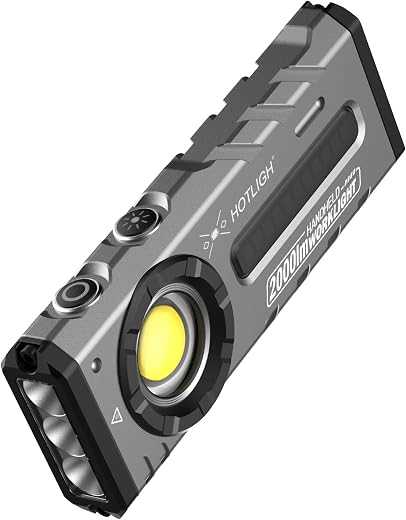
7. ZF8313 Magnetic Rechargeable Flashlight — Best Light for a Breakdown After Dark
Price: $23.99 | Amazon rating: 4.6/5 (911 ratings) | Role: Light where you break down | Key spec: 2,000 lumens, 144 m throw, magnetic tail, IPX6, USB rechargeable, up to 15 h
The last of these road trip essentials is the one you will be gladdest to own on the single worst evening of the trip. Phone torches are fine for finding a dropped key and useless for anything that needs two hands, because the hand holding the phone is the hand you needed. The ZF8313 solves that with a magnetic tail cap: it sticks to the wing, the boot lid or the jack, throws 2,000 lumens up to 144 metres, and gives you both hands back.
It charges over USB rather than eating primary cells, runs up to 15 hours on lower output, and carries an IPX6 rating — splash and rain proof, not submersible. At $23.99 with 4.6/5 from 911 buyers it is cheap enough to keep one in each car. The RGB and UV modes are marketing rather than function; ignore them. What matters is that a light with a magnet is a fundamentally different tool from a light without one, and roadside work at night is where that difference is worth the whole purchase price.
It is not a pocket torch. At 4.53 inches it is longer than a true everyday-carry light and it lives in the glovebox, not on a keyring. Note also that in the UK the advice for a motorway breakdown is to get out of the vehicle and behind the barrier rather than to work at the roadside at all, and warning triangles must never be used on motorways — so this is a light for lay-bys, campsites and unlit country roads far more than for the hard shoulder.
Best for: Changing a wheel on an unlit verge. The magnet sticks it to the wing or the boot lid and gives you two hands back, which no phone torch will ever do.
Skip if: You want a pocket light. At 4.53 in it is longer than a true EDC torch, and the RGB and UV modes are novelty rather than function. IPX6 handles rain but is not a diving rating.
Read the full ZF8313 Magnetic Flashlight review →
Where to Buy — ZF8313 Magnetic Flashlight
Road Trip Essentials — Buyer’s Guide: What to Look For
Seven products is a shopping list. What follows is the reasoning behind it, so you can substitute sensibly if your car, your dog or your budget is different from ours.
Road Trip Essentials Start With Restraint, Not With Comfort
The ranking of road trip essentials that most buyers use — comfort first, safety later — is backwards, and it is backwards for an unintuitive reason. Comfort items fail gracefully. A cheap cool bag means warm drinks; a bad neck pillow means a stiff neck. Restraint fails catastrophically or not at all. The AVMA’s guidance is unambiguous: an unrestrained animal can be injured by an airbag, thrown in a stop, or interfere with the driver’s control of the vehicle. Buy the containment first and let the rest of the budget follow.
Sizing matters as much as construction. The rule the AVMA gives is that the carrier should let the animal stand up, turn around and lie down comfortably, and that it should sit toward the centre of the vehicle rather than against a door. A crate that is too small is a welfare problem; one that is too big lets the dog build momentum inside it.
Road Trip Essentials for Dogs: Treat “Crash-Tested” as a Marketing Word
This is the single most useful thing in this guide. The Center for Pet Safety is the organisation whose name appears, directly or by implication, on a great many pet travel products. Its own FAQ says two things worth quoting: its testing is “approximately 30 MPH… a very violent crash simulation”, and “we don’t endorse ANY product”, with a certification programme still in development. Manufacturers referencing CPS are referencing its research, not an approval.
So when you compare road trip essentials for dogs, look for a published test report with a named protocol and a dummy weight, not a badge. In the absence of one, prefer a rigid frame over fabric, prefer a crate that is belted or anchored over one that merely sits, and put the crate in the cargo area or across the rear bench rather than on a front seat where an airbag deploys.
Cold-Chain Road Trip Essentials: Buy Volume You Will Actually Fill
Coolers are sold on ice retention and used on packing discipline. A full cooler holds temperature dramatically longer than a half-empty one, so a 45-quart box you fill beats a 70-quart box you do not. The safe target is 40 °F (4 °C) or below, and the clock you are racing is the USDA’s: two hours out of refrigeration, one hour if it is above 90 °F (32 °C) outside.
Two practical points that change behaviour more than any spec sheet. First, keep the cooler in the cabin, not the boot — extension guidance is explicit that the boot runs hotter. Second, a separate dry compartment is worth paying for if you carry anything that must stay dry as well as cold, because meltwater, not warmth, is what ruins most road trip food.
Road Trip Essentials Should Fold, and Nothing Should Fly
Space on a driving holiday is not a volume, it is a shape, and the shape is decided by the largest rigid object you own. Once a crate and a cooler are in, the remaining space is a set of awkward gaps. That is why soft, collapsible luggage outperforms hard cases here even though hard cases win at an airport, and it is why a packable jacket beats a good jacket you left at home.
The corollary is loose-object discipline. Anything not restrained is travelling at your speed and will keep travelling at your speed when the car does not. Heavy items go low and forward, in the footwell behind a front seat or against the rear seat back — never on a parcel shelf, and never stacked above the seat line behind a dog.
Assume No Mains Power: Road Trip Essentials That Charge Over USB
The most reliable filter for road trip essentials is to ask what happens on day three in a car park with no socket. USB-rechargeable beats mains-only; anything with primary cells needs spares; anything that must be plugged in is a liability. A 2,000-lumen light that runs 15 hours on a charge and takes USB is a different proposition from a mains-charged lantern, and a multitool needs no power at all, which is precisely why it stays useful when everything else is flat.
US vs UK: What Changes When You Drive With a Dog
The same seven road trip essentials work on both sides of the Atlantic. Almost everything around them changes — the law, the units, the roadside procedure and half the vocabulary.
The Dog: Guidance in America, a Code Rule in Britain
Britain has a named rule. Rule 57 of the Highway Code says: “When in a vehicle make sure dogs or other animals are suitably restrained so they cannot distract you while you are driving or injure you, or themselves, if you stop quickly”, and it lists a seat belt harness, pet carrier, dog cage or dog guard as ways of doing it. Rule 57 is advisory in itself, but breaching the Code can be used as evidence in proceedings for careless driving, and insurers routinely point at it after a claim.
The United States has no federal equivalent. Restraint is handled indirectly, through state distracted-driving statutes and, in a few states, animal-cruelty provisions. The practical effect is the same advice from a different direction: the NHTSA counts 3,208 people killed and an estimated 315,167 injured in distraction-affected crashes in 2024 — 8% of all traffic deaths that year. A dog climbing into your lap is a distraction in exactly that statistical sense.
Breakdown Road Trip Essentials: Rule 277 Is the One to Know
This is where the two countries diverge most sharply, and where a British reader’s road trip essentials list changes. In the UK, the Highway Code is explicit that when you break down on a motorway, “animals MUST be kept in the vehicle or, in an emergency, under control on the verge.” That capitalised MUST marks a legal requirement, not advice. Meanwhile the humans are told to get out of the nearside door and stand behind the barrier — so on a British motorway, the dog stays in and you get out.
Two more British specifics. Warning triangles must be placed at least 45 metres behind the vehicle on ordinary roads, and never used on motorways at all. And National Highways has retrofitted more than 150 additional emergency areas — blue signs with an orange SOS telephone symbol, with phones wired to its control rooms — plus over 700 signs telling you how far the next one is. In the US, reflective triangles are the default roadside signal and there is no equivalent national network of marked refuges.
Phones, Sat-Navs and the Cradle Rule
Since 25 March 2022 it has been illegal in England, Scotland and Wales to hold and use any mobile device while driving — not merely to make a call. Checking the time, scrolling, taking a photo and using an app all count, on any device “capable of interactive communication even if that functionality is not enabled at the time”. The penalty is a minimum £200 fine and six points, and six points inside two years of passing your test costs a new driver their licence. Navigation stays legal, but only with the phone mounted in a cradle.
American law is a patchwork: most states ban handheld use, a few do not, and the details change at every state line. If you are a British driver hiring a car in the States, the safe habit is the one you already have. If you are an American driving in Britain, note that the UK rule is stricter than almost any state’s, and that a phone loose on the passenger seat is enough.
Fuel, Distance and the Gallon Trap
Both countries measure road distance in miles and speed in miles per hour, which lulls people into assuming the rest converts. It does not. Britain sells fuel by the litre and quotes economy in miles per imperial gallon of 4.546 litres; America sells by the US gallon of 3.785 litres. The same car is about 20% more economical on paper in Britain purely because the gallon is bigger. A 40 mpg American car is roughly 48 mpg British.
Speed limits differ too. The British national limit is 70 mph on motorways and dual carriageways and 60 mph on single carriageways, applied by road type rather than posted everywhere; American limits are posted and range from 55 to 85 mph depending on the state. Temperatures on your cooler are °F in the States and °C in Britain, and the 40 °F food-safety threshold most American guidance quotes is 4 °C on a British fridge thermometer.
Knives and Tools: The Road Trip Essentials That Change at the Border
The Gerber above is the one product on this list whose legality changes when you fly. In England and Wales it is an offence to carry in public a folding pocketknife with a blade over three inches, or any locking blade, without good reason — and a locking multitool blade counts. “It lives in the car” is not automatically a good reason. In most American states a multitool in a vehicle raises no issue at all. Keep it packed in luggage rather than on your person when in Britain, and check the state you are driving through in the US.
Road Trip Essentials Vocabulary, Because It Is on the Signs
British boot is American trunk; bonnet is hood; petrol is gas and a petrol station is a gas station; a motorway is a highway or interstate and a dual carriageway is roughly a freeway; motorway services are a rest area or rest stop; a lay-by is a pull-off; indicators are turn signals; the windscreen is the windshield; tyres are tires; a number plate is a license plate; a car park is a parking lot; and a cool box is a cooler.
British torch is American flashlight, which is why half the road trip essentials lists you read call the same object by two names. A caravan is a trailer and a motorhome is an RV. And when a British forecast says it will be 22 degrees, that is 72 °F and a genuinely warm day for a dog in a parked car.
Road Trip Essentials — Which One Should You Buy?
Few people buy seven things at once. Here is how the list of road trip essentials divides by budget, and what each tier actually gets you.
Under $50 — Road Trip Essentials for the Glovebox
Three items, roughly $65 together, and the highest return per dollar on this page: the COOFANDY packable rain jacket at $19.99, the BAGSMART 37L foldable bag at $19.99, and the ZF8313 magnetic flashlight at $23.99. All three fold, none needs mains power, and all three solve problems you will otherwise solve badly at 9pm in a car park. If you buy nothing else from this list of road trip essentials, buy these.
$50 to $150 — Road Trip Essentials That Handle the Evening
Add the Gerber Suspension NXT at about $41 and the ZOMISIA 36-inch collapsible crate at $58.45. The multitool covers the small mechanical failures that cause most roadside delays; the crate turns any rented room into somewhere your dog will actually sleep. Together they take the kit from “we have a torch” to “we can handle the evening”, and the whole tier still costs less than one night in a pet-friendly hotel.
$150 and Up — The Whole Kit of Road Trip Essentials
The two big-ticket road trip essentials are the PetSafe Happy Ride collapsible car crate at $159.99 and the Ninja FrostVault 45-quart cooler at $299.95. If you can only take one, take the crate: it is the only item here that addresses the failure mode with the worst consequences. Add the FrostVault when your drives are genuinely all-day, when you are feeding more than two people out of the car, or when you would rather not depend on service-station food for a week.
Dogs, Heat and the Law: What the Rules Actually Say
This is the researched part of the article, and it is the part that changes what you buy. Four things govern travelling with a dog: restraint, heat, documents and food. All four are handled differently in the United States and the United Kingdom, and all four are cited below.
Heat: The Numbers Are Worse Than People Think
The American Veterinary Medical Association gives the arithmetic directly. The interior of a parked vehicle rises about 20 °F in ten minutes, almost 30 °F in twenty, and more than 40 °F above the outside temperature within an hour — so a 70 °F day produces an interior over 110 °F. The AVMA adds the line that undoes most people’s mental model: “cracking the windows makes no difference.”
The RSPCA states the same physics in Celsius for a British summer: at 22 °C outside — a pleasant day, not a heatwave — a car can reach 47 °C within an hour. Twenty-two degrees is the temperature at which most British owners would not think twice about a quick shop. That single conversion is the most useful fact in this section.
The practical consequence for road trip essentials is that no product solves this. A cooler does not cool a car, a crate does not ventilate one, and a sunshade buys minutes. The only reliable answer is that the dog comes with you or someone stays with the vehicle, which is why a packable jacket and a torch earn their place: they are what make “both of us get out” a workable plan in bad weather or after dark.
If You See a Dog in a Hot Car
In Britain the RSPCA’s advice is to dial 999 at once if the dog is showing signs of heatstroke, because the police have powers of entry that the charity does not. If the dog is not in distress, note the registration, ask nearby premises to page the owner, and stay with the animal. The RSPCA warns that breaking a window “could be classed as criminal damage”, though you may have a lawful excuse if you reasonably believe the owner would consent given the danger.
In the United States it depends entirely on the state. The Animal Legal Defense Fund counts 29 states with a law prohibiting leaving a companion animal unattended in a parked vehicle. Only eight — California, Colorado, Indiana, Massachusetts, Wisconsin, Florida, Ohio and Tennessee — allow a member of the public to break in, and six of those require you to call law enforcement first. In 19 states only officials may do it, and in New Jersey and West Virginia the confinement is unlawful but nobody is authorised to break in.
Documents: A 2026 Change British Owners Keep Missing
If your road trip essentials include a Channel crossing, the paperwork changed this year. From 22 April 2026, EU pet passports issued to GB residents before that date may no longer be valid for entry to the EU, and GB residents need an Animal Health Certificate to take a dog, cat or ferret from Great Britain into the EU. The certificate can now be used for up to six months of onward travel within the EU, which is a genuine improvement on the old single-trip AHC.
Two further details in the same change. There is now a limit of five pets per private vehicle rather than five per person, and if somebody else travels with the animal, written permission from the owner must accompany the travel document. EU pet passports can still be used for the return journey into Great Britain. American owners crossing into Canada or Mexico face a separate and equally moving set of rules, and should check both countries’ current requirements rather than last year’s.
Food: Two Hours, or One
The USDA’s threshold is the one to hold in your head. Perishable food is unsafe after two hours out of refrigeration, and that window collapses to one hour once the ambient temperature is above 90 °F (32 °C). A cooler is only a solution while it is at or below 40 °F (4 °C), which means packed full, packed with plenty of ice or gel packs, opened rarely, and topped up as the ice melts.
Clemson’s extension guidance adds the counter-intuitive instruction that changes where the box goes: put the cooler in the passenger compartment, not the boot, because the boot is too warm to hold safe temperatures. At the destination, keep it shaded — under a blanket or a towel if there is no natural shade. None of this is exotic, but it is the difference between a cooler that works and a cooler that is a box of warm water by three in the afternoon.
Restraint: Why It Leads Any List of Road Trip Essentials
The reason restraint leads this list of road trip essentials rather than trailing it is that the distraction data is unambiguous. NHTSA recorded 3,208 people killed in distraction-affected crashes in the United States in 2024 and an estimated 315,167 injured — 8% of the year’s 39,254 traffic deaths and 13% of all people injured. Britain’s Highway Code addresses the same risk from the front, in Rule 57, and from the back in Rule 277, which makes keeping animals in the vehicle during a motorway breakdown a legal MUST rather than a suggestion.
Road Trip Essentials — Frequently Asked Questions
Is it illegal to drive with an unrestrained dog in the UK?
Not directly. Rule 57 of the Highway Code says dogs must be suitably restrained so they cannot distract you or be injured in a sudden stop, and it lists harnesses, carriers, cages and dog guards as ways to comply. Rule 57 uses “should”, so breaching it is not itself an offence — but the Code can be cited as evidence in a careless or dangerous driving prosecution, and insurers may reduce or refuse a claim where an unrestrained animal contributed. Treat it as effectively mandatory.
What about the United States?
There is no federal restraint law. A handful of states address it through animal-cruelty or distracted-driving statutes, and enforcement is uneven. The practical case is statistical rather than legal: NHTSA counted 3,208 distraction-related deaths in 2024. A dog in your lap is the same category of hazard as a phone in your hand.
Do I need two crates for a road trip with a dog?
Not necessarily, but the two crates in this list do genuinely different jobs. The PetSafe Happy Ride is sized and belted for a rear bench and folds flat afterwards; the ZOMISIA is a 36-inch, 70 lb-rated kennel meant to be carried into wherever you are staying. If you drive an SUV and load the dog into the cargo area, one large crate can cover both roles. In a saloon or hatchback, it cannot.
Are “crash-tested” dog crates actually tested?
Some are, but the badge means less than it appears. The Center for Pet Safety — the body most often invoked — states in its own FAQ that its testing is an approximately 30 mph crash simulation and that it does not endorse any product, with certification still in development. Ask for a published report with a named protocol and dummy weight. In its absence, prefer a rigid frame, an anchored mounting point and a position away from airbags.
How long can a dog safely be left in a parked car?
Treat the answer as zero. The AVMA measures a roughly 20 °F rise in ten minutes and more than 40 °F within an hour, and says cracking the windows makes no difference. The RSPCA’s Celsius version is that 22 °C outside can become 47 °C inside within an hour. This is the constraint that shapes the rest of your road trip essentials: plan the day so the dog never has to wait in the vehicle.
What do I do if my car breaks down on a UK motorway with the dog aboard?
The Highway Code is specific and it surprises people: animals MUST be kept in the vehicle, or in an emergency kept under control on the verge. The humans leave by the nearside doors and wait behind the barrier, well away from the vehicle and from traffic. Do not put out a warning triangle on a motorway — triangles are for ordinary roads, at least 45 metres behind the car. Look for an emergency area, marked by a blue sign with an orange SOS telephone symbol.
Can I use my phone as a sat-nav on a British road trip?
Yes, but only in a cradle. Since 25 March 2022 it has been illegal in England, Scotland and Wales to hold and use any mobile device while driving, for any purpose — including checking the time or scrolling. The penalty is a minimum £200 fine and six penalty points, and six points within two years of passing your test means losing your licence. Mount it before you set off.
Is a multitool legal to keep in the car in the UK?
Carefully. GOV.UK explains that the only knife you may carry in public without good reason is a folding pocketknife with a cutting edge of three inches or less that is not a lock knife — and most multitool blades lock. The maximum penalty for carrying a knife illegally is four years’ imprisonment, an unlimited fine, or both. Keep a multitool packed with your luggage rather than on your person, and be able to explain why it is there.
Do I still need a pet passport to take my dog to Europe?
If you live in Great Britain, no — you need an Animal Health Certificate. From 22 April 2026 EU pet passports issued to GB residents before that date may no longer be valid for entry to the EU, though they can still be used for the return journey home. The AHC now covers up to six months of onward travel within the EU, there is a limit of five pets per private vehicle, and written owner permission must travel with the pet if somebody else takes it.
Which road trip essentials do people most often forget?
Water for the dog that is still cold at four in the afternoon, and something to pour it into. It is the reason a cooler ranks as highly as it does among these road trip essentials — a bowl and a bottle in a warm boot is not a plan on a July drive. Second place goes to a light with a magnet, because every driver eventually needs both hands in the dark.
Road Trip Essentials — Final Thoughts
The honest summary of these road trip essentials is that six of the seven are cheap and one is not, and that the cheap ones do most of the work. A $20 jacket, a $20 bag and a $24 magnetic light cover the overwhelming majority of the small miseries a driving holiday produces, and they do it by being present rather than by being excellent.
The multitool and the destination crate extend that competence for another $100. Only the car crate and the cooler ask for real money, and they ask for it in exchange for the two things a car genuinely cannot do on its own: hold a dog safely at speed, and keep food below 40 °F for a working day.
If there is a single idea to take from this page, it is the one the research keeps returning to. Nothing you can buy makes it safe to leave a dog in a parked car — not a sunshade, not a ventilated crate, not a cool box on the seat beside it. A 70 °F afternoon becomes over 110 °F inside within the hour, and 22 °C becomes 47 °C.
So build the trip around that constraint first and choose the rest of your road trip essentials to support it: kit that folds, kit that charges over USB, kit that lets both of you get out of the car in the rain and after dark without it being a disaster. Do that and the drive stops being something to survive.
Sources and Further Reading
- GOV.UK — The Highway Code, Rules about animals (47 to 58), including Rule 57
- GOV.UK — The Highway Code, Breakdowns and incidents (274 to 287), including Rules 275–277
- American Veterinary Medical Association — Pet safety in vehicles
- RSPCA — Dogs die in hot cars
- Animal Legal Defense Fund — Can you break a window to save a dog in a hot car?
- Center for Pet Safety — Frequently asked questions on crash testing and certification
- NHTSA — Distracted Driving in 2024 (Traffic Safety Facts research note)
- House of Commons Library — Changes in the law on driving while using a mobile phone
- GOV.UK — Selling, buying and carrying knives and weapons
- GOV.UK — New EU rules for pet travel for GB residents (22 April 2026)
- Clemson Cooperative Extension — Traveling with food
- National Highways — More than 150 additional emergency areas installed on smart motorways
Affiliate disclosure: Blue Rays Technologies is a participant in the Amazon Services LLC Associates Program. If you buy through the links on this page we may earn a commission at no extra cost to you. Prices and availability were correct at the time of writing and are set by Amazon, not by us. Nothing here is veterinary, legal or safety advice — check the current rules for your state or country before you travel.