
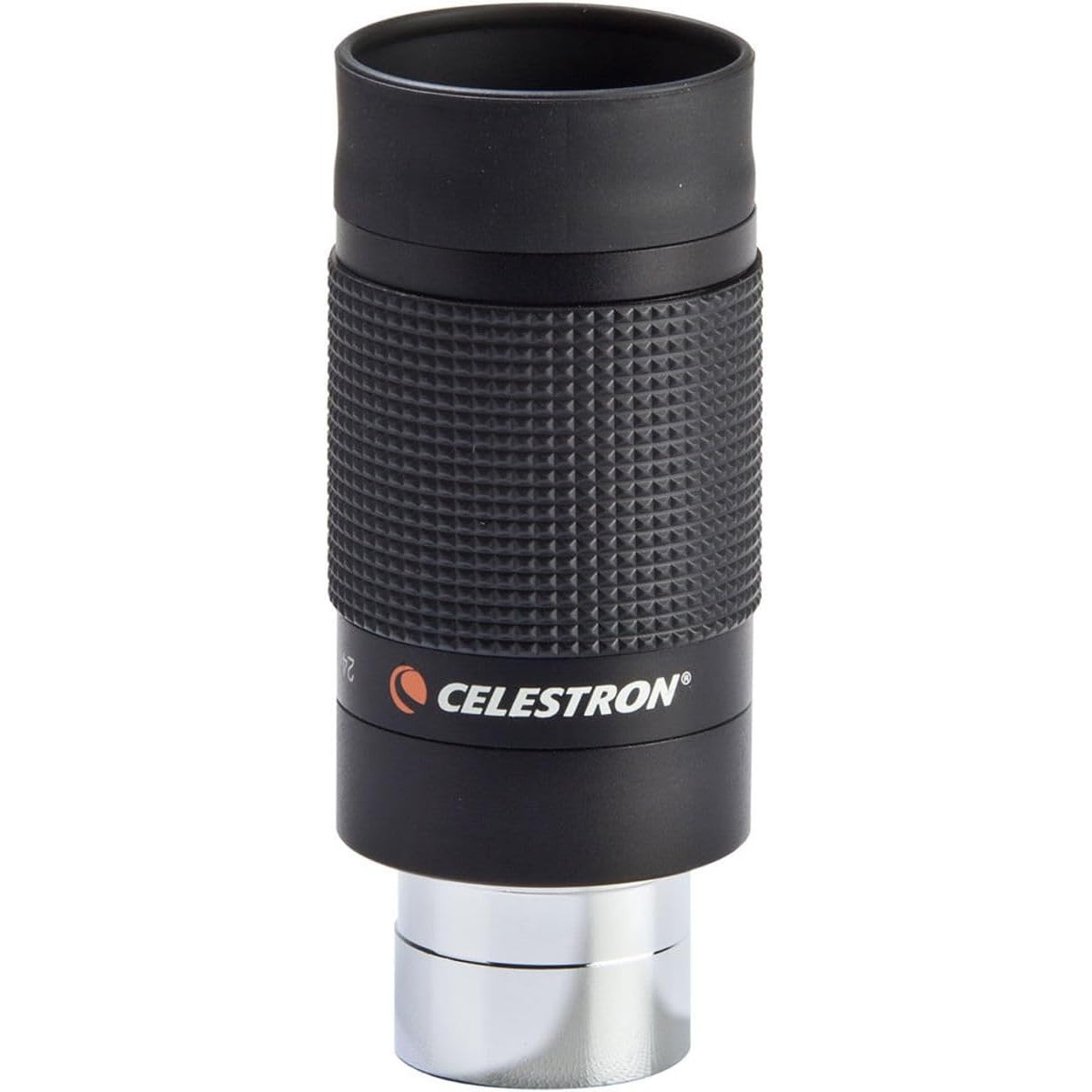
Choosing a telescope eyepiece is the first upgrade almost every telescope owner makes, and it is the one where the listings help least. We compared five, from $15.59 to $396, and the pick that suits most people is the Celestron 8-24mm zoom at $94.99 — not because it is the best glass here, but because it is the one that tells you what to buy next.
The five cover genuinely different jobs rather than five versions of one thing: a continuous zoom, a long-focal-length four-element Plössl for finding things, a premium zoom that fits both barrel standards, a cheap high-power Plössl for planets, and a three-piece set for the older 0.965-inch fitting that modern eyepieces will not go into at all.
We judged them on the figures their own listings publish: focal length, apparent field of view, barrel fitting and and how much of each listing describes the product rather than the telescope it plugs into. This comparison is research-based. We did not physically test these products; specifications, ratings and prices are taken from the live listings on the date shown. Links go to Amazon.com; UK readers can search the same models on Amazon.co.uk.
Telescope Eyepiece — Quick Comparison
| # | Product | Role | Focal length | Best for | Price | Score |
|---|---|---|---|---|---|---|
| 1 | Celestron 8-24mm Zoom | Best overall | 8–24mm zoom | One eyepiece instead of three | $94.99 | 8.7 |
| 2 | SVBONY 40mm Plössl | Best value | 40mm fixed | Finding things at low power | $24.99 | 8.3 |
| 3 | Baader Hyperion Mark IV | Premium pick | 8–24mm zoom | 2-inch focusers and binoviewing | $396.00 | 8.0 |
| 4 | Astromania 4mm Plössl | Best budget | 4mm fixed | High power on steady nights | $15.99 | 7.6 |
| 5 | Acxico 0.965in 3-Piece Set | Older telescopes | 20 / 12.5 / 4mm | A 0.965-inch focuser | $15.59 | 7.1 |
On this page
- The 5 Best Telescope Eyepiece Picks in 2026
- Telescope Eyepiece — Buyer’s Guide
- What the Rules Measure When You Point an Eyepiece at the Sun
- US vs UK: Inches, Approved Bodies and a Deleted Word
- Telescope Eyepiece Picks: Which One Should You Buy?
- Telescope Eyepiece Questions, Answered
- Telescope Eyepiece Picks: Final Thoughts
- Sources and Further Reading
The 5 Best Telescope Eyepiece Picks in 2026
1. Celestron 8-24mm Zoom — Best Overall
Amazon rating: 4.6 from 2,546 ratings | Barrel: 1.25 inch | Apparent field: 55 degrees
This is the eyepiece to buy if you do not yet know which eyepiece to buy. The published range runs from 8mm to 24mm at a stated 3:1 ratio, continuously rather than in click stops, and the listing makes the honest case for itself: instead of adding several expensive fixed focal lengths to a collection, you buy one barrel and find out over a few evenings which lengths you actually reach for.
It also carries the largest body of owner evidence here by a wide margin — 4.6 from 2,546 ratings — and a published two-year warranty, which most of this shelf does not manage. Two structured fields read 24 millimeters under the headings “Objective Lens Diameter” and “Optical Tube Length Measurement”, neither of which an eyepiece has.
Best for: You own one telescope, one or two eyepieces, and no settled idea of which focal lengths you use.
Skip if: You already observe at two known powers, or your focuser is 2 inches and you want that aperture used — this barrel is 1.25 inch only.
Read the full Celestron 8-24mm Zoom review →
Where to Buy — Celestron 8-24mm Zoom
2. SVBONY 40mm Plössl — Best Value
Amazon rating: 4.6 from 992 ratings | Barrel: 1.25 inch | Apparent field: 40 degrees
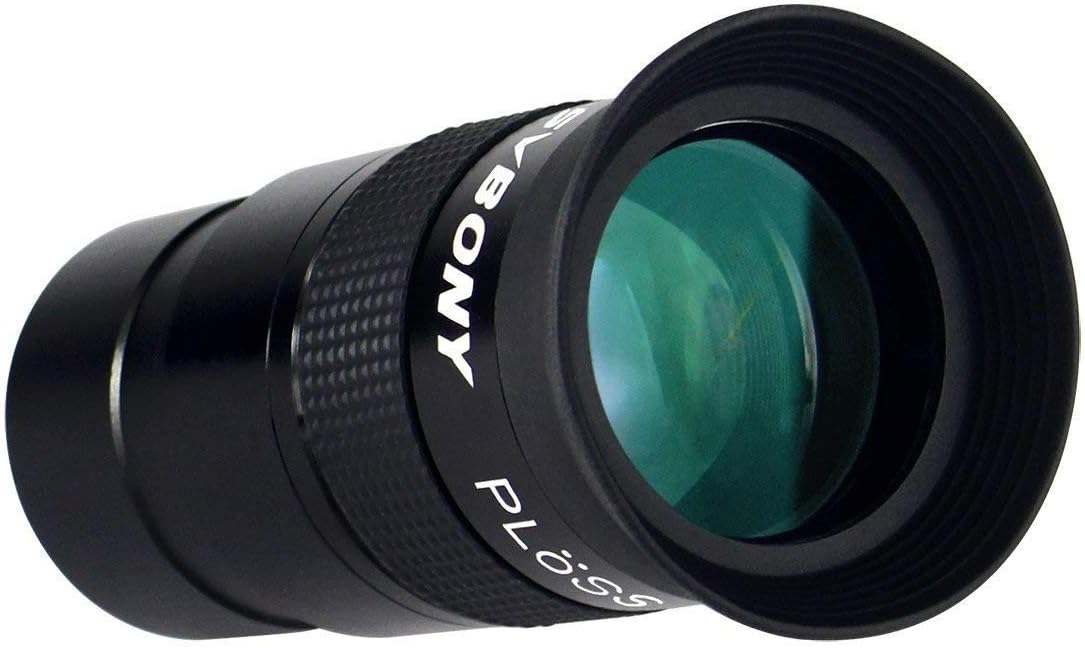
A long-focal-length four-element Plössl is the cheapest purchase that changes what a small telescope can do: inexpensive telescopes ship with short, high-power eyepieces, and high power makes finding anything harder. At 40mm this gives a bright image across a wide true field, which is what sweeping for a target requires.
The number 40 appears in seven structured fields. Four of them are focal-length fields and are correct. The other three read “Zoom Ratio: 40” on an eyepiece that does not zoom, “Screen Size: 40 millimeters” on a product with no screen. The glass is fine; the data is not.
Best for: Your telescope came with two short eyepieces and finding things is the frustrating part. This is the cheapest fix for that specific problem.
Skip if: You observe planets rather than star fields, or your telescope is a fast reflector where a 40mm exit pupil will exceed your own eye’s.
Read the full SVBONY 40mm Plössl review →
Where to Buy — SVBONY 40mm Plössl
3. Baader Hyperion Universal Mark IV — Premium Pick
Amazon rating: 4.4 from 107 ratings | Barrel: 1.25 inch and 2 inch | Apparent field: 68 degrees
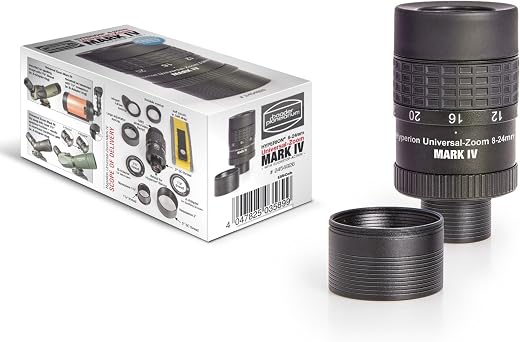
Two things justify $396 here. The first is that it ships with both a 1.25-inch and a 2-inch barrel, stated as usable on all focusers of either size and on some spotting scopes with a 1 3/8-inch thread. The second is the click-stop action at 8, 12, 16, 20 and 24mm, which the listing calls a must for binoviewing — two barrels set to the same detent without a torch.
The published apparent field is 68 degrees, against 55 and 40 for the two cheaper fixed-barrel options above, and that is the specification that earns the word premium. Then there is “Exit Pupil Diameter: 1.5 millimeters”, which is the most interesting wrong number on the page: an exit pupil exists only once you name a telescope. Three more fields call this product a Barlow, give it auto focus and describe it as a reflex finderscope.
Best for: You have a 2-inch focuser, more than one telescope, or a binoviewer. Those are the three cases where one barrel that fits everything is worth the money.
Skip if: It is your first eyepiece. Spend $24.99 on the Plössl, observe for a season, and come back when you know what a wider field would buy you.
Read the full Baader Hyperion Mark IV review →
Where to Buy — Baader Hyperion Mark IV
4. Astromania 4mm Plössl — Best Budget
Amazon rating: 4.6 from 73 ratings | Barrel: 1.25 inch | Apparent field: 50 degrees
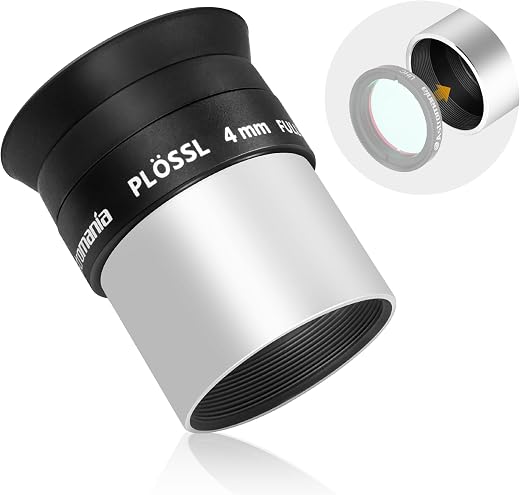
It is the listing that produced the single best specification failure of the five: “Focal Length Description” reads “19.685 inches”. That is 500 millimetres, which is a telescope’s focal length. The same listing says “4mm Focal Length” in its features and “4 mm focal length” in its description. The field a comparison tool reads is out by a factor of 125.
It is also the only listing of the five that publishes anything about eye relief, and what it publishes argues against buying it first: “Eye Relief is about 2/3 or 3/4 of focal length”. On a 4mm eyepiece that is under three millimetres — eyelashes on the glass, and no prospect of observing in spectacles. It printed the rule that produces it.
Best for: You already own something long and you want the planetary end of the range on the handful of nights when the air will carry it.
Skip if: It would be your first or only eyepiece, or you observe wearing glasses. Its own eye relief rule settles both questions.
Read the full Astromania 4mm Plössl review →
Where to Buy — Astromania 4mm Plössl
5. Acxico 0.965-Inch Three-Piece Set — Best for Older Telescopes
Amazon rating: 4.0 from 149 ratings | Barrel: 0.965 inch | Apparent field: 35 degrees
Nought point nine six five inches is 24.5 millimetres, and it was the eyepiece fitting on a generation of small refractors sold through catalogues. Almost nothing is made for it now, and the eyepieces are usually the part that has gone missing or fogged while the telescope itself is fine. Three replacements at $15.59 is the cheapest route to a working instrument.
Outside the 0.965-inch case, everything about it is a compromise: Huygens and Ramsden layouts a generation behind a four-element design, 35 degrees of apparent field, and 4.0 from 149 ratings, the lowest average here. Its focal length field reads, in full, “Multi-Coated 20 mm, 4 12.5 mm millimeters”, and its warranty field reads “no”.
Best for: Your telescope’s focuser measures 24.5 millimetres across. Then this is the difference between an instrument that works and one that does not.
Skip if: Your focuser takes 1.25-inch eyepieces. At almost the same money the Astromania Plössl above is better glass in the modern fitting.
Read the full Acxico 0.965in 3-Piece Set review →
Where to Buy — Acxico 0.965in 3-Piece Set
Telescope Eyepiece — Buyer’s Guide
The three numbers a telescope eyepiece actually owns
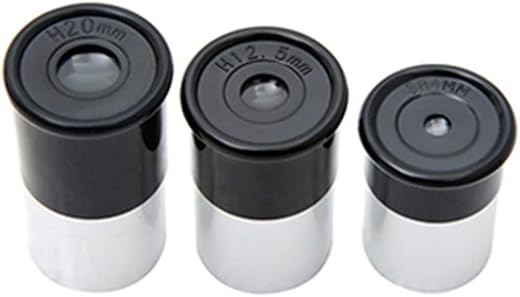
An eyepiece has three specifications of its own. The first is focal length in millimetres, which is the number printed on the barrel. The second is apparent field of view in degrees, which is the size of the image circle presented to your eye. The third is eye relief in millimetres: how far behind the glass your pupil can sit and still see the whole field.
Focal length is published on every listing we looked at. Apparent field is published on most. Eye relief, across the fifty-two eyepiece listings this search returned, was not published in a structured field by a single one of them.
Why magnification is not a telescope eyepiece specification
Magnification is the telescope’s focal length divided by the eyepiece’s. It is a property of the pair, not of either one, and it changes the moment you put the same eyepiece on a different instrument. A 10mm eyepiece gives 90 times on a 900mm telescope and 120 times on a 1,200mm one. Neither figure is a fact about the eyepiece.
This matters commercially because magnification is what the category is sold on. One listing here describes its 8mm to 24mm range in its own highlight field as “Variable 8-24mm Magnification”, conflating the two in four words.
Barrel diameter, and the specification with no standards body behind it
There are three barrel sizes in practice. 1.25 inch (31.7mm) is the modern norm; 2 inch (50.8mm) is used by larger focusers for long-focal-length wide-field eyepieces; and 0.965 inch (24.5mm) is the older fitting on small catalogue refractors. They are not interchangeable without an adapter, and on a short tube an adapter can stop the focuser reaching focus at all.
What is striking about the most consequential compatibility dimension in the category is that it is a convention rather than a standard. No body publishes it, no certificate attests to it, and it is expressed in imperial inches worldwide, including in countries that use millimetres for everything else. Measure the inside of your focuser before buying anything; 24.5mm and 31.7mm are easy to tell apart with a ruler and impossible to tell apart from a photograph.
Eye relief, and the one figure a telescope eyepiece listing will not give you
Eye relief decides whether an eyepiece is usable with glasses on. Roughly 15mm or more and you can observe in spectacles; under about 8mm and you cannot. In simple designs it scales with focal length, which is why a 40mm Plössl is comfortable and a 4mm one is not.
What the Rules Measure When You Point an Eyepiece at the Sun
There is one way to be permanently injured by an eyepiece, and it is to point the telescope at the Sun.
Solar filters are sold against ISO 12312-2, and the standard is narrower than the marking suggests. The American Astronomical Society’s eclipse safety pages state that “ISO 12312-2 applies only to certain products intended for direct viewing of the everyday Sun”, and add that it “also does not apply to solar filters meant to fit over the aperture (front) of optical devices” such as “camera lenses, binoculars, or telescopes”. The certification a buyer looks for, in other words, covers a different object from the one a telescope owner needs.
The two regimes then part company on who checks, and when. In UK law, Regulation (EU) 2016/425 on personal protective equipment — still in force, and up to date with changes in force on 12 October 2026 — sorts equipment into three categories. Annex I says “Category I includes exclusively the following minimal risks:” and lists, among them, “damage to the eyes due to exposure to sunlight (other than during observation of the sun);”. Those six words in brackets do the whole job: eyewear for observing the Sun is pushed out of Category I, and “Category II includes risks other than those listed in Categories I and III;”.
That reclassification has teeth, because Article 19 attaches a different procedure to each category. Category I needs only “internal production control (module A) set out in Annex IV” — the manufacturer’s own declaration. Category II needs “type-examination (module B) set out in Annex V” followed by “conformity to type based on internal production control (module C) set out in Annex VI;”, and module B is an examination by a third-party body before the product may be sold.
The United States has no equivalent gate. The one binding federal rule that reaches this kind of eyewear is 21 CFR 801.410, which opens “To protect the public more adequately from potential eye injury,” and requires that “eyeglasses and sunglasses must be fitted with impact-resistant lenses”. The criterion is mechanical: a steel ball “weighing approximately 0.56 ounce is dropped from a height of 50 inches” and “the lens must not fracture”. It is a real requirement, enforced, and it measures how well a lens survives being dropped on — not how much sunlight it stops.
So the divergence is not about what the two regimes say about solar viewing. It is about when anybody looks. Neither regime, incidentally, reaches the eyepiece itself: an eyepiece is not protective equipment and never was. The practical rule is the one every astronomical society gives. Filter the front of the telescope, never the eyepiece end, and if the only certification on offer is the one for holding up to your naked eye, it is not the certification you need.
US vs UK: Inches, Approved Bodies and a Deleted Word
The hardware does not fork. Barrel diameters are 1.25 inch, 2 inch and 0.965 inch on both sides of the Atlantic, and focal lengths and apparent fields are in millimetres and degrees everywhere. A telescope eyepiece bought in one country fits a telescope bought in the other, which is unusual in this series.
The vocabulary barely forks either. “Eyepiece” and “ocular” are both used in both places — the Baader listing above still carries its German product name, “Hyperion Universal Weitwinkel Zoom Okular”, in the field a shopping filter reads. The regulation shows the border in its own margin too: the retained text of Article 19 carries the note “Word in Art. 19(b) omitted (31.12.2020)”, and the word struck out is the one that used to make that examination an EU one rather than a British one.
Telescope Eyepiece Picks: Which One Should You Buy?
Under $20: the cheapest useful telescope eyepiece purchase
Two of the five sit here, and they answer opposite questions. If your focuser is 0.965 inch, the Acxico three-piece set at $15.59 is effectively the only answer. If your focuser is 1.25 inch, the Astromania 4mm Plössl at $15.99 is a good third eyepiece and a poor first one, for the reason its own listing publishes: under 3mm of eye relief.
$20 to $100: where most people should buy a telescope eyepiece
This is the tier that matters. The SVBONY 40mm Plössl at $24.99 fixes the problem beginners actually have, and it is the single best value here. The Celestron 8-24mm zoom at $94.99 is the better buy if you can stretch to it, because it covers the range and tells you which fixed focal lengths to buy afterwards. Buying both, at under $120 together, is a more complete set than most people assemble in a year.
Above $100: buying a telescope eyepiece for its specification
One pick, and it is a narrow recommendation. The Baader Hyperion Universal Mark IV at $396 buys a published 68-degree apparent field and the only barrel here that fits both 1.25-inch and 2-inch focusers. If you own one 1.25-inch telescope, it is twenty-five times the price of the cheapest eyepiece on this page for an apparent field thirteen degrees wider than a barrel costing a quarter as much.
A note on where this guide sits
This is our first guide to astronomical optics, so there is no neighbouring round-up to send you to within the category. The closest relative is elsewhere: our comparison of the best fly tying tools ran into the same defect from the other direction, where real measurements were published in the wrong unit. Eyepiece listings go one step further and publish figures that are not properties of the product at all.
Telescope Eyepiece Questions, Answered
How many telescope eyepieces do I need?
Three covers almost everything: something long for finding and for wide star fields, something medium for general viewing, and something short for the Moon and planets on steady nights. A single zoom covering that range, like the Celestron 8-24mm above, is a reasonable substitute for two of the three while you work out which lengths you prefer.
Are telescope eyepieces universal?
Within a barrel size, essentially yes. Any 1.25-inch eyepiece will go into any 1.25-inch focuser or star diagonal regardless of brand, and the same holds for 2-inch.
Which eyepiece is best for viewing planets?
The shortest focal length your telescope and the night’s air will carry, which is usually longer than beginners expect. Divide your telescope’s focal length by the eyepiece’s to get the magnification,. On most evenings a 10mm will show more planetary detail than a 4mm, because the 4mm magnifies the atmosphere as faithfully as it magnifies Saturn.
What is the difference between a 1.25 inch and a 2 inch telescope eyepiece?
Barrel diameter, and what it allows. A 2-inch barrel can pass a wider light cone, so it permits longer focal lengths at wide apparent fields than a 1.25-inch barrel physically can. A 2-inch focuser will take 1.25-inch eyepieces with an adapter, but doing so throws away the capability you paid for.
How do I clean a telescope eyepiece?
As rarely as possible. Blow loose dust off with a bulb blower, and leave the rest alone unless there is something on the glass that affects the view. When you must, use a proper lens fluid on a lens tissue, not a shirt,. Most eyepieces that die young die of being cleaned.
What telescope eyepieces should I buy first?
One long one. If your telescope came with a 25mm and a 10mm, add something in the 32mm to 40mm range and you will find more objects in a week than you did in the previous month. The $24.99 Plössl above is that purchase at the cheapest honest price we found.
Telescope Eyepiece Picks: Final Thoughts
The shelf’s habit is consistent enough to be useful. Thirty-five of the fifty-two listings we looked at published the diameter of a telescope’s objective lens; eighteen published an exit pupil that cannot exist until you name a telescope; not one published eye relief where a machine could read it. The figures are not invented and they are mostly not even wrong as arithmetic. They simply describe the instrument on the other end of the focuser.
So buy on the three numbers that belong to the eyepiece — focal length, apparent field of view and eye relief — work the magnification out yourself from your own telescope, and read any objective diameter, exit pupil or power figure on a listing as a description of equipment you may not own. On that basis the Celestron 8-24mm zoom at $94.99 is the pick for most people, the SVBONY 40mm Plössl at $24.99 is the best value on the page, and the Baader at $396 is worth its money only to the narrow group who already know why.
Sources and Further Reading
- American Astronomical Society — “ISO 12312-2”, solar eclipse eye safety
- Regulation (EU) 2016/425 on personal protective equipment, Annex I (legislation.gov.uk)
- Regulation (EU) 2016/425, Article 19 — conformity assessment procedures (legislation.gov.uk)
- 21 CFR 801.410 — Use of impact-resistant lenses in eyeglasses and sunglasses (Cornell LII)
We earn a commission on qualifying purchases made through the Amazon links on this page, at no extra cost to you. Prices and listing figures were read on 16 October 2026 and change without notice.