
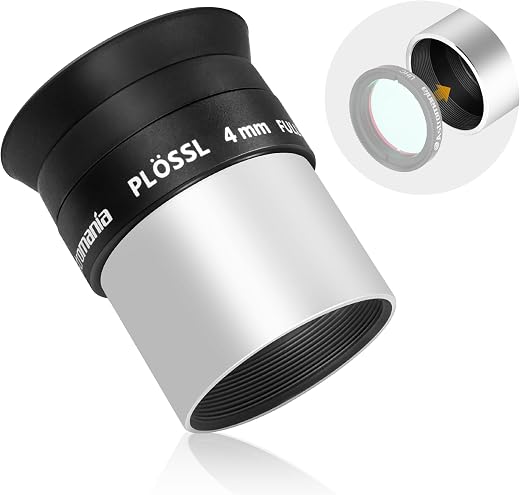
Astromania 4mm Plossl Eyepiece Review (2026): Worth It?
The Astromania 4mm Plssl costs $15.99 and carries 4.6 from 73 ratings, and its listing publishes its headline specification twice: as 4mm Focal Length in one field and as 19.685 inches in the field a shopping filter reads. It scores 7.6, and the most useful line on the whole listing is the one that tells you not to buy this focal length first.
$15.99
Astromania 4mm Plössl Eyepiece — 4mm Telescope Eyepiece Review
The Astromania 4mm Plössl costs $15.99 and carries 4.6 from 73 ratings, and its listing publishes its headline specification twice: as “4mm Focal Length” in one field and as “19.685 inches” in the field a shopping filter reads. It scores 7.6, and the most useful line on the whole listing is the one that tells you not to buy this focal length first.
This comparison is research-based. We did not physically test these products; specifications, ratings and prices are taken from the live listings on the date shown. This review belongs to our round-up of the best telescope eyepieces, where it is ranked fourth of five.
On this page
- Key Specifications
- Four Millimetres, Published as 19.685 Inches
- The One Line on This 4mm Telescope Eyepiece That Publishes Eye Relief
- Three More Fields Borrowed From the Telescope
- Limitations of This 4mm Telescope Eyepiece
- Setting Up This 4mm Telescope Eyepiece
- Who Should Buy This 4mm Telescope Eyepiece?
- The Verdict
- 4mm Telescope Eyepiece — Frequently Asked Questions
Key Specifications
Every figure below is taken from the live listing for this product on 16 October 2026.
| Reviewed model | 4mm telescope eyepiece |
| Published focal length (features field) | 4mm Focal Length |
| Published focal length (structured field) | 19.685 inches |
| Published field of view | 50 degrees |
| Published zoom ratio | 1:1 |
| Published eye relief | “About 2/3 or 3/4 of focal length” |
| Optical design | 4 element, fully multi-coated |
| Barrel fitting | 1.25 inch |
| Published objective lens diameter | 4 millimeters |
| Published optical tube length | 1.25 inches |
| Published exit pupil diameter | 1 millimeters |
| Published item weight | 2.22 ounces |
| In the box | 1 x 4mm plossl eyepiece, 2 x Dust Covers |
| Model number | SKU_AM_PT14 |
| Warranty field | None published |
| Owner rating | 4.6 from 73 ratings |
Four Millimetres, Published as 19.685 Inches
“Focal Length Description” on this listing reads “19.685 inches”. Nineteen and a half inches is 500 millimetres, which is a telescope’s focal length and not an eyepiece’s. The same listing’s “Additional Features” field says “4mm Focal Length” and the description says “4 mm focal length” twice. The correct figure is 4mm — and the field a comparison tool reads is out by a factor of 125.
This is worse than leaving the field empty, and the reason is worth being clear about. An empty field is visibly empty, so a buyer looks elsewhere on the page. A field reading 19.685 inches looks like a specification, sorts like one, and quietly places this 4mm telescope eyepiece alongside products it has nothing in common with. The number was measured, converted and entered; what went wrong happened after that.
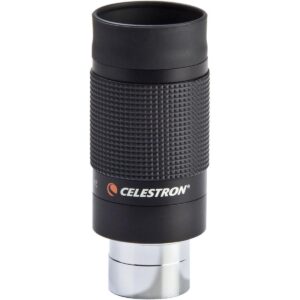
The rest of this 4mm telescope eyepiece is unremarkable in the way a cheap component should be: a four-element fully multi-coated Plössl in a machined aluminium alloy body, with a fold-down rubber eyeguard and a filter thread. The published field of view is 50 degrees, which is normal for the layout and is one of the two figures on the listing that describes the product it is printed on.
The One Line on This 4mm Telescope Eyepiece That Publishes Eye Relief
Buried in “Additional Features” is this: “Eye Relief is about 2/3 or 3/4 of focal length”. Across fifty-two eyepiece listings this shelf search returned, not one carried a structured field named eye relief, and this is the closest any of them comes to publishing the figure. It is a rule of thumb rather than a measurement, and it is the most useful sentence on the listing.
Work it through on this product and it argues against buying it as your first purchase. Two-thirds to three-quarters of 4mm is between 2.7 and 3.0 millimetres of eye relief, which means your eyelashes on the glass and no chance of observing in spectacles. The listing is not hiding that; it published the rule that produces it. A 4mm telescope eyepiece is a specialist high-power tool, and this one tells you so if you do the arithmetic.
Three More Fields Borrowed From the Telescope
“Objective Lens Diameter: 4 millimeters” is the focal length again, in a field that describes the front of a telescope. “Optical Tube Length Measurement: 1.25 inches” is the barrel diameter, in a field that describes the length of a tube. “Exit Pupil Diameter: 1 millimeters” depends on the focal ratio of whatever instrument this is plugged into and cannot be a fixed property of the eyepiece.
One field gets it right, and it is the one most of this shelf gets wrong: “Zoom Ratio” reads 1:1. A fixed-focal-length eyepiece has no zoom range, and 1:1 is the honest way to say so — the SVBONY listing on this shelf answers the same field with 40. “Power Source: Manual Operation” is also correct, which puts it ahead of the set further down this page that claims to be battery powered.
What the borrowed fields add up to is a 4mm telescope eyepiece whose structured data would place it, in any mechanical comparison, among products of a different kind entirely. The description is accurate; the title is accurate; the features field is accurate. The failure is confined to the layer a buyer never reads directly and a filter never reads anything else.
Limitations of This 4mm Telescope Eyepiece
- The structured focal length field reads 19.685 inches, out by a factor of 125 from the product’s actual 4mm.
- Eye relief works out at roughly 2.7 to 3.0 millimetres from the listing’s own rule of thumb, which rules out observing in spectacles.
- 4mm is the highest-power, narrowest-field end of the range, and the air is steady enough to use it on a minority of nights.
- 73 ratings is the smallest body of owner evidence on this shelf, even at a 4.6 average.
- No warranty field is published, and the model number field reads “SKU_AM_PT14”, which is a warehouse string rather than a model name.
- Three structured fields describe a telescope rather than this eyepiece.
Setting Up This 4mm Telescope Eyepiece
Fit it last, not first. Find and centre the object with a long-focal-length eyepiece, check the image is sharp, then swap to the 4mm: at this power the field of view is narrow enough that an object slightly off centre will not be in it at all, and the focus point shifts as you change eyepieces. The listing ships two dust covers, which is the right number for an eyepiece you will be swapping in and out in the dark.
Expect to refocus and expect to be disappointed on hazy nights. High power magnifies the atmosphere along with the planet, and on most evenings a 10mm will show more detail than this will. The body is aluminium alloy and the eyeguard folds down; there is nothing to service and nothing to adjust.
Fit it with the telescope already tracking or already pointed, and expect to re-centre. At the magnifications a 4mm telescope eyepiece produces on a typical instrument, an undriven mount moves a planet out of the field in well under a minute, which is the practical argument for owning a 10mm as well.
Who Should Buy This 4mm Telescope Eyepiece?
Buy this 4mm telescope eyepiece as a second or third eyepiece, specifically for planets and the Moon on steady nights, and only if you have a long-focal-length eyepiece already. At $15.99 it is the cheapest way to own the high-power end of the range, and 4.6 from 73 ratings suggests the people who bought it knew what it was for.
Do not buy it as a first eyepiece and do not buy it if you observe in glasses. The listing’s own eye relief rule settles both questions. A beginner who wants one upgrade should take the 40mm Plössl higher up this page, which solves the problem beginners actually have.
The honest summary is that this is the cheapest correct answer to a question most beginners are not asking yet. Buy it third, use it on perhaps one night in four, and it will still have been worth $15.99 on the night Saturn sits steady.
The Verdict
At $15.99 this is a competent four-element eyepiece for a narrow job, sold on a listing that publishes its own focal length as 19.685 inches, and it scores 7.6.
| Published field of view | 8.4 / 10 |
| Optical design | 8.2 / 10 |
| Owner evidence | 7.6 / 10 |
| Listing honesty | 5.0 / 10 |
| Eye relief disclosure | 8.8 / 10 |
| Build quality | 7.8 / 10 |
| Value for money | 9.4 / 10 |
| Breadth of use | 5.6 / 10 |
4mm Telescope Eyepiece — Frequently Asked Questions
The questions buyers ask most often, answered from the listing.
What magnification will a 4mm telescope eyepiece give me?
Divide your telescope’s focal length by four. On a 900mm instrument that is 225 times; on a 1,200mm instrument it is 300 times. Both are near or past the useful limit for most apertures and most nights, which is the practical reason a 4mm is a specialist purchase rather than a first one.
Why does the listing say the focal length is 19.685 inches?
Because the structured field is wrong. 19.685 inches is 500 millimetres, which is a telescope’s focal length rather than an eyepiece’s. The same listing states “4mm Focal Length” in its features and “4 mm focal length” in its description, and the product title ends in “4mm”. The eyepiece is 4mm.
Can I use this eyepiece wearing glasses?
No, and the listing tells you so indirectly. It states that “Eye Relief is about 2/3 or 3/4 of focal length”, which on a 4mm eyepiece is under three millimetres. Spectacle wearers need roughly 15 millimetres or more, so this focal length in this optical design is not usable with glasses on.
Is a cheap 4mm eyepiece worth having at all?
Yes, as the high-power end of a small set, on the handful of nights when the air is steady enough to carry it. What it is not worth is being the eyepiece you reach for first, and that is how a bundled short eyepiece puts beginners off astronomy: the image is dim, narrow and hard to find, and none of that is the telescope’s fault.
Check the current price on Amazon
Listing figures last read on 16 October 2026. We earn a commission on qualifying purchases made through the Amazon link above, at no extra cost to you.
Related reviews
Other reviews from the same shelf:


There are no reviews yet.