
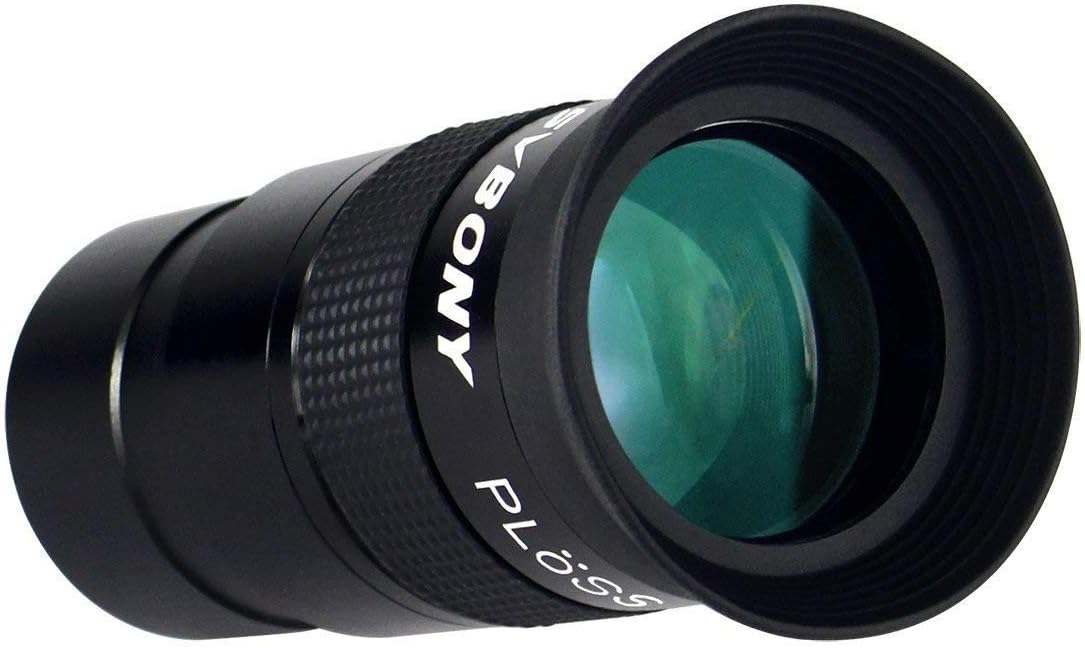
SVBONY 40mm Plossl Eyepiece Review (2026): Worth It?
The SVBONY 40mm costs $24.99 and carries 4.6 from 992 ratings, and it is the listing on this shelf that publishes the most fields and gets the most of them wrong in the same way: the number 40 appears in seven of them, meaning seven different things. It scores 8.3, because the optics behind the paperwork are a straightforward four-element design at a price that makes it the easiest first upgrade here.
$24.99
SVBONY 40mm Plossl Eyepiece — Plossl Eyepiece Review
The SVBONY 40mm costs $24.99 and carries 4.6 from 992 ratings, and it is the listing on this shelf that publishes the most fields and gets the most of them wrong in the same way: the number 40 appears in seven of them, meaning seven different things. It scores 8.3, because the optics behind the paperwork are a straightforward four-element design at a price that makes it the easiest first upgrade here.
This comparison is research-based. We did not physically test these products; specifications, ratings and prices are taken from the live listings on the date shown. This review belongs to our round-up of the best telescope eyepieces, where it is ranked second of five.
On this page
- Key Specifications
- The Number 40, Published in Seven Fields
- Why a 40mm Plossl Eyepiece Is the Cheapest Real Upgrade
- A Field Name That Describes the Wrong Quantity
- Limitations of This Plossl Eyepiece
- Setting Up This Plossl Eyepiece
- Who Should Buy This Plossl Eyepiece?
- The Verdict
- Plossl Eyepiece — Frequently Asked Questions
Key Specifications
Every figure below is taken from the live listing for this plossl eyepiece on 16 October 2026.
| Reviewed model | plossl eyepiece |
| Published focal length | 40 millimeters |
| Published angle of view | 40 degrees |
| Optical design | 4 element |
| Barrel fitting | 1.25 inch |
| Filter thread | M28.5 x 0.6 |
| Published photo filter size | 28.5 millimeters |
| Coating | Fully multi-coated (description); “Fully Coated” (field) |
| Published zoom ratio | 40 |
| Published screen size | 40 millimeters |
| Published maximum aperture | 4 f_stop |
| Published item weight | 96 g |
| Model number | FUSF9122A |
| Warranty field | One year, plus 30 days return |
| Owner rating | 4.6 from 992 ratings |
The Number 40, Published in Seven Fields
The focal length is 40mm and the apparent field is 40 degrees, and those two facts between them account for every structured figure on this listing. “Focal Length Description”, “Maximum Focal Length”, “Minimum Focal Length” and “Lens Fixed Focal Length” all read 40 millimeters, which is correct four times over and tells you nothing new on the second, third or fourth reading.
Then it goes wrong. “Zoom Ratio” reads 40 on a fixed-focal-length eyepiece that does not zoom at all. “Screen Size” reads 40 millimeters on a product that has no screen. “Maximum Aperture” reads 4 f_stop, which is the element count in a field borrowed from camera lenses. One real number has been distributed across seven fields, and three of the seven describe quantities this product does not have.
None of this is a reason to avoid the product, and that distinction matters. The fields were populated by whatever process fills a category template, and the optics behind them are a conventional four-element layout at a conventional focal length. What the seven fields cost you is the ability to compare this listing against another one mechanically, which is precisely what a shopping filter is for.
Why a 40mm Plossl Eyepiece Is the Cheapest Real Upgrade
A four-element Plössl at 40mm is the longest focal length the design handles well, and it is the eyepiece that turns a telescope into something you can sweep with. Low power means a bright image and a wide true field, which is what finding things actually requires — and the eyepieces bundled with inexpensive telescopes are usually short-focal-length, high-power glass that makes finding anything harder.
At $24.99 this plossl eyepiece is also the cheapest item on the shelf that is a single, serious piece of optics rather than a set. The description claims a “generous 40° apparent field of view” and an all-black interior to suppress stray light, and it specifies the filter thread as M28.5 x 0.6 so you know a 1.25″ moon filter will screw in.
A Field Name That Describes the Wrong Quantity
The structured field reads “Real Angle Of View: 40 degrees”, and the description reads “a generous 40° apparent field of view”. Those are two different quantities. Apparent field is the angle the eyepiece presents to your eye; true or real field is how much sky that covers, and it equals the apparent field divided by the magnification. On any telescope the real field is several times smaller than 40 degrees.
So the figure is right and its label is wrong, which is a more awkward error than a wrong figure, because a buyer comparing two listings in a filter has no way to see it. The practical reading is simple: treat 40 degrees as the apparent field, which is what the description says and what a four-element design of this focal length would be expected to deliver.
Both quantities are useful and they answer different questions. Apparent field tells you how immersive the view feels and how much eye movement it takes to look around the image. True field tells you whether the whole of the Pleiades will fit in one view, which is the question that decides whether an evening of sweeping is pleasant or frustrating. Only the second depends on your telescope, and only the first is a property of the eyepiece.
Limitations of This Plossl Eyepiece
- At 40mm on a short-focal-length telescope the exit pupil becomes large enough that the image can show the secondary mirror’s shadow on a reflector; this is a consequence of the long focal length, not a fault.
- Three of the thirty-seven structured fields — zoom ratio, screen size and maximum aperture — report quantities this eyepiece does not have.
- “Image stabilization” appears twice in the field list, with the same value both times.
- No eye relief figure is published, and a 40mm Plössl’s eye relief is long enough to be a genuine selling point if anyone had stated it.
- “Water Resistance Level: Water Resistant” is an unqualified claim with no rating or standard behind it.
Setting Up This Plossl Eyepiece
It fits any 1.25″ focuser or diagonal and needs nothing else. Use it as the eyepiece you start every session with: find the target at 40mm, centre it, then swap to something shorter if the air is steady enough to carry the power. The fold-down rubber eyeguard is on a bayonet mount, which the description says is there to keep spectacle lenses off the glass.
Keep the plastic case the listing says it ships with, and keep the dust caps on it. The only maintenance a plossl eyepiece needs is to stay capped; the commonest way a cheap eyepiece dies is a fingerprint on the eye lens cleaned off with a shirt.
One practical note on the long focal length: on a Newtonian reflector at a fast focal ratio, the exit pupil at 40mm can exceed the diameter of a dark-adapted eye pupil, and the visible symptom is a dark patch at the centre of the field where the secondary mirror sits. Nothing is broken when that happens. It simply means the pairing has reached the lowest useful power for that instrument.
Who Should Buy This Plossl Eyepiece?
Buy this if your telescope came with two short eyepieces and finding anything is the frustrating part. A long-focal-length four-element design at $24.99 fixes that specific problem more cheaply than anything else on this shelf, and it has 992 ratings averaging 4.6 behind it.
Skip it if you observe planets rather than star fields, because 40mm is the lowest-power end of the range and planets want the other end. Skip it too if your telescope is a fast reflector and you already know the exit pupil at 40mm will be larger than your eye’s pupil.
It is also the right present to buy somebody who was given a telescope and has stopped using it, because a short bundled eyepiece is the usual reason a telescope ends up in a cupboard. At $24.99 the risk is small and the failure mode it fixes is the common one.
The Verdict
At $24.99 this is the shelf’s best ratio of real optics to money, and the paperwork around it is the most thoroughly confused of the five, which is why it scores 8.3 rather than higher.
| Published focal length | 9.2 / 10 |
| Published field of view | 7.0 / 10 |
| Optical design | 8.6 / 10 |
| Owner evidence | 9.2 / 10 |
| Listing honesty | 6.2 / 10 |
| Build and coatings | 8.4 / 10 |
| Value for money | 9.8 / 10 |
| Accessory threads | 9.0 / 10 |
Plossl Eyepiece — Frequently Asked Questions
The questions buyers ask most often, answered from the listing.
What is a Plössl eyepiece?
A Plössl is a four-element optical layout, and it is the design most inexpensive eyepieces use because it gives a flat, well-corrected image across a moderate apparent field for very little money. This listing states the four-element design in both its “Item Highlight” field and its description. The layout’s weakness is short eye relief at short focal lengths, which is why a 40mm Plössl is comfortable and a 4mm one is not.
Is 40mm too long for my telescope?
It can be. At 40mm the exit pupil is the eyepiece’s focal length divided by your telescope’s focal ratio, so a fast f/4 reflector gives a 10mm exit pupil, which is larger than a dark-adapted eye can use. On an f/8 or slower instrument the figure is 5mm or less and the eyepiece works as intended. This is a property of the pairing, not of the eyepiece.
Does the 40 degree figure mean I see 40 degrees of sky?
No. The 40 degrees is the apparent field — the angle presented to your eye. The amount of sky covered is that figure divided by the magnification, so on a typical instrument you are looking at a true field of about one degree. The structured field on this listing calls it “Real Angle Of View”, which names the wrong quantity.
Will 1.25 inch filters screw onto this plossl eyepiece?
Yes. The listing specifies an M28.5 x 0.6 female filter thread and a “Photo Filter Size” of 28.5 millimeters, which is the standard 1.25″ astronomy filter thread. A moon filter is the usual first purchase and it fits.
Check the current price on Amazon
Listing figures last read on 16 October 2026. We earn a commission on qualifying purchases made through the Amazon link above, at no extra cost to you.
Related reviews
Other reviews from the same shelf:


There are no reviews yet.