
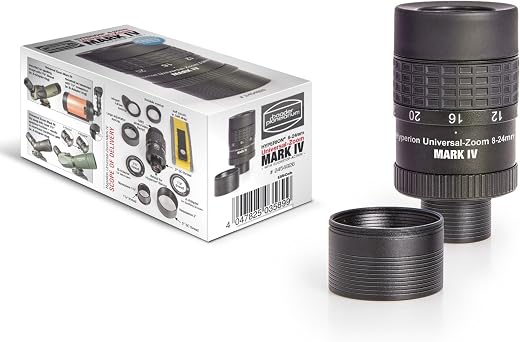
Baader Hyperion Universal Mark IV Zoom Review (2026): Worth It?
The Baader Hyperion Universal Mark IV costs $396 and carries 4.4 from 107 ratings, and it is the only item on this shelf that ships with both a 1.25″ and a 2″ barrel. It scores 8.0: the 68-degree apparent field and the five click-stopped focal lengths are real and well stated, and four of its twenty-three structured fields describe equipment that is not an eyepiece at all.
$396.00
Baader Hyperion Universal Mark IV Zoom — Wide Angle Telescope Eyepiece Review
The Baader Hyperion Universal Mark IV costs $396 and carries 4.4 from 107 ratings, and it is the only item on this shelf that ships with both a 1.25″ and a 2″ barrel. It scores 8.0: the 68-degree apparent field and the five click-stopped focal lengths are real and well stated, and four of its twenty-three structured fields describe equipment that is not an eyepiece at all.
This comparison is research-based. We did not physically test these products; specifications, ratings and prices are taken from the live listings on the date shown. This review belongs to our round-up of the best telescope eyepieces, where it is ranked third of five.
On this page
- Key Specifications
- Two Barrels in One Box, Which Is What the $396 Buys
- Sixty-Eight Degrees Is Why This Is a Wide Angle Telescope Eyepiece
- A Figure That Silently Assumes a Telescope You May Not Own
- Limitations of This Wide Angle Telescope Eyepiece
- Setting Up This Wide Angle Telescope Eyepiece
- Who Should Buy This Wide Angle Telescope Eyepiece?
- The Verdict
- Wide Angle Telescope Eyepiece — Frequently Asked Questions
Key Specifications
Every figure below is taken from the live listing for this wide angle telescope eyepiece on 16 October 2026.
| Reviewed model | wide angle telescope eyepiece |
| Published focal length | 8 to 24 millimeters |
| Click-stopped focal lengths | 8, 12, 16, 20 and 24mm |
| Published field of view | 68 degrees |
| Published zoom ratio | 3 |
| Barrel fittings | 1.25″ and 2″, both included |
| Also stated | Some spotting scopes with 1 3/8″ thread |
| Photo thread | M43 video and photo thread |
| Coating | Phantom Coating Group multicoatings |
| Published item weight | 16 ounces |
| Published dimensions | 6.3″D x 3.15″W x 3.15″H |
| Published exit pupil diameter | 1.5 millimeters |
| Published lens description | “Barlow” |
| Published focus type | “Auto Focus” |
| Model number | 2454826 |
| Warranty field | None published |
| Owner rating | 4.4 from 107 ratings |
Two Barrels in One Box, Which Is What the $396 Buys
The description states it plainly: “Includes 2″ and 1¼” barrel, usable for all telescopes with 1.25″ or 2″ focusers, and some spotting scopes with 1 3/8″ thread”. No other item on this shelf of five does that. Every other eyepiece here commits you to one fitting, and a 2″ focuser used with a 1.25″ barrel is a 2″ focuser throwing away the aperture you paid for.
The second thing the money buys is the click-stop action at 8, 12, 16, 20 and 24mm. A detent you can feel in the dark means you know which focal length you are at without a torch, and the description makes the specific case for it as “a must for effortless binoviewing” — two matched barrels set to the same stop. That is a narrow use, but it is the use this design is built around.
It is worth being precise about what the two barrels do and do not buy you. Fitting the 2″ barrel does not widen the apparent field, which is fixed by the optical design at 68 degrees. What it does is let a 2″ focuser and diagonal pass the full light cone without a step-down adapter in the path, which is the reason those focusers exist.
Sixty-Eight Degrees Is Why This Is a Wide Angle Telescope Eyepiece
The published apparent field is 68 degrees, against 55 for the Celestron zoom and 40 for the SVBONY Plössl. That is the specification that makes this a wide angle telescope eyepiece rather than a zoom that happens to be expensive, and it is the number to compare across the shelf, because apparent field is one of only two or three quantities an eyepiece genuinely owns.
What a wider apparent field buys is the sense of looking through a window rather than down a tube, and more sky at any given magnification. The coatings are named as the Phantom Coating Group multicoatings and the claim made for them is contrast and “total freedom from reflections”, which is a marketing phrase doing a specification’s job — though on a 68-degree field, stray light control is exactly where the money shows.
A Figure That Silently Assumes a Telescope You May Not Own
“Exit Pupil Diameter: 1.5 millimeters” is the most interesting wrong number on this shelf, because it is not wrong as arithmetic. The exit pupil of an eyepiece is its focal length divided by the telescope’s focal ratio, so 1.5mm is a perfectly good answer — for one focal length on one telescope. Change either and the figure changes. Published as a flat specification, it describes a pairing rather than a product.
Three more fields describe other equipment entirely. “Eye Piece Lens Description” reads “Barlow”, and a Barlow is the opposite kind of accessory — a lens that multiplies magnification, sold separately. “Focus Type” reads “Auto Focus” on a device with no motor and no electronics. “Finderscope” reads “Reflex”, and this is not a finder. The “Model Name” field, meanwhile, is the German product name — “Hyperion Universal Weitwinkel Zoom Okular” — carried over untranslated.
The pattern across all four fields is the same one, and it is the pattern this whole shelf shows: the figures were entered into a schema built for telescopes and cameras, and an eyepiece is neither. The description underneath, which a person wrote, is accurate throughout and specific about the things that matter. The structured block above it, which a filter reads, is not.
Limitations of This Wide Angle Telescope Eyepiece
- At $396 it is twenty-five times the price of the cheapest item here, and the apparent field it buys is 68 degrees against 55 for a barrel at under a quarter of the cost.
- Four of twenty-three structured fields — lens description, focus type, finderscope and mount — describe equipment that is not an eyepiece.
- The published exit pupil of 1.5 millimeters is only true for one focal length on one telescope and cannot be read as a property of the eyepiece.
- No warranty field is published at all, on the most expensive item on the shelf.
- At 16 ounces it is heavy enough to need the mount rebalanced, and in a 2″ diagonal that weight sits a long way from the pivot.
- 4.4 from 107 ratings is the smallest and the lowest-rated body of evidence among the three dearest items here.
Setting Up This Wide Angle Telescope Eyepiece
Decide which barrel you are using before the first session, because swapping them in the dark is the one fiddly part of owning this wide angle telescope eyepiece. In a 2″ diagonal, fit the 2″ barrel and balance the mount afterwards; the 16-ounce mass genuinely moves the balance point on a small refractor.
The three eyecups — a large adjustable rubber one, a smaller straight one and a winged foldable one — are not interchangeable conveniences but three different eye positions. Spectacle wearers want the foldable one; in that configuration the M43 thread underneath is exposed, which is also where a camera adapter goes. Keep the barrel you are not using capped and in the box.
Who Should Buy This Wide Angle Telescope Eyepiece?
Buy it if you have a 2″ focuser, more than one telescope, or a binoviewer, because those are the three cases where a single barrel that fits everything and clicks to repeatable focal lengths earns $396. The 68-degree apparent field is the widest on this shelf and it is a real, published figure.
Do not buy it as a first eyepiece. At this price the sensible path is the $24.99 Plössl, a season of observing, and then this one if you have learned that you want a wide field across a zoom range. Nothing about the optics argues against it; the argument is that a beginner cannot yet tell what it is doing better.
The Verdict
At $396 it publishes the widest apparent field here and the most confused set of structured fields relative to its price, and it scores 8.0 on that balance.
| Published field of view | 9.6 / 10 |
| Barrel compatibility | 9.8 / 10 |
| Published focal length | 9.2 / 10 |
| Build and coatings | 9.4 / 10 |
| Owner evidence | 7.0 / 10 |
| Listing honesty | 5.6 / 10 |
| Value for money | 5.8 / 10 |
| Upgrade path | 9.0 / 10 |
Wide Angle Telescope Eyepiece — Frequently Asked Questions
The questions buyers ask most often about this wide angle telescope eyepiece, answered from the listing.
Is this wide angle telescope eyepiece worth four hundred dollars?
It is if you own a 2″ focuser or more than one telescope, because it is the only barrel here that fits both standards and the only one with a published 68-degree apparent field. It is not if you own one 1.25″ telescope and are still working out which focal lengths you use, because a $94.99 zoom answers that question and a $24.99 Plössl answers the finding-things question.
What does the 68 degree figure actually mean?
It is the apparent field of view: the angle of the image circle presented to your eye. It is not how much sky you see — that is the apparent field divided by the magnification. Apparent field is one of the few numbers that belongs to the eyepiece itself rather than to the eyepiece and telescope together, which is why it is worth comparing between listings.
Why does the listing say Auto Focus?
Because the structured field is wrong. The product has no motor, no battery and no electronics; the only moving part is the twist collar you turn by hand. The same field list also describes the product as a Barlow and as a reflex finderscope, neither of which it is. We report the fields as published and rely on the description and the physical specification instead.
Can I use it for photography through the telescope?
The listing states an M43 video and photo thread “for afocal and classical projection photography”, which “permits optional adaptation of practically any camera with optional accessories”. So the thread is there and the adapters are extra. That is afocal photography through the eyepiece, which is a different technique from attaching a camera at prime focus.
Check the current price of this wide angle telescope eyepiece on Amazon
Listing figures last read on 16 October 2026. We earn a commission on qualifying purchases made through the Amazon link above, at no extra cost to you.
Related reviews
Other reviews from the same shelf:


There are no reviews yet.