
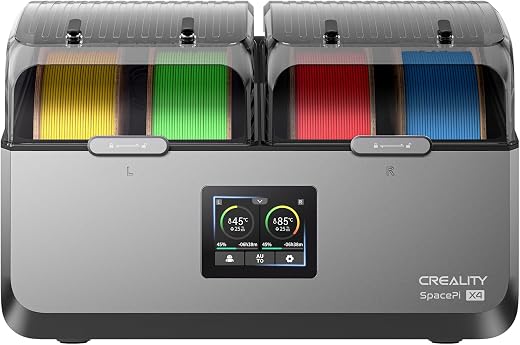
A filament dryer is the cheapest upgrade in 3D printing that nobody buys until a print fails, because wet filament does not look wet. It strings, it hisses, the layers refuse to bond and the surface comes out rough — and the first instinct is to blame the printer. We compared five filament dryer units on Amazon.com from $32.29 to $158.99, and the best overall is the Creality Space Pi X4, the only one that reaches a temperature nylon actually requires.
The five cover the range a home workshop or small print farm would realistically shop: a $32.29 single-spool box with real temperature control, a $39.59 two-spool box that doubles as sealed storage, a $43.99 box with the biggest chamber and review count, a $71.99 modular system that never breaks the seal, and a $158.99 dual-chamber machine that reaches 85°C.
Our scores weight eight criteria and the heaviest is maximum temperature, because it determines which materials a dryer can serve at all. This comparison is research-based. We did not physically test these products; specifications, ratings and prices are taken from the live listings on the date shown. Links go to Amazon.com; UK readers can search the same models on Amazon.co.uk after reading the mains-voltage caveat below.
Filament Dryer — Quick Comparison
| # | Product | Role | Key spec | Best for | Price | Score |
|---|---|---|---|---|---|---|
| 1 | Creality Space Pi X4 | Best overall | 85°C, dual 200 W PTC chambers, 4 spools | Nylon, PC and multi-printer setups | $158.99 | 8.8 |
| 2 | SUNLU S1 Plus | Best value | 35–55°C adjustable, 1–99 hour timer | A first dryer, PLA and PETG | $32.29 | 8.5 |
| 3 | Polymaker Polydryer | Best sealed system | Modular dock and sealed box, no temperature published | Keeping three or four materials sealed | $71.99 | 8.0 |
| 4 | Sovol SH01 | Best budget two-spool | 2 spools, 40/45/50°C, power-off seal | Two materials in a warm room | $39.59 | 7.8 |
| 5 | Comgrow SH01 | Most owned | 4,693 ratings, 50°C maximum, 2 spools | Buyers who want the popular choice | $43.99 | 7.5 |
On this page
- Filament Dryer — Quick Comparison
- The 5 Best Filament Dryer Picks in 2026
- Filament Dryer — Buyer’s Guide
- What Moisture Does to Filament, and What the Listings Leave Out
- US vs UK: Reference Atmospheres, Cold Workshops and Mains Voltage
- Filament Dryer — Which One Should You Buy?
- Filament Dryer — Frequently Asked Questions
- Filament Dryer — Final Thoughts
- Sources and Further Reading
The 5 Best Filament Dryer Picks in 2026
1. Creality Space Pi X4 — Best Overall and the Only One That Dries Nylon
Price: $158.99 | Amazon rating: 4.6 out of 5 from 603 ratings | Role: Best overall | Key spec: 85°C, dual 200 W PTC chambers, 4 spools
The Space Pi X4 is the only unit here that publishes a temperature high enough to dry engineering filament, and that one fact decides the ranking. Two 200-watt PTC heaters in two separately controlled insulated chambers reach 85°C — the territory nylon, polycarbonate and the PAHT blends need. Every other box stops between 50 and 55°C, and a box that stops at 50°C warms nylon rather than drying it.
The dual chamber makes it more than a bigger box: one side holds PLA at a safe 45°C while the other runs nylon at 80°C. Eight PTFE outlets let all four spools feed printers while they dry. The listing’s first line is a warning that other brands’ plastic spools may not be heat resistant — an unusually honest opening, and a true one at these temperatures.
Best for: Anyone printing nylon, polycarbonate or PAHT, and anyone feeding more than one printer.
Skip if: You print only PLA and PETG on one machine — 400 watts and two setpoints you will not use.
Read the full Creality Space Pi X4 filament dryer review →
Where to Buy — Creality Space Pi X4
2. SUNLU S1 Plus — Best Value and the Best First Purchase
Price: $32.29 | Amazon rating: 4.4 out of 5 from 3,373 ratings | Role: Best value | Key spec: 35–55°C adjustable, 1–99 hour timer
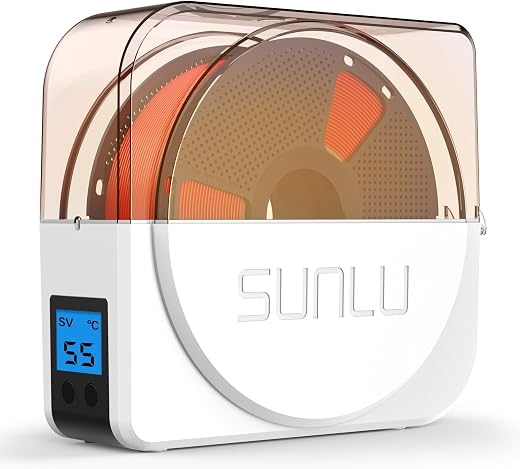
At $32.29 the S1 Plus does almost everything the $43.99 box at the bottom of this list does, with better control. Its heat is continuously adjustable from 35 to 55°C rather than offered as three fixed steps, and its timer runs from 1 to 99 hours against the 6-to-12 window both SH01 boxes allow. Two internal rollers feed the printer while the heater runs, so a dried spool can live in the box permanently.
It holds one spool up to Φ210 by 85 mm, which covers most 1 kg reels and excludes the 2 kg ones whatever the listing claims about 99 percent of spools. The 55°C ceiling sits at the bottom of PLA’s glass transition range, so it is a limit to respect rather than use, and nylon is out of reach. With 3,373 ratings at 4.4 and a stated one-year warranty, it is the sensible first dryer.
Best for: A first dryer, and anyone printing PLA, PETG and TPU who wants real temperature control.
Skip if: Nylon, PC or PAHT are in the rotation, or two materials must be ready at once.
Read the full SUNLU S1 Plus filament dryer review →
Where to Buy — SUNLU S1 Plus
3. Polymaker Polydryer — Best Sealed Dry, Store and Print System
Price: $71.99 | Amazon rating: 4.3 out of 5 from 724 ratings | Role: Best sealed system | Key spec: Modular dock and sealed box, no temperature published
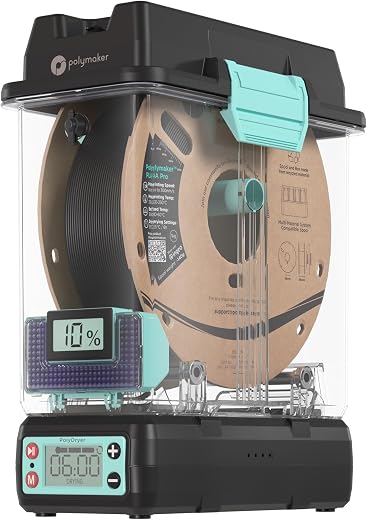
Polymaker is the only maker here that has designed around the real failure, which is not drying but re-wetting. The Polydryer splits into a heated Dry Dock and a sealed PolyDryer Box, and filament feeds out through the sealed box, so the spool never meets room air between drying and printing. One dock serves several boxes, each with its own hygrometer.
What it will not tell you is how hot it gets. There is no maximum temperature in the listing, no time range and no wattage — only “heat control” and “360° airflow”. That is a conspicuous omission on a $71.99 heated appliance when all four rivals state a ceiling, and it makes the PA Nylon heading its material list impossible to assess.
Best for: Workshops running three or four materials that all need to stay sealed and dry.
Skip if: A published temperature matters to you, or nylon is the reason you are buying.
Read the full Polymaker Polydryer filament dryer review →
Where to Buy — Polymaker Polydryer
4. Sovol SH01 — Best Budget Two-Spool Box
Price: $39.59 | Amazon rating: 4.2 out of 5 from 2,918 ratings | Role: Best budget two-spool | Key spec: 2 spools, 40/45/50°C, power-off seal
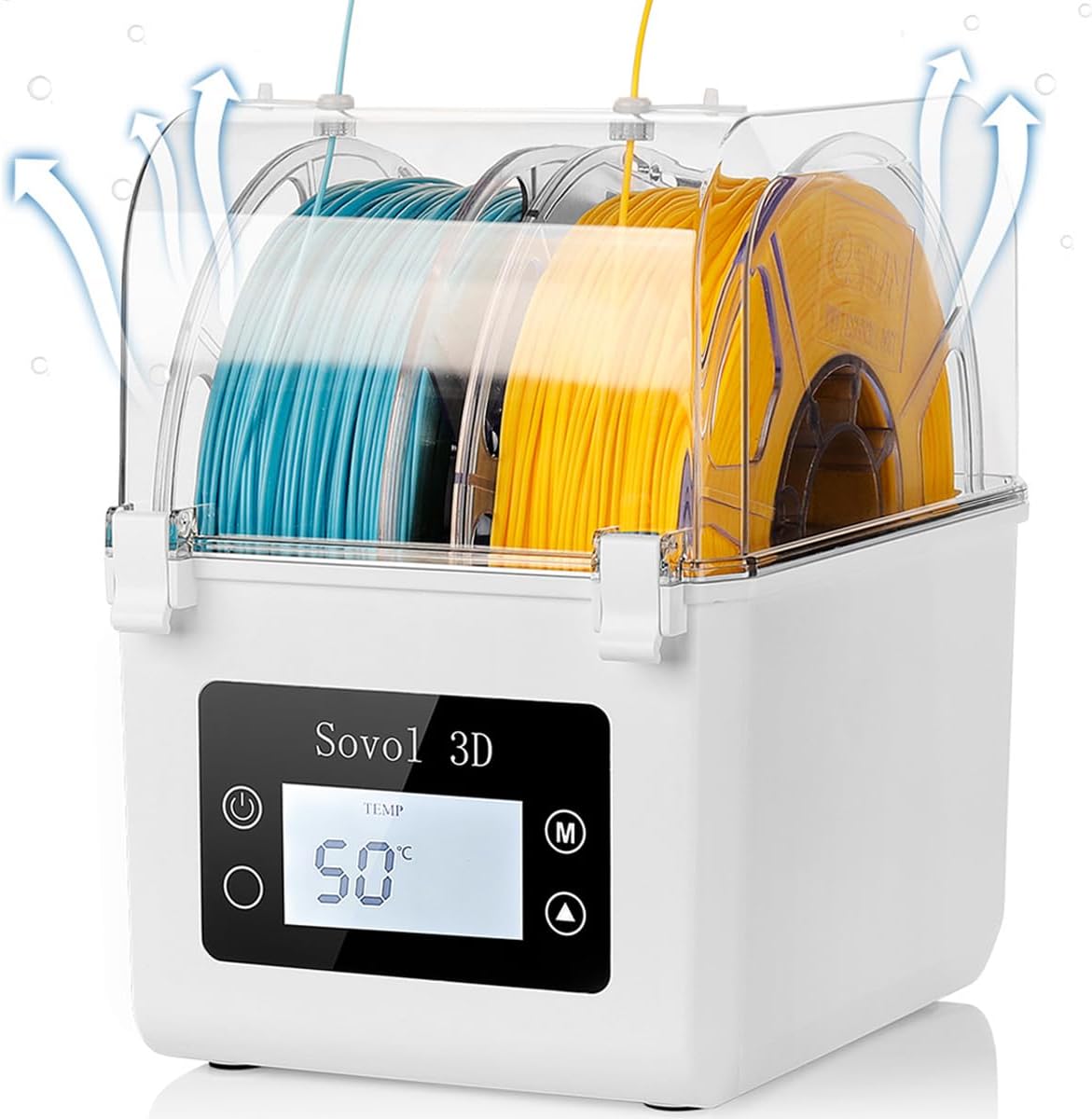
The Sovol holds two spools under 70 mm, or one up to 150 mm, for $7.30 more than a box that holds one. Its silicone and PTFE seal works as sealed storage with the power off, and there is room inside for four bags of desiccant, which Sovol is clear are not supplied. Three fixed temperatures — 40, 45 and 50°C — cover PLA, PETG, ABS and TPU without fine control.
Then comes the most candid sentence in any of these five listings, and the most awkward. Sovol states that in a room below 16°C the temperature inside the box will not come up to 50°C — then adds that this would not decrease the drying effect. The first half is a manufacturer publishing the limit of its own heating element. The second half is an assurance with nothing behind it, because a box that cannot reach its setpoint dries more slowly.
Best for: Two materials dry at once on a budget, in a room that stays above 16°C.
Skip if: Your workshop is cold — Sovol says the box will not reach 50°C below 16°C ambient.
Read the full Sovol SH01 filament dryer review →
Where to Buy — Sovol SH01
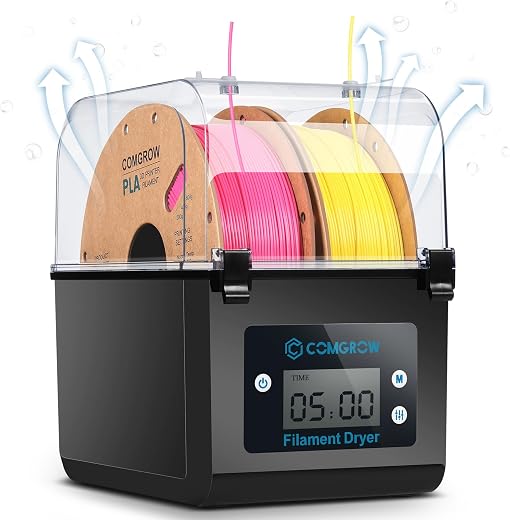
5. Comgrow SH01 — Most Owned, and the One to Check the Price On
Price: $43.99 | Amazon rating: 4.4 out of 5 from 4,693 ratings | Role: Most owned | Key spec: 4,693 ratings, 50°C maximum, 2 spools
This is the most owned product here by a distance — 4,693 ratings at 4.4 — with the roomiest budget chamber at 9.29 by 6.49 by 9.13 inches, two 1 kg spools, and the most carefully described sealing of the five: a silicone cable sheath, a Teflon outlet tube with a plug, and a snap-button lid.
The problem is the price next to the Sovol above it. Both are SH01-family boxes with the same two-spool layout, the same 40-to-50°C band and the same 6-to-12-hour timer; this one is $43.99 and the Sovol $39.59, a difference of $4.40. That gap was $23.08 when this guide was first published, and the Comgrow has since fallen to within a few dollars of the Sovol — which is the clearest evidence on this page that the price, not the hardware, is the variable worth checking on an SH01 box. Comgrow states no warranty where both cheaper boxes state one year. Its specification table names Creality 3D as the manufacturer while the brand reads Comgrow, counts one box as two items, and calls the appliance’s material polylactic acid.
Best for: Buyers who want the largest budget chamber and the biggest review count.
Skip if: The Sovol SH01 is in stock — substantially the same box, and now only $4.40 less.
Read the full Comgrow SH01 filament dryer review →
Where to Buy — Comgrow SH01
Filament Dryer — Buyer’s Guide
The Filament Dryer Temperature Ceiling Decides Everything Else
Start here and most of the decision makes itself. PLA and PETG are content in the 45-to-55°C band, TPU wants a little more, and nylon, polycarbonate and the PAHT blends want 70°C and upwards. No amount of extra time at 50°C substitutes, because below a certain temperature the water is not mobile enough in the polymer to leave. Four of the five units here stop at 50 or 55°C; one reaches 85°C.
The ceiling has an upper bound no listing in this category mentions, and it is the glass transition temperature of the plastic being dried. Published data sheets put PLA’s glass transition at 55 to 60°C and its heat distortion temperature at 75 to 85°C. A dryer set to 85°C with PLA inside is annealing it, not drying it, and the spool may fuse. The useful window sits just below the glass transition, so a hotter dryer only helps if it also comes down.
Spool Count, Spool Size and the Two-Kilogram Problem
One spool or two is the commonest regret. Two materials in rotation means a two-spool box or a second appliance, and the gap between the one-spool SUNLU and the two-spool Sovol is $7.30 — less than the cost of getting it wrong. Spool size matters more than the marketing admits: SUNLU claims 99 percent compatibility and then states a hard internal limit of Φ210 by 85 mm, which the common 2 kg reels exceed.
Sealing, Desiccant and Printing Through the Box
A dryer that is not also a store is half an appliance, because filament reabsorbs moisture the moment it comes out. Three things decide it: a seal that holds with the power off, room for desiccant inside that sealed volume, and an outlet that feeds the printer without opening anything. Desiccant only earns its keep inside a sealed box. Both SH01 boxes instruct that the seals be open while heating and closed while storing — an instruction most buyers miss.
What No Filament Dryer Listing Tells You
Every unit here displays a humidity percentage. Not one says which percentage is dry enough. There is no dew point, no target residual-moisture figure and no relative-humidity floor anywhere across the five listings, so the readout functions as reassurance rather than instrumentation. Nor does any publish a drying rate, leaving the temperature ceiling, capacity, timer range and warranty as the only comparable numbers. Two of the five state no warranty at all.
The same silence runs through the other half of an extruder’s life. Where a dryer declines to publish how long a cycle takes, a nozzle listing declines to publish the alloy it is cut from or how long the orifice holds its stated diameter — and of forty-two listings we gathered, exactly one published a single material property. Our best 3D printer nozzle guide compares five picks on that basis, and sets out the three different lead limits that apply to brass in the US and Great Britain without any of them covering the part itself.
What Moisture Does to Filament, and What the Listings Leave Out
The plastics industry has conditioned polymers to a known moisture content for decades, and the standard that governs it is instructive beside a $35 dry box. ISO 291:2008 defines two reference atmospheres for conditioning and testing plastics: 23°C at 50 percent relative humidity for non-tropical countries and 27°C at 65 percent for tropical ones, held to ±1°C and ±5 percent in the tightest class. The American equivalent is ASTM D618.
The sentence that matters most to anyone buying a dryer is this one: “The length of time necessary for a plastics material to come to humidity equilibrium is in general much longer than the length of time necessary for it to come to temperature equilibrium.” That is the whole argument against trusting a display. A box that reaches 50°C in twenty minutes has finished nothing. Water moves through a polymer slowly, which is why the SUNLU’s 99-hour timer is more useful than it looks.
The upper bound comes from the polymer. A published PLA technical data sheet gives a glass transition temperature of 55 to 60°C and a heat distortion temperature of 75 to 85°C. Those figures bracket everything a dryer may safely do with PLA, and not one of the five listings here mentions either. It is a missing specification across a whole product category.
There is a second reason to care where the heat goes. A NIOSH health hazard evaluation of 3D printer emissions measured particle number concentrations of 50,000 to 200,000 particles per cubic centimetre of air in printing areas, exceeding 450,000 on two occasions while a white PLA was running, at an average particle size of about 44 nanometres. The chemicals identified during PLA printing included acetaldehyde, acetone, ethanol, isopropyl alcohol and toluene.
The finding worth acting on is what an enclosure did. NIOSH reported that a custom enclosure “reduced particle concentration in the Print Room by over 99% and reduced the total organic chemical concentration by almost 70%”. Sealing works, measurably, and a filament dryer that keeps a spool in a closed box is on the right side of that result.
US vs UK: Reference Atmospheres, Cold Workshops and Mains Voltage
On the materials science the two countries agree. ISO 291’s non-tropical reference atmosphere of 23°C and 50 percent relative humidity is what laboratories on both sides of the Atlantic condition plastics to, and ASTM D618 does the same job in American practice. The US Environmental Protection Agency recommends households “keep indoor humidity below 60 percent (ideally between 30 and 50 percent) relative humidity” — the same band.
Where the two diverge is the room, and one listing here makes it concrete. Sovol states that below a 16°C ambient temperature its box will not reach 50°C. A heated American living room is comfortably above that; a British garage, shed or unheated spare room is below it for much of the year, as is an unheated basement across the northern United States. The same appliance is derated by geography, and Sovol is the only maker here candid enough to print the figure.
The second divergence is electrical, and it is a buying trap rather than a nuance. These are 120-volt, 60-hertz appliances sold on Amazon.com, and the Creality unit draws 400 watts across two PTC heaters. A British or Irish supply is 230 volts at 50 hertz, so a US-market dryer needs the correct regional variant — an adaptor changes the pins, not the voltage.
Filament Dryer — Which One Should You Buy?
Under $40 — start here. The SUNLU S1 Plus at $32.29 is the best value here and the right first purchase for PLA, PETG and TPU: adjustable 35 to 55°C, a 1-to-99-hour timer, print-through rollers and a stated one-year warranty. If two materials must be dry at once, the Sovol SH01 at $39.59 adds a second spool bay and a seal that holds with the power off — provided the room stays above 16°C.
A dryer solves the half of this hobby that happens before the print starts. If the other half is yours too — the figures that come off the plate and then need painting — our guide to the best miniature paint brushes compares five sets from $6.99 to $35.99, and makes the same argument this page does about a category that sells you a number and never publishes a measurement.
$60 to $75 — the middle, and the one to think hardest about. The Polymaker Polydryer at $71.99 is the best-designed product here, because dry, store and print without breaking the seal addresses re-wetting rather than drying. The Comgrow SH01 at $43.99 is the most owned unit with the largest budget chamber, and it is now the same box as the Sovol for only $4.40 more, which makes it a reasonable buy rather than the one to avoid.
Over $150 — only if the materials demand it. The Creality Space Pi X4 at $158.99 is the only unit here that reaches 85°C, with two independently controlled chambers and four spool bays. For nylon, polycarbonate or PAHT it is the only option on temperature. For a single printer running PLA it is capability nobody needs.
This is the first 3D-printing cluster on this site, so nothing here overlaps with it on buyer intent. The nearest neighbours are our home DIY essentials guide, which covers the tools around a workbench rather than the materials fed into a machine, our home maintenance essentials guide and our content creator essentials guide. No product and no source appears in both.
Filament Dryer — Frequently Asked Questions
Do you need a filament dryer?
If you print only PLA in a dry, heated room and get through a spool quickly, you can manage without one. Everyone else benefits, and TPU, nylon, polycarbonate and ASA are effectively unprintable once they have absorbed moisture. The symptoms — stringing, popping, poor layer adhesion and brittle parts — are routinely blamed on the printer.
What temperature should a filament dryer be set to?
Roughly 45 to 50°C for PLA, 50 to 55°C for PETG and TPU, and 70°C or above for nylon, polycarbonate and PAHT. The ceiling to respect is the material’s glass transition temperature: published PLA data sheets put it at 55 to 60°C, so PLA should never sit at the top of a high-temperature unit’s range.
How long does a filament dryer take?
Most listings suggest three to six hours for everyday filament and six to twelve for a neglected spool. ISO 291 notes that a plastic reaches humidity equilibrium far more slowly than temperature equilibrium, so longer is generally better and the display reaching temperature means very little.
Is a filament dryer better than a food dehydrator?
A dehydrator will remove moisture and many people use one successfully, but it has no sealed storage, no humidity readout, no filament outlet and usually coarse temperature control. A purpose-built unit is a dryer and a store in one, and storage is where most filament is actually ruined.
Can you print directly from a filament dryer?
Most of these can. Four of the five units here have an outlet with a PTFE tube or rollers for feeding the printer while the heater runs, and the Polymaker system feeds out of a sealed box without the seal being broken. It is the feature that stops a dried spool being re-wetted on an open shelf.
Do you still need desiccant?
Yes, and it belongs inside the sealed box rather than loose in a drawer. Desiccant can only hold a low humidity in a closed volume; in an open room it saturates and stops working. The Sovol provides four bays, Polymaker builds its system around heat, sealing and desiccant together, and neither supplies the sachets.
Filament Dryer — Final Thoughts
Shopping this category by price or spool count gets the wrong answer, because the specification that governs the result is the temperature ceiling and it is the one buyers skim. A 50°C box keeps PLA and PETG in order indefinitely and will never dry nylon. An 85°C machine dries anything and must be turned down for PLA, whose glass transition begins at 55°C. The rule: buy for the hardest material in your rotation, not the number of spools.
The second rule follows from the standard rather than the listings. Because a polymer gives up moisture far more slowly than it warms up, the sealed box matters at least as much as the heater — a spool dried for six hours and left on an open shelf is back where it started within days.
Sources and Further Reading
- ISO 291:2008 — Plastics: Standard atmospheres for conditioning and testing
- ASTM D618-21 — Standard Practice for Conditioning Plastics for Testing
- NIOSH Health Hazard Evaluation Report 2017-0059-3291 — Evaluation of 3-D Printer Emissions
- PLA Pro technical data sheet — glass transition and heat distortion temperatures
- US EPA — A Brief Guide to Mold, Moisture and Your Home
Affiliate disclosure: Blue Rays Technologies earns a commission from qualifying purchases made through the Amazon links on this page, at no additional cost to you. Commissions never influence our scores or the order of our picks.