
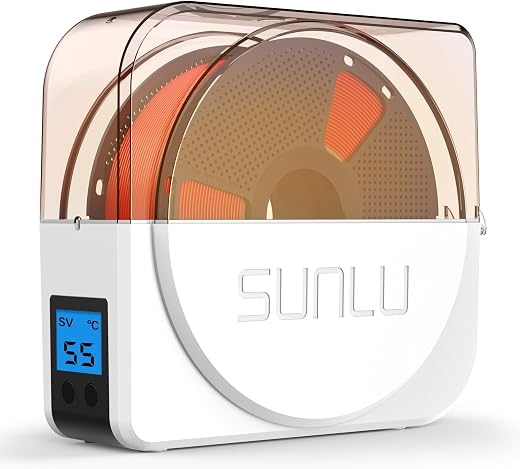
3D Printer Filament Dryer Review — SUNLU S1 Plus 55°C
A $32.29 single-spool box with a continuously adjustable 35–55°C range, a 1–99 hour timer and internal rollers for printing while it dries — the widest useful control in the group for the least money.
$32.29
3D Printer Filament Dryer Review — SUNLU S1 Plus 55°C
A $32.29 single-spool box with a continuously adjustable 35–55°C range, a 1–99 hour timer and internal rollers for printing while it dries — the widest useful control in the group for the least money. We score this 3d printer filament dryer 8.5 out of 10.
This review is research-based. We did not physically test these products; specifications, ratings and prices are taken from the live listings on the date shown. This 3d printer filament dryer is one of five compared in our best filament dryer guide.
On this page
- 3d printer filament dryer — Key Specifications
- A 3D Printer Filament Dryer With Real Temperature Control, Not Three Buttons
- Print While It Dries, and the Spool Limit Nobody Reads
- Three Thousand Ratings Is Its Own Kind of Specification
- 3d printer filament dryer — Limitations
- Setting Up This 3d printer filament dryer
- Who Should Buy This 3d printer filament dryer?
- The Verdict
- 3d printer filament dryer — Frequently Asked Questions
3d printer filament dryer — Key Specifications
| Specification | Detail |
|---|---|
| Reviewed model | 3d printer filament dryer |
| Temperature range | 35°C to 55°C, adjustable |
| Drying time | 1 to 99 hours (6 hours default) |
| Maximum spool size | Φ210 × 85 mm (H) |
| Filament diameters | 1.75 mm, 2.85 mm, 3.00 mm |
| Print while drying | Yes — two internal rollers |
| Display | 2-inch LCD, temperature and time |
| Claimed noise | Under 10 dB (see Limitations) |
| Model number | SUNLU Filament Dryer S1 Plus |
| Manufacturer part number | SLUK-FD-US-GMSLUS |
| GTIN / UPC | 06933582324353 / 782950697805 |
| Weight | 2.7 pounds |
| Warranty | 1 year |
| Price at time of writing | $32.29 |
| Amazon rating | 4.4 out of 5 from 3,373 ratings |
| Expert Score | 8.5 / 10 |
A 3D Printer Filament Dryer With Real Temperature Control, Not Three Buttons
The difference between this and the two SH01-family boxes further down is that its temperature is a dial rather
than a menu. Thirty-five to 55°C, continuously adjustable, against the Sovol’s fixed choice of 40, 45 or 50. That
matters because the correct drying temperature is not a round number — it is a function of the polymer, and a polymer’s
useful drying window sits just below its glass transition.
The timer is the other half of it. One to 99 hours, against 6 to 12 on both SH01 boxes. Ninety-nine hours is more
than anyone needs in one go, but the ability to run 20 hours on a badly neglected spool of PETG without restarting the
cycle four times is a genuine convenience, and the 6-hour default is the sensible everyday setting.
Print While It Dries, and the Spool Limit Nobody Reads
Two rollers inside the box let filament feed out to the printer while the heater runs, which is the single most
useful feature a cheap dryer can have. Drying a spool and then leaving it on an open shelf undoes the work; the
listing’s own framing — that any filament will reabsorb moisture from the air — is correct, and it is the argument for
leaving the spool in the box permanently.
The capacity claim needs reading carefully. SUNLU says the box is compatible with 99 percent of filament spools and
then gives the actual constraint: Φ210 × 85 mm. Most 1 kg spools fit inside that. The increasingly common 2 kg and
2.5 kg spools do not, and neither do some of the wider cardboard ones. It is one spool at a time, so a two-material
print means a second box.
Three Thousand Ratings Is Its Own Kind of Specification
At 4.4 from 3,373 ratings this is the second most reviewed unit in the comparison, and the most reviewed one
that costs under $40. For a category full of near-identical injection-moulded boxes that volume of ownership is worth
something — it is the closest thing to evidence available when nobody publishes a drying performance figure.
SUNLU also states a one-year warranty plainly, which only one other unit here does. Two of the five, including the
most expensive, state no term at all.
One caution about reading rating volume as a quality measure in this category. Several of these boxes are built on shared injection-moulded tooling and sold under different brand names at different prices, so a large review count can reflect how long a particular listing has existed and how heavily it has been promoted rather than how well the hardware performs. Three thousand ratings is worth taking seriously as evidence that the thing arrives working and keeps working. It is not evidence that it removes more moisture than a box with three hundred.
3d printer filament dryer — Limitations
The 55°C ceiling is the limitation that decides who should buy this. Published PLA data sheets put the glass
transition at 55–60°C, so 55°C is the very top of what PLA will tolerate and must not be exceeded. More importantly,
nylon, polycarbonate and PAHT want 70°C and above, so this is not the dryer for engineering filament however long you
run it.
The noise claim is not credible. “Less than 10dB while operating” would put a fan-driven heater below the
threshold of normal human hearing and roughly at the noise floor of an anechoic chamber. The unit is quiet; it is not
10 dB.
The specification fields are filled in loosely. Material Type reads “SUNLU Filament Dryer S1 Plus”
— the product’s own name in a field meant for a material — and so does Model Number, while
Item Diameter reads 1.75 mm, which describes filament rather than the box.
One spool only, and the listing closes a technical bullet with a suggestion to buy one as a gift for a friend who
loves 3D printing, which is not what anyone is reading a dehumidifier specification for. As with the rest of the
category, no target humidity figure is published anywhere.
Setting Up This 3d printer filament dryer
Set the temperature by material, not by habit. Around 45°C suits PLA with margin to spare, 50–55°C suits
PETG and TPU, and nothing in this box should be run at 55°C if it is PLA. The adjustable range is the feature — use it
rather than leaving it where it arrived.
Use the rollers from the first day. Thread the filament out to the printer and leave the spool living in the box
between jobs; a dried spool on an open shelf is a spool that will need drying again. The 6-hour default is a good
first cycle, and badly neglected filament is worth 12 to 20 hours.
Check the spool fits before ordering a 2 kg reel to go with it. The hard limit is Φ210 × 85 mm, which covers most
1 kg spools and excludes the larger ones regardless of what the 99 percent claim implies.
Who Should Buy This 3d printer filament dryer?
Anyone starting out, anyone who prints PLA and PETG and nothing more demanding, and anyone who wants a dryer
on the desk permanently rather than as an occasional rescue appliance. At $32.29 with a 35–55°C range, a 1–99 hour
timer and print-through rollers, it is the best value in the comparison by a wide margin.
Skip it if nylon, PC or PAHT are in the rotation, or if two materials need to be ready at once. One spool and a
55°C ceiling are real limits, and no amount of time at 55°C substitutes for 80°C.
The Verdict
This is the unit most people should buy. A 3d printer filament dryer that costs $32.29 and still offers
continuously adjustable heat from 35 to 55°C, a 1 to 99 hour timer, print-through rollers and a stated one-year
warranty is doing almost everything the $62.67 box further down does, with better control, for half the money. Three
thousand three hundred and seventy-three ratings at 4.4 are the nearest thing to reassurance this category offers.
It scores 8.5 rather than higher for two honest reasons: one spool at a time, and a 55°C ceiling that rules out
every engineering filament and sits at the very edge of PLA’s own glass transition. The 10 dB noise claim is not
believable either. None of that stops it being the right first purchase.
3d printer filament dryer — Frequently Asked Questions
What temperature should I set on this 3d printer filament dryer?
The range is 35–55°C. Around 45°C is a safe everyday setting for PLA, and 50–55°C suits PETG and TPU. PLA’s glass transition is 55–60°C on published data sheets, so running PLA at the very top of the range is best avoided.
How long does a drying cycle take?
The default is 6 hours and the listing says most common filaments need 3 to 6 hours. The timer can be set from 1 to 99 hours, which is useful for filament that has been neglected for a long time.
Will a 2 kg spool fit?
No. The stated internal limit is Φ210 × 85 mm, which accommodates most 1 kg spools. The larger 2 kg and 2.5 kg reels will not fit, despite the listing’s claim of compatibility with 99 percent of spools.
Can it dry nylon?
Not properly. Nylon, polycarbonate and PAHT need temperatures around 70°C and above, and this unit stops at 55°C. For those materials a higher-temperature unit is required.
Where to Buy
Affiliate disclosure: we earn a commission from qualifying purchases made through the links on this page, at no extra cost to you. It does not affect our scores.
Related Reviews
- Filament Dryer for Nylon Review — Creality Space Pi X4
- Filament Dryer and Storage Box Review — Polymaker Polydryer
- Filament Dryer Box Review — Sovol SH01
Full comparison: Best filament dryer guide.


There are no reviews yet.