
Filament Dryer and Storage Box Review — Polymaker Polydryer
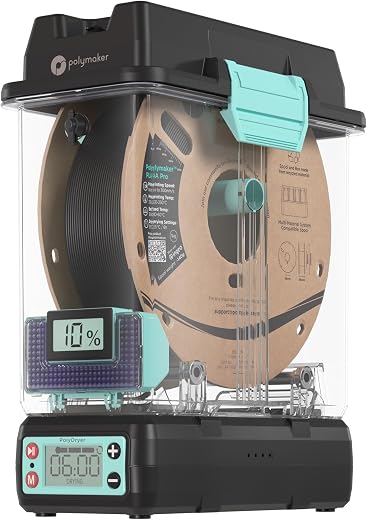
A modular $71.99 system of a heated Dry Dock and a sealed PolyDryer Box that lets filament go from drying to storage to printing without the seal ever being opened — and the only unit here that publishes no temperature at all.
$71.99
Filament Dryer and Storage Box Review — Polymaker Polydryer
A modular $71.99 system of a heated Dry Dock and a sealed PolyDryer Box that lets filament go from drying to storage to printing without the seal ever being opened — and the only unit here that publishes no temperature at all. We score this filament dryer and storage box 8.0 out of 10.
This review is research-based. We did not physically test these products; specifications, ratings and prices are taken from the live listings on the date shown. This filament dryer and storage box is one of five compared in our best filament dryer guide.
On this page
- Filament dryer and storage box — Key Specifications
- The Seal Is the Feature, and It Is a Better One Than It Sounds
- Heat, Seal and Desiccant Together Rather Than Separately
- A Filament Dryer and Storage Box That Fits Nylon’s Requirements on Paper Only
- Filament dryer and storage box — Limitations
- Setting Up This Filament dryer and storage box
- Who Should Buy This Filament dryer and storage box?
- The Verdict
- Filament dryer and storage box — Frequently Asked Questions
Filament dryer and storage box — Key Specifications
| Specification | Detail |
|---|---|
| Reviewed model | filament dryer and storage box |
| Architecture | Modular — Dry Dock plus PolyDryer Box |
| Maximum temperature | Not stated in the listing |
| Drying time range | Not stated in the listing |
| Power rating | Not stated in the listing |
| Airflow | 360° airflow through the drying dock |
| Humidity monitoring | Built-in hygrometer |
| Sealing | Dry, store and print without breaking the seal |
| Desiccant | Supported alongside heat and sealing |
| Stated materials | PA Nylon, PLA, PVB, PETG, ABS, ASA, TPU |
| Filament diameters | 1.75 mm, 2.85 mm, 3.00 mm |
| Spool capacity | 1 kg |
| Model number | PX01002_A |
| Weight | 1.3 kg |
| Warranty | No term stated in the listing |
| Price at time of writing | $71.99 |
| Amazon rating | 4.3 out of 5 from 724 ratings |
| Expert Score | 8.0 / 10 |
The Seal Is the Feature, and It Is a Better One Than It Sounds
Every other unit here treats drying as an event: put the spool in, run a cycle, take it out. Polymaker treats
it as a state. The Dry Dock heats, the PolyDryer Box seals, the filament feeds out through the box, and the box never
has to be opened between drying and printing. Swapping materials means lifting one sealed box off the dock and putting
another on.
That architecture addresses the category’s real failure, which is not drying but re-wetting. ISO 291, the
international standard for conditioning plastics before testing, notes that the time a plastic needs to reach
humidity equilibrium is in general much longer than the time it needs to reach temperature equilibrium. Moisture
leaves slowly and it returns slowly — but it does return, every hour the spool sits in open air. A system that never
exposes the spool is attacking the right problem.
Heat, Seal and Desiccant Together Rather Than Separately
Polymaker is explicit that this is a three-part approach: heated drying, sealed storage and desiccant support,
rather than any one of them. That is the correct engineering answer and it is worth saying out loud, because the rest
of the category sells heat alone and treats the silica gel as an accessory the buyer can work out for themselves.
A built-in hygrometer in each box means the state of each material is readable at a glance.
Buying more boxes than docks is the intended pattern, and it is a sensible one. One heated dock can service
several sealed boxes, so a workshop with nylon, PETG and TPU on the go keeps all three sealed and dry and only pays
once for the heater.
A Filament Dryer and Storage Box That Fits Nylon’s Requirements on Paper Only
The listing names PA Nylon first in its material list, ahead of PLA, which sets an expectation it never
substantiates. Nylon needs sustained heat well above what a 50°C box can deliver, and this listing does not say what
heat it delivers. “Controlled heating”, “even airflow” and “Heat Control” appear; a number does not.
That omission is unusual enough to be a finding in its own right. Four of the five units here publish a maximum
temperature. This one, which costs more than three of them, publishes neither a maximum temperature, nor a time
range, nor a wattage. Whatever it does, the buyer is asked to take on trust.
Filament dryer and storage box — Limitations
No temperature figure anywhere. Not a maximum, not a range, not a wattage, not a time setting. For a
$71.99 heated appliance that is the single biggest mark against it, and it makes the PA Nylon claim impossible to
assess. Every rival in this comparison states its ceiling.
The copy is hedged to a degree the others are not. “Designed to help keep filament in better condition”,
“supports more stable print results”, “helping reduce moisture-related issues”, “helps you judge filament status with
less guesswork”. These are careful, compliance-shaped phrases, and they stand out beside SUNLU and Sovol making flat
claims about what their boxes do.
One kilogram, one spool per box, and no warranty term stated. The modular pattern also means the real cost is not
$71.99 — it is $71.99 plus a box for every additional material, and the bare PolyDryer storage box sells separately
at $27.99.
Lowest-but-one star rating in the group at 4.3, and like everything else here it shows a humidity reading without
ever stating what reading is good enough.
Setting Up This Filament dryer and storage box
Plan the material split before buying. The system makes sense when one dock serves several sealed boxes, so
work out which materials need to be permanently dry — nylon, TPU and PETG are the usual answers — and budget for a box
each rather than expecting one purchase to cover the workshop.
Add desiccant from the start. Polymaker designs for heat, seal and desiccant together and the sealed box is where
silica gel actually earns its keep, because a sealed volume is the only place it can hold a low humidity instead of
endlessly drying the room.
Thread the filament out through the box and leave it there. The whole architecture is wasted if the spool comes
out to print, and the hygrometer is the thing to watch between sessions rather than the clock.
Who Should Buy This Filament dryer and storage box?
Anyone who already knows that re-wetting is the problem, and anyone running three or four materials who wants
all of them sealed at once. If the workshop currently has spools in freezer bags with a sachet in each, this is the
tidy, readable version of that habit with a heater attached.
Skip it if a published temperature matters to you, or if nylon is the reason you are buying. Despite PA Nylon
leading the material list, nothing in the listing establishes that this unit reaches nylon’s drying temperature, and
the Creality X4 states 85°C plainly.
The Verdict
This is the most thoughtfully designed product in the comparison and the least well documented. The modular
filament dryer and storage box arrangement — a heated dock, sealed boxes, feeding without breaking the seal — is the
correct answer to the problem the whole category actually has, which is that filament reabsorbs moisture the moment
you take it out. Heat, seal and desiccant working together is better engineering than heat alone.
It scores 8.0 because none of that can be verified. No maximum temperature, no time range, no wattage and no
warranty term are published, the copy hedges where rivals state, and the PA Nylon claim at the head of the material
list is unsupported by any figure. Buy it for the sealed architecture, not for the drying performance, and price in a
box per material.
Filament dryer and storage box — Frequently Asked Questions
What temperature does this filament dryer and storage box reach?
The listing does not say. It describes heat control, controlled heating and 360° airflow but publishes no maximum temperature, no time range and no wattage, which is unusual in this category and the main reason it does not score higher here.
What does “dry, store and print without breaking the seal” mean in practice?
The heated Dry Dock and the sealed PolyDryer Box are separate parts. Filament feeds out through the sealed box, so the spool is not exposed to room air between drying and printing, and swapping material means swapping a whole sealed box.
Do I still need desiccant?
Polymaker’s own description combines heated drying, sealed storage and desiccant support rather than treating any one as sufficient. In a sealed box desiccant can hold a low humidity, which is where it is genuinely useful.
Is it suitable for nylon?
PA Nylon heads the listing’s material list, but no temperature is published, so there is no way to confirm it reaches the sustained heat nylon drying needs. A unit that states a ceiling above 70°C is the safer choice for nylon.
Where to Buy
Affiliate disclosure: we earn a commission from qualifying purchases made through the links on this page, at no extra cost to you. It does not affect our scores.
Related Reviews
- Filament Dryer for Nylon Review — Creality Space Pi X4
- 3D Printer Filament Dryer Review — SUNLU Filament Dryer S1 Plus
- Filament Dryer Box Review — Sovol SH01
Full comparison: Best filament dryer guide.


There are no reviews yet.