
BONAI 16 Bay Battery Charger Review — Best Bulk NiMH Charger for AA and AAA?
This solves the real reason households abandon rechargeable batteries, which is the pairing requirement on cheap chargers rather than the cells themselves. Sixteen independently controlled slots take AA and AAA in any combination and any quantity, each with its own status light, behind a full protection list and UL certification. The ceiling on it is scope: NiMH only, no display or capacity analysis, and a deliberately moderate charge current that makes a full rack an overnight job.
$29.44
BONAI 16 Bay Battery Charger Review (2026) — Is Independent Slot Charging Worth It?
The reason most households give up on rechargeable batteries is not the batteries. It is the four-slot charger that insists on pairs, so a remote that takes two AAs and a toy that takes three leaves one cell stranded, and the whole system quietly reverts to buying alkalines at the supermarket.
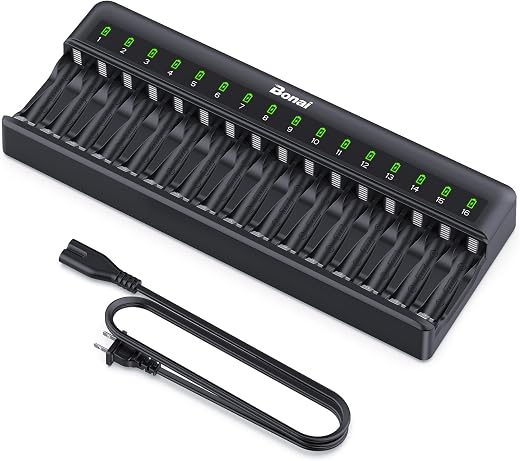
A 16 bay battery charger removes that constraint by making every slot independent. BONAI’s model takes AA and AAA NiMH cells in any combination, in any slot, in any quantity, with a status LED per port. At around $29 with a 4.6 average from close to 2,500 ratings, the question is whether sixteen bays is a genuine household need or an enthusiast’s indulgence.
In short: the 16 bay battery charger earns 8.2/10 from the Blue Rays Technologies team. The rest of this review sets out exactly how that score was reached.
What is in this 16 bay battery charger review
Key Specifications
Published specifications for the 16 bay battery charger, taken from the manufacturer listing.
| Reviewed model | 16 bay battery charger |
| Brand | BONAI |
| Model number | MY-C006 |
| Ports | 16 independent |
| Chemistry | NiMH rechargeable only |
| Cell sizes | AA and AAA, mixed freely |
| Output | 1.4 V DC, 250-500 mA |
| Input | 110-240 V, 0.5 A max |
| Charge time | About 3.5 hours |
| Dimensions | 4″D x 9.8″W x 1.2″H |
| Weight | 12.8 ounces |
| Protections | Overcharge, overvoltage, overcurrent, overheating, short circuit, reverse polarity |
| Certifications | UL, CE, FCC |
| Amazon rating | 4.6 / 5 from 2,458+ ratings |
Everything that follows is based on those published figures for the 16 bay battery charger, together with aggregated owner feedback from verified buyers.
Why Independent Slots Matter More Than Slot Count
Cheap chargers wire their slots in series pairs, which means two cells must be inserted together and must be at a similar state of charge. Anything else either fails to charge or overcharges the fuller cell, and it is the single most common reason a household’s rechargeable experiment ends badly.
Independent control removes the whole problem. Put one cell in slot eleven and nothing else in the unit and it charges correctly. Put nine AAs and four AAAs in at once, all at different states of charge, and each is managed on its own. That is the feature to buy this for, and the sixteen bays are what let you exploit it.
The per-port LED completes the picture: solid green for an empty powered port, solid red while charging, solid green when done and a flashing red for a defective cell. Being told which specific cell has failed is genuinely useful, because a dud in a set of eight is otherwise nearly impossible to find.
Charge Time, Current and Battery Longevity
Output is 1.4 volts at 250 to 500 milliamps, and a full charge takes around three and a half hours. That is a slow rate by the standards of a two-bay fast charger, and it is a good thing rather than a compromise. NiMH cells last longer and run cooler on a moderate charge current, and fast charging is what shortens their working life.
Charging sixteen cells at once takes longer than charging two, because the total current is shared. That is worth planning around: this is an overnight device for a household that charges a drawer’s worth of cells at a time, not a device for reviving two AAs ten minutes before a camera goes out.
It is normal for the unit to get warm during a full load. The instructions say so explicitly, and the correct response is to leave it uncovered on a hard surface with air around it, rather than in a drawer or on a carpet.
Safety, Limits and What It Will Not Charge
The protection list is comprehensive for the price: overcharge, overvoltage, overcurrent, overheating, short circuit and reverse polarity, with UL, CE and FCC certification behind it. Reverse polarity protection matters more than it sounds on a sixteen-slot unit, because sixteen slots is sixteen chances to put a cell in backwards while half paying attention.
The hard limit is chemistry. This charges NiMH only. Alkaline cells must never go in it, and lithium cells must never go in it — putting either in a NiMH charger is a genuine fire risk rather than merely ineffective. If your household mixes chemistries in the same drawer, label them.
It ships with a captive AC cord and no power brick, which accepts 110 to 240 volts. That makes it usable internationally with a plug adapter, though the cord itself is fitted with a standard North American plug.
Limitations and Compromises
No product is right for everyone, and these are the places where the 16 bay battery charger asks something back from the buyer.
It charges NiMH only. No alkalines, no lithium-ion, no lithium primaries. That is a hard safety boundary rather than a feature gap, and putting the wrong chemistry in is dangerous rather than just useless.
There is no display, no per-cell voltage readout, no discharge or refresh function and no capacity test. Enthusiasts who want to analyse cells need an analysing charger, and this is not one.
Charging a full load is slow because current is shared across sixteen ports. Three and a half hours is the figure for a light load; a full rack takes longer, which makes this an overnight tool.
The unit runs warm under a full load and must be left uncovered with air around it. That is normal and documented, but it means it needs a clear surface rather than a shelf between two boxes.
Charging Habits and Keeping Cells Healthy
Getting the best out of the 16 bay battery charger over a long life comes down to a few simple habits.
Label your cells with a marker and keep sets together. NiMH cells age at different rates, and a device fed with one new cell and three tired ones will behave like it has four tired ones.
Leave clear air around the unit while it works. It is documented as running warm under load, and the sensible thing is a hard surface with space rather than a drawer or a carpet.
Do not leave cells in the charger for weeks after they finish. The protection circuitry will stop the charge, but batteries stored at full charge in a warm charger age faster than batteries stored in a drawer.
When a cell finally dies, do not put it in the household bin. The EPA’s guidance is to take rechargeable cells to a retailer takeback or hazardous waste collection point, and to tape the terminals of lithium cells before transporting them.
Who Should Buy It?
The 16 bay battery charger suits some households far better than others. It is a clear buy if you recognise yourself here:
- You have a drawer of AA and AAA cells and no way to charge odd numbers
- Your household runs remotes, toys, torches and controllers on rechargeables
- You want one status light per cell so failures can be identified
- You are happy to charge overnight rather than in ten minutes
- You want a charger with a full protection list and UL certification
The 16 bay battery charger is the wrong purchase if any of the following apply:
- You only ever charge two cells at a time, where a small charger is cheaper and faster
- You use lithium or alkaline cells, which this must never charge
- You want capacity testing, refresh cycles or per-cell voltage readouts
- You have nowhere to leave a 9.8-inch device sitting uncovered while it works
The Verdict
This solves the actual reason households abandon rechargeable batteries, which is the pairing requirement rather than the batteries themselves. Sixteen independent slots that accept AA and AAA in any combination, with a status light per port and a comprehensive protection list behind UL certification, is a properly thought-out answer at a price that undercuts buying four separate small chargers.
The score is held back by scope rather than execution. There is no display, no discharge or capacity function, and the deliberate moderate charge current means a full rack is an overnight job. Those are reasonable omissions at $29, and the 4.6 average from nearly 2,500 ratings suggests buyers agree, but they do put a ceiling on it.
Review score for the 16 bay battery charger: 8.2/10. Strong on independent slots, safety and per-cell feedback; the compromise is NiMH only, no display or analysis functions, and slow charging under a full load. Blue Rays Technologies researches independently and earns a commission from qualifying purchases, which never affects the score.
If you want to see the current price, the full options and the latest buyer feedback, it is listed as the BONAI 16 Bay AA AAA Battery Charger on Amazon. For what to do with cells at the end of their life, including the advice to tape terminals before transport, the guidance is published by the US Environmental Protection Agency.
Frequently Asked Questions
The questions buyers ask most often about the 16 bay battery charger, answered plainly.
Can a 16 bay battery charger charge one battery on its own?
Yes, and that is the main reason to buy this one. Every slot is independently controlled, so a single cell in any slot charges correctly. Cheap paired chargers cannot do this, which is why odd numbers of cells end up stranded.
Can it charge alkaline or lithium batteries?
No, and it must not be attempted. This is a NiMH charger only. Putting alkaline or lithium cells into a NiMH charger is a genuine fire and rupture risk rather than simply an ineffective one. Check what you are holding before inserting it.
How long does a full rack take?
About three and a half hours for a light load, and longer with all sixteen bays occupied, because the available current is shared. This is designed as an overnight charger for a drawer’s worth of cells rather than a fast top-up device.
Is it safe to leave running unattended?
It carries overcharge, overvoltage, overcurrent, overheating, short-circuit and reverse-polarity protection and is UL, CE and FCC certified. The manufacturer’s own instruction is to keep it uncovered in a ventilated place, because it runs warm under load — so a clear hard surface rather than a drawer.
Related Reviews
If the 16 bay battery charger is not quite the right fit, these Blue Rays Technologies reviews cover the nearest alternatives.
- ZF8313 EDC Flashlight review — one of the things these cells go into
- Rioddas External CD/DVD Drive review — another desk-drawer utility
- XR Glasses review — the other powered gadget from this week
Last updated: 29 August 2026. Pricing and availability for the 16 bay battery charger change frequently; check the retailer listing for the current figure.
User Reviews
Be the first to review “BONAI 16 Bay Battery Charger Review — Best Bulk NiMH Charger for AA and AAA?”
Related Products

$29.44

There are no reviews yet.