
HTRC N2B6V2 LiPo Balance Charger Review (2026): Worth It?
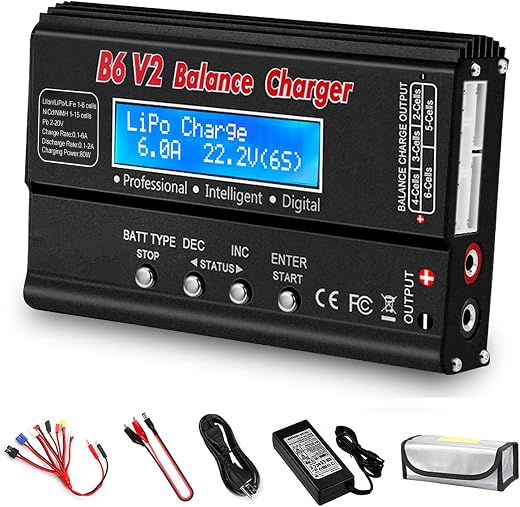
An 80-watt, 6-amp programmable balance charger covering lithium polymer, lithium iron phosphate, lithium ion, nickel and lead acid packs, with charge, discharge, balance and storage modes, terminal voltage control and memory slots. The listed two-year warranty is the longest of the five chargers researched for this comparison, and the storage voltage it targets is not published.
$39.99
HTRC N2B6V2 LiPo Balance Charger Review (2026) — 80 W, 6 A and a Two-Year Warranty for $39.99
A programmable charger is the first piece of kit in radio control that is bought for a reason rather than for a model, and the reason is usually a dead battery that did not need to die.
The HTRC N2B6V2 is an 80-watt, 6-amp single-channel unit covering lithium polymer, lithium iron phosphate, lithium ion, nickel metal hydride, nickel cadmium and lead acid packs, with charge, discharge, balance and storage modes, terminal voltage control, memory slots and a two-year warranty. The strength is that it covers the ordinary case completely. The compromise is a single channel and an unpublished storage voltage.
In short: this lipo balance charger earns 8.7/10 from the Blue Rays Technologies team. The rest of this lipo balance charger review sets out exactly how that score was reached.
This review is research-based. We did not physically test this product; specifications, ratings and prices are taken from the live listing on the date shown. It sits alongside four alternatives in our guide to the best lipo battery charger picks for 2026.
What is in this lipo balance charger review
- Key Specifications
- What the HTRC LiPo Balance Charger Actually Does With Six Amps
- The Two-Year Warranty Is the Longest on This Shelf
- Storage Mode: the One Feature a LiPo Balance Charger Is Judged On
- Limitations and Compromises
- Setting Up This Lipo Balance Charger
- Who Should Buy This Lipo Balance Charger?
- The Verdict
- Lipo Balance Charger — Frequently Asked Questions
- Related Reviews
Key Specifications
Published specifications for this charger, taken from the manufacturer listing on 6 October 2026.
| Reviewed model | lipo balance charger |
| Brand | HTRC |
| Manufacturer (as listed) | HuiTuo |
| Manufacturer part number | N2B6V2 |
| Charge power | 80 W |
| Charge current | 6 A |
| Output voltage | 18 V |
| Input | DC 11–18 V, supplied with a 15 V 6 A mains adapter |
| Ports | 2 |
| Cable connector | Barrel jack |
| Lithium cell counts | LiPo, LiFe and Li-ion 1–6S |
| Nickel cell counts | NiMH and NiCd 1–15 cells |
| Lead acid | 2–20 V |
| Modes | Charge, discharge, balance, storage, terminal voltage control, capacity and voltage check, memory |
| Weight | 0.6 kg |
| Colour | Black |
| Warranty (as listed) | 2 years |
| Amazon rating | 4.5 from 1,367 ratings |
| Price on the research date | $39.99 |
What the HTRC LiPo Balance Charger Actually Does With Six Amps
Eighty watts and six amps is the middle of this market, and it is the point where the numbers stop being the interesting part. A 5,000 mAh three-cell pack charged at the conventional 1C rate wants five amps, so six amps covers the single most common pack in radio control with a little headroom and nothing wasted. Pay more and you buy the ability to charge two packs at once, or to charge one pack faster than its own manufacturer recommends.
The listing is unusually complete about what sits behind that figure. Charge, discharge and balance are the three modes every unit at this price claims; this one adds terminal voltage control, a capacity and voltage check, memory slots and a digital DC power function, and it names storage mode explicitly in its own feature list. The cell support is broad rather than deep: lithium polymer, lithium iron phosphate and lithium ion all run one to six cells, nickel metal hydride and nickel cadmium run one to fifteen, and lead acid is covered from two to twenty volts.
The Two-Year Warranty Is the Longest on This Shelf
The specification field reads 2 year warranty. That is twice what the most expensive unit in this comparison offers, and it is the only two-year figure among the five products reviewed for this cluster. Three of the five publish no warranty position at all.
This matters more for a charger than for most electronics, because a charger is the one object in the hobby that is doing current work while nobody is watching it. A failed pack is an annoyance. A charger that keeps pushing current after the pack is full is the start of the only genuinely dangerous failure in the hobby, and a maker willing to stand behind the unit for twice as long as its dearer rivals is making a statement with a cost attached to it.
Storage Mode: the One Feature a LiPo Balance Charger Is Judged On
Storage mode is the reason to buy a programmable charger rather than the two-wire box that came with the model. A lithium polymer pack left at full charge degrades faster than the same pack left part-charged, and storage mode is the function that walks a pack down to a resting voltage and stops there. This unit names the mode. It does not publish the voltage it targets.
That absence is the central finding of this whole comparison, and it is not peculiar to this product: of the five chargers researched, only two publish a storage voltage at all. The conventional figure in the hobby is roughly 3.80 to 3.85 volts per cell, and a six-port specialist in the same comparison prints 3.8 V in its own output-voltage field. Here you get the function and a manual.
Terminal voltage control sits next to it in the feature list and is the other half of the same idea: the ability to set where a charge stops rather than accept 4.2 volts per cell as a given. Used deliberately, charging to a little under full is the cheapest life extension available to anyone who flies or drives twice a month rather than twice a week.
Limitations and Compromises
The honest limitations are a missing number and a missing cable. The missing number is the storage voltage; the missing cable is mains, because the 15 V 6 A adapter is supplied but the unit is fundamentally a DC charger with an adapter in the box rather than a true AC unit with an internal supply. If the adapter fails, the charger is a paperweight until a replacement arrives.
Six amps is a ceiling, not a target. Anyone running six-cell packs above 5,000 mAh, or charging two packs between heats, will find it slow, and the single-channel design means packs are charged one at a time. The listing also tells you not to charge more than one battery at once, which rules out the parallel-board habit that experienced flyers rely on.
Setting Up This Lipo Balance Charger
Setting up this lipo balance charger is a five-minute job and a lifetime habit. Connect the supplied adapter, connect the pack’s main lead to the charger’s output, and connect the balance lead — the small white plug with one wire per cell — to the matching socket on the balance board. The balance lead is the whole point of the device: without it the charger can see the pack but not the cells inside it.
Select the chemistry before the current. Choosing the wrong chemistry is the one setting error with consequences, and the listing warns about it twice. Then set the current: one times the pack’s capacity in amps is the default that every pack maker prints, so a 2,200 mAh pack charges at 2.2 A and a 5,000 mAh pack at 5 A.
Who Should Buy This Lipo Balance Charger?
This is the charger for the person with one or two models and no intention of becoming a battery technician. It covers every chemistry a hobbyist is likely to own, it charges the most common pack at its recommended rate, it has the modes that matter including storage, and it costs $39.99.
It is the wrong charger for a racer with six packs to turn around in an afternoon, who needs two channels and more amps, and for the pilot whose whole fleet runs single-cell whoop batteries, who needs a six-port one-cell charger instead. Both of those are covered elsewhere in this comparison.
The Verdict
This lipo balance charger is the one in the comparison that gets the ordinary case right. Eighty watts and six amps is enough for the packs most people own, the mode list is complete rather than aspirational, and the two-year warranty is the longest of the five — longer than the $115.99 dual-channel unit’s single year. Four and a half stars from 1,367 buyers is a large and consistent sample for a product in this price class.
The deductions are for the unpublished storage voltage, the single channel, the unnamed flammability standard and the adapter dependency. None of them is unusual on this shelf; the point is that the cheaper and dearer units share most of them without matching the warranty.
Review score for this lipo balance charger: 8.7/10. Strong on mode coverage, chemistry breadth, warranty length and sample size; the compromises are a single channel, an unpublished storage voltage, an unnamed flammability standard and dependence on the supplied adapter. Blue Rays Technologies researches independently and earns a commission from qualifying purchases, which never affects the score.
To check the current price and the latest buyer feedback, it is listed as the HTRC charger on Amazon. For the rules that govern moving packs like these by air, the US Department of Transportation requires lithium ion cells shipped as cargo to be at no more than a 30 percent state of charge.
Lipo Balance Charger — Frequently Asked Questions
The questions buyers ask most often about this lipo balance charger, answered plainly.
Does this lipo balance charger have a storage mode?
Yes. Storage mode is named in the listing’s own feature list alongside charge, discharge, balance and terminal voltage control. The target voltage it charges or discharges to is not published, so check the manual; the conventional figure in the hobby is about 3.8 volts per cell.
What size packs will 80 watts and 6 amps handle?
Six amps charges a 5,000 mAh pack at the standard 1C rate, which covers most radio-control cars and the majority of multirotor packs. Eighty watts is the real limit on six-cell packs: at 22.2 volts, 80 W works out at roughly 3.6 A, so a large six-cell pack will charge below 6 A.
Can it charge two batteries at once?
No. The listing states plainly that more than one battery should not be charged at the same time. Two ports are provided for input and balance rather than for simultaneous packs, and anyone needing two packs at once should look at a dual-channel unit.
Is HTRC the same company as HuiTuo?
The listing gives HTRC as the brand and HuiTuo as the manufacturer, with N2B6V2 as the part number. That is a brand name over a contract manufacturer, which is normal in this category, but it is worth noting before making a warranty claim.
Related Reviews
If this lipo balance charger is not quite the right fit, these Blue Rays Technologies reviews cover the nearest alternatives from the same comparison.
- VIFLY lipo storage charger review — the programmable multi-chemistry alternative
- HOTA dual channel lipo charger review — the mainstream single-channel unit at a third of the price
- Haisito lipo charger discharger review — the mainstream unit with a published two-year warranty
Last updated: 6 October 2026. Pricing and availability for this lipo balance charger change frequently; check the retailer listing for the current figure.


There are no reviews yet.