
Haisito C150 LiPo Charger Discharger Review (2026): Worth It?
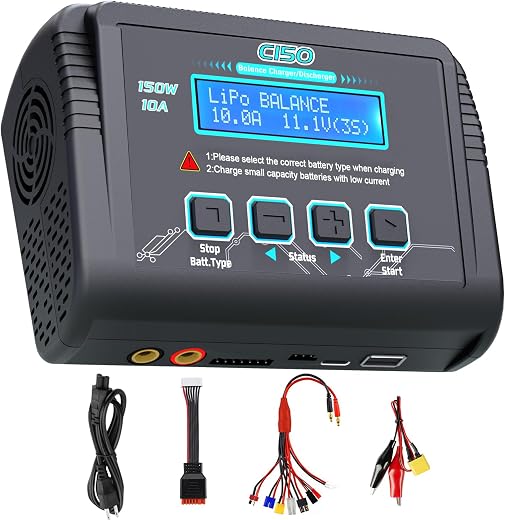
A 150-watt, 10-amp single-channel charger and discharger for lithium polymer, high-voltage lithium, lithium ion, lithium iron phosphate, nickel and lead acid packs, with twenty stored battery profiles, Deans, Tamiya, JST, EC3 and HiTec leads in the box, updatable firmware and FCC and RoHS marks. Its end voltage is adjustable from 3.85 to 4.3 volts per cell, a control the listing marks for experts.
$56.99
Haisito C150 LiPo Charger Discharger Review (2026) — 150 W, 20 Memories and an Expert-Only Setting
A lithium charge normally ends at 4.20 volts per cell because that is the figure the cell makers publish. This charger lets the owner move that number, in either direction, and labels the control for experts only.
The Haisito C150 is a 150-watt, 10-amp single-channel charger and discharger with twenty stored battery profiles, five connector types supplied in the box, updatable firmware, FCC and RoHS marks, and an end voltage adjustable from 3.85 to 4.3 volts per cell. The strength is control. The compromises are that the same control can be set wrong, and that no warranty position is published.
In short: this lipo charger discharger earns 7.8/10 from the Blue Rays Technologies team. The rest of this lipo charger discharger review sets out exactly how that score was reached.
This review is research-based. We did not physically test this product; specifications, ratings and prices are taken from the live listing on the date shown. It sits alongside four alternatives in our guide to the best lipo battery charger picks for 2026.
What is in this lipo charger discharger review
- Key Specifications
- The LiPo Charger Discharger That Lets You Move the Finish Line
- Twenty Memories, Five Connectors and the Only Conformity Marks on the Shelf
- Where This LiPo Charger Discharger Sits on Price and Evidence
- Limitations and Compromises
- Setting Up This Lipo Charger Discharger
- Who Should Buy This Lipo Charger Discharger?
- The Verdict
- Lipo Charger Discharger — Frequently Asked Questions
- Related Reviews
Key Specifications
Published specifications for this charger, taken from the manufacturer listing on 6 October 2026.
| Reviewed model | lipo charger discharger |
| Brand | Haisito |
| Manufacturer (as listed) | HTRC |
| Model | C150 |
| Manufacturer part number (as listed) | B07yd3jntz — the listing’s own ASIN |
| Charge power | 150 W |
| Charge current | 10 A |
| Discharge | 0.1–2 A, 10 W maximum |
| Output voltage | 15 V |
| Input | AC 100–240 V and DC |
| Ports | 4 |
| Cable connectors | Deans, Tamiya, JST, EC3, HiTec |
| Lithium cell counts | LiPo, Li-ion and LiFe 1–6S, LiHV 1–6S to 22.8 V |
| Nickel cell counts | NiMH and NiCd 1–15 cells |
| Memories | 20 battery profiles, firmware updatable |
| End voltage range | 3.85–4.3 V per cell, adjustable |
| Conformity marks (as listed) | FCC, RoHS |
| Dimensions | 3.94 in D x 5.71 in W x 1.38 in H |
| Amazon rating | 4.4 from 329 ratings |
| Price on the research date | $56.99 |
The LiPo Charger Discharger That Lets You Move the Finish Line
Most chargers end a lithium charge at 4.20 volts per cell because that is what the chemistry’s data sheets specify. This one lets you move it. The listing’s terminal voltage control sets the end voltage anywhere from 3.85 to 4.30 volts per cell, and adds the warning this features for expert only!
Both ends of that range are interesting for opposite reasons. The bottom end, 3.85 V, is the conventional storage voltage, so setting it there turns an ordinary charge into a storage charge — and with a discharge function also fitted, a full pack can be brought down to it rather than only topped up to it. Charging to a little under full, say 4.10 V, is the cheapest life extension available to anyone who charges the night before rather than the morning of.
Twenty Memories, Five Connectors and the Only Conformity Marks on the Shelf
Twenty stored battery profiles is the feature that separates a charger used by one person from a charger used in a workshop. Each pack gets its chemistry, cell count, current and end voltage saved once and recalled thereafter, which removes the setting error that is the main risk in using a programmable charger at all. Firmware is updatable, which is rare below $100.
The connector set is the broadest here: Deans, Tamiya, JST, EC3 and HiTec, supplied as an octopus harness in the box, alongside the AC cord, DC cable and balance board. For anyone whose models came from different decades and different makers, that is a genuine saving and a drawer of adapters avoided.
The specification field Specification Met: FCC, RoHS is the only conformity claim in this comparison. Neither is a safety certification in the sense a buyer might hope — FCC covers electromagnetic emissions and RoHS restricts hazardous substances, and neither says the charger will stop charging a failing pack. But they are checkable claims with regulators behind them, which puts them above the unnamed fire-proof material
three of the other listings rely on.
Where This LiPo Charger Discharger Sits on Price and Evidence
At $56.99 this sits between the $39.99 mainstream unit and the $115.99 dual-channel flagship, and the comparison with the cheaper one is the awkward part. For $17 more you get 150 W instead of 80, 10 A instead of 6, four connectors instead of a barrel jack, twenty memories, an adjustable end voltage and two regulatory marks. You give up a year of warranty, because this listing publishes no warranty position at all and the $39.99 unit publishes two years.
There is also a small puzzle in the fields. The manufacturer part number is given as B07yd3jntz, which is the listing’s own Amazon identifier rather than a part number — the field has been filled in with the only code to hand. The brand reads Haisito and the manufacturer reads HTRC, which is the same contract manufacturer behind two other products in this comparison. The C150 designation is the real model name.
Limitations and Compromises
The adjustable end voltage is both the headline and the hazard. A control that reaches 4.3 volts per cell is a control that can shorten a pack’s life or worse if it is set carelessly, and for expert only
is a label rather than a lock. Buyers who want a charger that cannot be set wrong should buy a simpler one.
No warranty is published, which is a real gap at this price when a cheaper rival publishes two years. Three of the five products researched for this cluster state nothing about warranty, so it is the norm rather than an outlier, but it is still an absence a buyer is entitled to notice.
Setting Up This Lipo Charger Discharger
Setting up this lipo charger discharger is worth doing once, properly, because the memories mean it only has to be done once. Connect the mains cord or DC lead, fit the right plug from the octopus harness to the pack’s main lead, and connect the balance lead to the balance board.
Then build a profile for each pack: chemistry first, cell count second, current third, end voltage last. One times capacity in amps remains the default charge rate, so a 4,000 mAh pack charges at 4 A. Leave the end voltage at 4.2 V unless there is a reason to change it, and if the reason is pack longevity, move it down rather than up. Save the profile, name it after the model, and the setting error disappears from the hobby.
Who Should Buy This Lipo Charger Discharger?
This is for the buyer who wants control and will use it: several packs of different chemistries and connectors, a willingness to build profiles, and an interest in charging to less than full to make packs last. The twenty memories, the five connectors and the end-voltage control all reward that person and are wasted on anyone else.
Skip it if a charger is a thing you want to plug in and forget. The adjustable end voltage is an extra way to get it wrong, the absent warranty is a real cost at $56.99, and the $39.99 unit covers the ordinary case with a published storage mode and two years of cover.
The Verdict
The most adjustable product in the comparison, and the one that most clearly trusts its buyer. One hundred and fifty watts, ten amps, twenty memories, five connectors in the box, a real discharge function and an end voltage that can be moved in either direction. The FCC and RoHS marks are the only checkable conformity claims on this shelf.
It scores below the two units above it because the same control that makes it useful makes it easy to misuse, because it publishes no warranty where a cheaper rival publishes two years, because its rating sample is a quarter the size, and because its part-number field contains its own ASIN. Good hardware, aimed at someone who already knows what 3.85 volts means.
Review score for this lipo charger discharger: 7.8/10. Strong on adjustability, memory slots, connector coverage, discharge capability and the only checkable conformity marks on this shelf; the compromises are an end-voltage range that reaches above the cell makers’ figure, no published warranty, a modest rating sample and a part-number field containing the listing’s own ASIN. Blue Rays Technologies researches independently and earns a commission from qualifying purchases, which never affects the score.
To check the current price and the latest buyer feedback, it is listed as the Haisito lipo charger discharger on Amazon. For the rules that govern moving packs like these by air, the US Department of Transportation requires lithium ion cells shipped as cargo to be at no more than a 30 percent state of charge.
Lipo Charger Discharger — Frequently Asked Questions
The questions buyers ask most often about this lipo charger discharger, answered plainly.
What does the adjustable end voltage on this lipo charger discharger do?
It sets the voltage at which a lithium charge stops, anywhere from 3.85 to 4.3 volts per cell against the usual fixed 4.2 V. Set low it gives a storage charge or a deliberately gentle full charge; set above 4.2 V it pushes cells past the figure their makers publish, which is why the listing marks it for experts.
Does FCC and RoHS mean it is safety certified?
Not in the way it might sound. FCC covers electromagnetic emissions and RoHS restricts hazardous substances in the materials; neither tests whether the charger stops charging a failing pack. They are still checkable claims, which is more than an unnamed fire-resistance claim offers.
How long does it take to discharge a pack to storage voltage?
Longer than most people expect. Discharge is capped at 2 amps and 10 watts, so a large six-cell pack coming down from full takes a considerable time. That ceiling is normal for this class of charger rather than a fault of this one.
Is Haisito the same as HTRC?
The listing gives Haisito as the brand and HTRC as the manufacturer, with C150 as the model. HTRC also appears as the brand on two other chargers in this comparison, so the same contract manufacturer is behind several products on this shelf under different names.
Related Reviews
If this lipo charger discharger is not quite the right fit, these Blue Rays Technologies reviews cover the nearest alternatives from the same comparison.
- HTRC lipo balance charger review — the budget two-cell option from the same maker
- VIFLY lipo storage charger review — the programmable multi-chemistry alternative
- HOTA dual channel lipo charger review — the mainstream single-channel unit at a third of the price
Last updated: 6 October 2026. Pricing and availability for this lipo charger discharger change frequently; check the retailer listing for the current figure.


There are no reviews yet.