
HTRC 2S Lipo Battery Charger Review (2026): Worth It?
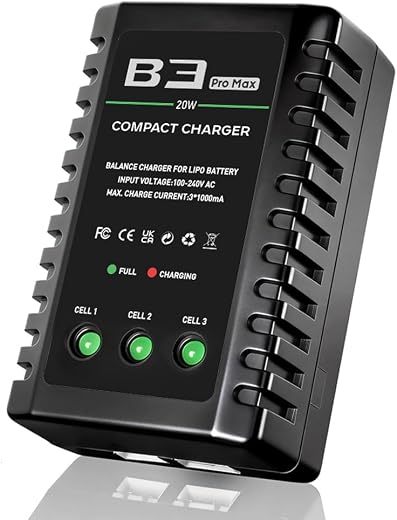
A mains balance charger for two-cell and three-cell lithium polymer packs, with an independent charging line per cell, 800 milliamps of balance current and a 1-amp maximum output. A two-colour LED reports charging and full; there is no screen, no storage mode and no discharge function. At the lowest price in this comparison it adds the one function a supplied charger usually lacks.
$14.99
HTRC 2S LiPo Battery Charger Review (2026) — $14.99, Two LEDs and No Menu At All
The charger that comes in the box with a hobby-grade model usually cannot see inside the battery it is charging. Fifteen dollars fixes that, and fixes nothing else.
This HTRC unit is a mains balance charger for two-cell and three-cell lithium polymer packs only, with an independent charging line per cell, 800 milliamps of balance current, a 1-amp maximum output and two indicator LEDs in place of a screen. The strength is that the function that matters is present at the lowest price in the comparison. The compromise is everything else: no storage mode, no discharge, no voltage readout and no published warranty.
In short: this 2s lipo battery charger earns 7.2/10 from the Blue Rays Technologies team. The rest of this 2s lipo battery charger review sets out exactly how that score was reached.
This review is research-based. We did not physically test this product; specifications, ratings and prices are taken from the live listing on the date shown. It sits alongside four alternatives in our guide to the best lipo battery charger picks for 2026.
What is in this 2s lipo battery charger review
- Key Specifications
- What a $14.99 2S LiPo Battery Charger Gets Right
- What It Leaves Out, Starting With Storage Mode
- The Same 2S LiPo Battery Charger Sold Under Another Brand for $2.00 More
- Limitations and Compromises
- Setting Up This 2S Lipo Battery Charger
- Who Should Buy This 2S Lipo Battery Charger?
- The Verdict
- 2S Lipo Battery Charger — Frequently Asked Questions
- Related Reviews
Key Specifications
Published specifications for this charger, taken from the manufacturer listing on 6 October 2026.
| Reviewed model | 2s lipo battery charger |
| Brand | HTRC |
| Manufacturer (as listed) | HuiTuo |
| Manufacturer part number | SQBLKHSB3 |
| Cell counts | 2S and 3S lithium polymer only |
| Pack voltages | 7.4 V and 11.1 V |
| Output voltage (as listed) | 7.4 V — one of the two it supports |
| Input | AC 100–240 V |
| Balance charge current | 800 mA |
| Maximum output current | 1,000 mA |
| Display | Two-colour LED: red charging, green full |
| Balance | Independent line per cell |
| Storage mode | None published |
| Discharge function | None |
| Warranty (as listed) | None stated |
| In the box | Charger, AC cable, manual |
| Amazon rating | 4.4 from 777 ratings |
| Price on the research date | $14.99 |
What a $14.99 2S LiPo Battery Charger Gets Right
This does one thing and the thing it does is the thing that matters most. It balances. Each cell in the pack gets its own charging line, so a two-cell or three-cell pack comes off the charger with its cells at the same voltage rather than one cell quietly running ahead of the other. That is the single function that separates a charger from a power supply, and at $14.99 it is here.
Everything else has been removed. There is no screen, no menu, no current setting and no chemistry selection — the listing states it is only suitable for LiPo Battery
, which removes the one setting error with consequences by removing the setting. Two LEDs do the reporting: red while charging, green when full. Balance current is 800 mA with a 1,000 mA maximum output.
What It Leaves Out, Starting With Storage Mode
There is no storage mode, and that is the limitation this comparison exists to point at. A pack charged on this unit comes off full, and a lithium polymer pack left full ages faster than one left part charged. With no discharge function, a full pack cannot be brought down to a resting voltage at all; the only options are to fly it down or to leave it full.
There is also no screen, which means no per-cell voltage reading, and a per-cell reading is how a buyer spots the cell that has gone high-resistance and is about to become a problem. Two LEDs tell you charging or charged and nothing else. A pack that has quietly developed a bad cell will charge, light green and give no warning.
The Same 2S LiPo Battery Charger Sold Under Another Brand for $2.00 More
During research for this comparison a second listing turned up that is worth naming. An SSUPCHG-branded balance charger for 2S and 3S packs with XHR plugs, at $16.99, carries description copy that matches this one almost phrase for phrase: the same Smart Chip
framing, the same list of over-voltage, over-temperature, overcharging, over-current and short-circuit protections, the same role.
The difference is $2.00 and the evidence behind it. This listing shows 4.4 stars from 777 ratings; the SSUPCHG one shows 4.5 from 136. Rebadging is ordinary in this category — three of the five products in this cluster name a brand and a different manufacturer in their own spec fields — and it is usually invisible to the buyer.
The practical lesson is that at the bottom of this market the brand on the case carries very little information, and the rating count carries most of it. Where two near-identical listings sit $2.00 apart, the one with five times the ratings is the better-evidenced purchase, and here that is also the cheaper one.
Limitations and Compromises
The limitation list is the specification list read backwards: two cell counts, one chemistry, one current, no storage mode, no discharge, no screen, no per-cell voltage, no warranty, and an instruction not to charge a 2S and a 3S pack together. At one amp maximum it is also slow by design.
The deeper limitation is that it cannot grow with the hobby. The first four-cell pack, the first nickel metal hydride pack, the first pack that needs putting away for the winter, and this charger has to be replaced rather than supplemented. The $39.99 unit in this comparison covers all three cases and costs twenty-five dollars more.
Setting Up This 2S Lipo Battery Charger
Setting up this 2s lipo battery charger takes about fifteen seconds and that is the point of it. Plug the mains cable in, plug the pack’s balance lead into the socket matching its cell count, and watch for the red light. When the light turns green the pack is full. There is nothing to select and nothing to get wrong except the socket.
The socket is the one thing to get right. A three-cell pack goes in the three-cell socket; the listing also says not to charge a 2S and a 3S pack at the same time, so do them one after the other. Only lithium polymer packs belong on this charger — nickel and lithium iron phosphate packs do not.
Who Should Buy This 2S Lipo Battery Charger?
Buy this 2s lipo battery charger if the hobby is one model, the packs are two-cell or three-cell lithium polymer, and the charger currently in use came free in the box. For fifteen dollars it adds per-cell balancing, which is the function that keeps those packs usable, and it adds nothing else to go wrong.
Skip it if the fleet will grow, if packs sit unused for weeks at a time, or if seeing a per-cell voltage matters. Storage mode and a screen are the two things this charger does not have and the two things a buyer eventually wants, and both arrive at $39.99.
The Verdict
Honest, narrow and correctly priced. It balances, it tells you when it has finished, it refuses to charge anything it should not, and it costs $14.99. Four point four stars from 777 buyers is a large sample for a product this cheap and it says the thing works.
It scores lowest of the five because the omissions are the ones this cluster is about: no storage mode, no discharge, no per-cell reading and no warranty position. Those are the reasons the category has programmable chargers at all. As a first balance charger it is a good buy; as a last one it is not.
Review score for this 2s lipo battery charger: 7.2/10. Strong on price, on per-cell balancing, on refusing chemistries it cannot handle and on sample size; the compromises are no storage mode, no discharge function, no per-cell voltage readout, no published warranty and a ceiling of two cell counts. Blue Rays Technologies researches independently and earns a commission from qualifying purchases, which never affects the score.
To check the current price and the latest buyer feedback, it is listed as the HTRC charger on Amazon. For the rules that govern moving packs like these by air, the US Department of Transportation requires lithium ion cells shipped as cargo to be at no more than a 30 percent state of charge.
2S Lipo Battery Charger — Frequently Asked Questions
The questions buyers ask most often about this charger, answered plainly.
Does this 2s lipo battery charger have a storage mode?
No. It charges 2S and 3S lithium polymer packs to full and stops, with no discharge function and no selectable target voltage, so a full pack cannot be brought down to a storage level. Packs that will sit unused for weeks are better served by a programmable charger.
Will it charge a 3S pack as well as a 2S?
Yes, both 7.4 V two-cell and 11.1 V three-cell lithium polymer packs are supported, with a separate balance socket for each. The listing says not to charge one of each at the same time, so run them one after the other.
Why is the output voltage listed as 7.4 V when it supports 11.1 V packs?
The specification field holds the two-cell figure only, even though the charger covers both two-cell and three-cell packs. It is an incomplete field rather than a limit on the hardware, and the description makes the full range clear.
Is a cheap balance charger safe for lithium polymer packs?
Balancing is the safety-relevant function and this one has it, with per-cell lines and the usual over-voltage, over-temperature, over-current and short-circuit protections. The standard precautions still apply: charge on a non-flammable surface, within sight, and never charge a pack that is swollen or physically damaged.
Related Reviews
If this charger is not quite the right fit, these Blue Rays Technologies reviews cover the nearest alternatives from the same comparison.
- HTRC lipo balance charger review — the budget two-cell option from the same maker
- VIFLY lipo storage charger review — the programmable multi-chemistry alternative
- HOTA dual channel lipo charger review — the mainstream single-channel unit at a third of the price
Last updated: 6 October 2026. Pricing and availability for this 2s lipo battery charger change frequently; check the retailer listing for the current figure.


There are no reviews yet.