
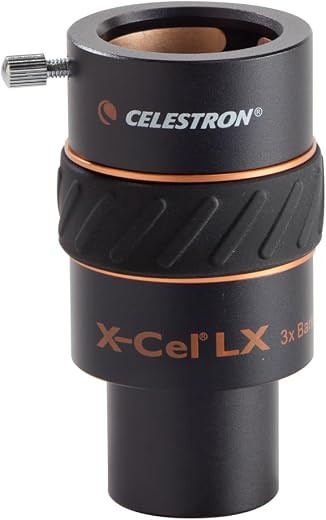
Celestron X-Cel LX 3X Barlow Lens Review (2026): Worth It?
Celestron X-Cel LX 3X 1.25 Barlow Lens for Telescope Eyepieces – Threaded at $89.90. 4.7 out of 5 from 1,050 Amazon ratings. Premium pick
$89.90
Celestron X-Cel LX 3X Barlow Lens Review (2026)
At $89.90 the X-Cel LX 3X is the dearest pick here and the highest-rated of the deep pools, carrying 4.7 out of 5 from 1,050 ratings. It scores 8.4 for a three-element design, a brass compression ring instead of setscrews and a removable optical cell, held back by a structured-data block that reports a telescope’s mount and objective diameter as though they were its own.
In short: the 3x barlow lens earns 8.4/10 from the Blue Rays Technologies team. This review is research-based. We did not physically test this product; specifications, ratings and prices are taken from the live listing on 17 October 2026. The rest of this review explains how that score was reached, and the full comparison is in our best barlow lenses roundup.
What is in this 3x barlow lens review
- Key Specifications
- Why a 3x barlow lens Needs Better Glass Than a 2x
- The Brass Compression Ring and the Removable Cell
- Vocabulary: Achromatic, Apochromatic and Three Elements
- Limitations and Compromises
- Setting Up This 3x Barlow Lens
- Who Should Buy This 3x Barlow Lens?
- The Verdict
- 3x Barlow Lens – Frequently Asked Questions
- Related Reviews
Key Specifications
Every figure below is copied from the live retailer listing on 17 October 2026. Where the 3x barlow lens publishes a field that does not describe a Barlow at all, we have put it in the limitations section rather than here.
| Reviewed model | 3x barlow lens |
| Brand | Celestron |
| Model name | X-Cel LX 3x Barlow Lens – 1.25″ |
| Model number | 93428 |
| Zoom ratio | 3x |
| Coating | Fully multi-coated |
| Compatible devices | Telescope, 1.25″ Eyepiece |
| Item weight | 0.15 kg |
| Optical tube length measurement | 32 millimeters |
| Warranty description | 2-YEAR WARRANTY |
| Amazon rating | 4.7 out of 5 from 1,050 ratings |
| Price on 17 October 2026 | $89.90 |
Why a 3x barlow lens Needs Better Glass Than a 2x
Tripling magnification triples every optical fault along with the image, which is why the cheap end of this category stops being usable at 3x. Celestron’s description claims “3-ELEMENT APOCHROMATIC OPTICS” with “All air-to-glass surfaces … fully multi-coated with anti-reflective coatings.” More elements let a designer cancel the colour error a single negative lens introduces.
The listing also names the buyer it is aimed at: “It’s perfect for owners of fast, short focal length telescopes.” That is honest targeting. A fast, short telescope reaches high magnification only with very short eyepieces, which have punishing eye relief, so a 3x amplifier behind a comfortable eyepiece is the sensible route there.
The Brass Compression Ring and the Removable Cell
Most of this shelf holds the eyepiece with a steel thumbscrew bearing directly on the barrel. Celestron explains the alternative: “Rather than setscrews, the X-Cel LX 3x Barlow is equipped with a brass compression ring to hold your eyepiece securely in place without the risk of scratching or marring its barrel.” If your eyepieces cost more than the Barlow, that ring is the feature you are buying.
The Item Highlight field also lists a “Removable Optical Cell”, and the barrel is “threaded to accept standard 1.25″ telescope eyepiece filters.” A centralised rubber grip ring is included for handling “even when your fingers are cold or you are wearing gloves” — a small thing that tells you the designer has used one outdoors in winter.
Vocabulary: Achromatic, Apochromatic and Three Elements
This listing calls a three-element design apochromatic in both its description and its Additional features field. Elsewhere on the same shelf a three-element Barlow is sold as achromatic, and a four-element one is sold without either word. The two terms describe how many wavelengths a design brings to a common focus, and the shelf does not use them consistently.
That matters only because the words are doing the work the numbers should do. Nothing in any of these listings states a measured colour error, a transmission figure across the visible band or a surface accuracy, so the adjective is all a buyer gets. Count the elements, which the listings do state, and treat the adjective as marketing.
Limitations and Compromises
The structured fields repeat the shelf’s standard faults. Mount reads “Altazimuth Mount”, which is a telescope’s mounting type and not something a Barlow has. Objective lens diameter reads “25 millimeters”, which again belongs to a telescope. Focal length description reads “3x” — the magnification put into a field asking for a length.
EU spare part availability duration reads “7 years” on a US listing for a sealed assembly with no moving parts and no spare parts, and Built-in media reads “Barlow Lens”, which restates the product’s own name in a field meant to list what is in the box.
The real limitation is the price and the power together. $89.90 is five times the cheapest pick here, and 3x is more magnification than many nights of atmosphere will support. On a poor night a 3x Barlow gives you a larger, blurrier planet, and the limit is the air rather than the glass.
For completeness, the fields on this listing that describe something other than this product are:
- Focal length description: 3x
- Mount: Altazimuth Mount
- Objective lens diameter: 25 millimeters
- EU spare part availability duration: 7 years
- Built-in media: Barlow Lens
Setting Up This 3x Barlow Lens
Insert the Barlow into the focuser or diagonal, then the eyepiece into the brass ring, and tighten until it just grips — a compression ring needs much less force than a setscrew. The barrel takes 1.25-inch filters directly, so a filter fitted here serves every eyepiece behind it.
Expect to spend longer finding focus than with a 2x. Three times the magnification is three times the sensitivity to the focuser’s backlash, and three times the apparent speed of any drift, so a driven or at least smoothly geared mount makes a real difference. The optical cell unscrews for cleaning; take the whole unit indoors to do it rather than working over a tripod.
Who Should Buy This 3x Barlow Lens?
Owners of a fast, short-focal-length telescope — Celestron’s own stated audience — and anyone whose eyepieces are worth protecting from setscrew marks. It is also the pick for someone who already owns a 2x and wants a genuine step up rather than a second 2x in a different box.
Skip it if you are buying your first Barlow, where $89.90 for 3x is the wrong order of purchase, or if your telescope is a long-focus achromat that already reaches high magnification without help.
The Verdict
The premium pick, and the price is doing real work rather than branding. Three elements, a brass compression ring, a removable optical cell, filter threading and 4.7 out of 5 from 1,050 ratings justify 8.4. It loses ground for a structured-data block that publishes a mount type, an objective diameter and an EU spare-parts duration that have nothing to do with it, and for a Built-in-media field that just repeats the product name. At $89.90 buy it second, after a 2x, or first if your telescope is fast and short.
Check the current price of 3x barlow lens on Amazon — the listing shows $89.90 on 17 October 2026, and the price on Amazon is the one that counts.
Affiliate disclosure: Blue Rays Technologies earns a commission on qualifying purchases made through the Amazon links on this page, at no extra cost to you.
3x Barlow Lens – Frequently Asked Questions
The questions below are the ones buyers actually search for about 3x barlow lens.
Is a 3x barlow lens too much magnification?
Often, yes. Multiply your telescope’s focal length by three and divide by your shortest eyepiece, and compare the result with roughly fifty times your aperture in inches, which is the practical ceiling most nights. If the first number is much larger, the 3x will only enlarge the blur.
What is a brass compression ring for?
It replaces the steel setscrew that otherwise presses straight onto your eyepiece’s barrel. Celestron’s listing says it holds the eyepiece “without the risk of scratching or marring its barrel.” On expensive eyepieces that is worth having.
Does it work with a camera?
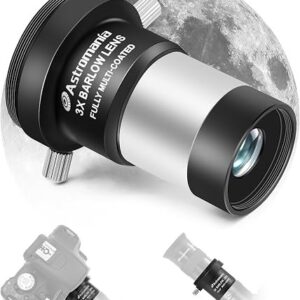
The listing does not advertise a T-thread, so it is sold as a visual accessory. For a DSLR or mirrorless body the Astromania 3x on this shelf states an M42x0.75 male thread for a T-ring.
Can I stack it with another Barlow?
Physically yes, optically rarely worth it. Stacking multiplies the factors and the faults together, and it moves the focal plane far enough out that many telescopes run out of inward focus travel.
Related Reviews
If this accessory is not the right fit, these Blue Rays Technologies reviews cover the nearest alternatives from the same comparison.
- Celestron Omni 2X review — best overall at $41.95
- SVBONY SV216 2X review — best for planetary imaging at $69.99
- Astromania 3X T-Thread review — best value for camera use at $23.99
Last updated: 17 October 2026. Pricing and availability for this product change frequently; check the retailer listing for the current figure.


There are no reviews yet.