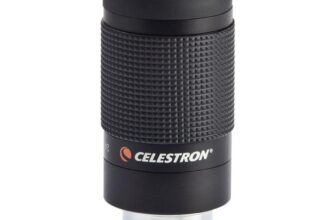

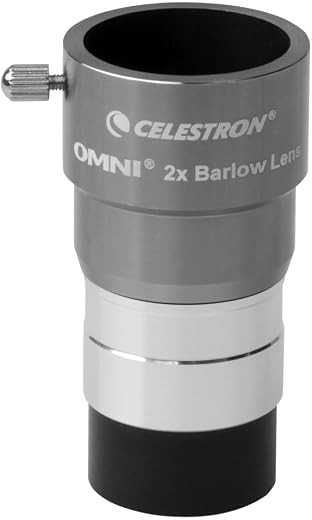
A barlow lens is the cheapest way to make the eyepieces you already own behave like shorter ones, and the only telescope accessory that doubles the useful range of an eyepiece case for less than the price of one more eyepiece. It sits between the focuser and the eyepiece, lengthens the telescope’s effective focal length, and multiplies magnification by the factor printed on the barrel. Our top pick is the Celestron Omni 2X, which carries 2,491 Amazon ratings at 4.6 – more owner evidence than the other four picks here combined.
The five picks below span $17.99 to $89.90 and factors of 2x, 3x and 5x, across three brands chosen from fifty-two listings filtered on a real brand, at least fifty ratings and a price that held steady across repeated reads. That last filter did most of the work: one listing read $17.99 on nine reads and $2,844 on a tenth, and another read $1,423,939 before settling at $54.99.
This comparison is research-based. We did not physically test these products; specifications, ratings and prices are taken from the live listings on 17 October 2026. Links go to Amazon.com; UK readers can search the same model names on Amazon.co.uk. One thing we will keep returning to: the factor on the barrel is not a fixed property of the glass, and on four of these five it changes with where you fit it.
Quick Comparison: All Five at a Glance
| # | Product | Role | Factor | Best for | Price | Score |
|---|---|---|---|---|---|---|
| 1 | Celestron Omni 2X | Best overall | 2x | A first Barlow for any 1.25-inch focuser | $41.95 | 8.6 |
| 2 | Celestron X-Cel LX 3X | Premium pick | 3x | Fast, short-focal-length telescopes | $89.90 | 8.4 |
| 3 | SVBONY SV216 2X | Best for imaging | 2x | Planetary cameras that need a known focal ratio | $69.99 | 8.1 |
| 4 | Astromania 3X T-Thread | Best value | 3x | Getting a camera body to reach focus | $23.99 | 7.7 |
| 5 | SVBONY 5X FMC | Best budget | 5x | A second Barlow for long-focus telescopes | $17.99 | 7.3 |
What is in this barlow lens comparison
- Quick Comparison: All Five at a Glance
- The 5 Best Picks in 2026
- Barlow Lens – Buyer’s Guide
- The Factor on the Barrel Is the Factor at One Spacing
- Count the Elements, Not the Adjectives
- Match the Factor to Your Aperture, Not Your Ambition
- Barrel Size, Filter Threads and How Your Eyepiece Is Held
- The Telescope Accessory a Government Actually Regulates
- US vs UK: The Same Five Milliwatts, Two Different Jobs
- Which One Should You Buy?
- Barlow Lens – Frequently Asked Questions
- Barlow Lens – Final Thoughts
- Sources and Further Reading
The 5 Best Picks in 2026
1. Celestron Omni 2X – Best Overall
Amazon rating: 4.6 from 2,491 | Barrel: 1.25 in | Listed weight: 0.08 kg
The Omni 2X is the only product here whose Zoom ratio field is filled in correctly as 2:1, and Celestron’s own description explains the point of the category better than most: it lets you “Keep the eye relief of your eyepieces while getting 2X the power.” A 20 mm eyepiece behind it frames what a 10 mm would, without putting your eyelashes on the glass.
The barrel is threaded for standard 1.25-inch filters.
Best for: You own a 1.25-inch focuser and two or three eyepieces, and you want to double the usable range of that case for less than the price of one more eyepiece.
Skip if: You only own 2-inch eyepieces, or you are buying specifically to put a camera on the telescope.
Read the full Celestron Omni 2X review →
Where to Buy — Celestron Omni 2X
2. Celestron X-Cel LX 3X – Premium Pick
Amazon rating: 4.7 from 1,050 | Barrel: 1.25 in | Listed weight: 0.15 kg
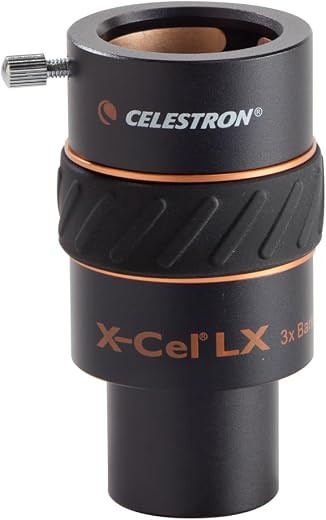
Tripling magnification triples every optical fault with it, which is why the cheap end of this shelf stops being usable at 3x. Celestron answers with three elements, fully multi-coated on every air-to-glass surface, and names its buyer honestly: “It’s perfect for owners of fast, short focal length telescopes.”
The mechanical detail worth the money is the brass compression ring, which Celestron says holds the eyepiece “without the risk of scratching or marring its barrel” – relevant if your eyepieces cost more than the amplifier.
Best for: Your telescope is fast and short, your eyepieces are expensive, and you already own a 2x that you have outgrown.
Skip if: This is your first Barlow, or your telescope is a long-focus achromat that already reaches high power unaided.
Read the full Celestron X-Cel LX 3X review →
Where to Buy — Celestron X-Cel LX 3X
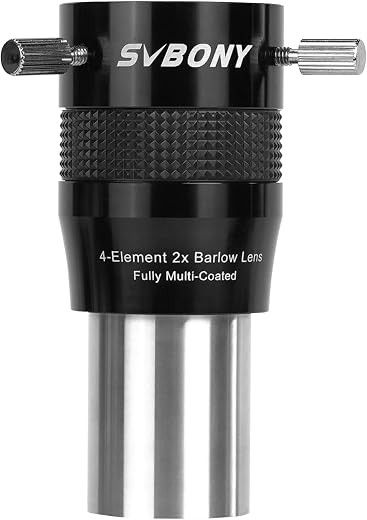
3. SVBONY SV216 2X Telecentric – Best for Planetary Imaging
Amazon rating: 4.6 from 53 | Barrel: 1.25 in | Listed weight: 13.1 oz
This is the only listing on the shelf that tells the truth about the category, and it does so to sell the exception. Its second bullet reads: “the magnification factor of the Barlow lens remains unchanged no matter where the Barlow lens is installed in the optical system.” A seller only advertises a constant factor when the normal case is a factor that moves.
The four-element telecentric design is claimed to give “a flatter field of view than standard Barlow lens”, which is what a sensor needs because a sensor cannot accommodate the way an eye can.
Best for: You are photographing planets or the moon and need a factor you can put into an exposure or resolution calculation.
Skip if: You observe visually and do not much mind whether your 2x is really 2.2x on the night.
Read the full SVBONY SV216 2X review →
Where to Buy — SVBONY SV216 2X
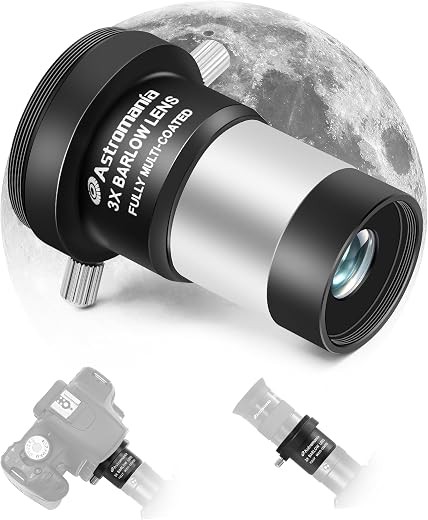
4. Astromania 3X with T-Thread – Best Value for Camera Use
Amazon rating: 4.3 from 160 | Barrel: 1.25 in | Listed weight: 4.06 oz
The useful claim is not about magnification. The listing states that it “solves the common problem where T-adapters prevent telescopes from focusing properly without barlow to reach infinity focus” and offers an M42x0.75 male thread for a DSLR or mirrorless T-ring. Many Newtonians and short refractors cannot reach focus with a camera bolted on, because the body’s flange sits further back than an eyepiece’s focal plane – and a Barlow pushes the focal plane outward, which here is the point.
For $23.99 you also get two large locking thumbscrews, a 1.25-inch filter thread, all-metal construction and the only Built-in media field on this shelf that is a real contents list: “1 x 3x Barlow Lens, 2 x Dust Covers.”
Best for: You want a camera on the telescope, or you want 3x for under $25 and accept that the glass is not Celestron’s.
Skip if: You want the best possible 3x view, or you need a factor you can rely on numerically.
Read the full Astromania 3X T-Thread review →
Where to Buy — Astromania 3X T-Thread
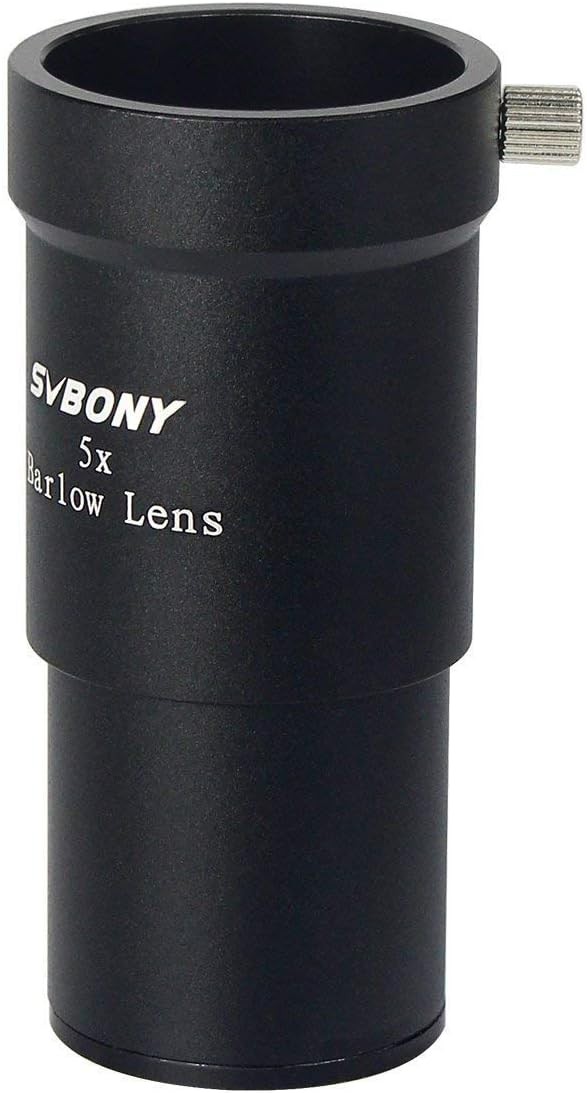
5. SVBONY 5X FMC – Best Budget
Amazon rating: 4.4 from 946 | Barrel: 1.25 in | Listed weight: 135 g
At $17.99 with 946 ratings at 4.4, this is the cheapest and second-best-evidenced pick here, and its warranty field is the fullest on the shelf: “We provide 1 year warranty for SVBONY telescope accessories and 30 days no reason to return,” with a stated position on service afterwards.
The problem is the number on the barrel. Five times is more than most nights can support, and the listing does not help: its own first bullet says this “5x barlow lens doubles the magnification of any 1.25 inch eyepiece,” one field says three elements in two groups while another says two, and its three printed part numbers – FUSF9102A, FAUF9102A and FCAF9102A – differ by a letter or two. Buy it second, never first.
Best for: You already own a 2x, your telescope is long-focus, and you want to find out where your own seeing ceiling actually is for the price of a takeaway.
Skip if: This is your first Barlow – at 5x you will blame the accessory for what the atmosphere is doing.
Read the full SVBONY 5X FMC review →
Where to Buy — SVBONY 5X FMC
Barlow Lens – Buyer’s Guide
The Factor on the Barrel Is the Factor at One Spacing
This is the single most important thing to understand before buying a barlow lens, and almost no listing says it. A classical Barlow is a negative lens placed inside the telescope’s focal plane, and its amplification depends on how far it sits from the new focal plane. The Orwell Astronomical Society in Ipswich puts the optics plainly: “if we alter the distance between the Barlow lens and the eyepiece we change the amplification factor,” and “Increasing the distance increases the amplification factor.”
The society gives the relation as M = 1 + (x / f), where x is the distance between the Barlow lens and the new focal plane and f is the Barlow’s own focal length. Put a 2x ahead of your star diagonal rather than after it and the light path between the Barlow and the eyepiece grows, so the factor grows with it.
That is why telecentric designs exist. For visual observing the drift rarely matters – you are choosing a magnification by eye anyway. For imaging it matters a great deal, because the focal ratio goes into the exposure.
Count the Elements, Not the Adjectives
Every listing on this shelf uses an optical adjective and not one of them publishes a measured figure. There is no stated colour error, no transmission percentage and no surface accuracy on any of the five. What you do get is element counts.
The vocabulary is inconsistent: one three-element unit here is sold as apochromatic, another as achromatic, and the four-element telecentric uses neither word. More elements give a designer more freedom to cancel colour error, so a two-element unit at 5x asks more of its glass than a four-element unit at 2x. Count elements where the listing states them, prefer fully multi-coated over multi-coated, and treat the adjective as marketing.
Match the Factor to Your Aperture, Not Your Ambition
Work out the magnification before you buy, because the number that matters is not the factor but the product. Multiply your telescope’s focal length by the Barlow’s factor and divide by your shortest eyepiece’s focal length. Then compare that with roughly fifty times your aperture in inches, which is the practical ceiling on an average night.
A 130 mm reflector at 650 mm with a 10 mm eyepiece gives 65x; a 2x makes that 130x, inside a ceiling near 250x, and a 5x makes it 325x, which is past it – a larger, dimmer, softer planet rather than a better one. This is why the SVBONY 5X is a second Barlow and not a first one.
Barrel Size, Filter Threads and How Your Eyepiece Is Held
All five picks here are 1.25 inch, the barrel size on most beginner and intermediate telescopes. If your focuser and eyepieces are 2 inch, none of these will help you and you want a 2-inch unit instead.
Two details separate them mechanically. First, a filter thread on the barrel means one 1.25-inch moon or colour filter serves every eyepiece you put behind the Barlow, rather than buying a filter per eyepiece. Second, how the eyepiece is clamped: a steel thumbscrew bears on the barrel and will eventually mark it, while a brass compression ring or a three-screw coaxial lock grips without marking and, in the three-screw case, centres the eyepiece instead of shoving it sideways.
Listed weights are published in three different unit conventions across these five listings, so convert before you compare: anything heavy hanging off the back of a small refractor will shift the balance of the tube.
The Telescope Accessory a Government Actually Regulates
Nothing in American or British law reaches a barlow lens. It is a sealed tube of passive glass with no emission, no power source and no moving parts, and no regulator has any interest in it. But a Barlow is precisely the accessory that exposes a badly collimated telescope, because tripling the magnification triples the asymmetry of a star image – so the thing a Barlow buyer most often needs next is a collimator, and the cheap collimators are lasers. Those are regulated, and the way they are regulated is strange.
In the United States the rule attaches to the purpose the seller declares. The Food and Drug Administration’s performance standard at 21 CFR 1040.11(b) states that each “surveying, leveling. or alignment laser product” “shall not permit human access to laser radiation in excess of the accessible emission limits of Class IIIa.” A laser collimator is an alignment laser product. Its guidance for manufacturers is plainer: “Laser products promoted for pointing and demonstration purposes are limited to hazard Class IIIa by FDA regulation,” which “means that pointers are limited to 5 milliwatts output power.”
Read that twice, because the operative words are promoted for: the same diode in a housing marketed for something else falls under a different ceiling. The FDA adds that “Class IIIb lasers cannot legally be promoted as laser pointers or demonstration laser products” – again a rule about promotion rather than about power.
Britain does not have that rule at all. The UK Health Security Agency’s laser radiation safety advice describes what the standard permits rather than imposing a ceiling: “The standard states that consumer laser products can be Class 1, Class 2, and a subgroup of Class 3R,” and that “Class 3B and Class 4 lasers are not suitable for general use by consumers.” Class 3R, the page notes, has “a maximum output power of 5 mW”.
Britain reaches the same tube after the fact. The Office for Product Safety and Standards published a product safety report on 5 October 2023 covering high-powered laser pointers sold via Amazon, finding they were “class 3 or class 4 lasers” presenting “a high risk of injuries and damage to sight” and concluding that “The product does not meet the requirements of the General Product Safety Regulations 2005.” The recommended action was blunt: “We recommend owners stop using this product immediately.” That is worth stating on a page like this one, which links to the same marketplace.
US vs UK: The Same Five Milliwatts, Two Different Jobs
The divergence is not about the hazard, which both countries describe identically, and not about the number, which is five milliwatts on both sides. It is about what the number does. In the United States five milliwatts is a ceiling imposed on a declared use-category: call your product an alignment laser or a pointer and 21 CFR 1040.11(b) caps it at Class IIIa. In the United Kingdom five milliwatts is a description of Class 3R that the UK Health Security Agency merely reports from a standard it frames with the words “UKHSA advises.” One is a limit; the other is a label.
And where America regulates the object by its stated purpose, Britain regulates the act by its effect. Section 1(1) of the Laser Misuse (Vehicles) Act 2018 provides that “A person commits an offence if” they “shine or direct a laser beam towards a vehicle which is moving or ready to move” and “the laser beam dazzles or distracts, or is likely to dazzle or distract, a person with control of the vehicle.” The class of the device does not appear anywhere in the offence. A one-milliwatt Class 2 pointer aimed at a car commits it; a five-milliwatt collimator pointed down a telescope tube in a field does not. The statute carries a defence of “reasonable excuse” under section 1(2).
For a telescope owner in either country the practical upshot is the same: buy the lowest-powered collimator that does the job, never look into the aperture while it is running, and never let the beam leave your own equipment.
Which One Should You Buy?
Under $25: the two cheapest picks
SVBONY 5X FMC at $17.99 buys the most magnification on the shelf and the fullest warranty statement, but 5x is a second Barlow and not a first one. The Astromania 3X with T-thread at $23.99 is the one to buy if there is a camera in your future, because its M42x0.75 thread is the only published camera connection among these five.
$25 to $70: where most buyers should land
The Celestron Omni 2X at $41.95 is the recommendation for almost everyone. The SVBONY SV216 2X at $69.99 is the imaging answer in the same band – four elements, a telecentric design and a factor its maker says holds wherever you fit it.
Above $70: paying for the glass and the grip
Only the Celestron X-Cel LX 3X at $89.90 is up here. Buy it if your telescope is fast and short, or if your eyepieces are worth more than your amplifier.
A Barlow and an eyepiece are different purchases that are easy to confuse, so we have treated them separately: our best telescope eyepieces guide covers the glass that sets your magnification in the first place, and found that those listings describe themselves using the telescope’s specifications rather than their own. The failure here is one step further on – the number a Barlow publishes really is about the Barlow, but only at a spacing nobody states. Buy the eyepieces first and the amplifier second.
Barlow Lens – Frequently Asked Questions
What does a barlow lens do?
It lengthens your telescope’s effective focal length, so every eyepiece behaves as a shorter one and the magnification rises by the factor on the barrel.
Are barlow lenses worth it?
For most owners of two or three eyepieces, yes – the Celestron Omni 2X at $41.95 does it with the deepest owner evidence here. A 5x bought first is usually what makes people say they are not.
Do I need a barlow lens or a shorter eyepiece?
A shorter eyepiece gives one magnification; a Barlow gives a second magnification for every eyepiece you own. A dedicated short eyepiece will usually give a marginally cleaner image.
Where does the barlow lens go on a telescope?
It goes into the focuser or star diagonal first, with the eyepiece dropped in afterwards. On a classical Barlow the order matters optically as well as physically – fitting it before the diagonal rather than after increases the amplification factor.
Are all barlow lenses the same?
No. Element count, whether the coatings are multi-coated or fully multi-coated, whether a filter thread is cut into the barrel, how the eyepiece is clamped, and whether the design is classical or telecentric all vary across the five picks here.
Why is my barlow lens blurry?
Most often the night rather than the lens. Check that the total magnification is inside about fifty times your aperture in inches, and give the telescope twenty minutes to cool. Collimation errors also become obvious at high power, which is the subject of the laser section above.
Barlow Lens – Final Thoughts
If you want one sentence: buy the Celestron Omni 2X, and buy an eyepiece before a second Barlow.
The thing to take away is not a product, though. Across these five listings the headline number – the factor – is the one figure that is not a fixed property of what you are buying. Four of the five are classical designs whose amplification moves with spacing, and exactly one listing says so, in a sentence written to sell you the exception at $69.99. When a shelf’s own marketing contains the disclosure its competitors omit, that is where to start reading.
Sources and Further Reading
- Orwell Astronomical Society (Ipswich) – Barlow lens: the amplification formula and why spacing changes the factor
- 21 CFR 1040.11 – FDA performance standards for specific purpose laser products, including surveying, leveling and alignment products (Cornell LII)
- US Food and Drug Administration – Important Information for Laser Pointer Manufacturers
- UK Health Security Agency – Laser radiation: safety advice
- Office for Product Safety and Standards – Product Safety Report: High Powered Laser Pointers sold via Amazon, 5 October 2023
- Laser Misuse (Vehicles) Act 2018, section 1 (legislation.gov.uk)
Affiliate disclosure: Blue Rays Technologies earns a commission on qualifying purchases made through the Amazon links on this page, at no extra cost to you. Prices and ratings were read from the live listings on 17 October 2026; the price shown on Amazon at the moment you click is the one that applies.