
A laundry room is not really a room. It is a container. Everything laundry produces —
the noise, the heat, the water on the floor, the humidity, the fabric-softener smell, the
pile of half-dry things that has nowhere to go — happens inside four walls with a door
you can shut. Take that room away, which is what living in a flat or a small apartment does,
and none of those by-products disappear. They simply land in the rooms you sleep and eat in.
That is the whole problem, and it is the reason a list of apartment laundry
essentials looks nothing like a list of laundry supplies.
The seven products below are organised around that idea rather than around the machine.
They run in the order laundry actually happens in a home with nowhere to hide it: the dose
that goes in, the wash itself, the water that ends up on the floor, the water that ends up in
the air, the reach you need because drying happens vertically, the pressing you have nowhere
to set up for, and finally the machine’s own upkeep, which is what decides whether it lasts
three years or ten. We have researched and reviewed every one of these apartment laundry essentials individually on this
site, and each entry links to the full review.
Three things we are not covering, and it is worth saying so up front: a tumble dryer, a
washer-dryer combo and a dehumidifier. The first two are appliance decisions rather than
purchases and they depend on a vent you probably do not have. The third is the correct answer
to indoor drying humidity and we say so plainly further down — but it is a sized-to-your-room
appliance, not a roundup pick, and we would rather tell you that than sell you an air purifier
in its place. Prices and links are Amazon.com; readers in the UK can search the same models on
Amazon.co.uk, and should read the voltage warning on the washing machine before they do.
Apartment Laundry Essentials — Quick Comparison
| # | Product | Role | Key spec | Best for | Price | Score |
|---|---|---|---|---|---|---|
| 1 | OMOZUN Detergent Pump | The dose | 5 dose settings, 8 ml/sec, fits 1.3 in necks | Repeatable dosing | $15.99 | 7.4 |
| 2 | Auertech Twin Tub Washer | The wash | 18 lb wash + 10 lb spin, 1,300 rpm, 120 V | No plumbed hookup | $179.99 (was $189.99) | 8.0 |
| 3 | VEELOIM Stone Mat | The drip | Diatomaceous earth, absorbent, non-slip, quick-dry | Drips on a hard floor | $29.98 (was $49.99) | 7.6 |
| 4 | Levoit Core Mini-P | The air | HEPA + activated carbon, desk-sized, quiet night mode | Smell and fibres | $47.81 | 8.6 |
| 5 | Handy Laundry Step Stool | The reach | 9 in, holds 300 lb, folds flat, non-slip | Reaching the airer | $12.99 | 8.9 |
| 6 | Joseph Joseph Pocket Max | The press | 35 in surface, folds to 17.9 × 6.1 in, iron hook | Ironing with no space | $99.99 | 8.3 |
| 7 | Leebein Spin Scrubber | The machine | Cordless, dual speed, 8 brush heads, detachable handle | The door seal | $35.99 (was $49.99) | 8.2 |
The 7 Best Apartment Laundry Essentials in 2026
Each of these apartment laundry essentials was reviewed individually on Blue Rays Technologies before it reached this list, and each entry links back to that full review. Scores are ours; prices and ratings were read from the live Amazon listing on the day of writing and move around.
1. OMOZUN Electric Laundry Detergent Pump — Best Apartment Laundry Essentials Pick for Dosing
Price: $15.99 | Amazon rating: 4.0 / 55 ratings | Role: The dose | Key spec: 5 dose settings, 8 ml/sec, fits 1.3 in necks
Almost every complaint about apartment laundry — the drum that smells, the towels that go stiff, the dark wash that comes out with white streaks — traces back to the same cause, and it is not the machine. It is too much detergent. Compact machines hold less water than the full-size drum the dose on the bottle was written for, and liquid detergent that does not fully dissolve stays in the fabric and in the rubber. The cap is the problem: it is a wide, unmarked, slippery thing designed to be generous.
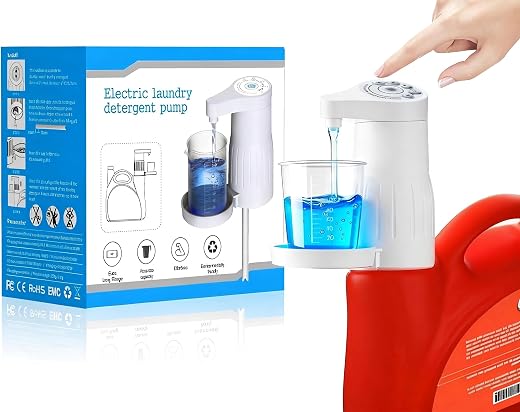
This is a battery-free, mains-powered pump that clamps onto the neck of a standard twin-opening bottle and delivers a measured shot at the press of a button. Five dose settings cover the range from a hand-wash quantity to a full load, and the flow rate is a modest 8 ml per second, which matters more than it sounds — a slow pump does not aerate the liquid into foam on the way out, so the graduated cup reads honestly. The unit is freestanding and takes up roughly the footprint of a mug.
It is a $16 gadget and we have not pretended otherwise in the score. What it buys is repeatability. Once every wash gets the same measured dose, you can halve it for a week and see whether the residue goes away, and if it does you have both fixed the problem and cut your detergent bill by half. That experiment is impossible when you are pouring by eye, and it is the single cheapest improvement available to anyone assembling apartment laundry essentials for a flat.
Best for: Anyone whose machine is small, whose water is soft, or who has ever tipped a glug of liquid detergent straight onto the clothes and hoped for the best. Five preset doses mean the same amount every wash, which is the only way to find out whether your residue problem is the machine or the measuring.
Skip if: You use pods or sheets, in which case dosing is already solved and this buys you nothing. Also skip it if 55 ratings is not enough evidence for you — it is the thinnest evidence base of anything on this list, and we have scored it accordingly.
Read the full Laundry Detergent Dispenser review →
Where to Buy — OMOZUN Detergent Pump
2. Auertech 28 lb Twin Tub Portable Washing Machine — Best Apartment Laundry Essentials Buy for Washing Without a Hookup
Price: $179.99 (was $189.99) | Amazon rating: 4.2 / 4,117 ratings | Role: The wash | Key spec: 18 lb wash + 10 lb spin, 1,300 rpm, 120 V
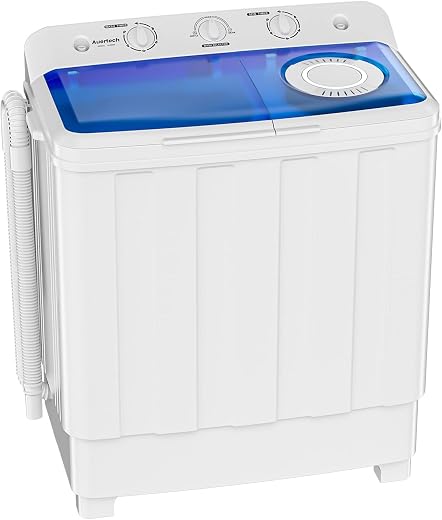
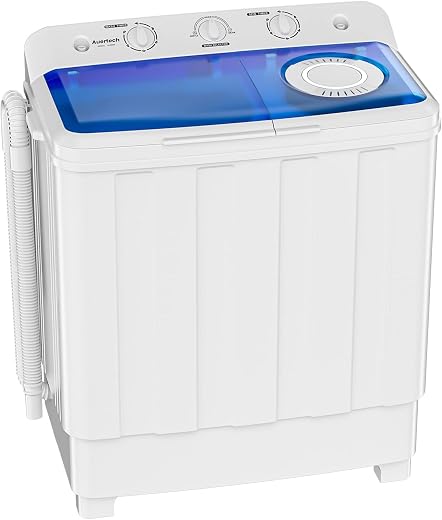
A twin tub is not a modern washing machine that happens to be small. It is an older, simpler design that survives because it solves a problem the modern one cannot: it needs no permanent plumbing. You fill the wash tub from a tap or a hose, run a timed wash, lift the wet load across into the spin tub, and let a 1,300 rpm spinner throw the water out through a drain hose into a sink or a bath. Nothing is connected to anything permanently, which is exactly why a twin tub sits at the centre of most apartment laundry essentials lists for rented homes.
The 28 lb headline figure is the two tubs added together and is not a load size. The honest numbers are 18 lb of washing and 10 lb of spinning, and the spinner is the smaller of the two for a reason — you spin in batches. Controls are two mechanical knobs and a wash/rinse selector. There is no water heater, no weight sensor and no cycle logic, so what you get in exchange for the low price is a machine with very little to go wrong and no electronics to fail out of warranty.
What it is genuinely good at is small, frequent loads, which is the right way to do laundry in a small home anyway. What it asks in return is that you stand there. This is a semi-automatic machine: it will not fill itself, it will not move the load between tubs, and it will not stop you overfilling the wash tub and slopping water down the side. Everything else on this list exists partly because of that.
Best for: A flat, dorm room, RV or annexe with a sink and a socket but no plumbed hookup. The twin-tub layout means you can be spinning one load while washing the next, which makes it faster in practice than its cycle times suggest.
Skip if: You are shopping from the UK or anywhere else on 230 V. The listing specifies 120 volts, and a travel adaptor does not change the frequency or the motor speed — buy the equivalent twin tub on your own market instead. Skip it too if you cannot lift and drain it: it is semi-automatic, and you are the automation.
Read the full Auertech portable washing machine review →
Where to Buy — Auertech Twin Tub Washer
3. VEELOIM Diatomaceous Earth Stone Mat — Best Apartment Laundry Essentials Pick for the Wet Floor
Price: $29.98 (was $49.99) | Amazon rating: 4.5 / 1,880 ratings | Role: The drip | Key spec: Diatomaceous earth, absorbent, non-slip, quick-dry
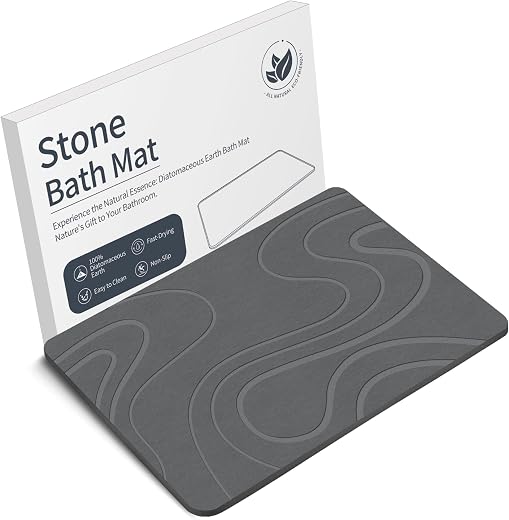
This is sold as a bath mat and we are recommending it for something else, so let us be straight about that from the start. What it actually is, is a slab of fired diatomaceous earth — a porous mineral that wicks water into itself and then releases it back to the room by evaporation. It is the only one of these apartment laundry essentials that dries itself, and that property is worth more beside a washing machine than it is beside a shower.
The problem it solves is specific. A twin tub drains through a hose you hold over a sink, an airer drips for the first hour, and a spin cycle throws a surprising amount of water down the outside of the tub. On a hard floor that becomes a slick patch you walk through in socks. A towel put down to catch it stays wet, and a wet towel on the floor of a small flat is precisely how a laundry corner starts to smell. The stone mat takes the same water and is dry again within the hour.
It is rigid, it is heavier than it looks, and the underside is textured so it does not slide on tile or vinyl. Ours arrived faintly dusty and needed a wipe. The honest limit is that porous stone eventually loads up with detergent residue and stops drinking; the fix is a light sand with the abrasive pad most sellers include, which restores it and is not optional maintenance.
Best for: Standing a portable washer, a spin dryer or an indoor airer on. It takes the drips a cloth mat would hold onto, and then dries itself instead of going sour in a corner.
Skip if: Your laundry corner is carpeted — a rigid mat on carpet rocks, and rocking is how these crack. It is also brittle: drop it on a tiled floor and you own two pieces. And it is a mat, not a tray, so it will not contain an actual leak.
Read the full VEELOIM stone bath mat review →
Where to Buy — VEELOIM Stone Mat
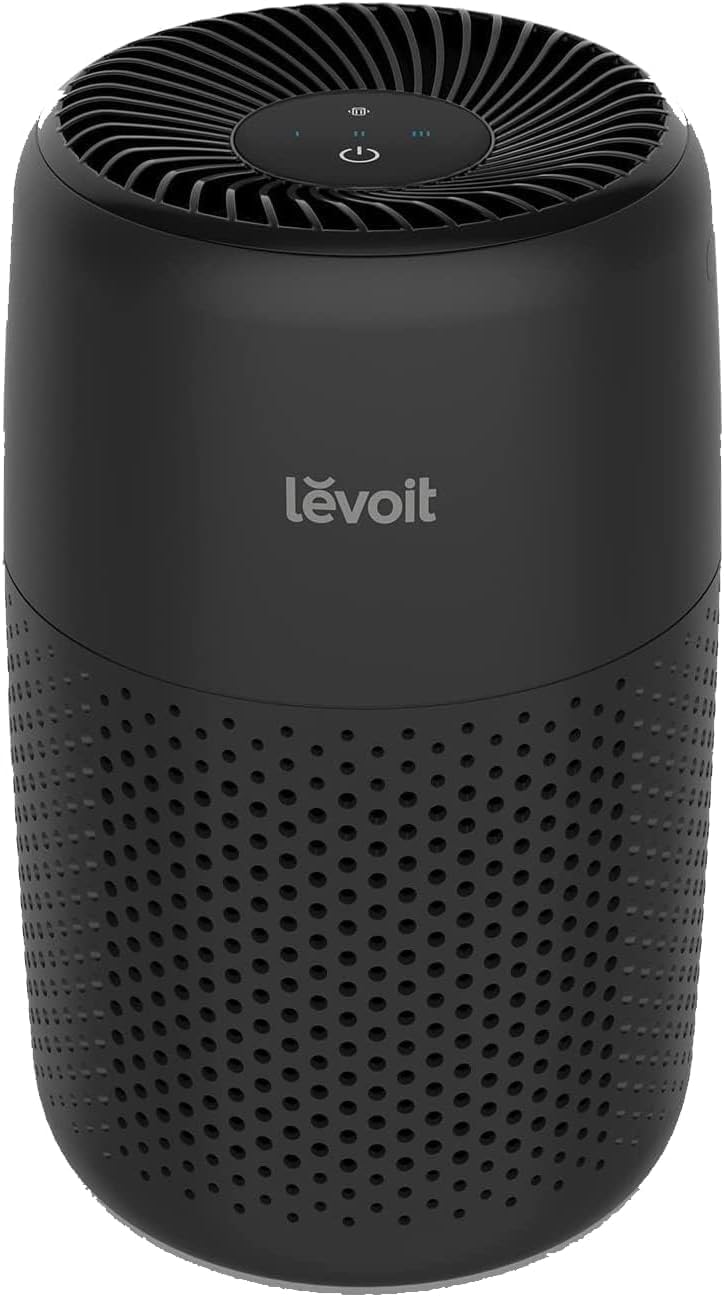
4. Levoit Core Mini-P Air Purifier — Best Apartment Laundry Essentials Pick for the Air
Price: $47.81 | Amazon rating: 4.6 / 45,351 ratings | Role: The air | Key spec: HEPA + activated carbon, desk-sized, quiet night mode
We have put a purifier on this list and then spent the Skip if line telling you what it does not do, which is unusual, and deliberate. Drying laundry indoors changes two things about a room: it raises the humidity, and it fills the air with fragrance compounds and shed fibres. Those are different problems with different solutions, and the reason so many people are disappointed by a purifier is that they bought it for the first one. It is the mistake we see most often in apartment laundry essentials shopping lists.
For the second one it is genuinely good, and this is the smallest sensible version of it. A three-stage cartridge — pre-filter, HEPA, activated carbon — sits in a cylinder about the size of a large mug, and the carbon layer is the part that earns its place here, because fragrance is a gas and a HEPA filter does nothing to gases at all. On its lowest setting it is quiet enough to leave running overnight next to a full airer, which is when the fibre load is highest and nobody is there to open a window.
It is also the most-reviewed thing in this roundup by a distance and it has held a 4.6 average across more than 45,000 ratings, which is the kind of evidence base that makes a recommendation easy. The running cost is the cartridge, not the electricity. Budget for a replacement filter roughly twice a year if it is running most nights, and treat that as the real price of adding it to your apartment laundry essentials.
Best for: The smell and the particulates — fabric-softener fragrance, the dusty note a tumble dryer pushes into a room, and the fibres a full airer sheds all day. In a one-room flat where the washing dries three feet from where you sleep, that is not a trivial job.
Skip if: You are buying it to deal with damp. It will not. An air purifier moves air through a filter; it removes nothing at all from the air’s water content. If your windows stream when the airer is up, the appliance you need is a dehumidifier, and no filter will substitute for one.
Read the full Levoit Core Mini-P review →
Where to Buy — Levoit Core Mini-P
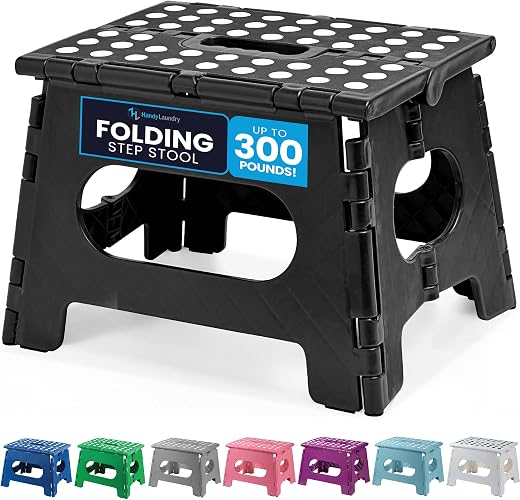
5. Handy Laundry 9-Inch Folding Step Stool — Best Apartment Laundry Essentials Buy for Reach
Price: $12.99 | Amazon rating: 4.7 / 84,130 ratings | Role: The reach | Key spec: 9 in, holds 300 lb, folds flat, non-slip
This is a $13 plastic step and it has the highest expert score in the roundup, which needs explaining. It has 84,130 ratings at a 4.7 average — by a wide margin the largest evidence base of any product we have reviewed on this site — and in a category where cheap products usually fail in the same predictable way, that volume is doing real work. It holds 300 lb, it does not flex underfoot, and the ribbed top does not become slippery when you step onto it with damp feet, which is the specific failure mode that matters on a wet floor.
The reason it belongs among apartment laundry essentials rather than on a general home list is height. In a home with no laundry room, drying happens vertically, because vertical is the only space nobody is using: airers over baths, racks over radiators, pulley airers on the ceiling, and the top of a stacked machine. All of those put the working surface between six inches and a foot above comfortable, and the alternative to a step is the thing everybody actually does, which is stand on the edge of the bath.
It folds to roughly an inch thick, which is the whole design. A stool that lives in a cupboard gets fetched once and then never again; a stool that hangs on the back of the door gets used. The manufacturer is literally called Handy Laundry, and for once the branding is honest about where the thing is meant to live.
Best for: Everyone. High airers, the top of a stacked machine, the cupboard where the detergent lives, the pulley airer over the stairwell. It folds to about an inch and hangs on the back of a door, which is why it gets used instead of fetched.
Skip if: You need real height. Nine inches is one step, not a ladder, and a stool is the wrong tool for a light fitting or a loft hatch. If you are going higher than one step, buy a proper stepladder and read the safety guidance that comes with it.
Read the full Handy Laundry folding step stool review →
Where to Buy — Handy Laundry Step Stool
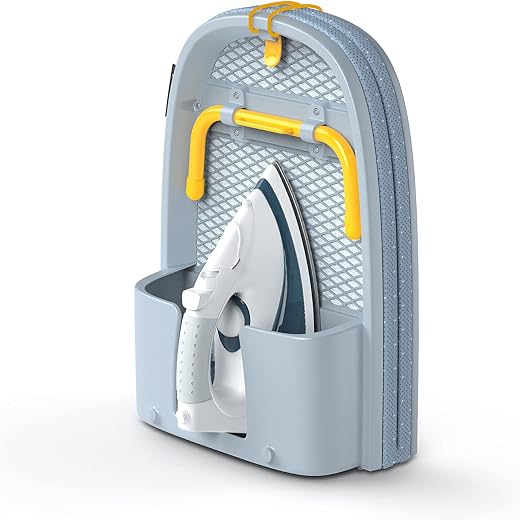
6. Joseph Joseph Pocket Max Tabletop Ironing Board — Best Apartment Laundry Essentials Pick for Pressing
Price: $99.99 | Amazon rating: 4.6 / 2,675 ratings | Role: The press | Key spec: 35 in surface, folds to 17.9 × 6.1 in, iron hook
A full-size ironing board is a piece of furniture that is in use for about twenty minutes a week and in the way for the other ten thousand. In a house it lives in the utility room and nobody thinks about it. In a flat it lives wedged behind a door, falls over when the door opens, and is the reason a lot of people simply stop ironing altogether.
The Pocket Max is Joseph Joseph’s answer, and the clever part is not that it folds — plenty of boards fold — but that the legs fold into the same plane as the top, so the whole thing collapses to 17.9 by 6.1 inches and about 13 inches deep. That is a shape that slides into a gap rather than needing a cupboard. There is an integrated hook for the iron on the end, which sounds like a gimmick until you realise the alternative in a small kitchen is putting a hot iron down on a worktop that is already covered.
The surface is 35 inches, which is a genuine shirt board rather than a novelty pad, and it is stable on a table because the feet are wide and rubberised. At $99.99 it is priced as a design object and it is fair to say you are paying for the folding mechanism rather than the ironing. Our view is that it earns it in exactly one situation — when the alternative is not ironing at all — and that is a common enough situation in a small flat to justify its place among these apartment laundry essentials.
Best for: Anyone who irons two shirts at a time rather than a basket at a time, and has nowhere to store a full-size board. Folded, it is roughly the size of a laptop bag and it stands on its end in a gap beside a wardrobe.
Skip if: You iron bedding, curtains or a household’s worth of school uniform. A 35-inch tabletop surface is a shirt-and-trousers board, and pressing a double duvet cover on it is a genuinely miserable afternoon. It is also the second most expensive thing here, which is a lot for a board.
Read the full Joseph Joseph Pocket Max ironing board review →
Where to Buy — Joseph Joseph Pocket Max
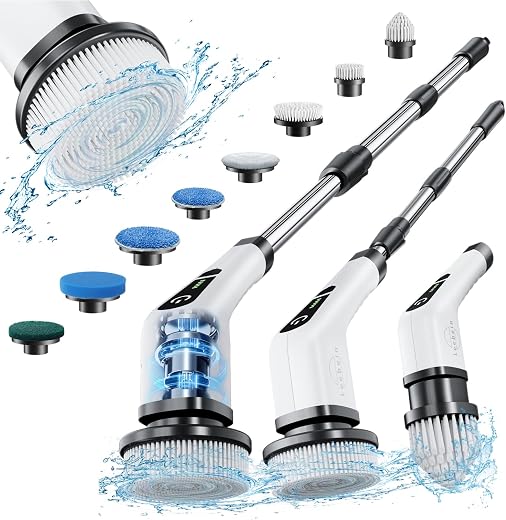
7. Leebein Electric Spin Scrubber — Best Apartment Laundry Essentials Pick for the Machine Itself
Price: $35.99 (was $49.99) | Amazon rating: 4.3 / 22,900 ratings | Role: The machine | Key spec: Cordless, dual speed, 8 brush heads, detachable handle
The last entry is the only one aimed at the machine rather than the laundry, and it is here because a front-loading washing machine in a small flat fails in a specific and preventable way. The rubber door boot is designed to hold water. It is warm, it is dark, it never fully dries between short cycles, and if the machine is dosed generously the residue in that fold is food. Within a year the seal is black and the clean washing smells of the machine, and nothing else on this page can undo that.
A cordless spin scrubber is the right shape for the job in a way a cloth is not. The head turns at a speed a wrist cannot hold, the handle detaches so you can work one-handed with the boot pulled back, and the kit ships with eight heads of which two — the small cone and the flat brush — are the ones you will use on a machine. Dual speed matters: the low setting is for the seal, because the high setting flicks dirty water up your arm.
It is genuinely a bathroom product being used somewhere better, and its 4.3 average across nearly 23,000 ratings is a bathroom average. The complaints that recur are battery life on the high setting and heads that wear quickly on rough grout — neither of which applies much to ten minutes a month on a rubber seal. It is the cheapest maintenance among these apartment laundry essentials and it is the one that decides whether the machine lasts.
Best for: The door seal, the detergent drawer and the filter housing — the three places a washing machine goes black and the three places a cloth cannot reach. The small cone head is the one that matters; it gets into the fold of the gasket where the mould actually lives.
Skip if: Your machine is a top loader with no rubber boot, in which case the gasket problem does not exist and this is just a bathroom tool. Skip it too if you already own one from a bathroom or car-cleaning kit — you do not need a second.
Read the full Leebein electric spin scrubber review →
Where to Buy — Leebein Spin Scrubber
Apartment Laundry Essentials — Buyer’s Guide: What to Look For
Apartment Laundry Essentials Start With Where the Water Goes, Not the Machine
The first question is not which washer to buy. It is where the dirty water leaves. A
portable machine drains through a hose you place, by hand, into a sink, a bath or a floor
drain, and everything about your laundry corner follows from where that hose can reach. If
the only sink is the kitchen sink, your laundry happens in the kitchen. If it is the bath,
you will be carrying a full tub across a hallway.
Work that out before anything else, because it also decides whether you need the drip
protection at all. A machine that drains into a bath makes very little mess. A machine that
drains into a kitchen sink two feet away makes a great deal. Good apartment laundry essentials
are chosen against the route the water takes out of your home, not against a feature list. Get that one decision right and the shopping list gets much shorter.
Apartment Laundry Essentials and the Drying Problem You Cannot Buy Your Way Out Of
Washing is easy. Drying is the part that beats people, because a wet load has to give up
its water somewhere and in a flat that somewhere is the air you are breathing. There are only
three honest answers: put it outside, put it in a machine that vents or condenses, or open a
window and accept that it will take a day.
Everything else — the fans, the filters, the sprays — is either helping one of
those three or is doing nothing. A purifier cleans the air; it does not dry it. A heated airer
speeds evaporation, which puts the water into the room faster, not less of it. Buy honestly
against that list of three, and be suspicious of any apartment laundry essentials guide that
implies there is a fourth. Ours does not, and it is the reason two obvious products are missing from the list below.
Voltage, Plugs and Why Half of These Apartment Laundry Essentials Are Country-Specific
Anything with a heating element or a motor is a market-specific purchase. The twin tub in
this roundup is specified at 120 volts, which makes it a North American machine; a British or
European reader needs the 230 V equivalent sold locally, and no travel adaptor fixes that.
The small, low-draw apartment laundry essentials — the pump, the purifier, the scrubber’s
charger — are usually dual-voltage and travel fine.
The other half of this is the socket. A washer and a dryer are among the highest-draw
appliances in a home, and running either through an extension lead shared with other
appliances is the classic small-flat mistake. London Fire Brigade’s advice on white goods is
blunt about it: “Don’t overload sockets with lots of energy-hungry appliances
– follow the one plug per socket rule.”
Noise, Neighbours and When You Can Run Your Apartment Laundry Essentials
A 1,300 rpm spin in a flat with a suspended timber floor is loud in the room below in a way
it never is in a house. If you share a party wall or a ceiling, the spin cycle is the part
that gets you a note, not the wash. Two practical consequences follow. First, small frequent
loads beat one big weekend load, because an unbalanced drum is what makes the noise. Second,
a machine that sits on a rigid mat rather than directly on floorboards transmits noticeably
less through the structure, which is one reason a mat earns a place among apartment laundry
essentials at all.
This is also why the delay-start button on a shared-building machine is a trap. Running a
wash overnight is exactly when nobody is awake to notice a leak, and it is when a fault has
the longest run at an empty flat.
What We Refused to Put on This Apartment Laundry Essentials List
No tumble dryer. In a flat you are choosing between a vented dryer you cannot vent, a
condenser that needs emptying and space, and a heat pump model that costs several times the
rest of this list combined. That is an appliance decision rather than a set of apartment laundry essentials, and it
deserves its own research.
No dehumidifier either, and this one is the refusal we are least comfortable with, because
it is the right machine for the job. If you dry indoors more than occasionally, a dehumidifier
does what nothing on this page does. We have left it off because it must be sized to your room
and your budget, and recommending a specific model to everyone reading would be dishonest. No
washer-dryer combo, no ironing press, and no scented laundry “boosters”, which are
fragrance sold as function and the most padded category in apartment laundry essentials
listings anywhere.
US vs UK: What Changes When You Do Laundry Without a Laundry Room
This is the roundup where the two markets diverge most sharply, because laundry is one of
the few household jobs where the two countries own different machines, keep them in different
rooms, dry the results by different methods and regulate all of it differently. Anyone
following an American apartment laundry essentials list from a British flat will go wrong in
at least three specific places, and they are worth naming before you spend anything.
The Words: Launderette, Airer and the British Apartment Laundry Essentials Vocabulary
Americans do laundry in a laundry room and use a dryer; if the
building has none, they go to a laundromat. The British put a washing machine under
the kitchen worktop, aspire to a utility room, own a tumble dryer
if they own one at all, and go to the launderette. A US drying rack is a
British clothes airer or clothes horse; a clothesline is a
washing line and its clothespins are clothes pegs.
Detergent is
washing powder or washing liquid, fabric softener is fabric
conditioner, a hamper is a laundry basket, an outlet is a socket, a
faucet is a tap, and the American first floor is the British ground floor —
which matters when a delivery driver is bringing the heaviest of your apartment laundry
essentials up a stairwell.
America Legislated a Right to Hang Washing Outside. Britain Never Had To
Here is the divergence almost nobody expects. In much of the United States, hanging washing
outdoors is a thing legislatures had to protect, because homeowners’ associations banned it on
aesthetic grounds. Vermont’s statute is unambiguous: “No deed restrictions,
covenants, or similar binding agreements running with the land shall prohibit or have the
effect of prohibiting solar collectors, clotheslines, or other energy devices based on
renewable resources from being installed on buildings.” Colorado reaches the same
place by listing “a retractable clothesline” among the energy conservation
measures an association must permit, subject to reasonable restrictions.
Britain has no equivalent statute for the simple reason that it has never needed one. There
is no HOA regime; restrictions on drying washing outdoors come from individual leases and
balcony clauses, not from a body with power over a whole neighbourhood. It is a rare case of a
freedom Americans had to win in state legislatures and the British have never thought about,
and it changes which apartment laundry essentials are even usable where you live. If you are shopping for apartment laundry essentials in a US condo, check your
association’s rules before you buy a rack — and then check whether your state has already
voided them.
Britain Writes the Ventilation Into Law; America Leaves It to the Code
The flip side is ventilation, and here Britain has the number. Approved Document F, the
building regulations guidance for ventilation in England, sets minimum intermittent extract
rates room by room: 30 l/s for a utility room, 30 l/s for a kitchen with a
cooker hood or 60 l/s without one, 15 l/s for a bathroom and 6 l/s for sanitary accommodation.
Whole-dwelling minimums start at 19 l/s for a one-bedroom home and 25 l/s for a two-bedroom
one, and the document is explicit about why: “Without adequate ventilation, mould
and internal air pollution might become hazardous to health.”
There is no equivalent national figure in the United States. Residential ventilation is set
by whichever model code a state or city has adopted and by ASHRAE 62.2, a private standard you
have to buy. The practical upshot for anyone assembling apartment laundry essentials is that a
new British flat is legally obliged to be able to extract the moisture your washing produces,
and an American one may or may not be, depending entirely on the jurisdiction. Check your own
extract fan before you buy anything else.
Two Different Machines: Why Apartment Laundry Essentials Are Not Interchangeable Across the Atlantic
British and American washing machines are not the same appliance with different plugs.
American machines have historically taken a hot feed from the household water heater; British
machines are cold-fill and heat their own water with an internal element, which is why a
British cotton cycle can run for two or three hours where an American one runs for well under
an hour. On 230 V that element can be substantially more powerful than a 120 V circuit would
comfortably allow.
The consequence for a small flat is scheduling rather than performance. A British reader
planning a laundry evening around a US guide’s cycle times will be an hour and a half out. It is also why UK energy advice concentrates so heavily on washing at 30 °C: on a cold-fill
machine, almost all the electricity goes into heating the water, so temperature is the dial
that moves the bill, and no amount of apartment laundry essentials will move it further.
Energy Labels: Rescaled A–G Against EnergyGuide and ENERGY STAR
UK and EU appliances carry a rescaled energy label. GOV.UK guidance confirms washing
machines and washer-dryers moved to “A – G energy rating classes instead of
A+++ – G energy rating classes” in the first phase of rescaling in March 2021,
with dealers required to replace old labels by 18 March 2021, and the label must show the model
and supplier, the energy used, and the efficiency class with colour-coded arrows. The
rescaling was deliberately harsh: machines that were A+++ became B or C overnight, and almost
nothing scored an A.
The American system is different in kind. The yellow EnergyGuide label gives estimated
annual running cost and a comparison range rather than a letter grade, and ENERGY STAR sits on
top as a voluntary endorsement. Neither is wrong, but a British reader comparing apartment laundry essentials and looking for
an A rating on a US listing will not find one, and an American reader should not read a
European “C” as a bad machine.
Dryer Fires Are an American Statistic Because Dryers Are an American Appliance
The United States Fire Administration estimates 2,900 clothes dryer fires in
residential buildings reported to US fire departments each year, causing
5 deaths, 100 injuries and $35 million in property loss. The leading factor is
not a design defect: “Failure to clean (34 percent) was the leading factor
contributing to the ignition of clothes dryer fires in residential buildings,” and
the leading items first ignited were “dust, fiber, and lint (28 percent) and clothing
not on a person (27 percent)”. Incidence peaks in January at 11 percent of the
annual total.
Britain’s version of this advice is the same advice given by a different institution.
London Fire Brigade’s white goods guidance says simply “Clean your tumble dryer
filter after every load,” alongside advice to register new appliances so
manufacturers can reach you in a recall and to take extra care with second-hand machines. The
lesson for either market is identical, free, and worth more than any of the apartment laundry
essentials on this page: the filter, every load, no exceptions.
Microplastic Filters: France Requires Them, Britain Has a Bill, America Has Neither
Synthetic clothing sheds fibres into wash water, and the regulatory response has split three
ways.
In the UK, the Microplastic Filters (Washing Machines) Bill — a Ten Minute Rule
private member’s bill introduced in the 2024–26 session — proposes
“to require manufacturers to fit microplastic-catching filters to new domestic and
commercial washing machines” and to raise awareness of the consequences
“for pollution in rivers and seas”. It passed a Commons second reading and
has not become law. The United States has no federal requirement at all. If this matters to
you, an aftermarket filter is the only option in either market today, and it is the one
addition to a set of apartment laundry essentials that regulation may yet make compulsory.
Apartment Laundry Essentials — Which One Should You Buy?
Under $35: The Apartment Laundry Essentials That Fix the Most for the Least
Start with the Handy
Laundry folding step stool at $12.99 and the OMOZUN
detergent pump at $15.99. Between them they cost under $30, and they fix the two things
that actually stop people doing laundry properly in a small home: not being able to reach the
drying space, and not knowing how much detergent is going in. Add the VEELOIM
stone mat at $29.98 if your machine drains anywhere near a floor you walk on. This tier is
where the best value in apartment laundry essentials sits by a wide margin, and most readers
should stop here.
Laundry in a flat shares its problems with the rest of the home: damp, surfaces and nowhere to put anything. Our deep cleaning tools guide covers the surfaces and the apartment kitchen essentials guide covers the room that competes for the same square metre.
$35 to $60: The Apartment Laundry Essentials Worth Adding Next
The Leebein
spin scrubber at $35.99 is maintenance rather than convenience, and it is the item most
likely to extend the life of a machine you did not choose and cannot replace. The Levoit
Core Mini-P at $47.81 belongs here if your washing dries in the room you sleep in —
and only if you have read the caveat above about what it does not do. If you are building a set
of apartment laundry essentials gradually, this is the tier to reach second.
Over $60: The Apartment Laundry Essentials That Are Real Purchases
The Joseph
Joseph Pocket Max at $99.99 and the Auertech
twin tub at $179.99 are decisions, not impulse buys. The twin tub only makes sense if you
have no hookup and no building laundry; if you have either, the money is better spent on
detergent and quarters. The ironing board only makes sense if the alternative is genuinely not
ironing. Two related reviews worth reading before you commit are our touchless
paper towel dispenser review, for a laundry corner that doubles as a cleaning station, and
the JOYMOOP flat
mop, which is the tool for an actual leak rather than a drip.
Moisture, Heat and Lint: What the Regulators Actually Say About Home Laundry
Most laundry advice online is folklore. The four areas below are the ones where national
regulators, fire services and public health bodies have published something specific, and they
are the parts of this subject where being right matters. None of it can be solved by buying
anything, which is exactly why it belongs in an honest apartment laundry essentials guide
rather than in the product entries above.
The Ventilation Numbers No Apartment Laundry Essentials Guide Can Sell You
England’s Approved Document F sets minimum intermittent extract rates for new and altered
dwellings. A utility room requires 30 l/s, a kitchen 30 l/s with a cooker hood
extracting to outside or 60 l/s without one, a bathroom 15 l/s and sanitary accommodation
6 l/s. Whole-dwelling minimum ventilation rates begin at 19 l/s for one bedroom and 25 l/s for
two. The document also requires that all rooms with external walls have background ventilators
— the trickle vents people tape shut in winter.
The reason to know the utility-room figure even if you have no utility room is that it is
the rate the regulations think a room full of wet washing needs. If your washing is drying in a
bedroom with the door shut and a taped-up trickle vent, you are running a utility room at
roughly zero litres a second, and no combination of apartment laundry essentials will rescue
that room. The guidance is direct about the stakes: without adequate
ventilation, “mould and internal air pollution might become hazardous to
health.”
Dryer Fires: 2,900 a Year, and Why Lint Beats Every Gadget in an Apartment Laundry Essentials Kit
The US Fire Administration’s residential clothes dryer fire data is the clearest number in
this whole subject. An estimated 2,900 fires a year, 5 deaths, 100 injuries and $35 million in
property loss — and failure to clean is the leading contributing factor at 34 percent,
with dust, fibre and lint the leading item first ignited at 28 percent. Fires cluster in autumn
and winter and peak in January, when everything is being dried indoors and dryers run hardest.
What makes this actionable rather than alarming is that the leading cause is a two-second
job. Clean the lint filter after every load, not every few loads, and have the vent duct itself
cleared periodically, because lint that gets past the filter accumulates where you cannot see
it. It costs nothing and it outranks every purchase in this apartment laundry essentials
guide. London Fire Brigade gives British readers the identical instruction in a single line.
Washing Temperature, and What Actually Kills Germs
There is a gap between what a hot wash feels like and what disinfection actually requires.
The CDC’s healthcare linen guidance — written for hospitals, not homes, and worth reading
in that light — specifies “hot water (70–80°C X 10 min) [158–176°F])
and an approved laundry detergent”. That is far above a domestic 40 °C cycle, and
it is why a normal wash is about cleanliness rather than sterility.
For households, NHS Scotland’s national infection prevention guidance on washing clothes at
home is more practical: wash the affected clothing “using the highest temperature you
can and following the washing instructions”, wash it “separately from your
other home laundry”, tumble dry if the care label allows and iron with a hot steam
iron if you can. Both bodies give the same physical-handling instruction, and it is the one
people ignore: do not shake the laundry, because shaking aerosolises what is on it, and that single habit costs nothing.
Registration, Recalls and the One-Plug-Per-Socket Rule for Apartment Laundry Essentials
Two pieces of British fire-service advice apply everywhere. Register new appliances with the
manufacturer so they can contact you if a model is recalled — white goods recalls are the
one category where the manufacturer genuinely cannot find you otherwise — and check
second-hand machines against the recall register before you plug them in, which matters
disproportionately in rented flats where the machine came with the tenancy. And follow the one
plug per socket rule for energy-hungry appliances rather than daisy-chaining an extension lead
behind the machine.
The Dryer You Might Actually Fit Alongside Your Apartment Laundry Essentials
If you do eventually buy a dryer for a flat, the technology worth understanding is the heat
pump. ENERGY STAR describes it as “a closed loop system by heating the air using it
to remove moisture from the clothes and then reusing it once the moisture is removed”,
notes that such dryers are “easy to install since they don’t require
ventilation” and can be “installed in any room with electricity and a water
source”, and states they “can reduce energy use by at least 28% compared to
standard dryers”.
No vent is the sentence that matters in a rental. They are slower
and they cost more, and they are the only dryer format that fits the constraint these
apartment laundry essentials are built around.
Apartment Laundry Essentials — Frequently Asked Questions
1. Do I really need a portable washing machine, or should I use the laundromat?
Do the arithmetic honestly. If your building has a laundry room or there is a launderette
within a few minutes’ walk, a machine that costs $180 and takes up permanent floor space is
often the worse deal, and it is fair to say so in an apartment laundry essentials guide that
is trying to sell you one. A twin tub wins when there is no building laundry, when carrying
washing is difficult, or when you need to wash small amounts frequently rather than a sack
once a week. In every other case it is the one entry on this apartment laundry essentials list
we would talk you out of.
2. Will an air purifier stop my flat getting damp when I dry washing indoors?
No. This is the most common and most expensive misunderstanding in the whole category. A
purifier draws air through a filter and removes particles and, with a carbon stage, some gases.
It removes no water. If your windows are running with condensation when the airer is up, you
need ventilation or a dehumidifier, and buying a filter instead will cost you money and change nothing.
3. What temperature should I wash at?
For ordinary laundry, 30 °C with a good detergent is enough and it is where almost all
the energy saving is, because on a cold-fill machine the heating element is the load. Raise it
when there is a reason — illness in the house, towels, anything soiled. Public health
guidance for laundry from someone with an infection is to use the highest temperature the care
label allows and wash it separately.
4. How much detergent should I actually use in a compact machine?
Less than the cap suggests, and the reason is that dosing instructions assume a full-size
drum and average water hardness. Start at half the recommended dose in a soft-water area and
work up only if things are not coming clean. Consistent measuring is the point of a dosing pump and the reason it opens this list of
apartment laundry essentials — you cannot run that experiment if every wash gets a
different unmeasured pour.
5. Can I vent a tumble dryer out of a window?
Vent kits exist and people do it, but it is the compromise that produces most of the
complaints: the hose kinks, warm moist air is pushed against a cold window and condenses, and
the window cannot be closed. If you are choosing a dryer to sit alongside your apartment laundry essentials in a flat with
no permanent vent, a condenser or heat pump model avoids the problem entirely, at the cost of
emptying a tank.
6. Is a twin tub really slower than a normal washing machine?
In wall-clock time it is often faster, because it does two things at once. A single cycle is
short, and while one load spins you can start the next wash. What it costs is your attention:
you are the pump, the timer and the transfer mechanism. Judge it on how much of your presence it needs, not on
cycle length, and budget the time as part of the cost of these apartment laundry essentials.
7. What are the best apartment laundry essentials to buy first on a small budget?
The step stool and the dosing pump, in that order, for under $30 together. They cost less
than a month of laundromat visits and they fix the two everyday frictions — reach and
measurement — that make people give up on doing this properly. Everything else on this
list can wait until you know what your particular corner actually struggles with.
8. My washing machine smells. What do I do?
Three things, in order. Run a hot maintenance wash with the drum empty. Pull back the rubber
door seal and clean the fold, which is where the black growth lives and where a cloth will not
reach. Then leave the door and the detergent drawer ajar between washes so the drum can dry.
If the smell returns within a fortnight you are almost certainly still overdosing detergent,
which is why dosing leads this apartment laundry essentials list rather than trailing it.
9. Do these apartment laundry essentials work the same way in the UK?
Most of them do. The exception is the washing machine, which is specified at 120 volts and
is therefore a North American product; British and European readers need the 230 V equivalent
from their own market. The small mains and battery items are fine. The advice on ventilation, dosing,
drying and machine hygiene applies to apartment laundry essentials identically in both
countries.
10. Is drying clothes on a radiator bad for the heating bill?
It makes the radiator less efficient at heating the room, because the heat is going into
evaporating water instead of warming air, and that water then has to be ventilated out. It is
not a disaster and millions of people do it, but if you do it, open a window in that room while
the washing dries — ventilation is the cheapest of all apartment laundry essentials. The moisture has to leave the building one way or another.
Apartment Laundry Essentials — Final Thoughts
The pattern that emerges from putting these seven together is that almost none of the money
belongs on the washing machine. The two apartment laundry essentials we would buy first cost less than $30 between them, and
the item most likely to save you a repair bill is a $36 brush. The expensive things
on this list — the twin tub and the folding board — are both purchases that only
make sense in a specific situation, and we have tried to describe those situations precisely
rather than recommend them to everyone.
The other thing worth carrying away is that the hardest part of this subject cannot be
bought. Getting the water out of the room is a ventilation problem, and the regulators who have
put numbers on it — 30 litres a second for a utility room, a lint filter cleaned after
every load — are describing physics, not products. A good set of apartment laundry
essentials makes the job possible in a home that was not designed for it; opening a window is
what makes it work.
Sources and Further Reading
- HM Government — Approved Document F, Ventilation, Volume 1: Dwellings (2021 edition)
- US Fire Administration — Clothes Dryer Fires in Residential Buildings
- US Fire Administration — Appliance and Electrical Fire Safety
- London Fire Brigade — White goods safety
- Vermont General Assembly — 27 V.S.A. § 544, Energy devices based on renewable resources
- Colorado General Assembly — Limitation on a Homeowners’ Association’s Regulation of Property Rights (§ 38-33.3-106.7, C.R.S.)
- CDC — Linen and laundry management (Appendix D)
- NHS Scotland / ARHAI — Washing clothes at home (National Infection Prevention and Control Manual)
- GOV.UK — Regulations: energy information (energy labelling of products)
- ENERGY STAR — Heat Pump Dryers
- ENERGY STAR — Clothes Dryers
- UK Parliament — Microplastic Filters (Washing Machines) Bill
- legislation.gov.uk — The Ecodesign for Energy-Related Products and Energy Information Regulations 2021, Schedule 9
Disclosure: this apartment laundry essentials guide contains affiliate links. If you buy
through them we may earn a commission at no extra cost to you, and it does not change what we
recommend or the scores we give. Prices were checked at the time of writing and change often;
the Auertech washing machine is a 120 V North American appliance and readers outside North
America should buy the 230 V equivalent on their own market. Nothing here is professional
electrical, building or medical advice — where we quote a regulator we have linked the
original so you can read it in full.