
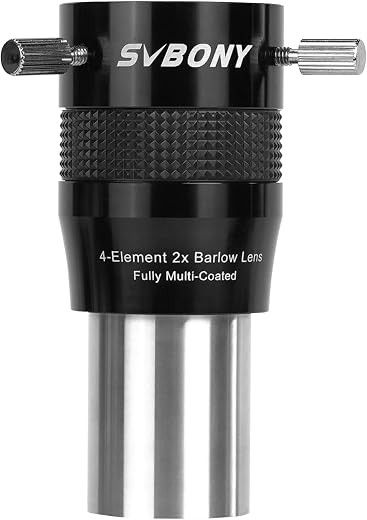
SVBONY SV216 Telecentric Barlow Lens Review (2026): Worth It?
SVBONY 216 2X Barlow Lens, 1.25″ FMC Barlow Lens Telescope Accessory at $69.99. 4.6 out of 5 from 53 Amazon ratings. Best for planetary imaging
$69.99
SVBONY SV216 Telecentric Barlow Lens Review (2026)
The SV216 is the only product on this shelf whose listing admits that a Barlow’s amplification normally depends on where it sits, and then sells a four-element telecentric design as the cure. It scores 8.1 for publishing the fact that matters most in this category, and loses ground for a rating pool of fifty-three and for the fewest structured fields of any pick here.
In short: the telecentric barlow lens earns 8.1/10 from the Blue Rays Technologies team. This review is research-based. We did not physically test this product; specifications, ratings and prices are taken from the live listing on 17 October 2026. The rest of this review explains how that score was reached, and the full comparison is in our best barlow lenses roundup.
What is in this telecentric barlow lens review
- Key Specifications
- The One Sentence That Makes This a telecentric barlow lens
- Four Elements, a Flatter Field and a Coaxial Lock
- Eye Relief, Stated Correctly
- Limitations and Compromises
- Setting Up This Telecentric Barlow Lens
- Who Should Buy This Telecentric Barlow Lens?
- The Verdict
- Telecentric Barlow Lens – Frequently Asked Questions
- Related Reviews
Key Specifications
Every figure below is copied from the live retailer listing on 17 October 2026. Where the telecentric barlow lens publishes a field that does not describe a Barlow at all, we have put it in the limitations section rather than here.
| Reviewed model | telecentric barlow lens |
| Brand | SVBONY |
| Item model number | FCAW9168A |
| Product dimensions | 5.9 x 3.15 x 2.76 inches |
| Item weight | 13.1 ounces |
| Date first available | November 11, 2022 |
| Manufacturer | SVBONY |
| Amazon rating | 4.6 out of 5 from 53 ratings |
| Price on 17 October 2026 | $69.99 |
The One Sentence That Makes This a telecentric barlow lens
Buried in the second bullet of the description is the most useful sentence on this entire shelf: “The magnification of the SV216 Barlow lens is constant at 2 times; the 4-piece design of the Barlow lens and the optimized optical structure ensure that the magnification factor of the Barlow lens remains unchanged no matter where the Barlow lens is installed in the optical system.”
Read that twice, because of what it implies about everything else in this category. A seller only advertises that its factor is constant if the normal case is that the factor is not. The Orwell Astronomical Society in Ipswich states the underlying optics without the marketing: “if we alter the distance between the Barlow lens and the eyepiece we change the amplification factor.” This is the product that says so on its own sales page.
Four Elements, a Flatter Field and a Coaxial Lock
The description sets out what the extra glass buys: a design that “effectively prolongs the focal length of the primary mirror without introducing chromatic aberration and vignetting problems that bother users” and “offers excellent spherical aberration control; resulting in a flatter field of view than standard Barlow lens.” A flatter field is what a camera sensor needs, because a sensor cannot accommodate the way an eye can.
The mechanical answer is a three-screw coaxial lock rather than a single thumbscrew: “SV216 2x Barlow lens adopts 3 screws design and coaxial locking device; improving the concentricity of the optical axis of the system can significantly improve the quality of captured images.” Three screws at 120 degrees centre the eyepiece or camera nosepiece instead of pushing it off-axis, which is exactly the fault a single setscrew introduces.
Eye Relief, Stated Correctly
The last bullet gives the reason to buy any amplifier, in the right direction: “The low magnification eyepiece is matched with the SV216 telecentric 2x 4-element Barlow lens; which can enjoy the magnification effect of the high magnification eyepiece while the eye relief distance is still within the comfortable observation range of the human eye.”
No structured field on this listing says anything about eye relief, because this listing has almost no structured fields at all — six, against twenty-four to twenty-eight on the other four picks. Everything useful about it is in prose a person wrote, and nothing useful is in the data a filter can sort. That inversion is the shelf’s most consistent feature.
Limitations and Compromises
Fifty-three ratings is the thinnest evidence of any pick here, against 2,491 for the Celestron Omni and 946 for the SVBONY 5x. It clears our fifty-rating floor by three. A 4.6 average on fifty-three ratings is a weaker statement than the same average on two thousand, and it is the main reason this sits at 8.1 rather than higher.
The six structured fields give you a model number, a weight, a box size and a date, and nothing optical. There is no coating field, no element count in any field, no compatibility field and no warranty field — the four-element claim and the telecentric claim both live only in the description. On a $69.99 product that is a thin disclosure, and it is the inverse of what the price would suggest.
The listed 13.1-ounce weight and 5.9 by 3.15 by 2.76-inch box are packaging figures rather than the lens’s own, so there is no reliable way to know how much this adds to the back of the focuser. On a small refractor with a light eyepiece that is worth checking before you commit, because a heavy amplifier shifts the balance.
Setting Up This Telecentric Barlow Lens
Fit it into a 1.25-inch focuser or diagonal and tighten the three locking screws evenly rather than one at a time — the point of three screws is to centre the nosepiece, and tightening one hard defeats that. The description says the factor does not change with position, so unlike a classical Barlow you can place this before or after a star diagonal without recalculating.
For imaging, add the camera first and find focus on a bright star before the planet drifts into the field; a telecentric amplifier moves the focal plane out like any other, and some short refractors will need the focuser racked almost fully in. Keep the caps on both ends between sessions, since a four-element unit has more internal surfaces to collect dust.
Who Should Buy This Telecentric Barlow Lens?
Anyone photographing planets or the moon with a planetary camera, and anyone who has been frustrated by a 2x Barlow that behaves like a 2.5x when a diagonal is in the train. Paying $69.99 buys a factor you can rely on in an exposure calculation, which is worth more to an imager than to a visual observer.
Skip it if you observe visually and do not care whether your 2x is really 2.2x, where the $41.95 Celestron Omni gives you deeper owner evidence and a stated warranty for $28 less.
The Verdict
The most intellectually honest listing on this shelf and the right buy for planetary imaging. 8.1 reflects a four-element telecentric design, a three-screw coaxial lock, a flatter field for sensors and the only published acknowledgement that a Barlow’s factor normally moves with position. It is held back by fifty-three ratings, by six structured fields that say nothing optical, and by being $28 dearer than a pick with forty-seven times the owner evidence. Buy it for a camera, not for an eyepiece.
Check the current price of telecentric barlow lens on Amazon — the listing shows $69.99 on 17 October 2026, and the price on Amazon is the one that counts.
Affiliate disclosure: Blue Rays Technologies earns a commission on qualifying purchases made through the Amazon links on this page, at no extra cost to you.
Telecentric Barlow Lens – Frequently Asked Questions
The questions below are the ones buyers actually search for about telecentric barlow lens.
What makes a telecentric barlow lens different?
A classical Barlow’s amplification rises as the distance between its negative lens and the focal plane grows, so the factor depends on what else is in the train. A telecentric design is built so the factor holds; this listing claims it “remains unchanged no matter where the Barlow lens is installed.”
Is it worth $69.99 over a $17.99 Barlow?
For imaging, often yes, because an exposure and a resolution calculation both need a known focal ratio. For visual use the honest answer is usually no, and the Celestron Omni at $41.95 carries far deeper owner evidence.
Why does it have three locking screws?
To centre what you put in it. The listing says the coaxial locking device improves “the concentricity of the optical axis,” which a single setscrew cannot do because it pushes the barrel sideways.
Does SVBONY state a warranty for it?
Not on this listing — there is no warranty field and the description does not give a term. SVBONY’s other product on this shelf does state one year plus thirty days, so the omission here is a gap in the listing rather than a stated policy.
Related Reviews
If this accessory is not the right fit, these Blue Rays Technologies reviews cover the nearest alternatives from the same comparison.
- Celestron Omni 2X review — best overall at $41.95
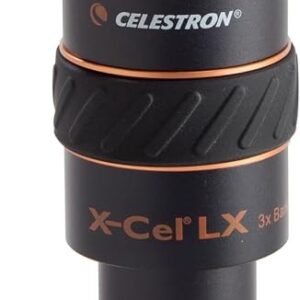
- Celestron X-Cel LX 3X review — premium pick at $89.90
- Astromania 3X T-Thread review — best value for camera use at $23.99
Last updated: 17 October 2026. Pricing and availability for this product change frequently; check the retailer listing for the current figure.


There are no reviews yet.