
VIFLY WhoopStor V3 LiPo Storage Charger Review (2026): Worth It?
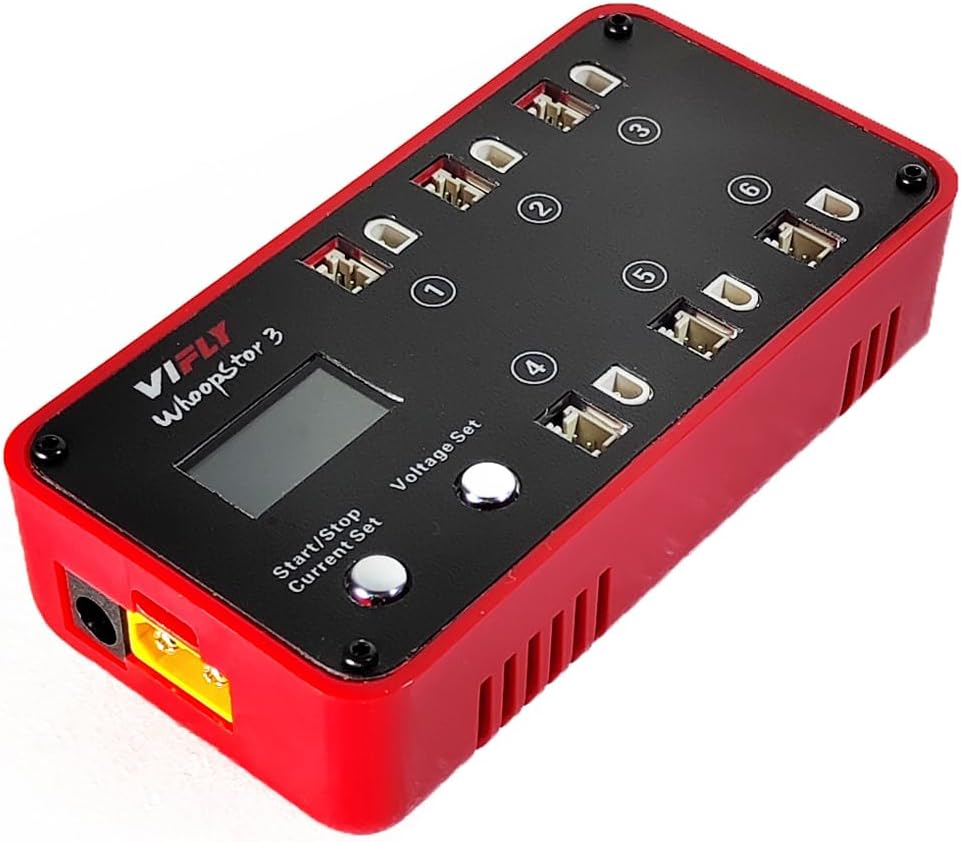
A six-port charger and discharger for single-cell lithium polymer packs, running 0.3 to 1.3 amps per channel over USB Type-C, XT60 or DC, with a colour LCD and a selectable target voltage in both directions. Its published output voltage of 3.8 V is the storage voltage, which makes it the only charger in this comparison to state the figure the category is sold on.
$32.99
VIFLY WhoopStor V3 LiPo Storage Charger Review (2026) — the Only One That Prints the Number
Every charger in this category is sold on how fast it fills a battery. This one is sold on where it stops, and it is the only product in the comparison whose published output voltage is a resting voltage rather than a maximum.
The VIFLY WhoopStor V3 is a six-port charger and discharger for single-cell packs on PH2.0 and BT2.0 connectors, running 0.3 to 1.3 amps per channel from USB Type-C, XT60 or a DC jack, with a colour LCD showing live voltage and current and a settings memory. The strength is that storage is the function rather than a menu item. The compromise is that it charges one cell count and no other.
In short: this lipo storage charger earns 8.6/10 from the Blue Rays Technologies team. The rest of this lipo storage charger review sets out exactly how that score was reached.
This review is research-based. We did not physically test this product; specifications, ratings and prices are taken from the live listing on the date shown. It sits alongside four alternatives in our guide to the best lipo battery charger picks for 2026.
What is in this lipo storage charger review
- Key Specifications
- Why This LiPo Storage Charger Publishes 3.8 Volts and the Others Do Not
- One Cell, Six Ports and a Deliberately Narrow Remit
- Three Listings, One LiPo Storage Charger: What the Spec Fields Disagree About
- Limitations and Compromises
- Setting Up This Lipo Storage Charger
- Who Should Buy This Lipo Storage Charger?
- The Verdict
- Lipo Storage Charger — Frequently Asked Questions
- Related Reviews
Key Specifications
Published specifications for this charger, taken from the manufacturer listing on 6 October 2026.
| Reviewed model | lipo storage charger |
| Brand | VIFLY |
| Manufacturer (as listed) | vifly |
| Model | WhoopStor 3 (whoopstor3R) |
| Output voltage | 3.8 V DC |
| Input voltage | 12 V |
| Current | 0.3–1.3 A per port |
| Ports | 6 independent channels |
| Cell count | 1S only |
| Battery connectors | PH2.0 and BT2.0 |
| Power input | USB Type-C (PD and QC at 9 V and 12 V), XT60, DC barrel |
| Dimensions | 5.1 in D x 3.4 in W x 1.5 in H |
| Weight (as listed) | 0.19 kg in one field, 120 g in another |
| Display | Colour LCD, real-time voltage and current |
| Functions | Charge, discharge, storage to a selected voltage, settings memory |
| Colour | Red |
| Amazon rating | 4.6 from 684 ratings |
| Price on the research date | $32.99 |
Why This LiPo Storage Charger Publishes 3.8 Volts and the Others Do Not
The specification field that decides this review is Output voltage: 3.8 V DC. On every other charger in this comparison, the output-voltage field holds the maximum the unit can reach — 18 V, 22.2 V, 25.4 V. Here it holds the resting voltage of a lithium polymer cell at roughly half charge, because that is the number this product exists to deliver.
The listing describes it as the first 1S LiPo charger with storage function
and the mechanism as select your target voltage, it will do it for you automatically
. That sentence covers both directions: a pack below the target is charged up to it, a pack above it is discharged down to it. A charger that can only charge cannot put a full pack into storage, which is why most chargers name a storage mode and then need a discharge function to honour it.
One Cell, Six Ports and a Deliberately Narrow Remit
This charges one-cell packs and nothing else. There is no six-cell support, no nickel metal hydride, no lead acid, no balance lead, because a single-cell pack has no cells to balance against each other. The connectors are PH2.0 and BT2.0 — the two plugs used by tiny whoop and small indoor multirotors — and nothing larger will fit.
Current runs from 0.3 A to 1.3 A per port and the listing recommends charging at a 2C rate, which is twice the conventional figure and reflects how these very small packs are built and used. Power comes in over USB Type-C using PD and QC at 9 V or 12 V, over XT60, or over a DC barrel jack. The listing is explicit that ordinary 5 V USB will not run it, which is the kind of detail that saves a wasted evening.
Three Listings, One LiPo Storage Charger: What the Spec Fields Disagree About
The same WhoopStor V3 appears on Amazon under three separate listings, all at $32.99, all showing 4.6 stars from exactly 684 ratings. That identical count is the signature of a pooled review set: Amazon merges ratings across variations of one product, so a buyer comparing the three is comparing one product with itself. It is worth knowing, because it means the 684 figure describes the product rather than the particular listing you happen to land on.
Where the three listings differ is in their spec fields, and the differences are instructive. One prints an output voltage of 3.8 V, another 4.2 V — the storage voltage and the full-charge voltage, both true of the same device, filed in the same box. The weight is given as 0.19 kg on one and 140 g on another, with a third field reading Unit Count: 120 g, a mass entered in a field that expects a number of items.
The manufacturer field moves too: vifly on one listing, Wuhan Zhiying Technology Co., Ltd on another, with different part numbers and different barcodes. One listing states a one-year warranty; the one reviewed here states none. None of this changes what the hardware does, and all of it is a reminder that a spec field is typed by a person.
Limitations and Compromises
The limitation is the remit. If a single pack in the house has more than one cell, this is not the only charger that household needs, and it will never be. It is a second charger by design, and the price reflects that: $32.99 buys six ports of one-cell charging where the same money buys a programmable multi-chemistry unit from the next product up in this comparison.
It also needs its own power supply, and a specific one. Type-C at 9 V or 12 V, XT60 or a DC barrel jack are the options; a plain 5 V phone charger will not do it. Buyers who assume USB-C means any USB-C will find nothing happens.
Setting Up This Lipo Storage Charger
Setting up this lipo storage charger takes one decision and one cable. The decision is the target voltage: full charge for a pack about to be flown, storage for a pack going back in the box. The cable is the power input, and it has to be one of the three the unit accepts — Type-C at 9 V or 12 V, XT60, or the DC jack.
Plug packs into any of the six ports in any order. They do not need to match, and a finished pack can be swapped out while the rest keep going. The LCD shows live voltage and current per channel, which is the fastest way to spot the pack that is reading low and has quietly died since the last session.
Who Should Buy This Lipo Storage Charger?
Buy this lipo storage charger if the flying is small and the pack count is high: tiny whoop, indoor multirotor, micro fixed wing, anything running one-cell packs on PH2.0 or BT2.0 plugs. Six ports, a selectable storage voltage in both directions and a live per-channel readout is the correct tool for that job, and nothing else in this comparison does it.
Skip it if the fleet runs two-cell packs or larger, or if only one charger is going to be bought. It is a specialist, it says so, and the specialism is the reason it is the highest-rated product researched for this cluster at 4.6 stars.
The Verdict
This is the product that made the rest of the comparison legible. Every charger here claims to protect pack life; this is the one whose published output voltage is the storage voltage, whose description explains that storage means charging or discharging to a target, and whose interface puts that choice in front of the user rather than three menus down.
It loses marks for a remit that covers one cell count, for a power-input requirement that will catch people out, and for a set of spec fields that disagree with each other about weight, output voltage and who made it. It earns them back for doing the thing the category is sold on and almost never specifies. At $32.99 it is the cheapest honest answer to the question this cluster is about.
Review score for this lipo storage charger: 8.6/10. Strong on the specification this category hides, on channel count and on buyer ratings; the compromises are a single cell count and a specific power-input requirement. Blue Rays Technologies researches independently and earns a commission from qualifying purchases, which never affects the score.
To check the current price and the latest buyer feedback, it is listed as the VIFLY charger on Amazon. For the rules that govern moving packs like these by air, the US Department of Transportation requires lithium ion cells shipped as cargo to be at no more than a 30 percent state of charge.
Lipo Storage Charger — Frequently Asked Questions
The questions buyers ask most often about this lipo storage charger, answered plainly.
What voltage does this lipo storage charger store packs at?
Its published output voltage is 3.8 V DC, and the storage target is selectable. That matters because a lithium polymer cell left near its 4.2 V full charge ages faster than the same cell left part charged, so the resting voltage is the number that decides how long a pack lasts.
Can it discharge a full pack down to storage voltage?
Yes, and that is the point of it. The listing describes selecting a target voltage and the unit reaching it automatically, in either direction. A charger without a discharge function can name a storage mode but cannot bring a fully charged pack down to it.
Will it charge 2S or 3S batteries?
No. It is a one-cell charger with PH2.0 and BT2.0 connectors, intended for tiny whoop and similar small multirotor packs. Two-cell and larger packs need a balance charger, because they have cells that can drift apart from each other.
Why do three listings for this charger show the same 684 ratings?
Amazon pools ratings across merged variations of one product, so several listings of the WhoopStor V3 report an identical 4.6 from 684. The figure describes the product rather than one listing, and the spec fields differ between those listings even though the hardware does not.
Related Reviews
If this lipo storage charger is not quite the right fit, these Blue Rays Technologies reviews cover the nearest alternatives from the same comparison.
- HTRC lipo balance charger review — the budget two-cell option from the same maker
- HOTA dual channel lipo charger review — the mainstream single-channel unit at a third of the price
- Haisito lipo charger discharger review — the mainstream unit with a published two-year warranty
Last updated: 6 October 2026. Pricing and availability for this lipo storage charger change frequently; check the retailer listing for the current figure.


There are no reviews yet.