
Almost every job in a house that is not cooking or cleaning ends in the same place: one object attached to one wall. A shelf, a mirror, a coat rail, a curtain pole, a television bracket, a stair gate, a bookcase strapped so it cannot fall on a toddler. The object varies. The problem never does. You are attaching something permanent to a surface you cannot see inside, and the cost of getting it wrong is almost never the hole — it is what was behind the hole.
That is the thinking behind this list of home DIY essentials. It is not a starter tool kit, and it deliberately refuses to be a general one. Seven products, in the order a real job happens: move the furniture away from the wall, find out what is inside it, get yourself to the right height, make the hole, drive the fixing, deal with the cables you have just left dangling, and repair the hole you put in the wrong place first. Each one links to our full review, and every recommendation is scored on the evidence available rather than on brand loyalty.
We researched and scored these home DIY essentials on four things: whether the tool answers a question you cannot answer by standing in the room and looking, whether it works on the wall you actually own, whether the running costs are honest, and whether the maker’s own claims survive contact with a British house as well as an American one. That last point matters more than any other buying guide admits, because the wall behind the plaster is genuinely different in the two countries. Product links go to Amazon.com; UK readers can search the same models on Amazon.co.uk, and where a tool does not translate we say so in the entry rather than burying it.
Home DIY Essentials — Quick Comparison
The seven home DIY essentials below, in the order you meet them on a real job. Prices were read on the morning of publication and move constantly.
| # | Product | Role | Key spec | Best for | Price | Score |
|---|---|---|---|---|---|---|
| 1 | WEN 721830 Hardwood Furniture Dolly (2-pack) | Clearing the wall | 1,320 lb dynamic load per pair | Walls hidden behind heavy furniture | Not currently priced | 8.5 |
| 2 | JAXWQ TH410 5-in-1 Stud Finder | Finding out what is inside | Studs, metal, pipe and live AC wire | Timber-framed walls | $21.99 | 8.1 |
| 3 | Handy Laundry 9-Inch Folding Step Stool | Getting to height | 9 in rise, 300 lb capacity | Shoulder-height and overhead work | Not currently priced | 8.9 |
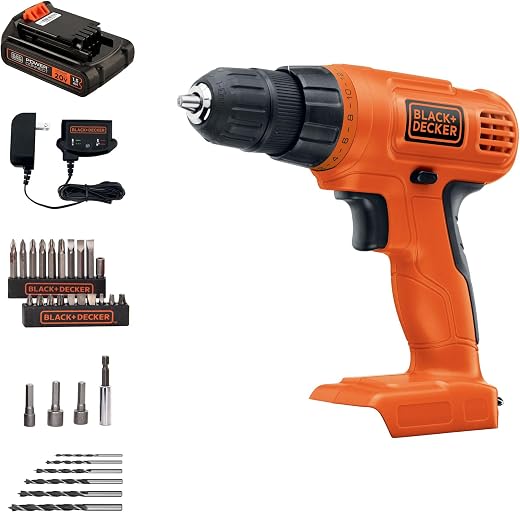
| 4 | BLACK+DECKER 20V MAX LD120VA Drill Driver | Making the hole | 750 rpm, 24-position clutch, 30 bits | Drywall, timber and flat-pack | $49.99 | 8.6 |
| 5 | HOTO 12-in-1 Electric Screwdriver | Driving the fixing | 0.55 lb, 3 torque settings, USB-C | Assembly and small fixings | $49.99 | 9.0 |
| 6 | Costop 9-Pack Magnetic Cable Clips | The cables afterwards | Self-adhesive, holds 0.3 in cords | Wall-mounted screens | $8.99 | 8.5 |
| 7 | 3M High Strength Small Hole Repair | Undoing the wrong hole | Repairs up to 3 in diameter | Everyone, eventually | $6.45 | 8.7 |
The 7 Best Home DIY Essentials in 2026
Seven home DIY essentials, ordered the way a job actually runs rather than by price. Each entry names what it is for, what it is not for, and links to our full review.
1. WEN 721830 Hardwood Furniture Dolly — Best Home DIY Essentials Pick for Clearing the Wall
Price: not currently shown on Amazon | Amazon rating: 4.5 / 7,111 ratings | Role: clearing the wall | Key spec: 18 x 30 in, 1,320 lb dynamic load per pair
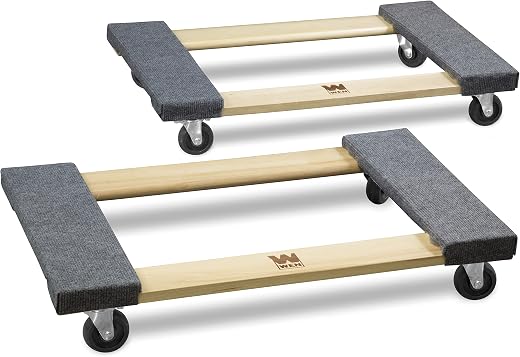
Nobody puts a furniture dolly first in a list of home DIY essentials. It belongs first. The wall you want to drill is very often the wall behind the wardrobe, the bookcase, the sideboard or the sofa, and the standard approach — drag it, walk it corner to corner, or ask a neighbour — is how floors get scratched and backs get hurt. A pair of these takes the furniture out of the argument. Each dolly measures 18 by 30 by 5 inches, the pair is rated to a 2,000-pound static and 1,320-pound dynamic load, and four ball-bearing swivel casters mean the load moves in any direction rather than only forwards.
The build is birch hardwood with carpeted ends, which is the detail that separates this from the cheap steel-and-vinyl versions: the carpet is what stops the dolly marking a polished sideboard or a painted skirting board while you slide it clear. Two dollies is the right quantity, because one dolly under one end of a wardrobe is a lever and two dollies under both ends is a trolley. WEN sells single units and smaller tri-dolly sets; for wall access, the 18 by 30 inch pair is the size that actually fits a piece of furniture.
One honest caveat, and it is the reason this is not scored higher. Casters of this type are made for hard floors. On a deep pile carpet they sink, the swivel action fights you, and you end up doing the dragging you were trying to avoid. The other caveat is that Amazon is not currently displaying a price for this listing at all — we re-checked with a live scrape rather than guessing, and the figure genuinely is not there. WEN’s own 12-inch tri-dolly set was listing at $23.18 at the same moment, which is the nearest thing to a reference point we can give you honestly.
Best for: hard-floored rooms where the wall you need is behind something two people cannot comfortably lift, and for anyone who would rather not test their back against a full bookcase.
Skip if: your floors are carpeted throughout, your furniture is light flat-pack, or you have nowhere to store two 18 by 30 inch boards between jobs.
Read the full WEN 721830 Furniture Dolly review →
Where to Buy — WEN 721830 Furniture Dolly
2. JAXWQ TH410 5-in-1 Stud Finder — Best Home DIY Essentials Pick for Seeing Inside the Wall
Price: $21.99 | Amazon rating: 4.2 / 10,985 ratings | Role: finding out what is inside | Key spec: detects stud centre and edge, metal, joists, pipe and live AC wire
This is the tool that justifies the whole category. Every other item on this list of home DIY essentials does something you could, at a pinch, do another way. Nothing replaces knowing whether there is a stud, a copper pipe or a live cable behind the spot you are about to put a 6 mm masonry bit through. The TH410 runs five modes from one sensor chip: wood stud centre, wood stud edge, metal, deep scan for joists and pipework, and live AC wire. The backlit LCD shows what it has found and where the centre sits, which is more useful than the beep-only scanners it competes with.
In practice the workflow that works with home DIY essentials of this kind is to scan the same 600 mm of wall three times — once left to right, once right to left, and once in AC mode — and only mark where all three passes agree. Multi-mode scanners of this class are consistent on half-inch drywall over timber and get noticeably less confident on lath and plaster, on tiled surfaces, and on anything with foil-backed insulation behind it. At 8.1 ounces it is light enough to hold flat against a wall one-handed while you pencil the mark with the other, which sounds trivial and is not.
Two things keep the score at 8.1 rather than higher. The first is the rating: 4.2 is the weakest average in this roundup, and although the sample is large at nearly eleven thousand ratings, the listing itself is recent, so treat the average as a live figure rather than a settled one.
The second point is more important, and it applies to every stud finder ever made. It tells you something is there. It does not tell you what it is, it will not see a plastic water pipe at all, and the manufacturer’s live-AC mode is a warning system rather than a guarantee. The Health and Safety Executive’s advice for exactly this situation is blunt: if you are unsure where concealed cables are, turn the electricity off before you drill.
Best for: American and Canadian homes, or any timber-framed wall, where finding the stud is the whole job and a miss means a fixing that pulls out of the plasterboard.
Skip if: your walls are solid brick or dense block, which is most of Britain’s pre-1930s housing stock — the scanner will read dense everywhere and tell you nothing useful.
Read the full JAXWQ TH410 Stud Finder review →
Where to Buy — JAXWQ TH410 Stud Finder

3. Handy Laundry 9-Inch Folding Step Stool — Best Home DIY Essentials Pick for Working at Height
Price: not currently shown for the black colourway | Amazon rating: 4.7 / 84,106 ratings | Role: getting to the right height | Key spec: 9 in rise, 300 lb capacity, folds flat
Nine inches does not sound like one of your home DIY essentials. It is the difference between drilling with your arms above your head and drilling at chest height, and that single change does more for accuracy than any feature on any drill. Overhead work is where holes wander, where the bit skates off the mark, and where dust falls into your eyes rather than onto the floor. Raising yourself by nine inches removes the problem entirely for the band of wall between shoulder and picture-rail height, which is where most shelves, mirrors, brackets and coat rails end up.
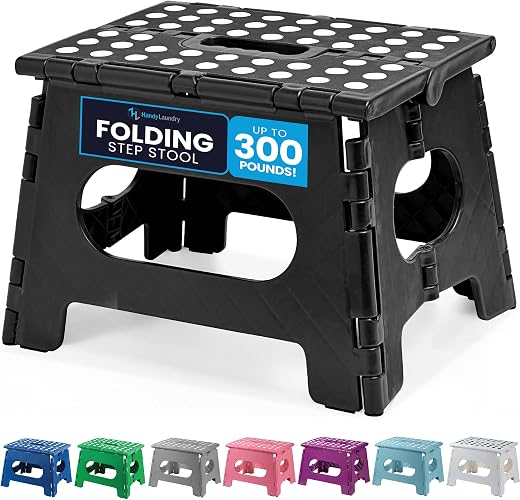
The stool itself is unremarkable in the best way: 9.75 by 12.5 inches on the floor, 9 inches of rise, a 300-pound capacity, a non-slip top and non-slip feet, and it folds flat enough to live behind a door or under a bed between jobs. It carries a 4.7 average across more than eighty-four thousand ratings, which is the largest evidence base of any product we have reviewed. When a design this simple accumulates that much agreement, the sensible reading is that there is nothing here to go wrong.
It is worth being precise about what this member of our home DIY essentials list is not. This is a step, not a ladder, and the honest way to use it is that if the job needs more than nine inches you should stop and get a proper set of steps rather than stand on the arm of a sofa. Working from a stool also changes your reach envelope: you gain height but you lose the ability to lean sideways safely, so move the stool rather than stretching. Amazon is not currently showing a price for the black version; the identical green colourway was listing at $13.99 on the morning we checked.
Best for: the enormous amount of household work that happens between shoulder height and the top of a door frame, and for small homes where a step ladder has nowhere to live.
Skip if: the job is at ceiling height, on a stairwell, or anywhere you would need to hold on with one hand — that is a ladder job and no stool makes it safe.
Read the full Handy Laundry Folding Step Stool review →
Where to Buy — Handy Laundry Folding Step Stool
4. BLACK+DECKER 20V MAX LD120VA — Best Home DIY Essentials Pick for Making the Hole
Price: $49.99 (was $59.99) | Amazon rating: 4.5 / 39,053 ratings | Role: making the hole | Key spec: 20V, 750 rpm, 24-position clutch, 30-piece accessory set
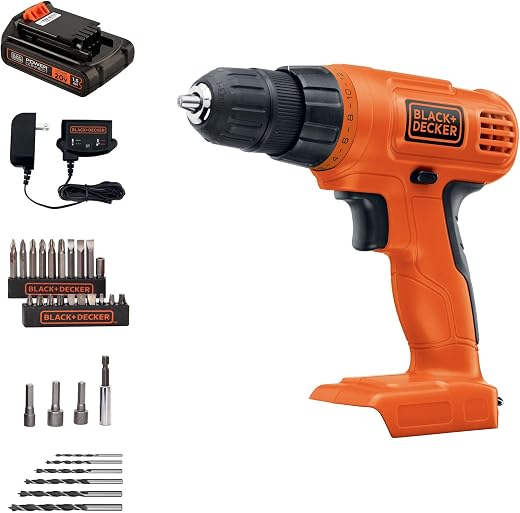
This is the drill most people should buy and the one most buying guides talk them out of. It runs on BLACK+DECKER’s 20V MAX POWERCONNECT platform, tops out at 750 rpm, and comes with a battery, a charger and thirty accessories: six brad-point drill bits, ten one-inch screwdriving bits, nine two-inch bits, four nut drivers and a magnetic bit holder. For a household that drills a dozen holes a year, that box is the entire tool problem solved for fifty dollars, and the 39,053 ratings behind its 4.5 average represent an unusually large amount of agreement about a power tool.
The feature that earns this drill its place among our home DIY essentials is the 24-position clutch. A clutch is the ring behind the chuck that lets the drill stop turning once a set torque is reached, and it is what stops you driving a screw straight through a cabinet back or stripping the head off a machine screw in a flat-pack fitting. Twenty-four positions is more granularity than a beginner needs and exactly the right amount for learning: start low, climb until the screw seats, remember the number. The soft grip handle matters more than it sounds too, because comfort is what determines whether you stop after four holes or finish the job.
The limitation is the one that decides whether this tool works in your country, and it is not the battery. There is no hammer action, and 750 rpm is a driving speed rather than a masonry speed. In a timber-framed American wall with half-inch drywall over it, that is completely sufficient. In a British house with solid brick, dense concrete block or a hard render coat, a drill driver of this class will polish the surface and go nowhere. If your walls are masonry, this is still an excellent screwdriver and an excellent flat-pack tool — but the hole itself needs a hammer drill or an SDS, and no amount of pressure substitutes for percussion.
Best for: timber-framed and plasterboard walls, flat-pack assembly, pilot holes and the general run of household fixings — and for anyone who wants one box with nothing else to buy.
Skip if: your walls are solid masonry and you actually need to make holes in them; buy a hammer drill or an SDS for that job and keep this as the driver.
Read the full BLACK+DECKER LD120VA Drill Driver review →
Where to Buy — BLACK+DECKER LD120VA Drill Driver
5. HOTO 12-in-1 Electric Screwdriver — Best Home DIY Essentials Pick for the Fixings
Price: $49.99 | Amazon rating: 4.7 / 3,765 ratings | Role: driving the fixing | Key spec: 0.55 lb, 12 S2 bits to 60 HRC, 3 torque settings, USB-C
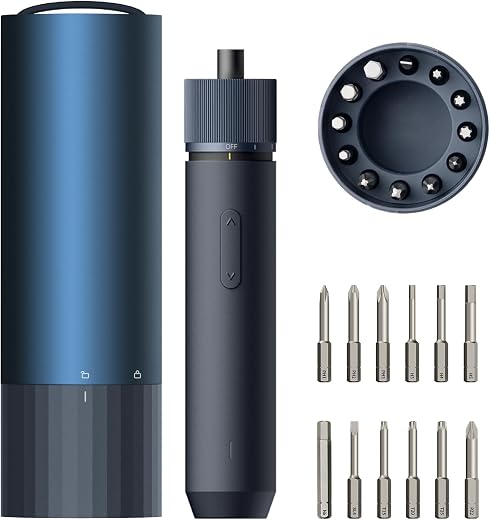
The highest-scoring product in this set of home DIY essentials is not the drill. It is the small thing you use afterwards, because the great majority of turns of a screwdriver in a house have nothing to do with drilling: flat-pack assembly, a loose cabinet hinge, a bracket that needs the last quarter turn by feel, a switch plate, a curtain track, the back of a television. The HOTO weighs 0.55 pounds against a drill driver’s two-plus, takes standard quarter-inch hex bits, charges over USB-C, and ships with twelve S2 steel bits rated to 60 HRC in an aluminium case.
Three torque settings is the correct number for this job, because the risk with a small driver is not lack of power but too much of it in a soft material. Set it low for chipboard and cabinet hinges, mid for machine screws, and reserve the top setting for something that has already resisted. The circular LED around the tip is the feature you will not appreciate until you use it: it lights the screw head from all sides at once, which removes the shadow that a torch mounted on the body of a drill always casts exactly where you are working.
The honest limitation is that this cannot drill and is not trying to. It is a driver, and if you buy it expecting a compact drill you will be disappointed by the first masonry job you point it at. It is also, at $49.99, the same money as the BLACK+DECKER drill driver that comes with a battery and thirty accessories — so this is a second tool rather than a first one, bought by people who have discovered that the reason they avoid small jobs is that fetching the big drill feels like a project.
Best for: assembly, hinges, switch plates and the hundred small fixings a year that never justify getting the drill out — and for anyone working in a tight cupboard or under a desk.
Skip if: you own one tool and it has to do everything, or you were hoping to drill masonry — this drives fixings extremely well and makes no holes at all.
Read the full HOTO 12-in-1 Electric Screwdriver review →
Where to Buy — HOTO 12-in-1 Electric Screwdriver
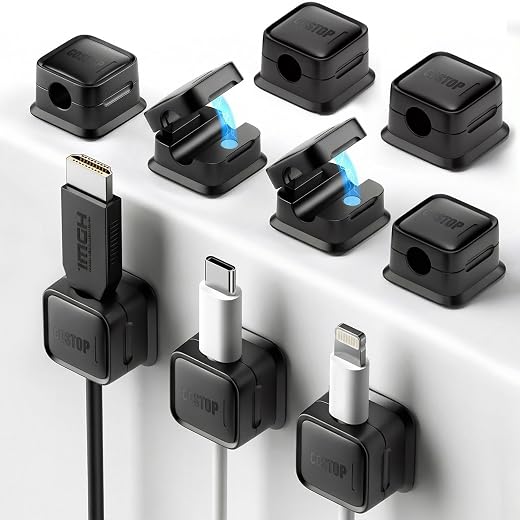
6. Costop 9-Pack Magnetic Cable Clips — Best Home DIY Essentials Pick for the Cables Afterwards
Price: $8.99 | Amazon rating: 4.6 / 6,603 ratings | Role: the cables afterwards | Key spec: self-adhesive, 0.78 in square, holds cords up to 0.3 in
Here is the failure nobody photographs. You spend an afternoon getting a television bracket dead level on the wall, you stand back, and a bundle of black cables hangs out of the bottom of it like a tail. Every wall-mounted screen, every floating shelf with a lamp on it, every under-desk installation ends with the same unsolved problem, and it is the reason a lot of otherwise good work looks unfinished. Nine adhesive magnetic clips at $8.99 is the cheapest fix on this page and one of the most visible.
The magnetic hinge is what distinguishes these from the open-jaw plastic clips sold in the same aisle. Each clip is a 0.78-inch ABS square that opens and closes against a magnet, so a cable can be dropped in or taken out one-handed and will not spring free when the cable is under tension — which is what happens to open clips every time somebody pulls a charging lead. They take cords up to about 0.3 inches, which covers phone leads, USB-C, HDMI, mouse and keyboard cables and most power leads, but not a thick shielded HDMI or a mains cable with a moulded plug.
The one instruction people ignore and then complain about is the curing time: the manufacturer says to stick the clips and wait thirty minutes before loading them. Adhesive pads reach a fraction of their final bond strength immediately and full strength over time, so a clip that is loaded straight away tends to peel within a day and gets blamed on the product. Clean the surface first, press for a few seconds, walk away, come back after half an hour. On textured wallpaper or a freshly painted wall they will still struggle, and that is a surface problem rather than an adhesive one.
Best for: finishing a wall-mounted screen or shelf properly, and for the under-desk cable tangle that no amount of tidying fixes permanently.
Skip if: you are routing thick shielded HDMI, mains leads with moulded plugs, or fixing to textured wallpaper — adhesive clips will not hold any of those.
Read the full Costop Magnetic Cable Clips review →
Where to Buy — Costop Magnetic Cable Clips
7. 3M High Strength Small Hole Repair — Best Home DIY Essentials Pick for Undoing the Wrong Hole
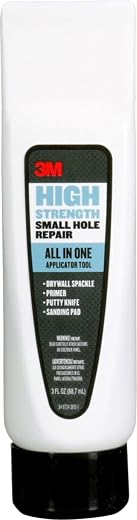
Price: $6.45 (was $7.74) | Amazon rating: 4.5 / 28,150 ratings | Role: undoing the wrong hole | Key spec: 3 fl oz, repairs holes up to 3 in, primer-enhanced
Every list of home DIY essentials should end with the thing that lets you be wrong. This one costs $6.45. The all-in-one applicator carries a primer-enhanced spackling compound at one end and a sanding pad built into the cap, so the entire repair — fill, level, sand, and paint over — happens with one object and no separate putty knife, no separate abrasive and no half-used tub drying out in a cupboard. 3M rates it for holes up to three inches in diameter, which covers essentially every mistake a domestic drill makes.
The technical claims worth caring about are the primer and the shrinkage. Conventional lightweight spackle absorbs paint differently from the wall around it, so the repair shows through as a dull patch even after a coat — the effect painters call flashing. A primer-enhanced compound resists that, which is the difference between a repair you can paint over immediately and one that needs a separate primer coat first. 3M also claims no shrinking, cracking or sagging, which is the failure mode of cheap fillers: they look perfect wet and leave a dimple when dry, so you fill twice.
The stated 3X faster repair is a comparison against traditional vinyl spackling and is mostly about the integrated tool rather than the chemistry. Two limitations are worth knowing. Anything larger than three inches wants a patch and mesh rather than filler alone, and this is a plasterboard and modern plaster product — on old British lath and plaster, where the failure is usually a section that has lost its key to the laths, filling the hole treats the symptom and not the cause. It is also worth noting that the compound firmly holds nails and screws after it has cured, which quietly means you can move a fixing two inches without waiting for a professional.
Best for: everyone, eventually — and specifically for renters and anyone who wants the freedom to try a bracket position, decide it is wrong, and start again.
Skip if: the damage is bigger than three inches, the wall is lath and plaster with a failed key, or you need a structural repair rather than a cosmetic one.
Read the full 3M High Strength Small Hole Repair review →
Where to Buy — 3M High Strength Small Hole Repair
Home DIY Essentials — Buyer’s Guide: What to Look For
Most tool advice starts with the tool. That is the wrong end. The wall decides what you can buy, the fixing decides what the wall has to hold, and only then does the tool matter. These are the five questions worth answering before you spend anything on home DIY essentials.
The First Home DIY Essentials Question: What Is Your Wall Made Of?
Knock on it. A hollow, drummy sound with a solid line every 400 to 600 millimetres means a timber or metal frame with plasterboard over it, and your fixing has to find the frame or use a proper cavity anchor. A dead, dense thud everywhere means solid masonry — brick, block or stone with plaster on top — and your fixing goes into the wall itself with a plug. A slightly springy surface that sounds hollow and crumbles into fine grey dust when you drill is likely lath and plaster, which is the hardest of the three to fix into reliably.
This single answer determines more of your home DIY essentials shopping list than anything else. Frame walls make a stud finder the most valuable item in a set of home DIY essentials and make a hammer drill unnecessary. Masonry walls make the stud finder close to useless and the hammer drill compulsory. Buying the wrong half of that pair is the most common and most expensive mistake in this category.
Home DIY Essentials and the Hammer-Action Problem
A drill driver spins. A hammer drill spins and simultaneously punches the bit forward thousands of times a minute. Masonry does not care how hard you push a spinning bit against it; it yields to percussion. This is why a perfectly good $50 drill driver feels broken the first time somebody points it at a brick wall, and why the answer is never a sharper bit or more pressure. If you own masonry walls, budget for hammer action from the start, and treat a drill driver as the tool that drives the screw once the hole exists.
There is a second tier above hammer drills called SDS, where the bit itself slides in a chuck designed to transmit impact. For a household drilling a few dozen holes a year, an SDS is more machine than the job needs. For anyone taking on old concrete lintels or a full room of shelving in a Victorian terrace, it turns a fight into a formality.
Choosing Home DIY Essentials by Fixing, Not by Tool
Among home DIY essentials the screw is the part that fails, not the drill. Into a timber stud, a wood screw of the right length is stronger than anything else you can do. Into masonry, a plastic plug — a Rawlplug in Britain, a wall anchor in America — expands as the screw enters and grips the sides of the hole, so the hole diameter has to match the plug exactly rather than approximately. Into hollow plasterboard with no stud behind it, ordinary plugs are worthless and you need a proper cavity fixing that opens out behind the board.
Work backwards from the load. A framed picture needs almost nothing. A floating shelf carrying books, a wall-mounted television, a grab rail or a stair gate all put leverage on the fixing rather than straight shear, and leverage is what pulls anchors out of plasterboard. When the load matters, find the stud or use the masonry, and treat cavity fixings as a last resort rather than a default.
Home DIY Essentials: Torque, Clutch Numbers and What They Actually Mean
Voltage sells drills and tells you very little. A 20V platform and an 18V platform are the same battery chemistry counted differently. What matters day to day is the clutch: the numbered ring that lets the tool stop turning at a set resistance. Low numbers for soft materials and small screws, higher numbers for dense timber, and the drill symbol at the end for drilling only, where the clutch is bypassed entirely.
The practical habit worth forming is to start two or three clicks lower than you think and climb. A screw that stops short can always be driven further. A screw driven straight through the back of a cabinet cannot be un-driven, and neither can a stripped screw head.
The Home DIY Essentials Nobody Sells You: Dust and Eye Protection
No home DIY essentials roundup lists safety glasses, because nobody clicks on them, which is exactly why they get left out of the box. Drilling upward at head height puts fine material directly into your eyes, and the American guidance for construction sites — look for the Z87+ marking on impact-rated eyewear, per OSHA’s eye and face protection standard 1926.102 — is a reasonable domestic benchmark too. Britain’s equivalent goggles carry a different marking but the same idea.
Dust matters more than most people assume, and how much it matters depends entirely on the wall. That is a big enough difference between the two countries that it has its own section below.
US vs UK: What Changes When You Buy Home DIY Essentials
This is the section most tool guides skip, and it is the one that decides whether the home DIY essentials you just bought work in your house. Americans and Britons buy the same drills from the same brands and then point them at fundamentally different walls, under two regulators who have made opposite choices about almost everything.
Home DIY Essentials Vocabulary That Does Not Travel
Americans do DIY; the British do DIY too, but in America the phrase leans towards crafts and decorating while in Britain it means home repair and always has. Beyond that: drywall is plasterboard, a wall anchor is a Rawlplug, a flashlight is a torch, a wrench is a spanner, a hex key is an Allen key, baseboard is skirting board, and a hardware store is a DIY shop or simply a builders’ merchant. An American first floor is a British ground floor, which matters the moment somebody quotes you for carrying something upstairs.
Home DIY Essentials and the Wall Itself: Studs at 16 Inches vs Brick All the Way Through
American housing is overwhelmingly timber-framed: vertical studs at regular centres, sheathed in half-inch drywall, with a cavity full of insulation and services. Everything about American home DIY essentials assumes that geometry, which is why the stud finder is treated as a basic tool and why a drill driver with no hammer action is a perfectly complete answer.
British housing is mostly masonry, and often solid masonry: brick or dense block, plastered directly. Even in newer British homes with plasterboard internal partitions, external walls are almost always masonry. Point an American home DIY essentials shopping list at a British wall and half of it stops working — the stud finder reads dense everywhere, the drill driver polishes the brick, and the wall anchor that grips beautifully in drywall spins uselessly in a masonry hole. The correct British home DIY essentials kit is the same list with a hammer drill and a box of plugs substituted for the stud finder.
Home DIY Essentials and Dust: Two National Limits That Differ by a Factor of Two
Timber and plasterboard make a nuisance dust. Brick, block, concrete, mortar and stone make something else: respirable crystalline silica. The Health and Safety Executive’s own leaflet puts it plainly — “Silica is a natural substance found in most rocks, sand and clay and in products such as bricks and concrete” — and lists the activities that release it, including “grinding, drilling, boring, sawing, cutting, sanding, chiselling, blasting”. Heavy, prolonged exposure causes silicosis, COPD and lung cancer.
Both regulators have set a number, and they are not the same number. Britain’s workplace exposure limit is 0.1 mg/m³ respirable dust, averaged over 8 hours. America’s permissible exposure limit under OSHA’s construction silica standard is 50 µg/m³ as an 8-hour time-weighted average, with an action level at 25 µg/m³. Fifty micrograms is 0.05 mg, so the American limit is exactly twice as strict as the British one — and it applies in the country whose walls generate far less of the stuff.
The American standard also goes further in a way that is directly useful to a homeowner. Its Table 1 names handheld drills specifically and prescribes the control: “Use drill equipped with commercially available shroud or cowling with dust collection system”. Do that and, for work of any normal duration, no respirator is required at all. That is a free, checkable specification for what good practice looks like, written by a regulator, and it is the reason a $20 drill dust collector is a better buy for a British household than for an American one.
Home DIY Essentials and Vibration: Britain Puts a Number in Law, America Publishes Advice
Hold a hammer drill against masonry for twenty minutes and your hands will tell you why this is regulated. The Control of Vibration at Work Regulations 2005 set two figures for hand-arm vibration: an “exposure action value of 2.5 m/s2 A(8) at which level employers should introduce technical and organisational measures to reduce exposure” and an “exposure limit value of 5.0 m/s2 A(8) which should not be exceeded”. Both are legally binding on British employers.
America has no equivalent mandatory standard. NIOSH publishes recommended criteria and notes that “In the United States, an estimated 1.5 million workers use vibrating tools”, listing “powered hammers, chisels, chain saws, sanders, grinders, riveters, breakers, drills, compactors, sharpeners, and shapers” among the culprits. Neither regime reaches you in your own home, but the British figures give a domestic user something the American ones do not: a number to compare a tool’s declared vibration value against before buying it.
The Party Wall etc. Act 1996 — and the Shelf It Specifically Allows
Britain has a statute about using your home DIY essentials on the wall you share with your neighbour, and America has nothing comparable. Under the Party Wall etc. Act 1996 a party wall is “a wall that stands astride the boundary of land belonging to two (or more) different owners”, and works such as cutting into it “to take the bearing of a beam (for example for a loft conversion)”, inserting a damp proof course, raising it or rebuilding it all require written notice to the adjoining owner “at least two months before the planned starting date”.
Start without notice and the neighbour “can seek to stop the work through a court injunction or seek other legal redress”.
The delightful part, and the part almost nobody knows, is that the government’s own explanatory booklet lists the things that are too minor to need a notice at all — and the first example is “drilling into a party wall to fix plugs and screws for ordinary wall units or shelving”, alongside “cutting into a party wall to add or replace recessed electric wiring” and “removing old plaster and replastering”. So the shelf is explicitly fine. The steel beam is not. If your work could affect the wall’s “structural strength and support functions”, notice is required.
Anchoring Furniture With Home DIY Essentials: America Made the Dresser Stable
Both countries agree that a chest of drawers can kill a child who climbs it. They have answered differently. America legislated: STURDY, signed into law on 29 December 2022, produced a mandatory Safety Standard for Clothing Storage Units effective 1 September 2023, and crucially the standard tests stability through simulated loading and dynamic force without relying on the unit being anchored to a wall. The CPSC’s Anchor It! campaign, ten years old in 2025, still says “Anchor TVs and furniture, such as bookcases and dressers, securely to the wall” and credits the effort with “a nearly 50-percent decline in tip-over-related injuries and deaths in the U.S.”
Britain has no product-specific stability regulation for chests of drawers. It relies on general product safety law and on the retailer supplying a restraint strap in the box. The practical consequence for anyone reading this on either side of the Atlantic is the same: the strap in the flat-pack bag is not decoration, and fixing it to a stud or into masonry rather than into bare plasterboard is what makes it work.
Home DIY Essentials: Units, Screw Gauges and Drill Bit Sizes
American bits and screws are fractional inches and gauge numbers; British ones are millimetres. The conversions worth memorising: a #6 screw is roughly 3.5 mm, #8 is 4.0 mm, #10 is 5.0 mm; a 1/4 inch bit is 6 mm; 1/2 inch drywall is 12.5 mm plasterboard. American mains is 120 V at 60 Hz, British is 230 V at 50 Hz, and a British plug carries its own fuse, so a US-market corded tool bought online will not simply work on a British socket.
Home DIY Essentials — Which One Should You Buy?
Three honest budgets for home DIY essentials, and what each one buys you. Every product named links to its full review.
One workshop purchase sits outside this list because it belongs to a different kind of making, but it is worth knowing about if a 3D printer has joined the tools on your bench: filament absorbs moisture out of the air and prints badly long before it looks damp, and the fix costs about the same as a decent cordless screwdriver. Our guide to the best filament dryer compares five of them and explains why the maximum temperature, rather than the number of spool bays, is the specification that decides which one you need.
Under $40: The Home DIY Essentials Starter Set
If you buy three things and nothing else, buy the JAXWQ TH410 stud finder at $21.99, the 3M High Strength Small Hole Repair at $6.45 and the Costop magnetic cable clips at $8.99. That is under forty dollars and it covers knowing, undoing and finishing. It assumes you can borrow a drill, which most people can, and it is the correct order of purchase because the two cheapest items are the ones that stop a mistake becoming permanent. British readers should swap the stud finder for a box of assorted plugs and put the saving towards a hammer drill.
Around $100: The Home DIY Essentials Kit That Finishes Jobs
Add the BLACK+DECKER LD120VA drill driver at $49.99 and the Handy Laundry folding step stool, which lists in the low teens. Around a hundred dollars now buys the whole sequence: clear, find, reach, drill, drive, tidy, repair. This is the tier most households should stop at, and the step stool is the item people leave out and then wish they had, because it is the difference between a hole where you marked it and a hole an inch to the left. For a broader view of what else belongs in the cupboard, our home maintenance essentials guide covers the diagnostic side.
$150 and Up: Home DIY Essentials for People Who Actually Enjoy This
Add the HOTO 12-in-1 electric screwdriver at $49.99 and the WEN 721830 furniture dolly pair. Neither is necessary and both change how often you start a job, which is the real bottleneck. The HOTO removes the friction of fetching a drill for a two-screw task; the dollies remove the excuse that the wall is behind the wardrobe. If you are also setting up a workspace, our desk setup essentials guide covers the room around the wall you just drilled.
Drilling Safety Basics for Home DIY Essentials
None of the following can be solved by buying home DIY essentials, which is exactly why it belongs in a buying guide. These are the four things that actually hurt people doing this work, and what the two national regulators say about each.
Home DIY Essentials and Concealed Cables: The Only Advice That Always Works
Every stud finder sold advertises live-wire detection, and every one of them is a probability rather than a promise. Detectors read changes in density and in electrical field; they cannot see a plastic water pipe, they struggle through foil-backed insulation and tiles, and an unenergised cable produces no field to detect. The Health and Safety Executive’s guidance for people whose job this is comes down to one sentence: “If unsure where concealed cables are, turn the electricity supply off before drilling into walls etc.” It also says plainly, “Make sure you know the location of concealed power cables and gas pipes before drilling into walls or floors.”
For a household, that translates into a routine rather than a purchase. Scan, mark, and then look at what is directly above and below your mark: a socket, a switch or a light fitting means cables are running vertically or horizontally to it, and the wall directly around that route is the wall you should not drill. If the mark falls in one of those bands and cannot be moved, turn the circuit off at the consumer unit or breaker panel first. It costs nothing and it is the only measure that works when the detector is wrong.
Home DIY Essentials and Silica: The Dust a Masonry Wall Makes
HSE’s leaflet on the subject is the clearest short statement available: silica is “a natural substance found in most rocks, sand and clay and in products such as bricks and concrete”, and drilling is on its list of activities that release it. The diseases it names are silicosis, COPD — “a group of lung diseases, including bronchitis and emphysema” — and lung cancer, and it is explicit that “heavy and prolonged exposure to RCS can cause lung cancer”. Its cleaning advice is worth copying exactly: “use a vacuum of dust class M or H, or wet cleaning” rather than sweeping, because sweeping puts settled dust straight back into the air you are breathing.
A homeowner drilling six holes is nowhere near an occupational exposure. The reason to care is that domestic jobs scale badly: a full wall of shelving, chasing out for a new socket, or taking off old tile adhesive turns a trivial exposure into a significant one in an afternoon. The proportionate response is a shop vacuum held at the hole by a second person, or a drill dust collector for a few dollars, plus not sweeping up afterwards.
Home DIY Essentials and Hand-Arm Vibration: The Tool You Hold for Twenty Minutes
Vibration white finger and the wider hand-arm vibration syndrome are cumulative, permanent and easy to dismiss until they are not.
Britain’s regulations name the two thresholds directly — an exposure action value of 2.5 m/s² A(8) and an exposure limit value of 5.0 m/s² A(8) that “should not be exceeded” — and manufacturers publish declared vibration figures for exactly this reason. NIOSH, on the American side, estimates that “an estimated 1.5 million workers use vibrating tools” and lists drills among the tools most commonly associated with the syndrome.
The practical read for a domestic user of home DIY essentials is simple. Hammer drills and SDS machines are the tools that matter here; a drill driver and an electric screwdriver are not in the same class. If a job needs sustained hammer drilling, break it into sessions, keep your hands warm, and hold the tool no tighter than the work requires, because grip force multiplies the dose you take.
Home DIY Essentials, Tip-Overs and the Standard That Changed in 2023
The most consequential thing most people will ever attach to a wall is not a shelf. It is a chest of drawers or a television, fixed so that a climbing child cannot bring it down.
America’s answer since 1 September 2023 has been a mandatory stability standard for clothing storage units, adopted under the STURDY Act and built around ASTM F2057-23, which tests units through simulated loading and dynamic force rather than assuming they will be anchored. The CPSC’s parallel advice has not changed in a decade: “Anchor TVs and furniture, such as bookcases and dressers, securely to the wall”, and where that is impossible, “place TVs on a sturdy, low base, push the TV back as far as possible, and keep cable cords out of reach”.
The fixing is what makes the strap work. A restraint screwed into bare plasterboard with the plastic plug that came in the bag will pull out under exactly the load it exists to resist. Find the stud, or fix into masonry with a plug matched to the hole, and treat the strap as a structural fixing rather than an accessory. It is the one place on this page where getting the fixing right is not about the wall looking tidy.
Home DIY Essentials — Frequently Asked Questions
What are the home DIY essentials a complete beginner should buy first?
A stud finder if your walls are timber-framed or a box of assorted plugs if they are masonry, a filler for mistakes, and a drill you can borrow before you buy. Those three cover knowing, undoing and doing. Everything else on this page improves the experience rather than enabling it.
Do the home DIY essentials really need to include a stud finder, or can I knock on the wall?
Knocking tells you hollow from solid, which is genuinely useful and free. It will not tell you where a cable runs, and it will not find the centre of a stud accurately enough for a heavy bracket. On timber-framed walls a scanner is worth the twenty dollars. On solid British brick it is close to useless, which is why the same shopping list does not work in both countries.
Why won’t my cordless drill go into a brick wall?
Because it spins and does not hammer. Masonry yields to percussion, not to rotation and pressure. A drill driver in a brick wall will glaze the surface, overheat the bit and go nowhere. You need hammer action or an SDS machine, plus a masonry bit rather than a wood bit.
How do I know what size hole to drill for a wall plug?
The plug tells you. Plastic plugs are colour-coded to a bit size and expand to grip the sides of the hole, so an oversized hole means the plug spins instead of gripping. Match the number on the plug to the bit, drill slightly deeper than the plug is long so debris has somewhere to go, and clear the dust out before you insert it.
Are the home DIY essentials on this list safe for renters?
The filler is the item that makes the rest of them renter-friendly, because a nail-sized hole repaired and painted over is usually indistinguishable. Check your tenancy agreement first: many British tenancies restrict fixings to walls, and the deposit dispute that follows is rarely about the hole itself but about the state it was left in.
What is the difference between a drill driver and an impact driver?
A drill driver applies steady rotation with a clutch to limit torque. An impact driver adds rotational hammer blows, which drives long screws into dense timber without stripping heads or twisting your wrist, but it has no clutch and is far too aggressive for cabinet hinges or small fixings. For general household home DIY essentials, the drill driver is the right first tool.
Can I use my home DIY essentials on a wall I share with my neighbour?
In England and Wales the Party Wall etc. Act 1996 governs work to shared walls, and the government’s explanatory booklet lists “drilling into a party wall to fix plugs and screws for ordinary wall units or shelving” among the works too minor to need a notice. Cutting into the wall to take the bearing of a beam is a different matter and requires two months’ written notice. There is no American equivalent statute.
Do I need a dust mask to drill a few holes at home?
For a handful of holes in plasterboard, no. For sustained drilling into brick, block or concrete, the dust contains respirable crystalline silica and the sensible precautions are a vacuum at the hole and not dry-sweeping afterwards. HSE recommends “a vacuum of dust class M or H, or wet cleaning” for clean-up, which is good advice at any scale.
How much weight can a plasterboard fixing actually hold?
Far less than the packet implies once leverage is involved. A fixing rated for a static pull may fail quickly under the twisting load a deep shelf or a television arm applies. For anything heavy, find the stud or fix into masonry. Cavity anchors are for lightweight items and for the times there is genuinely no frame behind the mark.
Which of these home DIY essentials would you buy if you could only buy one?
The 3M small hole repair, at $6.45. That is only half a joke. It is the item that converts an irreversible mistake into a ten-minute correction, and having it in the cupboard changes how willing you are to attempt the job at all. The drill is the tool you use; the filler is the tool that lets you learn.
Home DIY Essentials — Final Thoughts
The reason this list looks different from most home DIY essentials roundups is that it is organised around a single job rather than around a tool category. Move the obstruction, find out what is inside the wall, get to the right height, make the hole, drive the fixing, tidy the cables, and repair the hole you got wrong. Buy for that sequence and you end up with fewer things than a starter kit contains, all of which you will use. Buy by category and you end up with a plastic case of sockets you will never open.
The other thing worth carrying away is that the wall is not a detail. Almost every disagreement between British and American DIY advice traces back to the fact that one country’s internal walls are mostly timber and plasterboard and the other’s are mostly brick. That difference decides whether a stud finder is essential or useless, whether hammer action is optional or compulsory, and even what the dust in the air is made of and which regulator has set a limit for it. Work out what your own walls are made of first, and the rest of the shopping list writes itself.
Sources and Further Reading
- Health and Safety Executive — INDG463: Control silica dust in construction
- eCFR — 29 CFR 1926.1153, Respirable crystalline silica (construction), including Table 1
- HSE — Hand-arm vibration: the Control of Vibration at Work Regulations 2005
- CDC / NIOSH — Criteria document on hand-arm vibration syndrome
- HSE CIS65 — Avoiding concealed services and overhead power lines
- GOV.UK — The Party Wall etc. Act 1996: explanatory booklet
- Federal Register — Safety Standard for Clothing Storage Units (STURDY Act)
- CPSC — Anchor It! campaign marks ten years
- CDC / NIOSH — Construction toolbox talk: eye protection
- OSHA — Interim enforcement guidance for the respirable crystalline silica standard in construction
- CPSC — Commissioner statement on STURDY Act enforcement
- HSE — Hand-arm vibration at work overview
- HSE — Silica dust and construction health risks
Disclosure: this guide contains affiliate links. If you buy through them we may earn a commission at no extra cost to you, which is how the site is funded. Prices and Amazon ratings were read on the morning of publication and change constantly; two of the seven products had no price displayed by Amazon at all when we checked, and we have said so in their entries rather than inventing a figure. Links go to Amazon.com — UK readers can search the same models on Amazon.co.uk, but should read the wall-construction and hammer-action warnings above before assuming an American shopping list transfers.
Nothing here is professional advice: work on gas, on a consumer unit or on a structural wall is not a DIY job in either country.