
Stud Finder Tool Review — 5-in-1 Wall Scanner With LCD
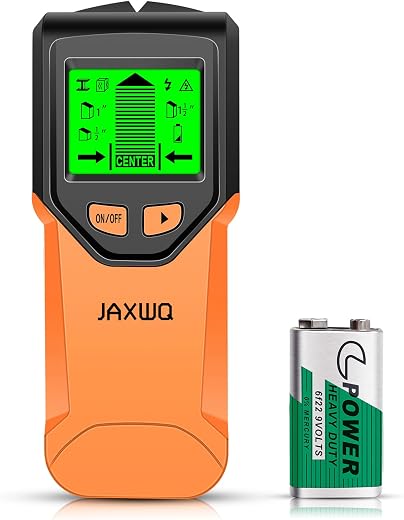
A five-mode capacitive wall scanner with a backlit LCD, audible alerts and a live AC wire warning, at twenty-two dollars and eight ounces. It finds studs, joists, metal and pipe in plasterboard reliably once calibrated on blank wall, and the live cable warning is the feature that justifies the purchase; it is defeated by plaster, lath and tile.
$21.99
5-in-1 Wall Scanner Review (2026) — Is a $22 Stud Finder Tool Accurate Enough?
Every hole in a wall is a small bet. Behind the plasterboard there is a stud you want, a pipe you do not, and a cable that will make the decision permanent.
This stud finder tool is the cheap way to stop guessing. It is a five-mode sensor with a backlit LCD, audible alerts and a live AC wire warning, at twenty-two dollars and eight ounces. The strength is that it costs less than the plasterer you would otherwise be calling and it has almost eleven thousand ratings behind it. The compromise is that it is a capacitive scanner rather than a multi-sensor array, and capacitive scanners need technique.
In short: the stud finder tool earns 8.1/10 from the Blue Rays Technologies team. The rest of this stud finder tool review sets out exactly how that score was reached.
What is in this stud finder tool review
- Key Specifications
- What a Capacitive Stud Finder Tool Can and Cannot See
- The Live AC Wire Warning Is the Feature Worth the Money
- Reading the Display Without Fooling Yourself
- Limitations and Compromises
- Technique, Calibration and Safe Practice
- Who Should Buy It?
- The Verdict
- Frequently Asked Questions
- Related Reviews
Key Specifications
Published specifications for the stud finder tool, taken from the manufacturer listing.
| Reviewed model | stud finder tool |
| Manufacturer | JAXWQ |
| Model | TH410 |
| Detection modes | 5 (wood stud, metal, deep, AC wire, pipe) |
| Display | Backlit LCD with centre and edge indication |
| Alerts | Visual plus audible beep |
| Live wire detection | Yes, AC warning |
| Power | Battery, alkaline |
| Weight | 8.1 oz |
| Package size | 7.72 x 3.23 x 1.69 in |
| Surfaces | Walls, floors, ceilings |
| Reads | Centre and edge of studs, joists, pipes |
| Colour | Onion |
| Amazon rating | 4.2 from 10,985 ratings |
| Price at review | $21.99 |
What a Capacitive Stud Finder Tool Can and Cannot See
A capacitive scanner does not see wood. It measures a change in dielectric constant as you slide it across a surface, and it infers that something denser is behind the board at that point. That distinction explains almost every complaint anyone has ever had about one.
It means the scanner needs a run-up over empty wall to calibrate, it means it will flag a bundle of cables or a run of pipe as confidently as a joist, and it means a wall that is not uniform, such as one with old lining paper, a bonded plaster skim or a batten behind it, will produce readings that are technically correct and practically useless.
Used properly it is very good. Calibrate on a blank area, sweep slowly, mark both edges, and take the midpoint. A stud found from both sides and confirmed by a second sweep from the opposite direction is a stud; a single beep is a hypothesis.
The Live AC Wire Warning Is the Feature Worth the Money
Of the five modes, the one that justifies the purchase is the live wire warning. Drilling into a cable is the failure mode with consequences that are not measured in filler and paint, and OSHA’s own guidance for working safely with electricity is built around not being anywhere near an energised conductor you did not know about.
The caveat matters as much as the feature. AC detection finds live, energised cable. It will not reliably find a cable on a circuit that is switched off, an armoured or metal-clad run, or a cable buried deeper than the tool’s range. It is a warning device, not a clearance certificate.
The practical rule is to scan, then think about where cables logically run: vertically above and below sockets and switches, and horizontally across at socket height. If the scanner disagrees with common sense, believe common sense.
Reading the Display Without Fooling Yourself
The backlit LCD is genuinely better than the single LED on the cheapest scanners because it shows edge, centre and battery state, and because a hallway or a loft is usually badly lit.
The audible beep is what stops you looking at the screen instead of the wall. On a ceiling in particular, where you cannot see the display and the tool at the same time, the tone is the only usable output.
Battery state is not a cosmetic readout on a device like this. A capacitive sensor with a tired alkaline cell drifts, and drifting produces confident wrong answers rather than obvious failures. Change the battery when the icon says so, not when it stops working.
Limitations and Compromises
No product is without cost, and the stud finder tool has a clear set of them.
It is a single-sensor capacitive tool. Multi-sensor arrays from Franklin and others find edges without calibration and cost two to three times as much; if you scan walls for a living, buy one of those.
The 4.2 star average across almost eleven thousand ratings is the honest picture of a category where user technique decides the result. A high proportion of one-star reviews on any capacitive scanner are calibration problems.
Depth is limited. Thick plaster, lath and plaster, tiled walls and anything with a metal mesh behind it will defeat it.
It runs on an alkaline battery that is not included on every listing, and it is exactly the kind of tool you pick up once a year to find flat.
Technique, Calibration and Safe Practice
Getting the best out of the stud finder tool comes down to a handful of habits.
Always calibrate on a blank section of the same wall, holding the tool flat and still until it settles. Calibrating over a stud is the single most common reason for nonsense readings.
Sweep from both directions and mark both edges of anything you find. A stud in a modern home is usually 1.5 inches wide; if your two marks are eight inches apart, you have found a pipe run or a bundle of cable, not a stud.
Scan in AC mode as a separate pass before drilling, keep the drill shallow on the first bite, and if you are working in an older property, treat the paint itself as a hazard and check it before sanding or drilling repeatedly.
Who Should Buy It?
The stud finder tool suits some households far better than others.
- You hang shelves, mirrors or a television once or twice a year
- You want a live cable warning before you drill
- You are working on plasterboard on timber studs
- You want an audible alert for ceiling and loft work
- You want a readable display rather than one blinking LED
- You would rather spend twenty-two dollars than patch a wall
Look elsewhere if any of the following describes you.
- You need professional-grade accuracy every day
- Your walls are solid masonry, lath and plaster or tiled
- You want a scanner that works without calibration sweeps
- You need to trace dead cables rather than live ones
- You already own a multi-sensor detector
The Verdict
For the money this is the right amount of tool. It does not pretend to be a professional array, it puts the two features that matter most on the front of the device, and the display and beeper are the parts a cheaper unit would have cut.
It scores 8.1 because the underlying technology has limits that no amount of design can remove, and because the 4.2 star average is a fair reflection of how many people expect a capacitive scanner to work without technique. Learn to calibrate it and it is one of the best twenty-two dollars in a household toolbox.
Review score for the stud finder tool: 8.1/10. Strong on the live wire warning, display, audible alerts and price; the compromises are capacitive limits, a real learning curve and poor performance on anything but plasterboard. Blue Rays Technologies researches independently and earns a commission from qualifying purchases, which never affects the score.
If you want to see the current price, the mode list and the latest buyer feedback, it is listed as the 5-in-1 Stud Finder Wall Scanner with LCD on Amazon. Cables behind a wall are the part of this job with consequences, and the US Occupational Safety and Health Administration booklet on working safely with electricity.
Frequently Asked Questions
The questions buyers ask most often about the stud finder tool, answered plainly.
How accurate is a cheap stud finder tool?
Accurate enough on plasterboard over timber studs if you calibrate it on blank wall first and sweep from both directions. Single-pass readings are a hypothesis, not a result.
Will it find live wires reliably?
It warns about live, energised AC cable within its depth range. It will not find switched-off circuits, metal-clad runs or deeply buried cable, so treat it as a warning device rather than a guarantee.
Does it work on plaster or masonry walls?
Poorly. Capacitive scanners are designed for plasterboard. Thick plaster, lath and plaster, tiled and solid masonry walls will all defeat it.
Why does it beep in places where there is obviously no stud?
Usually because it was calibrated while sitting over something dense, or because it is reading a pipe or cable bundle. Recalibrate on empty wall and sweep again from the other side.
Related Reviews
If the stud finder tool is not quite the right fit, these Blue Rays Technologies reviews cover the nearest alternatives.
- NewPos lead test kit review — before you sand or drill in an older home
- HOTO electric screwdriver review — for what goes in the hole afterwards
- BLACK+DECKER cordless drill driver review — from today’s batch
Last updated: 7 September 2026. Pricing and availability for the stud finder tool change frequently; check the retailer listing for the current figure.





There are no reviews yet.