
The forecast says snow and the shops sell out of exactly two things: bread and grit. Neither is the problem. The problem is that a snow day is not a day off — school closes, the office closes, the roads stop working, and in exchange your house acquires a set of outdoor jobs that did not exist yesterday.
The path has to be cleared before it is walked on and refrozen. The car has to be dug out and made legal to drive. The bin still goes out. All of it happens in the dark at either end of a short day, with hands that stop working long before the weather does, and the right snow day essentials are the ones that keep each of those jobs from being abandoned half-finished.
This guide covers seven products for that day, in the order the day actually runs: the dark, the path, the car, the hands, the batteries everything runs on, ignition for whatever heats the house, and the thing you put on when you come back inside. Every one of these snow day essentials has been reviewed individually on this site, and the full review for each is linked from its entry.
We judged them on four things: whether they work in a glove, whether they still work at minus five, whether they are where you left them nine months later, and whether the cheap manual alternative is honestly just as good — which for one of the seven, we say plainly that it might be.
A note on links and prices before we start. Product links go to Amazon.com and prices are in US dollars; British readers can search the same models on Amazon.co.uk, though two of the seven have a US mains plug and one is sold under a different model number in the UK. The differences run deeper than plugs, and they are worth knowing: the law on who has to clear the pavement outside your house is close to opposite in the two countries, and the warning systems that tell you a snow day is coming are built on completely different principles. There is a full US versus UK section below.
Snow Day Essentials — Quick Comparison
| # | Product | Role | Key spec | Best for | Price | Score |
|---|---|---|---|---|---|---|
| 1 | ZF8313 Magnetic EDC Flashlight | The dark | 2,000 lm, magnetic base, USB-C | Two-handed jobs before sunrise | $24.99 | 8.4 |
| 2 | VOLTASK SS-20B Cordless Snow Shovel | The path | 24 V, 13 in wide, 9.3 lb, 20 ft throw | A path, steps and a short drive | See listing | 8.2 |
| 3 | AstroAI 27-Inch 2-in-1 Snow Brush | The car | 27 in reach, detachable brush head | Clearing a whole roof, not a porthole | $17.99 | 8.6 |
| 4 | POMPONGO Rechargeable Hand Warmers | The hands | 6,000 mAh, 2-pack, power bank too | Finishing the job you started | $16.99 | 8.5 |
| 5 | BONAI 16-Bay Battery Charger | The batteries | 16 independent bays, AA/AAA NiMH | Torches, radios and alarms | $27.89 | 8.2 |
| 6 | UCO Stormproof Match Kit | Ignition | 25 matches, 15 s burn, floating case | Wood burners and emergency stoves | $10.99 | 8.7 |
| 7 | Berkshire Primalush Wearable Blanket | Coming back in | 58 x 64 in cape wrap with pockets | Warming up without the thermostat | $22.19 | 8.5 |
The 7 Best Snow Day Essentials in 2026
Seven products, in the order the day runs. Every score below is the score from our own full review of that product, and every entry links to it.
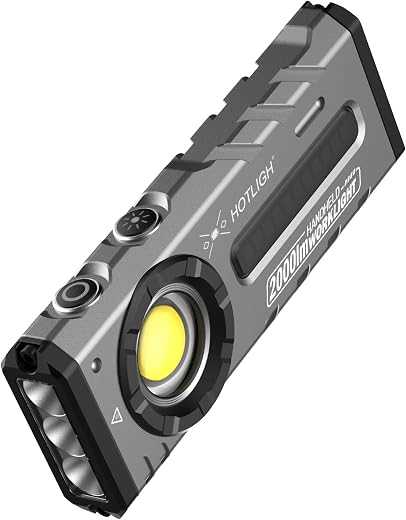
1. ZF8313 Magnetic EDC Flashlight — Best Snow Day Essentials Pick for the Dark
Price: $24.99 (was $42.99) | Amazon rating: 4.6 from 1,024 ratings | Role: The dark | Key spec: 2,000 lumens, magnetic base, USB-C rechargeable, RGB and UV modes
A snow day starts in the dark and ends in the dark, and that is the part nobody plans for. In late December a British morning is not properly light until around eight o’clock and is going again by four, which means every outdoor job on this list gets done either side of daylight. You are not looking for the boiler’s isolation switch, the water stopcock, the fuse for the outside light or the wheel arch you just reversed into a drift with the kitchen window as your only illumination. The first of the snow day essentials is therefore not a shovel. It is being able to see.
The ZF8313 earns its place on one feature rather than its headline output. The magnetic base means it sticks to the car, the garage door, the boiler casing or the metal gatepost and stays there, which leaves you with two hands. Anyone who has tried to scrape a windscreen while holding a torch in their teeth understands why that matters more than lumens, and it is the reason this heads a list of snow day essentials rather than sitting in the also-rans.
The 2,000-lumen figure is the usual optimistic peak rather than a sustained number, but even at a fraction of it this throws far more light than a phone, and unlike a phone it is not the thing you need to keep charged for calling someone.
The RGB and UV modes are marketing rather than snow day essentials, and it is worth saying so plainly. Red is mildly useful for preserving night vision and for being seen if you are walking on an unlit lane; the UV mode has no winter application at all. What does matter is that it charges over USB-C, so it takes the same cable as almost everything else in the house, and that it is small enough to live in a coat pocket rather than a drawer you have to remember. On a snow day, essentials that live in a drawer might as well not exist.
Best for: Anyone whose winter mornings and evenings both happen in the dark, and anyone who needs both hands free while pointing light at a windscreen, a lock, a meter or a drain.
Skip if: You want to light a whole room during a power cut — a lantern does that better — or you want something that runs on AA cells you can swap in the cold rather than an internal pack you have to recharge.
Read the full ZF8313 Magnetic EDC Flashlight review →
Where to Buy — ZF8313 Magnetic EDC Flashlight
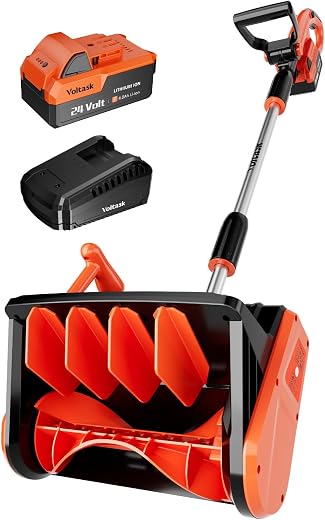
2. VOLTASK SS-20B Cordless Snow Shovel — Best Snow Day Essentials Buy for the Path
Price: not currently displayed on Amazon — see the listing | Amazon rating: 4.4 from 2,407 ratings | Role: The path | Key spec: 24 V, 13-inch clearing width, 6.5-inch depth limit, 20-foot throw, 9.3 lb
The path from your front door to the road is the single job that decides whether a snow day is an inconvenience or a fortnight of compacted ice. Fresh snow takes minutes to move; the same snow walked on twice, thawed once and refrozen overnight takes a chisel. Every official piece of guidance on both sides of the Atlantic says the same thing in different words, and the British Snow Code puts it most simply: clear it early in the day, when it is fresh, because hard-packed snow is a different job. That is the argument for buying snow day essentials in September rather than deciding what you need on the morning it starts.
The VOLTASK is a 13-inch battery snow shovel weighing nine pounds, which puts it in an odd and useful middle ground between a plastic shovel and a two-stage snow blower. It starts instantly, it throws about twenty feet, the directional plate means you do not have to twist your back to aim it, and at nine pounds most people can carry it down a set of steps in one hand. Against that, a 4 Ah pack gives roughly twenty-five minutes and heavy wet snow eats into that, the clearing width is narrow, and the 6.5-inch depth limit is a real limit rather than a suggestion.
One honest note before you click through: Amazon is not showing a price for this exact model as this guide publishes, which usually means the listing is between stock. VOLTASK’s current brushless equivalent sits around $160. That is worth knowing because the buying decision here is genuinely marginal — if your path is short and straight, a fifteen-dollar plastic shovel and ten minutes does the same work, and the machine only earns its keep if you have steps, a drive, or a back that objects to lifting. Read the full review before you spend, because this is the one entry on the list where we would talk some readers out of it.
Best for: A front path, a set of steps and a short drive, cleared early and often, by someone who would rather push a light machine than lift a loaded shovel.
Skip if: You are facing an end-of-driveway plough ridge, compacted snow or ice, or anything over six inches deep; you have a long driveway and no second battery; or your winters produce two snowfalls a year.
Read the full Electric Snow Shovel review →
Where to Buy — Electric Snow Shovel
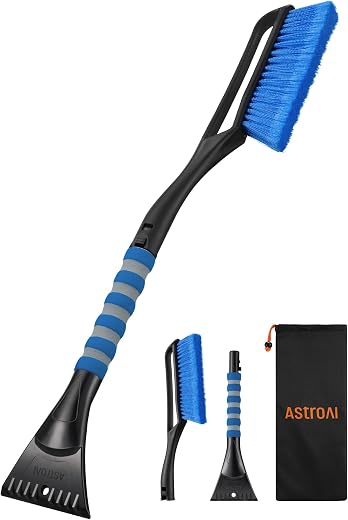
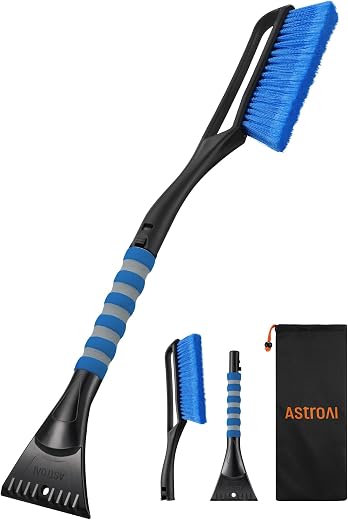
3. AstroAI 27-Inch 2-in-1 Snow Brush — Best Snow Day Essentials Tool for the Car
Price: $17.99 | Amazon rating: 4.6 from 31,979 ratings | Role: The car | Key spec: 27-inch reach, detachable brush head, moulded ice scraper, foam grip
This is the largest body of evidence attached to anything in this roundup: nearly thirty-two thousand ratings at 4.6, which is not the sort of number a mediocre product accumulates. It is also the cheapest of these snow day essentials, and it fixes the most common winter failure, which is not being unable to drive but being unable to see. A quickly cleared porthole in the middle of a windscreen is how most people leave the house on the first snowy morning of the year, and it is the reason the second most common winter driving mistake is a scrape down the side of a parked car.
The twenty-seven-inch length is the specification that matters and the reason to prefer this over the stub scraper in the door pocket. It reaches the middle of a saloon roof and the far side of a windscreen from one side of the car, which means you clear the roof properly rather than driving off with a slab of snow above the rear window waiting to slide down it at the first set of traffic lights. In several American states and under the British requirement to have a clear view of the road, that slab is not just untidy; leaving it there is the offence.
The brush head detaches, which sounds like a gimmick and is not. Used as a brush it moves powder without dragging grit across paintwork; detached, the scraper is a short, stiff tool you can lean on, which is what frozen sleet actually requires. The foam grip is the one weak point — it is comfortable, but it holds water and then freezes if you leave it in the boot wet. Keep it in the car rather than on the drive and it will outlast several winters, which is more than can be said for most snow day essentials bought in a hurry.
Best for: Any car parked outside, and especially any estate, SUV or people carrier whose roof cannot be reached with a short scraper from the driver’s side.
Skip if: You have a garage, or you want a heated or powered de-icer — this is a manual tool and it asks for a couple of minutes of effort in the cold.
Read the full Car Ice Scraper review →
Where to Buy — Car Ice Scraper
4. POMPONGO Rechargeable Hand Warmers — Best Snow Day Essentials Choice for the Hands
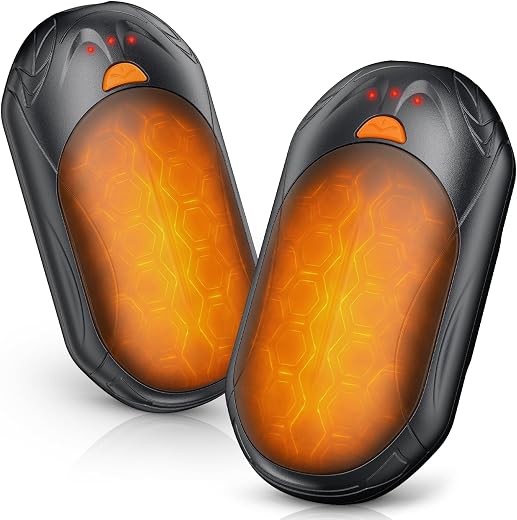
Price: $16.99 (was $19.99) | Amazon rating: 4.7 from 2,420 ratings | Role: The hands | Key spec: 6,000 mAh, up to 20 hours of heat, two units, doubles as a phone power bank
Cold hands are what ends outdoor jobs, not cold weather, and this is the entry on the snow day essentials list that most often decides whether the other six get used properly. Fingers lose dexterity long before anything dangerous happens, which is why the shovelling gets abandoned half-finished, the car gets a porthole instead of a clear windscreen, and the gritting never happens at all. The US National Weather Service points out that the wind chill index exists precisely to tell you when conditions have crossed into frostbite territory, noting that values near minus 25 degrees Fahrenheit mean frostbite is possible within fifteen minutes. Long before that threshold, cold hands have already made you cut the job short.
A pair of 6,000 mAh rechargeable warmers is a better answer than disposable sachets for a straightforward reason: they are there. Sachets get used up, forgotten and rediscovered a year past their date, whereas these sit on the same charger as everything else and are ready in October. Twenty hours is the optimistic figure at the lowest setting; on high, expect a good deal less. Two units is the right number, because one in each pocket is what you actually want and because you can hand one to whoever is holding the other end of the job.
The secondary function is genuinely useful rather than a spec-sheet flourish. Each unit is a small power bank, and a phone at 8% in a cold car is a more realistic snow day emergency than frostbite. That said, be clear-eyed about the physics: batteries and cold do not get on. Work at Stanford’s SLAC National Accelerator Laboratory found that storing lithium-ion cathodes below zero degrees Celsius made batteries lose up to 5% more of their capacity after 100 charges, because the cold cracks the particles inside the cathode. Keep them in an inside pocket, not the glovebox.
Best for: Anyone who does twenty minutes of outdoor work at a time in winter, anyone with poor circulation, and anyone who wants a pocket power bank that happens to be warm.
Skip if: You want heat that works with no forward planning at all — a rechargeable warmer left flat since March is worse than a box of sachets in a drawer.
Read the full Rechargeable Hand Warmers review →
Where to Buy — Rechargeable Hand Warmers
5. BONAI 16-Bay Battery Charger — Best Snow Day Essentials Backup for the Batteries
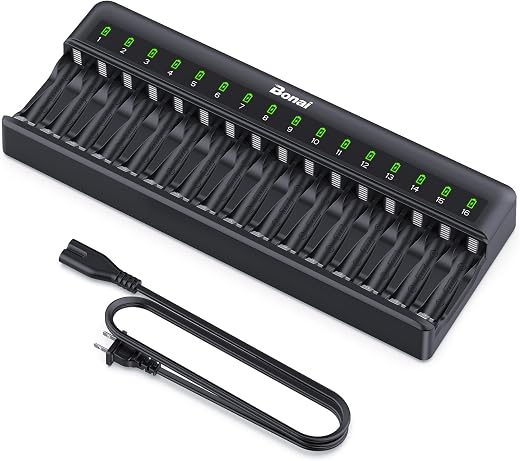
Price: $27.89 (was $29.44) | Amazon rating: 4.5 from 2,470 ratings | Role: The batteries | Key spec: 16 independently controlled bays, AA and AAA NiMH, about 3.5 hours, LED per bay
Look at what a bad winter week actually runs on and it is not lithium packs, it is AA cells. The torch in the kitchen drawer, the radio, the carbon monoxide alarm, the smoke alarm that chirps at three in the morning when it gets cold, the thermostat, the kids’ everything. A sixteen-bay charger is an unglamorous item on a list of snow day essentials and it is the one that quietly keeps the other six working, because independent bays mean you can charge a mixed pile of half-flat cells rather than matched pairs.
Independent control is the specification worth paying for, and cheap chargers do not have it. Paired-channel chargers charge cells two at a time and will happily overcharge the good one to fill the tired one; per-bay control charges each cell to its own end point and shows you, with a per-bay LED, which cells are actually dead. Around three and a half hours for a full set is unremarkable and fine, since the realistic use is filling everything overnight before a cold snap rather than racing.
Two limits to be honest about. It charges NiMH AA and AAA only, so it does nothing for the torch, the hand warmers or anything else with a built-in lithium pack — those need their own USB cables, and the sensible arrangement is one charger for cells and one powered USB hub for packs. Second, it ships with a US plug, so British readers need an adapter or a different model. That is a recurring theme in this list and the US versus UK section below deals with it properly.
Best for: Households whose winter kit runs on AA and AAA cells, and anyone who currently owns four chargers and no idea which cells are charged.
Skip if: Everything you own uses built-in lithium packs and USB-C, or you are shopping in the UK and do not want to run a mains adapter permanently.
Read the full BONAI 16 Bay Battery Charger review →
Where to Buy — BONAI 16 Bay Battery Charger
6. UCO Stormproof Match Kit — Best Snow Day Essentials Insurance for Ignition
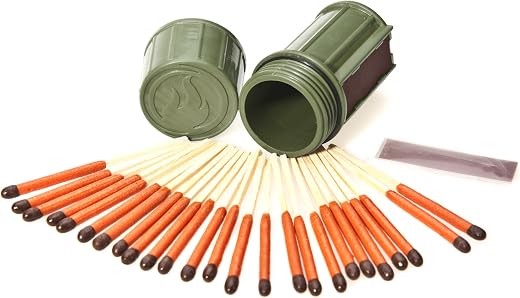
Price: $10.99 | Amazon rating: 4.8 from 9,938 ratings | Role: Ignition | Key spec: 25 stormproof matches, 3 strikers, waterproof floating case
This is the highest-rated product in the roundup — 4.8 from nearly ten thousand ratings — and the cheapest, and it is on the list for one narrow job. If you have a wood burner, an open fire, a gas hob with electronic ignition that fails when the power does, or a camping stove of last resort, you need something that lights in a wind and after a soaking. Ordinary matches fail at exactly the moment you need them, which is why stormproof ones belong in a set of snow day essentials rather than a camping box: the moment in question is standing at a back door with the wind coming across an open garden.
These burn for around fifteen seconds, relight after being dunked in water, and come in a waterproof case that floats, with spare strikers stored inside it. Fifteen seconds does not sound like much until you have tried to light a stubborn firelighter with a paper match in a draught. The case is the underrated part: the reason household matches fail in winter is not the match, it is that the box has been sitting somewhere damp since last February and the striking strip has given up.
A necessary caveat, and it is the reason this entry is about ignition rather than lighting. These are for lighting a heat source, not for lighting the house. The US Centers for Disease Control and Prevention is unambiguous about that trade-off during a winter storm: use battery-powered flashlights or lanterns rather than candles, if possible, because candles can lead to house fires. Twenty-five matches for a heat source is sensible planning. Twenty-five matches and a bag of tealights instead of a torch is not.
Best for: Any home with a wood burner, an open fire, a gas hob that needs a manual light, or a stove kept for emergencies.
Skip if: You have no combustion appliance at all — in an all-electric home this is ten dollars for a scenario you do not have.
Read the full UCO Stormproof Matches review →
Where to Buy — UCO Stormproof Matches
7. Berkshire Blanket Primalush Wearable Blanket — Best Snow Day Essentials Pick for Coming Back In
Price: $22.19 | Amazon rating: 4.6 from 1,168 ratings | Role: Coming back in | Key spec: 58 x 64 inch plush cape wrap with pockets, one size
The last of the snow day essentials is the only one that does nothing outdoors, and it is the one most likely to be used every single day of the winter. A wearable blanket is a thermostat you put on rather than turn up, and it costs nothing to run. Anyone who has come in from twenty-five minutes of clearing a path with the other snow day essentials knows the specific problem it solves: you are not cold all over, you are cold in a way that a hot drink and a normal jumper do not touch for about half an hour.
The Primalush is a cape wrap rather than a sleeved blanket, which is the right choice for this job. Sleeves are for wearing a blanket while doing things; a cape is for wrapping the shoulders and back, which is where the heat has gone, and it comes off in one movement when you have warmed through. At 58 by 64 inches it is genuinely blanket-sized rather than a novelty poncho, and the pockets mean the hand warmers from entry four have somewhere to live while you thaw out.
There is an argument this is a comfort item rather than kit, and the honest answer is that the distinction is thinner than it looks. Public health advice in Britain has for years told households to heat their living space adequately and to wear suitable clothing rather than treating the thermostat as the only lever, and the cheapest snow day essentials in the whole list are the ones that let a room be a degree cooler without anyone minding. It is also, at twenty-two dollars, the least regrettable purchase here if the winter turns out mild.
Best for: Anyone who comes indoors cold, anyone trying to hold the heating down a degree, and anyone who reads or works in a cold room in winter.
Skip if: You want something you can wear while doing chores — a sleeved blanket or a proper fleece does that, and a cape does not.
Read the full Berkshire Blanket Wearable Blanket review →
Where to Buy — Berkshire Blanket Wearable Blanket

Snow Day Essentials — Buyer’s Guide: What to Look For
Most winter buying guides are a list of things that are nice to own in cold weather. This one is built round a narrower test, because the failure mode of snow day essentials is not that they are bad products — it is that they are the wrong products, bought in a panic, in the week the forecast turns. Here is what actually separates the kit that gets used from the kit that goes back in the cupboard.
Buy Snow Day Essentials for the Nine Months They Sit Unused
Almost everything on this list spends most of the year doing nothing. That inverts the usual buying criteria. Run time matters less than self-discharge; durability under load matters less than tolerance of being ignored. A rechargeable hand warmer that holds charge for six months beats one with a longer peak run time, and a match case that keeps its strikers dry through a damp summer beats a bigger box of ordinary matches.
The same logic explains the sixteen-bay charger’s place in a list of snow day essentials. Its job is not to charge quickly. Its job is to be the reason that, on the night the forecast turns, filling every AA cell in the house is a single decision rather than a search for four different chargers.
Snow Day Essentials Have to Work in a Glove — and Without One
A surprising amount of winter kit is designed for bare hands. Small switches, recessed buttons, twist-to-focus torch heads and touchscreens all fail in gloves, and the alternative is taking the gloves off, which is the thing you are trying to avoid. Look for large physical switches, magnets instead of clips, and anything that lets you put a tool down without it disappearing into snow.
This is why the magnetic base on a torch is worth more than several hundred lumens, and why a detachable brush head beats a clever multi-function handle. Every one of these snow day essentials was assessed on whether it can be operated with cold, clumsy fingers rather than on a bench.
Be Honest About Which Snow Day Essentials the Manual Version Beats
A fifteen-dollar plastic snow shovel clears a short straight path about as fast as a battery machine, and never runs out. A five-dollar scraper clears a windscreen. Powered snow day essentials earn their place when there are steps, a longer drive, a bad back, or an amount of snow that turns a ten-minute job into a forty-minute one — and not otherwise.
The US Occupational Safety and Health Administration frames the manual job clearly, advising that you should scoop small amounts of snow at a time and where possible, push the snow instead of lifting it, and that you should keep the back straight, lift with the legs and do not turn or twist the body. If pushing rather than lifting is the correct technique anyway, a machine that pushes is doing the same thing with a motor. Buy it for the volume, not for the glamour.
Count the Power Sources Your Snow Day Essentials Need, Then Reduce Them
A typical winter cupboard contains AA cells, AAA cells, CR123s, a proprietary tool battery, three USB-C devices and two micro-USB survivors. That is six charging decisions on a night when you want none. The most useful thing a buyer can do is standardise: put the cell-powered things on one charger and the pack-powered things on one USB hub, and throw away anything that needs a cable you own exactly one of.
Cold makes this worse rather than better. Work at the SLAC National Accelerator Laboratory found that storing lithium-ion cathodes below zero degrees Celsius led batteries to lose up to 5% more of their capacity after 100 charges, because the cold was shrinking the particles within the cathode and in the process cracking them. Anything with a lithium pack belongs indoors, not in a car boot or an unheated garage.
The Snow Day Essentials Safety Item Nobody Thinks About
The least interesting entry on any list of snow day essentials is usually the one that matters most, and here it is the carbon monoxide risk that snow itself creates. The US Consumer Product Safety Commission’s winter advice is blunt: clear snow away from the outside vents for fuel-burning appliances such as furnaces so that dangerous carbon monoxide does not build up in the house. Drifting snow and a blocked balanced flue is a real and seasonal hazard, and clearing it takes a torch and two minutes.
If you want a fuller treatment of what stops working when the power goes with it, our power outage essentials guide covers the blackout half of winter, and our home maintenance essentials guide covers the tools that tell you what your house is doing the rest of the year.
US vs UK: What Changes When You Buy Snow Day Essentials
Snow is one of the few household topics where American and British readers are not solving the same problem with different vocabulary — they are solving genuinely different problems under genuinely different rules. Britain gets less snow, treats each fall as an event, and puts the legal duty on the state. America gets more snow, treats it as a season, and puts the legal duty on you. That difference changes which snow day essentials are worth buying.
Snow Day Essentials Vocabulary: Worse Than the Usual US/UK Gap
An American clears a sidewalk and a driveway; a Briton clears a pavement and a drive. American snow comes off a windshield with a scraper kept in the trunk; British snow comes off a windscreen with one kept in the boot.
A flashlight is a torch, a sled is a sledge, a snow plow is a snowplough, and the vehicle Americans call a salt truck is a gritter, which in some parts of Britain has a name voted for by the public. The item with no American equivalent at all is the grit bin: a yellow box of council salt at the end of a street, free to use on the public road and not, strictly, for your own drive.
Who Has to Clear It: The Law Behind Half These Snow Day Essentials
In much of the United States, clearing the public sidewalk outside your property is a legal obligation with a clock attached. New York City’s rules are typical of the pattern and unusually explicit: if the snow stops falling between 7:00 a.m. and 4:49 p.m. you must clear within four hours; between 5:00 p.m. and 8:59 p.m., within fourteen hours; and between 9:00 p.m. and 6:59 a.m., by 11:00 a.m. the next day. You are told to try to clear a path at least four feet wide, and the fines escalate from $100–$150 for a first offence to $250–$350 for a third and subsequent.
Britain has nothing of the kind. There is no legal duty on a householder to clear the pavement outside their home at all, and the government’s Snow Code exists mainly to reassure people that clearing it voluntarily will not be punished: it’s unlikely you’ll be sued or held legally responsible for any injuries if you have cleared the path carefully. Council guidance repeating the Code puts the point even more directly — there is no law preventing you from clearing snow and ice from paths or pavements outside your house, shop or office.
Where does the British duty sit instead? With the highway authority. Section 41(1A) of the Highways Act 1980 provides that a highway authority are under a duty to ensure, so far as is reasonably practicable, that safe passage along a highway is not endangered by snow or ice — a subsection inserted in 2003. So the two countries have made opposite choices: America transfers the job to the citizen and enforces it with fines, while Britain keeps it with the state and then has to publish guidance persuading citizens that helping out is safe. Neither approach makes the snow easier to move, but only one of them means a shovel is effectively compulsory.
Salt and Snow Day Essentials: How Much, and When It Stops Working
Both countries salt, but the domestic advice differs in scale. The British Snow Code gives a household quantity that surprises people the first time they read it: a tablespoon for each square metre you clear should work. It also warns against the obvious wrong move — do not use hot water. This may melt the snow and ice but it is likely to refreeze causing more risk than it prevents — and asks you not to raid the council grit bin for your own drive.
The limit worth knowing on both sides of the Atlantic is temperature. As Coventry City Council puts it, rock salt works by lowering the temperature at which water freezes, but below -5 degrees centigrade, the effectiveness of grit is reduced and pavements/roads may still freeze. Salt also relies on pedestrian movement on pavements or the action of vehicle tyres to spread it over the road, which is why a salted but unused path can still be treacherous. In a genuine cold snap, clearing beats treating, and that is an argument for owning a shovel rather than a bigger bag of salt.
Two Warning Systems That Change Which Snow Day Essentials You Need
The American system tells you about the weather. The National Weather Service defines a Blizzard Warning by measurable thresholds — frequent gusts greater than or equal to 35 mph accompanied by falling and/or blowing snow, frequently reducing visibility to less than 1/4 mile for three hours or more — and an Ice Storm Warning by ice accumulation of around 1/4 inch or more. A Winter Weather Advisory means conditions should not be hazardous enough to meet warning criteria.
The British system tells you about the consequences. UKHSA’s Cold-Health Alerts, run with the Met Office from 1 November to 31 March, are issued when cold weather is forecast that could lead to significant impacts on health, and are colour-coded on a matrix of impact and likelihood rather than degrees: yellow for effects on vulnerable groups, amber when impacts are expected across the whole health service, with potential for the whole population to be at risk, and red to indicate significant risk to life for even the healthy population.
There is no published temperature threshold at all. For a buyer this matters more than it sounds: an American can decide what to own from a forecast number, whereas a British reader gets a judgement about consequences and has to translate it into a shopping list themselves.
Plugs and Units: Two Snow Day Essentials That Need UK Attention
Two of these snow day essentials carry a caveat for British buyers. The BONAI charger ships with an American AC plug, so it needs an adapter on 230 V mains; check the model listed on Amazon.co.uk rather than assuming the US listing ships as-is. Battery snow shovels are also far more common in North America than in Britain, and UK model numbers differ. Everything else is plug-free.
Units to translate as you read: snow depths are given in inches in the US and centimetres in the UK, so the shovel’s 6.5-inch depth limit is about 16.5 cm and its 13-inch width about 33 cm; 20 feet of throw is roughly 6 metres; the CDC’s hypothermia threshold of 95°F is 35°C; and -5°C, where grit begins to fail, is 23°F. Britain quotes a “feels like” temperature where America quotes wind chill; they are calculated differently and are not interchangeable numbers.
Snow Day Essentials — Which One Should You Buy?
Nobody needs all seven at once, and buying all seven snow day essentials in the same week is how people end up with a cupboard of unused winter kit. Here is the honest order, by budget.
Under $30: The Two Snow Day Essentials Everyone Should Own
If you buy nothing else on this list, buy the AstroAI 27-inch snow brush and ice scraper at $17.99 and the UCO Stormproof Match Kit at $10.99. That is under thirty dollars for the two snow day essentials with the widest gap between what they cost and what they prevent: a car you cannot legally or safely see out of, and a heat source you cannot light. The scraper has the largest evidence base in this guide by a distance, and the matches the highest rating.
If your home is all-electric with no combustion appliance anywhere, swap the matches for the Berkshire Primalush wearable blanket at $22.19, which is the single item here most likely to be used every day from October to March.
$30–$80: The Working Set of Snow Day Essentials
This is where a genuine set of snow day essentials comes together. Add the ZF8313 magnetic flashlight at $24.99 for the dark half of the day, and the POMPONGO rechargeable hand warmers at $16.99 so the outdoor jobs get finished rather than abandoned. Those two plus the scraper and the matches come to roughly seventy dollars and cover the dark, the car, the hands and ignition.
Households whose winter runs on AA cells should put the BONAI 16-bay charger at $27.89 in this tier instead of the hand warmers. If your outdoor lighting is the problem rather than your handheld lighting, our review of the LIANGLOME solar fence lights is worth a look — with the caveat that short days and snow-covered panels are exactly the conditions solar lighting handles worst.
Over $100: Snow Day Essentials Only Worth It If the Path Is a Real Job
The VOLTASK cordless snow shovel is the only item here above a hundred dollars, and it is the only one we would actively discourage some readers from buying. It is worth it if you have steps, a drive, or a back that objects to lifting, and if your winters reliably produce snow more than once or twice. It is not worth it for a short flat path, where a plastic shovel wins on price, reliability and run time.
If the car rather than the path is your winter risk, the money is better spent elsewhere: a car jump starter or a portable tire inflator addresses the two failures cold weather actually causes, and both cost less than the shovel.
Snow Day Essentials and the Law: Who Has to Clear the Snow Outside Your House?
This is the part of snow that no product page will tell you, and it is the part that determines whether the snow day essentials in your garage are a convenience or a legal requirement. The answer is almost exactly opposite in the two countries this guide is written for, and both answers are more surprising than most people assume.
In America, the clock starts when the snow stops
Across a great many US municipalities, the abutting property owner — not the city — is responsible for the public sidewalk. New York City’s Department of Sanitation publishes the timetable in plain terms: if the snow stops falling between 7:00 a.m. and 4:49 p.m. you must clear within four hours; if it stops between 5:00 p.m. and 8:59 p.m., within fourteen hours; and if it stops between 9:00 p.m. and 6:59 a.m., by 11:00 a.m. the next day. The city asks that, where possible, you try to clear a path at least four feet wide along the sidewalk.
The enforcement is real. Fines run $100–$150 for a first offence, $150–$350 for a second, and $250–$350 for a third and subsequent. Read that alongside the price of the snow day essentials in this guide and the maths is stark: a single first-offence summons costs more than the four cheapest snow day essentials here put together.
In Britain, nobody makes you — and the government has to reassure you it is safe to help
British householders have no equivalent duty. There is no statutory obligation to clear the pavement outside your home, and the persistent belief that clearing it makes you liable if someone later slips has been the subject of official reassurance for well over a decade. The Snow Code’s central sentence is a promise rather than an instruction: it’s unlikely you’ll be sued or held legally responsible for any injuries if you have cleared the path carefully. Council guidance repeating the Code is blunter still — there is no law preventing you from clearing snow and ice from paths or pavements outside your house, shop or office.
The duty in Britain sits with the highway authority. Section 41 of the Highways Act 1980 requires an authority to maintain the highway, and subsection (1A), inserted in 2003, adds that in particular, a highway authority are under a duty to ensure, so far as is reasonably practicable, that safe passage along a highway is not endangered by snow or ice. That is a duty on the council, qualified by reasonable practicability, and it is why British winter conversation is about gritting routes and grit bins rather than about whose four feet of pavement is whose.
The comparison is worth stating plainly because it is genuinely complementary rather than merely different. America transferred the job to the citizen and enforces it with fines; Britain kept the job with the state and then had to publish guidance persuading citizens that volunteering will not rebound on them. One country legislated the duty; the other legislated the reassurance.
The Practical Snow Day Essentials Advice Both Countries Agree On
Underneath the legal difference, the technical guidance on snow day essentials and how to use them converges. Clear early, while the snow is fresh — British council guidance repeating the Snow Code puts it as it’s much easier to clear fresh snow than hard packed snow — start as early as possible. Do not use water: do not use hot water. This may melt the snow and ice but it is likely to refreeze causing more risk than it prevents. Think about where the cleared snow goes so that it does not block other people’s paths or the road, and keep it off gullies and drains.
Salt sparingly and know its limit. A tablespoon for each square metre you clear should work, according to the Snow Code, and ordinary domestic table salt or dishwasher salt will do the job. But as Coventry City Council notes, salt works by lowering the temperature at which water freezes and below -5 degrees centigrade, the effectiveness of grit is reduced and pavements/roads may still freeze. It also relies on pedestrian movement on pavements or the action of vehicle tyres to spread it over the road, so a treated path that nobody walks on is not as safe as it looks.
The Health Risks No List of Snow Day Essentials Will Fix
Two hazards do more damage on a snow day than the snow does, and no list of snow day essentials can buy your way out of either. The first is the shovelling itself. The US Centers for Disease Control and Prevention is direct about it: cold weather puts an extra strain on the heart, and if you have heart disease or high blood pressure, follow your doctor’s advice about shoveling snow or performing other hard work in the cold.
OSHA’s technique guidance is the practical counterpart — scoop small amounts of snow at a time and where possible, push the snow instead of lifting it, keeping the back straight, lifting with the legs and not turning or twisting the body. OSHA also warns that snow blowers commonly cause lacerations or amputations when operators attempt to clear jams with the equipment turned on, and that you should never attempt to clear a jam by hand.
The second is carbon monoxide, and here snow is the direct cause rather than a bystander. The Consumer Product Safety Commission’s winter advice includes an instruction most households have never heard: clear snow away from the outside vents for fuel-burning appliances such as furnaces so that dangerous carbon monoxide does not build up in the house.
A drifted-over balanced flue or boiler vent is a two-minute job with a torch and the most valuable thing on this entire list of snow day essentials. The CPSC pairs it with the standing rule for generators — operate portable generators outside only, at least 20 feet away from the house — and notes that an average of nearly 100 people die in the U.S. each year from CO poisoning caused by portable generators.
Know the hypothermia signs while you are out there. The CDC lists shivering, exhaustion or feeling very tired, confusion, fumbling hands, memory loss, slurred speech and drowsiness, and is unambiguous about the threshold: if body temperature is below 95°F, the situation is an emergency — get medical attention immediately. For frostbite, the National Weather Service notes that wind chill values near minus 25 degrees mean that frostbite is possible within 15 minutes. And on lighting, the CDC’s preference is worth repeating because it cuts against instinct: use battery-powered flashlights or lanterns rather than candles, if possible. Candles can lead to house fires.
Snow Day Essentials — Frequently Asked Questions
What are the most important snow day essentials to buy first?
A 27-inch snow brush and ice scraper, and a torch you can put down. Those two solve the two failures that stop a household functioning: not being able to see out of the car, and not being able to see anything at all at seven in the morning. Together they cost around forty-three dollars.
Do I legally have to clear the pavement outside my house?
In much of the United States, yes, with a deadline and a fine — New York City requires clearing within four hours if the snow stops between 7:00 a.m. and 4:49 p.m., with fines from $100. In Britain, no. There is no such duty on householders, and the duty to keep safe passage from being endangered by snow or ice sits with the highway authority under section 41(1A) of the Highways Act 1980.
Can I be sued in the UK if someone slips on a path I cleared?
The government’s Snow Code addresses this directly and says it’s unlikely you’ll be sued or held legally responsible for any injuries if you have cleared the path carefully. This is guidance rather than a guarantee, and the operative word is carefully — clear to the ground, salt afterwards, and do not use water.
Is an electric snow shovel worth it, or should I buy a plastic one?
For a short, flat path, a plastic shovel wins on price, reliability and unlimited run time. A battery machine earns its place when you have steps, a driveway, more than one snowfall a year, or a back that objects to lifting. Note that OSHA’s advice for manual shovelling is to push rather than lift anyway, which is exactly what a powered shovel automates.
Why does salt stop working in a really cold snap?
Salt works by lowering the freezing point of water, and there is a floor to how far it can push it. Coventry City Council’s guidance states that below -5 degrees centigrade, the effectiveness of grit is reduced and roads and pavements may still freeze. Salt also needs footfall or traffic to spread it, so an untrodden salted path stays icier than a busy one.
How much salt should I actually put down?
Far less than most people use. The Snow Code’s figure is a tablespoon for each square metre you clear, and ordinary table salt or dishwasher salt works. Do not empty a council grit bin onto your own drive — that salt is for the public road.
Do rechargeable hand warmers work in the cold, or do they go flat?
They work, but they lose capacity in cold and they should live in an inside pocket rather than a car. Research at the SLAC National Accelerator Laboratory found that storing lithium-ion cathodes below zero degrees Celsius made batteries lose up to 5% more of their capacity after 100 charges because the cold cracks the cathode particles. Charge them in October, not in January.
Are candles a reasonable backup if the power goes out in a storm?
No, and this is one place the official advice is firmer than most people expect. The CDC’s winter storm guidance says to use battery-powered flashlights or lanterns rather than candles, if possible, because candles can lead to house fires. Keep matches for lighting a stove or a wood burner, and use a torch for lighting a room.
Do any of these snow day essentials need an adapter in the UK?
One does. The BONAI 16-bay charger ships with an American AC plug and needs an adapter or a UK-specific listing on 230 V mains. Battery snow shovels are also sold under different model numbers in the UK. Everything else on this list is either plug-free or charges over USB-C.
What is the difference between a US winter storm warning and a UK cold-health alert?
They measure different things. The National Weather Service defines its warnings by physical thresholds — a Blizzard Warning needs gusts of 35 mph or more with blowing snow reducing visibility below a quarter of a mile for three hours or more. UKHSA’s Cold-Health Alerts, run with the Met Office from 1 November to 31 March, are graded on likely health impact rather than temperature, from yellow through amber to red, with no published temperature threshold at all.
Snow Day Essentials — Final Thoughts
The thing that makes a snow day difficult is not the snow. It is that a set of jobs which normally live outside the household’s attention — the path, the car, the flue, the bins — all become urgent at once, in the dark, in the cold, in the two hours before anyone has had breakfast. The seven snow day essentials in this guide are organised around that sequence rather than around a category, which is why a wearable blanket and a box of matches sit on the same list as a battery snow shovel. Each of the snow day essentials above removes a specific reason a job gets abandoned half-done.
If you take one thing from the research rather than the shopping list of snow day essentials, make it the legal asymmetry. American readers should treat a shovel and a scraper as compliance items with a deadline attached, because that is precisely what they are.
British readers should know that nobody is going to make them clear anything, that the duty sits with the council, and that the government has gone out of its way to say that helping out is unlikely to land them in court. And everybody, on both sides, should go and look at the outside vent of whatever burns gas in their home the next time it drifts over — that is the two-minute job on this page most likely to matter.
Sources and Further Reading
- Highways Act 1980, section 41 (including subsection 1A on snow and ice) — legislation.gov.uk
- The Snow Code: clearing snow and ice from pavements yourself (PDF) — Suffolk County Council
- Snow Code guidance on clearing paths and driveways (PDF) — Inverclyde Council
- Snow removal responsibilities for property owners (PDF) — NYC Department of Sanitation
- About rock salt: how gritting works and its temperature limits — Coventry City Council
- Safety guidelines: during and after a winter storm — US Centers for Disease Control and Prevention
- Winter weather hazards and precautions: snow removal — US Occupational Safety and Health Administration
- Winter weather safety tips to prevent fires and carbon monoxide poisoning — US Consumer Product Safety Commission
- Winter weather warnings, watches and advisories — US National Weather Service
- Wind chill and frostbite times — US National Weather Service
- Cold-Health Alerting system: overview — UK Health Security Agency
- Cold-Health Alerts: alert levels explained — Met Office
- How extreme cold can crack lithium-ion battery materials, degrading performance — SLAC National Accelerator Laboratory
Disclosure: Blue Rays Technologies researches independently. This guide contains affiliate links to Amazon.com, and we earn a commission from qualifying purchases at no extra cost to you, which never affects our scores or the order of this list. Prices and Amazon ratings were checked on the date of publication and change often; the VOLTASK snow shovel had no price displayed at the time of writing. British readers should check Amazon.co.uk model numbers, and note that the BONAI charger listed here ships with a US mains plug. Nothing in this article is legal advice — snow clearing obligations vary by municipality in the United States, and the UK Snow Code is guidance rather than a guarantee.