
Nothing in a house fails suddenly. The tap that drips today was dripping quietly last winter, the hinge that finally tore out of the door frame had been loose for a year, and the damp patch behind the wardrobe was a cold bridge long before it grew anything. What makes home repair expensive is almost never the repair. It is the eighteen months during which nobody looked.
That is the thread running through this list, and it is why the seven home maintenance essentials below are not the seven tools you would find on a builder’s van. Not one of them builds anything. Every single one answers a question you cannot answer by standing in the room and looking: what is underneath the paint, what has worked loose, what is inside the unlit cupboard behind the boiler, which of the three valves under the stairs is the one that actually stops the water, where the spare went, and whether the battery in the thing on the ceiling is flat.
Home maintenance is an information problem for far longer than it is a do-it-yourself problem — and in Britain a good deal of it is legally not yours to fix anyway, which makes finding out what is wrong the only move you are allowed to make on your own.
Every product in these home maintenance essentials was judged on four things: whether it tells you something you did not already know about your own house, whether it still works after six months in a drawer, whether it survives being used badly by someone who is not a tradesperson, and whether the cheap version does the job as well as the expensive one.
We deliberately left out the cordless drill, the ladder, the pressure washer and everything that touches gas or a consumer unit, and the buyer’s guide explains why in each case. Prices and links go to Amazon.com; readers in the UK can search the same models on Amazon.co.uk, where the model numbers are usually identical but the plug, the voltage and occasionally the chemical formulation are not — the US vs UK section covers exactly where those differences bite.
Home Maintenance Essentials — Quick Comparison
| # | Product | Role | Key spec | Best for | Price | Score |
|---|---|---|---|---|---|---|
| 1 | ZF8313 Magnetic EDC Flashlight | Look | 2,000 lumens, magnetic base, UV mode | Meter cupboards, loft hatches, under sinks | $23.99 | 8.4 |
| 2 | NewPos Lead Test Kit, 30 swabs | Test | Vinegar-activated swabs, 30-second result | Old paint, old woodwork, old dishes | $9.99 | 8.0 |
| 3 | Gerber Suspension NXT | Reach | 15 tools, 8.48 oz, lifetime warranty | The fault you find by accident | ~$41 | 8.7 |
| 4 | HOTO 12-in-1 Electric Screwdriver | Turn | 4 N·m, 3 torque settings, 12 S2 bits | Everything that has worked loose | $39.99 | 9.0 |
| 5 | DYMO LetraTag 100H + 3 tapes | Record | Handheld thermal, 3 cassettes included | Valves, panels, filters, dates | $42.70 | 8.5 |
| 6 | OUTUXED 36-Grid Organizer, 2-pack | Stock | 36 adjustable compartments × 2 | Screws, fuses, wall plugs, washers | $14.99 | 8.4 |
| 7 | BONAI 16-Bay Battery Charger | Power | 16 independent bays, AA and AAA NiMH | Alarms, sensors, thermostats, remotes | $23.99 | 8.2 |
- The 7 Best Home Maintenance Essentials in 2026
- Home Maintenance Essentials — Buyer’s Guide: What to Look For
- US vs UK: What Changes When You Maintain a House on the Other Side of the Atlantic
- Home Maintenance Essentials — Which One Should You Buy?
- Home Maintenance Essentials: What the Evidence Says About Falls, Lead and Housing Condition
- Home Maintenance Essentials — Frequently Asked Questions
- Home Maintenance Essentials — Final Thoughts
- Sources and Further Reading
The 7 Best Home Maintenance Essentials in 2026
The seven home maintenance essentials are ordered the way a maintenance job actually runs, not by price or by rank: you look, you test, you reach, you turn, you record what you did, you stock the part you will need next time, and you keep the things that warn you powered. Every entry carries the same fields, and every entry has a line telling you when to skip it, because a list of home maintenance essentials in which all seven items are wonderful is not a list, it is an advertisement.
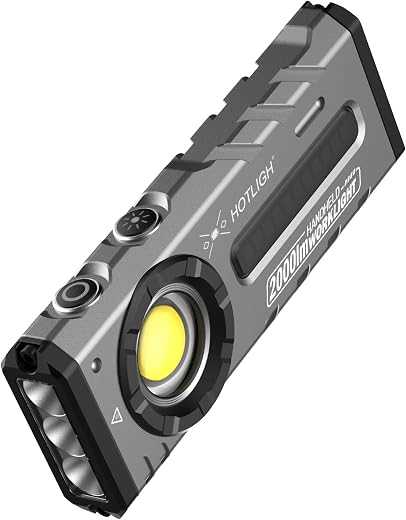
1. ZF8313 Magnetic EDC Flashlight — Best Home Maintenance Essentials Pick for Seeing Into Dark Spaces
Price: $23.99 (was $42.99) | Amazon rating: 4.6 from 1,017 ratings | Role: Look | Key spec: 2,000 lumens, 144 m beam, magnetic base, UV mode, USB-C
Almost every part of a house that goes wrong is somewhere with no light in it, which is why a light heads this list of home maintenance essentials. The stopcock is under the sink at the back. The consumer unit is in a cupboard under the stairs with a coat rail in front of it. The overflow you can hear but not see is in the loft. Your phone torch will do for ten seconds and then you need both hands, and that is the moment the job stops.
The ZF8313 solves that with a magnet in the tail. Stick it to a radiator, a boiler casing, a washing machine, the underside of a shelf bracket, and you have a fixed 2,000-lumen work light pointing where you need it while both hands are free. The brightness is steplessly adjustable from about 120 lumens up to 2,000, which matters more than the headline number — full power inside a kitchen cupboard is blinding, and the low setting is the one you will use most. It charges over USB-C in around two hours from a 2,000 mAh cell and the listing quotes 15 hours of runtime at low output.
The unexpectedly useful part is the UV mode. Ultraviolet light is how professionals find things that are invisible in white light: refrigerant and air-conditioning leaks dosed with fluorescent dye, pet urine in carpet before it becomes a smell you cannot locate, and the fine mist pattern from a slow plumbing weep on a cupboard base. It is not a diagnostic instrument and it will not find a leak that has not been dyed, but for £20-ish of home maintenance essentials it earns its place on that mode alone. The build is aluminium, IPX6 rated, with a pocket clip.
Best for: Anyone who has ever tried to read a water meter, bleed a radiator or find a fuse while holding a phone in their teeth. The magnet is the feature, not the lumens.
Skip if: You already own a decent head torch — hands-free is hands-free, and a headlamp beats a magnet on a wall you cannot stick anything to. The listing is also internally contradictory about batteries, claiming both a built-in 2,000 mAh cell and “1 AAA batteries required”, which is sloppy enough to be worth checking on arrival.
Read the full ZF8313 Magnetic EDC Flashlight review →
Where to Buy — ZF8313 Magnetic EDC Flashlight
2. NewPos Lead Test Kit (30 Swabs) — Best Home Maintenance Essentials Pick Before You Sand Anything
Price: $9.99 (was $12.99) | Amazon rating: 4.3 from 283 ratings | Role: Test | Key spec: 30 vinegar-activated swabs, result in about 30 seconds
This is the cheapest item on the list and the only one that can change what you do next rather than how comfortably you do it. Sanding, scraping, dry-cutting or heat-gunning a painted surface in an older house is the single most common way a household creates lead dust, and the dust is the hazard — intact paint on a wall is not. Ten dollars of swabs bought before you pick up the sander is a genuinely different category of purchase from anything else in these home maintenance essentials.
The kit is thirty individually sealed swabs, and it is the cheapest of these home maintenance essentials by a wide margin. You dip the tip in ordinary kitchen vinegar rather than water — the manufacturer is explicit that the vinegar activation is what makes the result reliable — press and rub it on the surface for the stated time, and read the colour change within about thirty seconds.
Red or pink indicates lead. It is a screening test, not a laboratory assay: it tells you to stop and think, not how many micrograms per square centimetre you are dealing with. Thirty swabs is enough to test every window sill, door frame, skirting board and radiator in a small house and still have half the pack left.
The second use is the one most buyers do not expect and the reason it stays in a kitchen drawer rather than a toolbox: dishes. The same swabs work on glazed ceramics, and imported or handmade traditional pottery is a recognised source of leachable lead when the glaze has been fired at too low or too uncontrolled a temperature. If you own a brightly glazed serving bowl bought on holiday, this is a two-minute test with a real answer at the end of it. Ratings volume is thin at 283, which is the main reason the score is not higher.
Best for: Anyone about to disturb paint in a home built before 1978 in the US or before the early 1990s in the UK, and anyone with a cupboard of decorative imported ceramics they actually eat off.
Skip if: You need a result you can act on legally or commercially — a swab is not an inspection, and if you are hiring someone to do the work in the US the certification rules described below put the obligation on them, not on you. Also skip if your home is new build; there is nothing to find.
Read the full NewPos Lead Test Kit review →
Where to Buy — NewPos Lead Test Kit

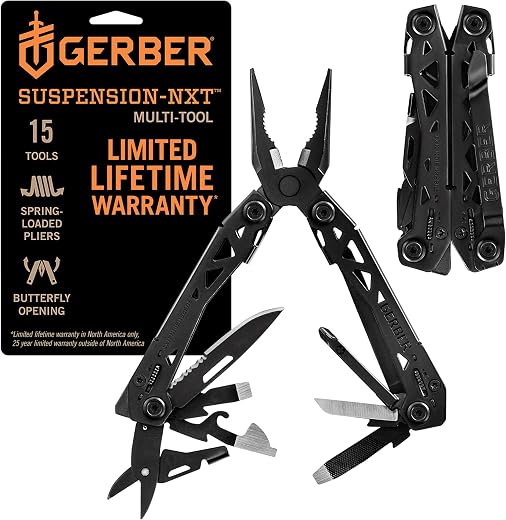
3. Gerber Suspension NXT — Best Home Maintenance Essentials Pick for the Fault You Find by Accident
Price: around $41 | Amazon rating: 4.6 from 23,791 ratings | Role: Reach | Key spec: 15 tools, 8.48 oz, 4.25 in folded, limited lifetime warranty
Most household faults are not discovered during a job, which is the argument for carrying one of your home maintenance essentials in a pocket. They are discovered on the way to something else — a loose grub screw on a tap handle noticed while washing up, a cable tie that has gone brittle behind the television, a radiator bleed key that needs a quarter turn of pliers because the square has rounded off. The tool that fixes those is not the best tool for the job. It is the tool that happens to be within reach, and that is a completely different specification.
The Suspension NXT is built for that. Fifteen tools on a spring-loaded, butterfly-opening stainless frame: needle-nose pliers, wire stripper, three flathead drivers, two cross drivers, awl, file, scissors, can and bottle openers, and a 2.25-inch partially serrated blade, all behind a tool lock. It weighs 8.48 ounces and folds to 4.25 inches with a pocket clip, which is the difference between a multitool that lives on you and one that lives in a drawer being useless. The open-frame design sheds grit rather than trapping it, which matters if it spends time in a garden or a garage.
Two things justify its place among these home maintenance essentials over a cheaper multitool. The first is the limited lifetime warranty, which at this price is unusual and is the reason the tool is worth buying once rather than three times. The second is the plier jaw and the spring: needle-nose pliers you can open one-handed are the single most-used function on any household multitool, and cheap ones bind. What you give up is blade steel — this is not a knife you would choose for cutting — and eight and a half ounces is heavy for a trouser pocket.
Best for: Anyone who wants one tool on them at all times, and anyone whose household jobs are mostly small, unplanned and discovered rather than scheduled. The 23,791-rating evidence base is the largest of any tool in this list.
Skip if: You want a serious cutting knife, or you already carry a full-size plier multitool. It is also the wrong buy if the jobs you actually face are screw-driving in volume — for that, the next entry does more in ten minutes than this does in an hour.
Read the full Gerber Suspension NXT review →
Where to Buy — Gerber Suspension NXT
4. HOTO 12-in-1 Electric Screwdriver — Best Home Maintenance Essentials Pick for Everything That Works Loose
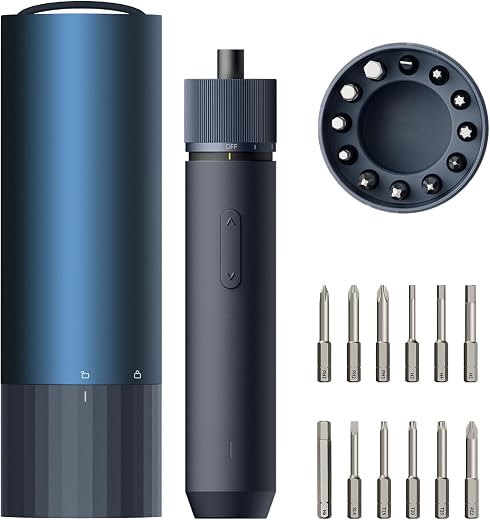
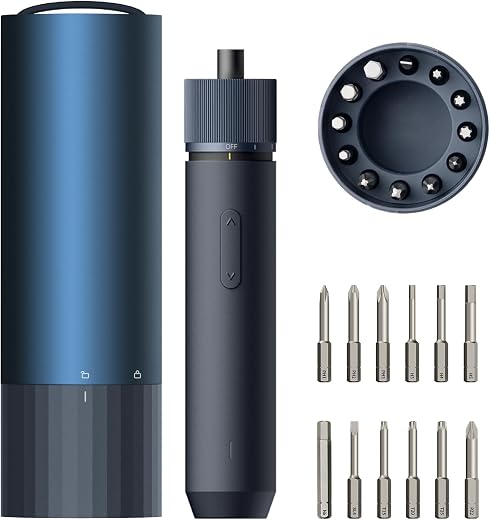
Price: $39.99 (was $49.99) | Amazon rating: 4.7 from 3,761 ratings | Role: Turn | Key spec: up to 4 N·m, four-stage torque knob, 12 × 50 mm S2 bits, USB-C
Ask any facilities manager what the most frequent maintenance task in a building is and the answer is not leaks or lamps. It is fasteners backing out. Hinges, handles, toilet seats, cupboard doors, curtain poles, cot bolts, socket faceplates, the screws holding a stair spindle, the bed frame that starts creaking in month four — every one of those is a screw that has worked loose through ordinary use and vibration, and every one is a two-minute job if you have the right driver within arm’s reach and a twenty-minute job if you do not.
The HOTO is the best-scoring item in this entire set of home maintenance essentials because it is the one that matches its job most exactly. It is a 0.55-pound cordless driver delivering up to 4 N·m through a four-stage rotary torque knob, with a magnetic 1/4-inch hex holder, twelve 50 mm S2 steel bits at 60 HRC covering Phillips, Pozidriv, flathead, hex and Torx, and a circular shadowless LED around the collar. It charges over USB-C and lives in an aluminium case that keeps the bits together, which is the actual reason cheap bit sets disappear.
Torque control is the part that matters and the part most buyers of home maintenance essentials ignore. A cordless drill delivers far more torque than any of these jobs need, and the result is stripped MDF, cracked plastic escutcheons and sheared hinge screws. Four newton-metres with a settable clutch is enough for flat-pack furniture and household fasteners and not enough to destroy them, which is why this beats a drill for maintenance work even though it would lose badly at drilling a wall. It is not a substitute for a drill; it is a substitute for a screwdriver you use forty times a year.
Best for: Almost every household. If you buy one powered thing from this list, buy this one — it is the item that turns a recurring irritation into a task you finish while the kettle boils.
Skip if: You need to drill masonry, drive long screws into structural timber, or fit anything into a joist. Four newton-metres will stall, and pushing a precision driver at that work is how you kill it. Buy a drill as well, not instead.
Read the full HOTO Electric Screwdriver review →
Where to Buy — HOTO 12-in-1 Electric Screwdriver
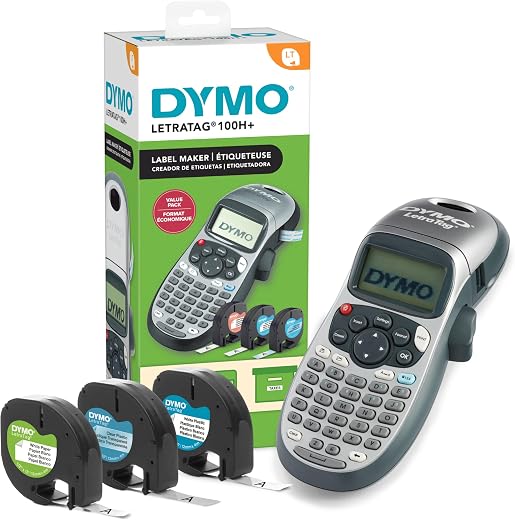
5. DYMO LetraTag 100H (with 3 Tapes) — Best Home Maintenance Essentials Pick for Remembering What You Did
Price: $42.70 (was $44.99) | Amazon rating: 4.6 from 31,259 ratings | Role: Record | Key spec: handheld thermal, 5 font sizes, 7 print styles, three 1/2-inch cassettes included
A label maker looks like an office toy on a list of home maintenance essentials, right up to the first cold night you spend on your knees in a cupboard turning three identical valves to find out which one feeds the bathroom. Almost everything that goes wrong in a house goes wrong at a moment of stress, in poor light, often to somebody who did not install it — a house sitter, a tenant, a partner, a future owner, or you in four years having entirely forgotten. Labels are the cheapest possible defence against that.
The labelling jobs worth doing take about an hour once, and they make every other item in these home maintenance essentials easier to use. Label the internal stop tap and the outside stop tap. Label each breaker or fuse way with the room it actually feeds, tested rather than assumed. Label the boiler with its service date and the filter with its size.
Label the loft hatch with the insulation depth and the year it was topped up. Put the paint colour and finish inside the door of the cupboard it was used in. Put the date on the back of every smoke alarm when the battery goes in. None of this costs anything beyond tape, and every one of them removes a future twenty minutes of guessing.
The LetraTag 100H itself is deliberately unambitious hardware: handheld, battery powered, a small graphical display that previews the label before it prints, five font sizes, seven print styles and eight box styles. The bundle includes three half-inch cassettes — paper white, plastic white and plastic clear — and the plastic tapes are the ones to use anywhere damp. Its 31,259 ratings make it one of the most-reviewed products in this list. The honest weakness is running cost: tape cassettes are the expense, and at this price you are paying for the ecosystem as much as the machine.
Best for: Anyone in an older house, anyone who has ever inherited somebody else’s plumbing, and every landlord or house-share where the person who finds the leak is not the person who knows the building.
Skip if: You will label six things and stop — a permanent marker and masking tape genuinely does the same job for nothing. Skip it too if you want peel-and-stick industrial labels; this is a consumer thermal machine and the paper tape does not survive a damp cellar.
Read the full DYMO Label Maker review →
Where to Buy — DYMO LetraTag 100H
6. OUTUXED 36-Grid Organizer Box (2-Pack) — Best Home Maintenance Essentials Pick for the Spare You Already Own
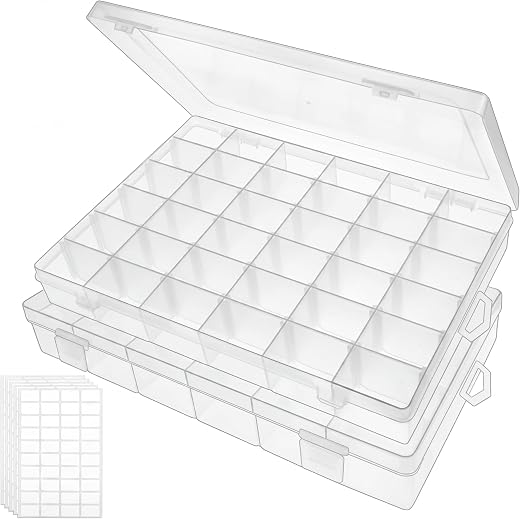
Price: $14.99 | Amazon rating: 4.6 from 13,107 ratings | Role: Stock | Key spec: two boxes, 36 adjustable compartments each, 10.8 × 7.0 × 1.8 in
Every household already owns the screw it is about to drive to the shop for, which is the least glamorous truth about home maintenance essentials. It is in a takeaway tub, a biscuit tin, a drawer with three dead batteries and a curtain hook, or the bag the flat-pack came in. The reason people buy a second one is never that the first has been used up; it is that finding it costs more than replacing it. That is a storage failure being mistaken for a supply problem, and it is the single most wasteful habit in domestic maintenance.
Two 36-grid boxes solve it for fifteen dollars. Each is 10.8 by 7.0 by 1.8 inches with removable horizontal dividers, so the compartments can be merged into larger bays for things like wall plugs, cable clips or hinges while staying small for screws and washers. Sold as a craft and tackle box, it is exactly the right format for household hardware, and the clear PP lid is what makes it work — you find the part by looking rather than by tipping everything onto a table.
A sensible split for home maintenance essentials looks like this: one box for fasteners, sorted by type and length rather than by which appliance they came from, and one box for consumables — fuses, washers, O-rings, tap seats, spare keys, picture hooks, furniture feet, blind cords, batteries in their original packaging. Label the outside of each lid, which is where the previous entry earns its keep. The one real limitation is that the boxes are explicitly not water resistant, so they belong indoors rather than in an unheated garage or shed where condensation will find them.
Best for: Anyone who has bought the same pack of wall plugs three times. Also excellent for keeping the leftover fixings from flat-pack furniture, which are the fixings you will actually need.
Skip if: Your storage problem is bulky rather than small — power tools, paint tins and offcuts need shelving, not compartments. Skip it too if the boxes would live in a damp outbuilding, because these are not sealed.
Read the full OUTUXED 36-Grid Organizer Box review →
Where to Buy — OUTUXED 36-Grid Organizer Box
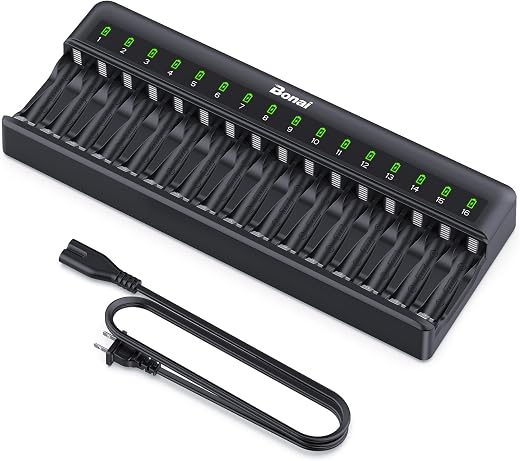
7. BONAI 16-Bay Battery Charger — Best Home Maintenance Essentials Pick for Keeping the Warnings Alive
Price: $23.99 (was $26.66) | Amazon rating: 4.6 from 2,468 ratings | Role: Power | Key spec: 16 independently controlled bays, AA and AAA NiMH, about 3.5 hours, 0.5 A per bay
Count the battery-powered devices in a modern house that exist purely to tell you something is wrong: smoke alarms, heat alarms, carbon monoxide alarms, leak sensors, thermostats and thermostatic radiator heads, door and window contacts, a wireless doorbell, the outdoor thermometer, the boiler programmer. Add the ones that merely annoy you when they die — remotes, clocks, kitchen scales, the torch in the drawer — and a typical household is running a dozen or more cells whose failure mode is silence.
Sixteen independent bays is the right shape for that problem, and independence is the specification to check when you compare home maintenance essentials of this kind. Cheap chargers pair their slots, so you must insert two identical batteries at once and both are governed by whichever finishes first. The BONAI charges any number of cells in any slots, mixes AA and AAA freely, and gives each bay its own LED — red charging, green done. Charging at 0.5 amps per bay it takes around three and a half hours, which is slow by fast-charger standards and is exactly what NiMH cells want if you would like them to last.
The maintenance argument is simple. If replacing a battery costs money and a trip, low batteries get ignored and devices get “temporarily” removed from ceilings. If a charged AA is always in a box in the cupboard, the alarm gets fixed the day it chirps. That is the whole case for putting a bulk charger in a list of home maintenance essentials rather than a gadget list. Two warnings: it is supplied with a standard American AC plug, so UK buyers need an adaptor and should confirm the input voltage range before use, and batteries are not included, so budget for a set of decent low-self-discharge cells at the same time.
Best for: Households running lots of AA and AAA devices, especially safety devices, and anyone who has ever silenced a chirping alarm rather than fixing it.
Skip if: Your alarms are sealed ten-year lithium units, which most new installations now are — then the charger has nothing to do. Skip it too if you need lithium-ion, 18650 or 9 V charging, none of which this handles.
Read the full BONAI 16-Bay Battery Charger review →
Where to Buy — BONAI 16-Bay Battery Charger
Home Maintenance Essentials — Buyer’s Guide: What to Look For
The market for household tools is organised around jobs people imagine doing. The market for actual home maintenance essentials is organised around jobs that arrive uninvited. These five rules are the difference between the two, and they are why this list looks nothing like a starter tool kit.
Home Maintenance Essentials Rule One: Buy Diagnosis Before You Buy Muscle
The most expensive thing a household can own is an unknown, and no amount of horsepower in your home maintenance essentials will fix it. A slow leak you cannot see costs a ceiling. A flue you never had checked costs a great deal more than that. Paint you sand without testing costs a decontamination. Against those, a torch, a test kit and a label machine are almost free, and they are the three items on this list that most people would have bought last.
The practical rule when assembling home maintenance essentials is to spend the first fifty dollars on finding things out and the next fifty on fixing them. Almost everyone does it the other way round, ends up with a drill and no idea which wall is safe to put it in, and then pays someone to tell them.
Why These Home Maintenance Essentials Deliberately Exclude a Ladder
Height is where domestic maintenance stops being inconvenient and starts being dangerous, and the safety regulators on both sides of the Atlantic are unusually blunt about it. Britain’s Health and Safety Executive says plainly that “ladders can be a sensible and practical option for low-risk, short-duration tasks, although they should not automatically be your first choice”, and its own leaflet defines short duration for you: if the task means staying up a leaning ladder or stepladder for “more than 30 minutes at a time”, you should be considering different equipment.
The American data is worse than most people expect. The CDC reports that “43% of fatal falls in the last decade have involved a ladder”. Those are occupational figures rather than domestic ones, which arguably makes them more alarming, not less: they describe people who do this for a living.
Gutters, roofs, fascias, chimneys and high external paintwork are the jobs to hire out, and no set of home maintenance essentials should quietly encourage you to do them yourself. If you do own a ladder, the two rules worth memorising are three points of contact when climbing — “a hand and two feet” — and the 1 in 4 rule, one unit out for every four units up, giving the 75-degree angle HSE specifies.
Home Maintenance Essentials and Torque: The Number That Prevents Damage
The single most common way a household damages its own property with its home maintenance essentials is by over-tightening. Chipboard and MDF have almost no thread strength; once a screw spins in flat-pack furniture, the joint is finished. Plastic fittings crack, hinge screws shear, and tap escutcheons split. All of that is torque, and a cordless drill has far too much of it for the work.
Look for an adjustable clutch and a maximum in the region of four to six newton-metres — roughly 35 to 53 inch-pounds — rather than the largest figure on the box. A settable driver is the tool that lets you stop at the right point instead of relying on wrist feel through a trigger. This is also why a drill is not on this list of home maintenance essentials: it is a hole-making machine that happens to drive screws badly, and confusing the two costs you furniture.
Home Maintenance Essentials You Only Touch Twice a Year: Buy for Idleness
Home maintenance essentials spend almost all of their life doing nothing. That inverts the usual buying priorities. Run time barely matters; self-discharge does. Peak brightness barely matters; whether the thing still holds charge after four months in a drawer matters enormously. Sealed and rechargeable beats disposable for anything you will forget about, and low-self-discharge NiMH cells beat standard rechargeables for anything that sits in a device waiting for an emergency.
Apply the same thinking to consumables. A lead test kit with thirty swabs is not thirty times better than one with three; it is a kit you will still have when you next need it in two years. Tape cassettes, spare fuses and washers all follow that pattern. Storage is the other half of it, which is why a compartment box earns a place among these home maintenance essentials ahead of several things that plug in.
Home Maintenance Essentials Worth Skipping: the Drill, the Pressure Washer and the Stud Finder
A cordless drill is a project tool rather than one of the home maintenance essentials, and most households use one perhaps twice a year — hire or borrow it. A pressure washer is the fastest way to force water behind render, under a door threshold and into a soffit, and to strip the sand out of old mortar joints; the damage is invisible until winter. A cheap capacitive stud finder is genuinely unreliable on lath and plaster, on dot-and-dab plasterboard and anywhere with foil-backed insulation, and false confidence about what is behind a wall is more dangerous than no information at all.
The largest exclusion is anything that lets you work on gas or on a consumer unit, and that one is not a matter of skill or preference. In Britain it is a matter of law, which is the subject of the next section.
US vs UK: What Changes When You Maintain a House on the Other Side of the Atlantic
Most dual-market guides to home maintenance essentials treat the US and UK difference as a matter of plugs and spelling. For home maintenance it goes much deeper than that: the two countries draw the line between “your job” and “a professional’s job” in completely different places, and the British line is drawn in criminal law.
Home Maintenance Essentials and Gas: in Britain, This Job Is Simply Not Yours
The Gas Safety (Installation and Use) Regulations 1998 are unambiguous. Regulation 3 states that “No person shall carry out any work in relation to a gas fitting or gas storage vessel unless he is competent to do so”, and goes further for anyone doing it as work: no employer may allow an employee to carry out such work, and no self-employed person may carry it out, “unless the employer or self-employed person, as the case may be, is a member of a class of persons approved for the time being by the Health and Safety Executive”.
In practice that approved class is the Gas Safe Register, and as the Register puts it, “by law all gas engineers must be on the Gas Safe Register”.
For British landlords the duties are harder still: “Landlords are under a legal obligation to have an annual safety check carried out on all gas appliances and flues”, it is “a legal requirement to maintain gas appliances, flues/chimneys and pipework in a safe condition”, and the record must be given to tenants “within 28 days of the check being completed”. America has nothing equivalent at federal level. Gas fitting is governed by state and municipal licensing and by adopted fuel-gas codes, and the practical result is that a competent American homeowner can often legally do work on their own gas appliances that a British homeowner cannot.
Electrics: Part P and the EICR versus the American Permit
England and Wales regulate domestic electrical work through Part P of the Building Regulations, whose requirement P1 reads: “Reasonable provision shall be made in the design and installation of electrical installations in order to protect persons operating, maintaining or altering the installations from fire or injury.” Certain work is notifiable to building control — installing a new circuit, replacing a consumer unit, and additions or alterations to existing circuits in “special locations” such as a room containing a bath or shower. The bathroom zone is defined precisely: 0.6 metres horizontally from the edge of a bath or shower tray, or 1.2 metres from the centre of a shower head, and up to 2.25 metres vertically.
There are three ways to comply. A registered competent person self-certifies and notifies building control within 30 days; a non-registered installer appoints a registered third-party certifier; or the work is notified to the local authority in advance.
Rented homes carry an extra layer: under the Electrical Safety Standards in the Private Rented Sector (England) Regulations 2020, “an electrical safety check must be completed every 5 years”, by “a qualified person”, with copies to tenants “within 28 days from when the safety check is carried out”, remedial work inside 28 days, and fines of “up to £30,000” for a breach. The same regime reached social housing for new tenancies from 1 November 2025 and existing ones from 1 May 2026.
The American structure is different rather than absent. There is no national homeowner electrical licence; the National Electrical Code is adopted state by state and enforced through local permits and inspections, and many jurisdictions explicitly allow a homeowner to pull a permit for work on their own single-family residence. Neither country lets you rewire a consumer unit on a Sunday afternoon, but only one of them makes changing a socket in a bathroom a notifiable building-control matter.
Lead Paint: 1978 in America, the Early 1990s in Britain
Both countries got lead out of domestic paint, but not at the same time, which is why the age cut-off you should worry about depends on which side of the Atlantic your house is. American guidance keys everything to homes “built before 1978”. British consumer paint kept lead legally on sale into the early 1990s, so a British property of the same vintage as an American “safe” one may not be.
The bigger divergence is who is allowed to disturb it. In the United States the EPA’s Renovation, Repair and Painting rule requires that “all renovation, repair, and painting firms (including sole proprietorships)” be certified before working for money on housing built before 1978. Britain has no equivalent certification scheme for lead paint at all. That asymmetry is the whole argument for keeping a ten-dollar swab kit in your own home maintenance essentials on the British side: nobody else in the transaction is obliged to check.
Lead is also not only a wall problem. The FDA warns that in traditional and imported pottery, “when fired at inadequate or uncontrolled temperatures, the lead is not fully incorporated into the glaze structure and is available to leach into food”, and that ceramicware containing extractable lead “should not be labeled as ‘Lead Free'”. The same swabs that test a window sill will test a serving dish.
Asbestos: Britain Banned It, America Never Quite Did
This is the divergence most readers get backwards. Britain banned asbestos outright in 1999, and HSE’s guidance is that any building constructed or refurbished before 2000 may contain it — which in practice means garage roofs, soffits, insulating board, water tanks and textured coatings across an enormous share of the housing stock.
The United States never achieved a comprehensive ban. EPA’s own explanation is that the Fifth Circuit Court of Appeals “overturned most of the original ban in the 1989 final rule”, leaving prohibitions only on “corrugated paper, roll board, commercial paper, specialty paper, and flooring felt, and any new uses of asbestos”.
Chrysotile — “the only known form of asbestos currently imported into the U.S.” — was finally addressed by a Toxic Substances Control Act rule published on 28 March 2024, with a correction effective 28 May 2024. The advice for a homeowner is identical in both countries and worth repeating in any list of home maintenance essentials: if you suspect asbestos, do not sand it, drill it, break it or sweep it. Undisturbed material is not the hazard; the dust is.
Home Maintenance Essentials Vocabulary: Stopcock, Consumer Unit, Skirting Board
The words diverge more here than in almost any other household category, and searching with the wrong one returns the wrong product. A British stopcock or stop tap is an American shutoff valve. A consumer unit or fuse box is a breaker panel or service panel. Skirting board is baseboard, a spanner is a wrench, a torch is a flashlight, an Allen key is a hex key, a Rawlplug or wall plug is a wall anchor, plasterboard is drywall, a downpipe is a downspout, and the airing cupboard has no clean American equivalent at all.
One word is an outright trap. A British loft is an American attic; an American loft is an apartment. Search “loft storage” from a US-configured browser and you will be shown furniture for a converted warehouse. Bleeding a radiator, likewise, is a routine British autumn task and a phrase that means almost nothing in a country where most homes are heated by forced air.
Home Maintenance Essentials Numbers: Volts, Newton-Metres and Tape Widths
Britain runs at 230 V and 50 Hz, America at 120 V and 60 Hz, so any mains-powered tool bought across the Atlantic needs its input range checked rather than just its plug. British plugs to BS 1363 also contain their own cartridge fuse, typically 3 A or 13 A, which is a component American readers simply do not have and British readers should keep spares of.
Torque is quoted in newton-metres in the UK and often in inch-pounds in the US: the 4 N·m driver above is roughly 35 in-lb. Screw gauges are numbered in America — #6, #8, #10 — and metric in Britain, at 3.5 mm, 4.0 mm and 5.0 mm. Label tape at half an inch is 12 mm. None of it is hard, but all of it is a returned parcel if you get it wrong.
Home Maintenance Essentials — Which One Should You Buy?
Three sensible stopping points for a set of home maintenance essentials, depending on how much of the job you intend to do yourself and how old the building is.
Maintenance jobs cluster around two moments: arriving somewhere new and preparing a room for somebody else. Our moving day essentials guide deals with the first and the guest room essentials guide with the second, and both lean on the same small set of tools as this list.
Under $50: the Two Home Maintenance Essentials Nobody Regrets
Buy the NewPos Lead Test Kit at $9.99 and the OUTUXED 36-Grid Organizer Box at $14.99, and you have spent twenty-five dollars on the two items with the best ratio of usefulness to price in this entire guide. One tells you whether the next job is safe to start; the other stops you buying the same pack of wall plugs for the fourth time. If there is anything left in the budget, add the ZF8313 magnetic flashlight and you can now see what you are doing.
$50 to $120: the Working Set of Home Maintenance Essentials
This is the tier most households should land on. The HOTO 12-in-1 Electric Screwdriver at $39.99 is the highest-scoring item here and the one that changes your week rather than your year, and the Gerber Suspension NXT at around $41 is the tool that is on you when the fault appears. Add the ZF8313 flashlight and the lead test swabs and there is very little routine domestic maintenance this set cannot at least diagnose.
$120 and Up: Full Home Maintenance Essentials for an Older House
Older buildings punish disorganisation, so this tier is about record-keeping and readiness rather than more power. Add the DYMO LetraTag 100H at $42.70 to label valves, breakers, filters and service dates, and the BONAI 16-Bay Battery Charger at $23.99 so that no alarm in the house ever gets silenced for want of an AA. Two adjacent buys worth considering from our other reviews: the JOYMOOP flat mop for cleaning up after the work, and Buself disposable shoe covers if you are moving between a dusty job and carpet. For heavier floor cleaning after building work, the Tineco iFLOOR 5 Breeze is the one we rate.
Home Maintenance Essentials: What the Evidence Says About Falls, Lead and Housing Condition
Buying guides tend to assert that home maintenance essentials matter. The official statistics are more specific than that, and they point at a small number of things that actually hurt people or cost money — which is a better basis for a shopping list than intuition.
How Many Homes Actually Need Work
The English Housing Survey measures this directly, and the 2024 figures are sobering. “In 2024, 15% or 4.0 million dwellings in England” failed to meet the Decent Homes Standard. “In 2024, 9% or 2.3 million dwellings in England had a HHSRS Category 1 hazard” — that is the most serious tier of hazard under the statutory Housing Health and Safety Rating System. And “in 2024, 5% or 1.4 million dwellings had a problem with damp.”
Disrepair specifically runs at 3% of owner-occupied homes and 6% of private rented ones. Those are not exotic numbers. They describe roughly one home in seven falling below a basic standard, mostly through accumulated small failures rather than dramatic ones, and they are the strongest available argument for owning a few home maintenance essentials before you need them.
Home Maintenance Essentials and the Ladder Problem
Of everything in this article, height is the part where buying the wrong thing can genuinely hurt you. The CDC’s analysis of American ladder falls found that “43% of fatal falls in the last decade have involved a ladder”, and that in a single year work-related ladder falls caused 113 deaths, an estimated 15,460 non-fatal injuries involving at least one day away from work, and “an estimated 34,000 nonfatal injuries treated in EDs”.
Among workers generally, “approximately 20% of fall injuries involve ladders”, rising to an estimated 81% of fall injuries among construction workers treated in US emergency departments. These are occupational numbers, collected from people who are trained, insured and supervised. The domestic equivalent is a homeowner on a Saturday with nobody holding the bottom. HSE’s own pre-use discipline is worth borrowing whether or not you are at work: a visual check “by the user; at the beginning of the working day; after something has changed.”
Lead: What the Rules Actually Require, and of Whom
The EPA’s Renovation, Repair and Painting programme is a certification scheme aimed at businesses, not households. “All renovation, repair, and painting firms (including sole proprietorships)” must be EPA-certified to carry out covered work for compensation in housing and child-occupied facilities “built before 1978”. A homeowner working on their own home sits outside that scheme, which is precisely why the homeowner is the one who needs to know what is under the paint.
The dinner-table half of the lead question is less well known. The FDA’s guidance on imported traditional pottery explains that “when fired at inadequate or uncontrolled temperatures, the lead is not fully incorporated into the glaze structure and is available to leach into food”, and that ceramicware which contains extractable lead “should not be labeled as ‘Lead Free'”. A swab kit bought for a window sill answers both questions for the price of a takeaway coffee.
Why a Check Beats a Fix
Every statistic above points the same way. The costly failures are slow, hidden and cumulative: damp that was condensation for two winters, a Category 1 hazard that started as a loose handrail, a flue nobody inspected, dust from a surface nobody tested. Almost none of them are fixed by owning a better drill, and almost all of them are caught by someone with a light, a test and a habit of looking. That is the entire design principle behind these home maintenance essentials, and it is why the cheapest items on the list score as well as the most expensive.
Home Maintenance Essentials — Frequently Asked Questions
What home maintenance essentials should I buy first?
A light and a test kit, in that order. The magnetic flashlight makes every subsequent job possible, and the lead swabs stop you starting a job you should not start. Together they cost about thirty-four dollars and they are the two purchases most people make last.
Do I really not need a drill?
You need access to one, not ownership of one. Genuine drilling — masonry, joists, long fixings — happens a couple of times a year in most homes and is a good candidate for borrowing or hiring. The recurring work is screw-driving at low torque, which a 4 N·m driver does better and more safely than any drill.
How often should I actually check things?
Twice a year for the physical sweep — one before winter, one in spring — plus a monthly test of any alarm. Autumn is the useful one in both countries: gutters, external woodwork, heating, draughts and alarms all want attention before the first cold, wet month rather than during it.
Are lead test swabs reliable?
They are a screening tool. A clear positive is worth acting on; a negative on one spot does not clear the whole house, because paint layers and rooms differ. Use the manufacturer’s vinegar activation rather than water, test several locations, and treat the result as a decision about whether to sand — not as a survey.
Can I work on my own gas boiler in the UK?
No, in any practical sense. The Gas Safety (Installation and Use) Regulations 1998 require that “no person shall carry out any work in relation to a gas fitting or gas storage vessel unless he is competent to do so”, and anyone doing gas work as a business must belong to an HSE-approved class of persons — the Gas Safe Register. Landlords additionally owe an annual safety check on every gas appliance and flue.
Do I have to tell building control about electrical work in England?
For some of it, yes. Installing a new circuit, replacing a consumer unit, and altering circuits in special locations such as a bathroom are notifiable under Part P. You can comply through a registered competent person who self-certifies within 30 days, a registered third-party certifier, or by notifying building control before you start.
What is the safest way to use a ladder at home?
Keep the task short, keep three points of contact — “a hand and two feet” — set the ladder at 75 degrees using the 1 in 4 rule, and do a visual check before every use. If the job needs more than about 30 minutes up there, HSE’s guidance is to use different equipment. Roofs and gutters are the classic case for paying somebody.
Is asbestos in my house dangerous if I leave it alone?
Undisturbed, sealed asbestos-containing material is generally left in place; the hazard is airborne fibre released by sanding, drilling, breaking or sweeping. Britain banned asbestos in 1999 and anything built or refurbished before 2000 may contain it, so the practical rule during any home maintenance job in an older property is to stop as soon as you find something suspect.
Will tools bought in the US work in the UK?
USB-C rechargeable items — the flashlight and the electric screwdriver here — travel fine, because the charger is the only mains component and almost all of them accept 100 to 240 V. Anything with a fixed mains transformer, such as the 16-bay battery charger with its American plug, needs its input voltage range checked before use, not just an adaptor.
How much should I budget for home maintenance essentials in year one?
About $120 buys the working set: driver, multitool, flashlight and test kit. Adding the label maker and the charger takes it to roughly $186 and covers an older house properly. Compared with a single call-out fee, that is a rounding error — and the labelling alone will save you the price of the machine the first time a pipe bursts at midnight.
Home Maintenance Essentials — Final Thoughts
The unifying idea in this guide is that maintenance is a matter of knowing before it is a matter of doing. Six of these seven home maintenance essentials exist to give you information — where the fault is, what the surface is made of, which valve is which, what you already own, whether the alarm still has power. Only one of them, the electric screwdriver, actually changes anything, and it is here because the change it makes is the smallest and most frequent one in every house on earth: turning something that has come loose back up tight.
That framing also happens to be the right one on both sides of the Atlantic, for slightly different reasons. American homeowners are permitted to do a great deal themselves, so knowing what is behind the paint and inside the wall decides whether the job goes well.
British homeowners are legally barred from the gas work and much of the electrical work, so noticing early and describing the problem accurately to the person who is allowed to fix it is genuinely the whole of their contribution. Either way, the household that owns a good light, a test kit and a label machine is in better shape than the one that owns a bigger drill. Prices were correct at the time of writing and move constantly on Amazon; check before you buy.
Sources and Further Reading
- The Gas Safety (Installation and Use) Regulations 1998, Part B — legislation.gov.uk
- Gas Safe Register — Frequently Asked Questions
- Approved Document P: Electrical safety — dwellings (2013 edition), GOV.UK
- Shelter England — Responsibility for electrical safety in rented homes
- HSE — Ladders and stepladders at work
- HSE leaflet INDG455 — Safe use of ladders and stepladders (PDF)
- CDC MMWR — Occupational Ladder Fall Injuries, United States
- US EPA — Renovation, Repair and Painting Program: Firm Certification
- FDA — Guidance for Industry: Safety of Imported Traditional Pottery Intended for Use with Food
- US EPA — Since asbestos was banned, do I need to be worried about products on the market today?
- Federal Register — Asbestos Part 1; Chrysotile Asbestos, TSCA rule and correction (2024)
- HSE — Asbestos: frequently asked questions
- English Housing Survey 2024 to 2025, Chapter 1: Housing quality — GOV.UK
Disclosure: this article contains affiliate links. If you buy through them we may earn a commission at no extra cost to you, and it never changes which products we recommend or the scores we give them. Prices and availability were correct at the time of writing and change frequently. Links point to Amazon.com; UK readers should search the same model names on Amazon.co.uk and check plug type and input voltage before buying any mains-powered item. Nothing here is a substitute for a qualified professional: gas work in the UK must be carried out by a Gas Safe registered engineer, notifiable electrical work must be certified under Part P, and suspected asbestos should be assessed rather than disturbed.