
Every outdoor gathering fails in the same three places. The ice turns to water by four o’clock and the drinks go warm. The sun sets and nobody can see the step down onto the lawn. And when the temperature drops at nine, everyone drifts indoors an hour before they wanted to. Furniture is not what fixes any of that — the backyard party essentials that matter are the small pieces of kit that manage heat, cold and light, and almost nobody buys them until the third party of the summer has already gone flat.
This guide covers seven of them, chosen as seven different jobs rather than seven versions of the same thing: a wheeled cooler that keeps food dry as well as cold, a smokeless propane firebowl, a patio side table with an ice chest hidden inside it, an inflatable water hammock, a freestanding towel rack, a set of unbreakable plates and an eight-pack of solar step lights. Between them these backyard party essentials cover the whole arc of an afternoon that turns into an evening. Not one of them is furniture, and only one costs more than $200.
Every one of these backyard party essentials was assessed on the same four criteria: whether it solves a job nothing else on the list solves, how it behaves after four to eight hours outdoors rather than in a five-minute demonstration, whether the running costs (gas, ice, batteries, replacement parts) are reasonable, and whether it survives being left out in weather.
We have also written this guide for readers on both sides of the Atlantic, because the rules genuinely differ — American hosts and British hosts face different food-safety clocks, different fire rules, different gas fittings and, in the summer of 2026, very different rules about what you are allowed to put water in. Product links go to Amazon.com and carry an affiliate tag; UK readers can search the same model names on Amazon.co.uk, where prices, plugs and gas fittings will differ.
Backyard Party Essentials — Quick Comparison
| # | Product | Role | Key spec | Best for | Price | Score |
|---|---|---|---|---|---|---|
| 1 | Outland Living Firebowl 893 Deluxe | Heat and focal point | 19 in bowl, 58,000 BTU, 23 lb | Warmth with no smoke or embers | $159.99 | 9.1 |
| 2 | Ninja FrostVault 45 qt Cooler | All-day cold chain | 47.6 qt, 68 cans, dry drawer, wheels | Parties that run lunch to dark | $299.95 | 8.8 |
| 3 | Veradek Cooler Side Table | Drinks station | 40 L (10.5 gal), 48–55 cans, 12 hr | Patios where kit must look like furniture | $119.99 | 9.0 |
| 4 | Aqua 4-in-1 Monterey Hammock Float | Water lounging | 47 × 26 in, 250 lb, 2-pack | Adults who want to float, not swim | $22.49 | 8.4 |
| 5 | Yozoluck 6-Bar Towel Rack | Wet-kit logistics | 6 bars, 25 × 25 × 51.2 in, powder-coated | Stopping towels ending up on chairs | $59.97 | 8.2 |
| 6 | EVER TOAST Unbreakable Plates | Serving without breakage | 8.5 in, recycled plastic, set of 2 | Poolside and deck serving | $14.99 | 8.2 |
| 7 | LIANGLOME Solar Fence Lights (8-pack) | Edge and step lighting | 50 lm each, IP65, 3000/4000/6000 K | Marking hazards after dark, no wiring | $27.05 | 8.0 |
The 7 Best Backyard Party Essentials in 2026
The list of backyard party essentials runs in the order you will actually use them over the course of a day: heat and cold first, because they are the expensive decisions and the ones you cannot improvise; then water, towels and serving; and lighting last, because it is the cheapest item here and the one almost every host forgets until the first guest misjudges a step. Prices are the US Amazon figures at the time of writing and will move.
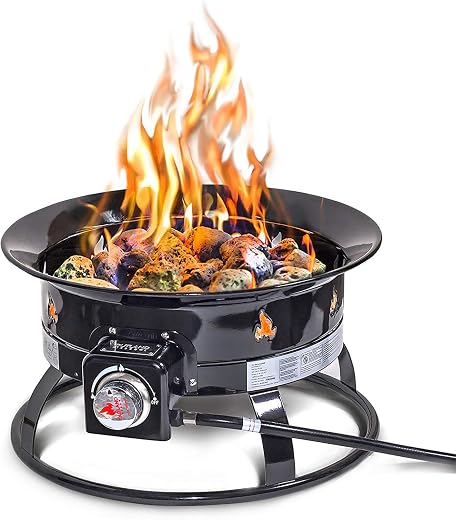
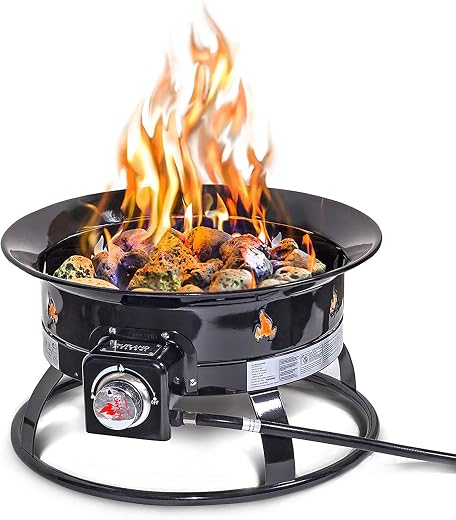
1. Outland Living Firebowl 893 Deluxe — Best Fire Pit for Smokeless Evening Heat
Price: $159.99 | Amazon rating: 4.8 from 17,777 ratings | Role: heat source and focal point | Key spec: 19 in bowl, 58,000 BTU, 23 lb, 10 ft pre-attached hose and regulator
A wood fire is the traditional answer to a garden that gets cold at nine o’clock, and it is the wrong one for most modern gardens. It smokes, it throws embers, it needs tending, it cannot be turned off when guests leave, and in a great many British neighbourhoods it will produce a complaint before it produces any warmth. The Outland Firebowl sidesteps all of that by burning propane through a bed of 4.4 lb of natural lava rock: real visible flame, 58,000 BTU of output, no smoke, no sparks and no ash to shovel out the next morning.
The practical detail that matters is the 10-foot pre-attached hose and regulator, which lets the propane cylinder sit well away from the seating circle rather than under the bowl. A stabiliser ring holds a standard 20 lb tank steady on grass. The whole unit weighs 23 lb and comes with a cover and carry kit, so unlike most backyard party essentials of this size it genuinely moves — patio one weekend, campsite the next, and away in the garage over winter without a tarpaulin. At 19 inches across it is small enough not to dominate a modest patio, which is the failure mode of most steel wood-burning bowls.
The trade-off is heat character. Gas flame radiates less than a wood fire of equivalent nominal output, so it warms the ring of people directly around it rather than the whole terrace, and on a windy night you will feel that. It is also not a cooking appliance — the lava rock bed is not designed to take a grill, and it is not a barbecue substitute. What it is, reliably, is instant heat that turns off with a knob. Among all the backyard party essentials on this list, it is the one that most changes how late people stay.
Best for: hosts who want fire on demand with no smoke, no embers and no clear-up — and anyone living somewhere that discourages or restricts garden burning.
Skip if: you want to cook over the flame, you specifically want the smell of woodsmoke, or you have nowhere sensible to store and refill a 20 lb propane cylinder. UK buyers should also note the regulator is a US fitting and will not connect to a Calor-type patio gas cylinder without the correct 37 mbar propane regulator and hose.
Read the full Outland Living Firebowl review →
Where to Buy — Outland Living Firebowl 893 Deluxe
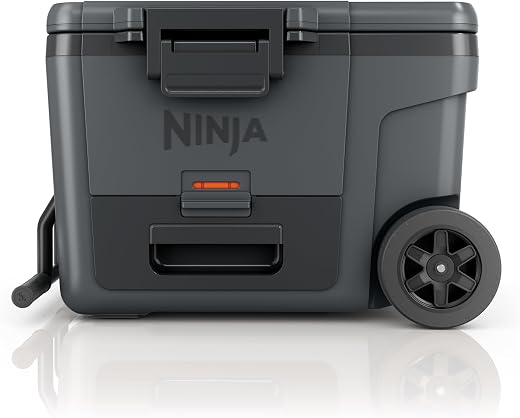
2. Ninja FrostVault 45 qt Cooler — Best Cooler for an All-Day Party
Price: $299.95 | Amazon rating: 4.5 from 693 ratings | Role: the cold chain | Key spec: 47.6 qt, 68 cans, sealed dry drawer, all-terrain wheels, 5-year warranty
Most coolers fail at the same point, and it is not insulation. It is that everything inside ends up swimming. Four hours in, the ice has become water, the cheese is floating, the burger buns are soggy at one corner and the limes have gone cloudy. The FrostVault’s answer is a sealed dry drawer that sits underneath the main ice chamber and stays at fridge temperature without ever touching meltwater. It measures 14.6 × 13.29 × 5.47 inches — enough for a pack of burgers, a block of cheese, butter and the salad that would otherwise be ruined.
The main chamber is a genuine 47.6 quarts, rated at 68 cans, which comfortably covers a party of a dozen people from lunch until dark with room for ice. It rides on all-terrain wheels with a tow handle, which matters more than it sounds: at 30.2 lb empty and a good deal more loaded, a 45-quart hard cooler is not something you carry across a lawn twice. SharkNinja backs it with a five-year limited warranty, which is unusual at this price and suggests some confidence in the hinges and latches — historically the first things to fail on a wheeled cooler.
It is expensive, and honestly it is more cooler than a purely poolside afternoon needs. The case for it is range: this is one of the few backyard party essentials that does the backyard on Saturday, the beach on Sunday and a camping weekend in September, and the dry drawer earns its keep every single time. If you are assembling backyard party essentials that also have to work away from home, this is the piece that travels best. Rinse it with warm soapy water and air-dry it before storage; the foam will hold odours if you close a damp lid on it.
Best for: long gatherings where food as well as drink has to stay cold, and for anyone who wants one cooler to cover parties, beach days and camping.
Skip if: you only ever need drinks cold for an afternoon — the Veradek table below does that for a third of the price and looks better doing it — or if 30 lb of empty cooler is more than you want to lift into a car.
Read the full Ninja FrostVault 45 qt review →
Where to Buy — Ninja FrostVault 45 qt Cooler
3. Veradek Outdoor Cooler Side Table — Best Drinks Station That Looks Like Furniture
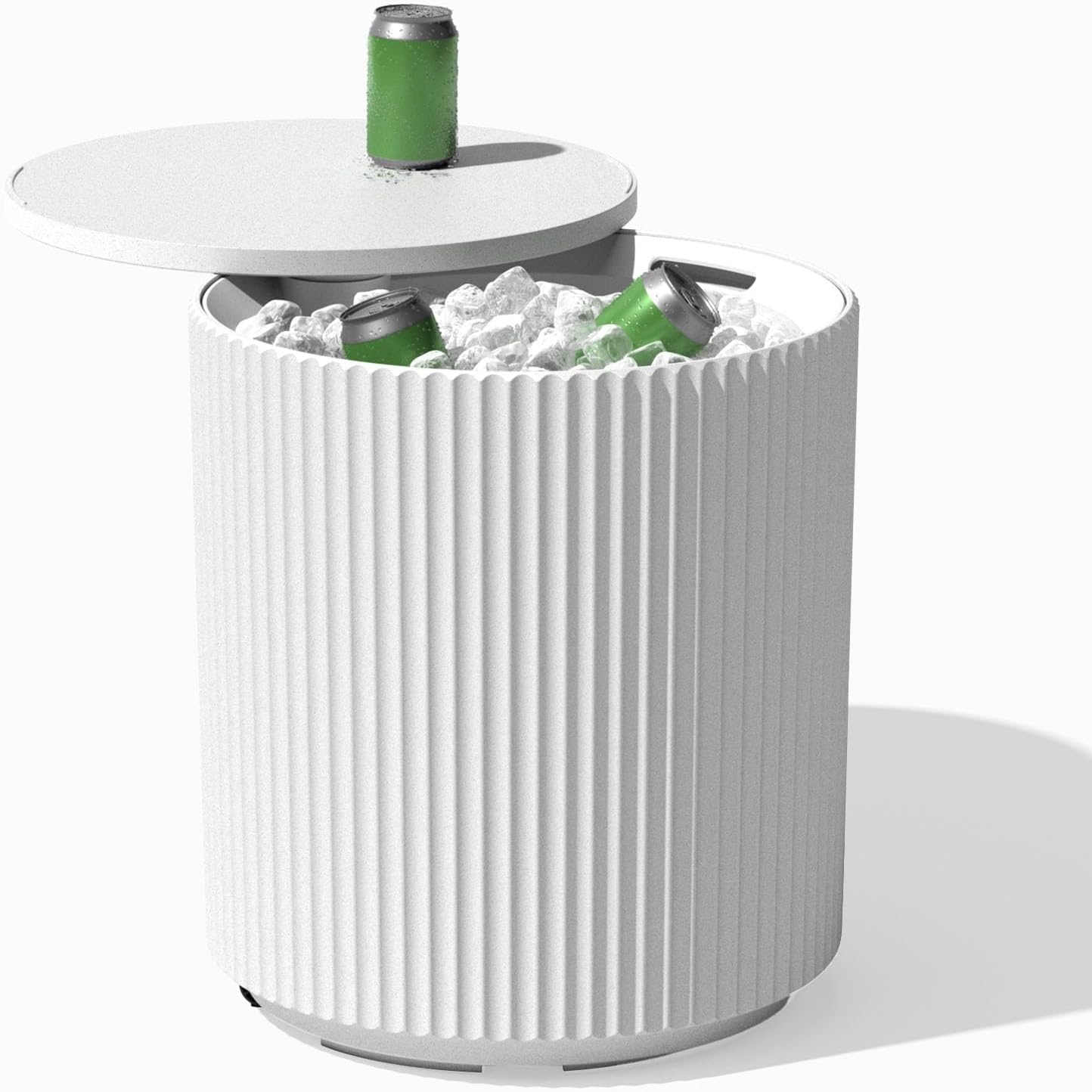
Price: $119.99 | Role: permanent drinks station | Key spec: 40 L (10.5 gal) cavity, 48–55 cans, up to 12 hours cold, 1.75 in umbrella hole
The reason a cooler ruins a patio is that it is a box on the floor that people have to bend over, and it never gets put away because putting it away means carrying it. The Veradek solves the problem by refusing to look like a cooler at all. It is a stone-plastic composite side table with a fluted, carved-stone finish, made in Canada, and the top swivels on a patented mechanism to reveal a 40-litre insulated cavity underneath. Closed, it is an end table you would happily leave out all summer. Open, it holds 48 to 55 twelve-ounce cans on ice.
Double-walled insulation keeps that load cold for up to twelve hours in normal conditions — the honest length of a party rather than the length of a camping trip, and as much as any of these backyard party essentials will manage without mains power. The composite is impact- and scratch-resistant with an anti-dulling treatment so the finish does not chalk out after a season in the sun, and it comes in black, white and sand. There is a 1.75-inch hole in the top for a standard umbrella pole, which quietly makes it the most useful surface on the patio: drinks below, shade above, somewhere to put a plate.
Set expectations correctly and it is close to perfect. It is not a multi-day ice chest, and in direct sun above 95°F (35°C) you will lose ice noticeably faster than the twelve-hour figure. Put it in partial shade or under the umbrella it is designed to carry and that problem largely disappears. Of all the backyard party essentials here it is the one guests comment on, and the one that most reduces the number of trips to the kitchen — which is the real measure of whether a host gets to enjoy their own party.
Best for: patios and decks where the kit has to look intentional, and hosts who want drinks within arm’s reach of the seating rather than in a box by the back door.
Skip if: you need multi-day ice retention, you host mainly in full sun above 95°F, or you want something you can carry to the beach — this is furniture, and it is meant to stay put.
Read the full Veradek Cooler Side Table review →
Where to Buy — Veradek Outdoor Cooler Side Table
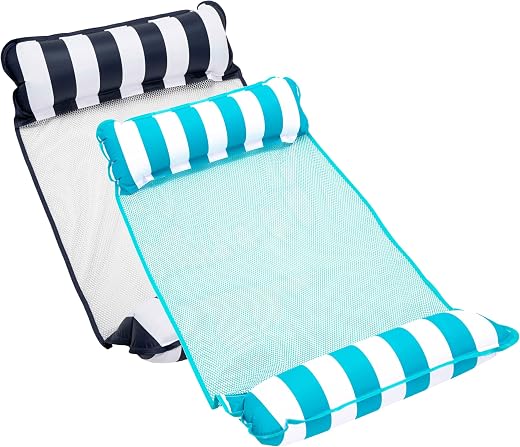
4. Aqua 4-in-1 Monterey Hammock Pool Float — Best Float for Adults
Price: $22.49 (2-pack) | Amazon rating: 4.5 from 69,679 ratings | Role: water lounging | Key spec: 47 × 26 in, 250 lb capacity, vinyl and mesh, four configurations
Nearly 70,000 ratings is an unusual amount of evidence for a pool float, and it is worth understanding what people are actually buying. The Monterey is a water hammock rather than a lilo: inflated tubes at each end with a mesh sling between them, so you sit or lie partly in the water rather than baking on top of it. That single design decision is why adults keep it, and why it is one of the few water-based backyard party essentials that does not end up punctured behind the shed. It converts between four positions — hammock, lounger, drifter and upright chair — by moving your own weight, not by reconfiguring anything.
It takes 250 lb, measures 47 × 26 inches in use, weighs almost nothing, and packs down to something you can keep in a drawer, which matters in a garden with no storage. The two-pack pricing is the other reason it appears here: hosting means having more than one, and a pair at this price is less than a single rigid lounger. The mesh section also keeps you cooler than a solid float in genuinely hot weather, because water circulates against your back instead of sitting between you and a sheet of warm vinyl.
Two honest caveats. It needs lung power or a pump — there is nothing self-inflating here — and the vinyl tubes are soft-touch rather than heavy-gauge, so it wants a swept pool floor and no dogs. Far more importantly, this is a buoyancy aid and a leisure product, not a life-saving device. It does not keep a non-swimmer safe and it is not a substitute for supervision. That is not a criticism of this float in particular; it is true of every inflatable, and it is the single most important thing to understand about adding water to a party.
Best for: adults who want to float rather than swim, and hosts who need two or three floats without spending three figures.
Skip if: you want something rigid you can leave inflated all season, you have no pump, or you were hoping for a flotation device that adds safety — it does not.
Read the full Aqua Monterey Hammock Float review →
Where to Buy — Aqua 4-in-1 Monterey Hammock Pool Float
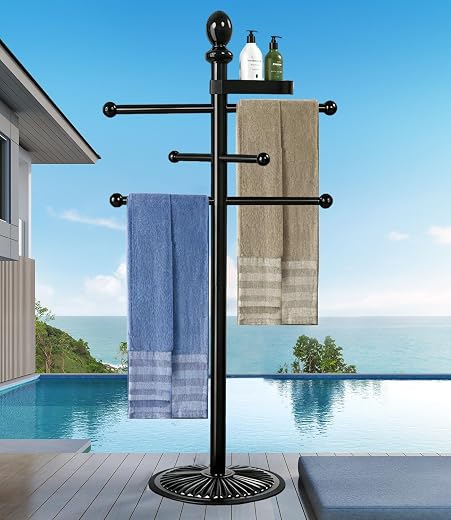
5. Yozoluck 6-Bar Pool Towel Rack — Best Fix for Wet Towels
Price: $59.97 | Amazon rating: 4.4 from 394 ratings | Role: wet-kit logistics | Key spec: 6 bars, 25 × 25 × 51.2 in, powder-coated metal, weighted base
This is the least glamorous entry on the list and the one that changes the look of a garden most. Without somewhere to put them, wet towels go on the backs of chairs, over the railing, on the grass, and eventually into the house across a kitchen floor. Six bars on a 51-inch freestanding frame absorbs the towels of a whole gathering, keeps them off furniture, and — because they hang in open air rather than in a heap — means they are dry enough to use again in an hour instead of going musty overnight.
The construction is the most durable of any of these backyard party essentials: powder-coated metal on a heavy round base with a 25-inch footprint, which is what stops it doing the thing cheap towel stands do: tipping forwards the moment two wet towels hang on the same side. It needs no fixing to the ground and no assembly to speak of, so it moves between the pool, the hot tub and the back door as the season changes. Powder coating is the right finish for something that lives in chlorine spray and rain; bare or painted steel rusts at the welds within a season.
It is a single-purpose object at a price that makes some people hesitate, and it is fair to say $59.97 buys a lot of hooks. The counter-argument is that hooks need a wall in the right place and this does not, and that six towels is a party’s worth rather than a family’s worth. Consider the winter question before you buy: it is 51 inches tall and does not fold, so it needs somewhere to go between October and April, or it needs to be a thing you accept living outside. Among these backyard party essentials it is the one most often bought second, after a summer of towels on the patio furniture.
Best for: any garden with a pool, hot tub or paddling pool where towels currently end up on chairs, railings and the lawn.
Skip if: you have a fence or wall where hooks would work just as well, or you have no winter storage for a 51-inch frame that does not fold flat.
Read the full Yozoluck Pool Towel Rack review →
Where to Buy — Yozoluck 6-Bar Pool Towel Rack
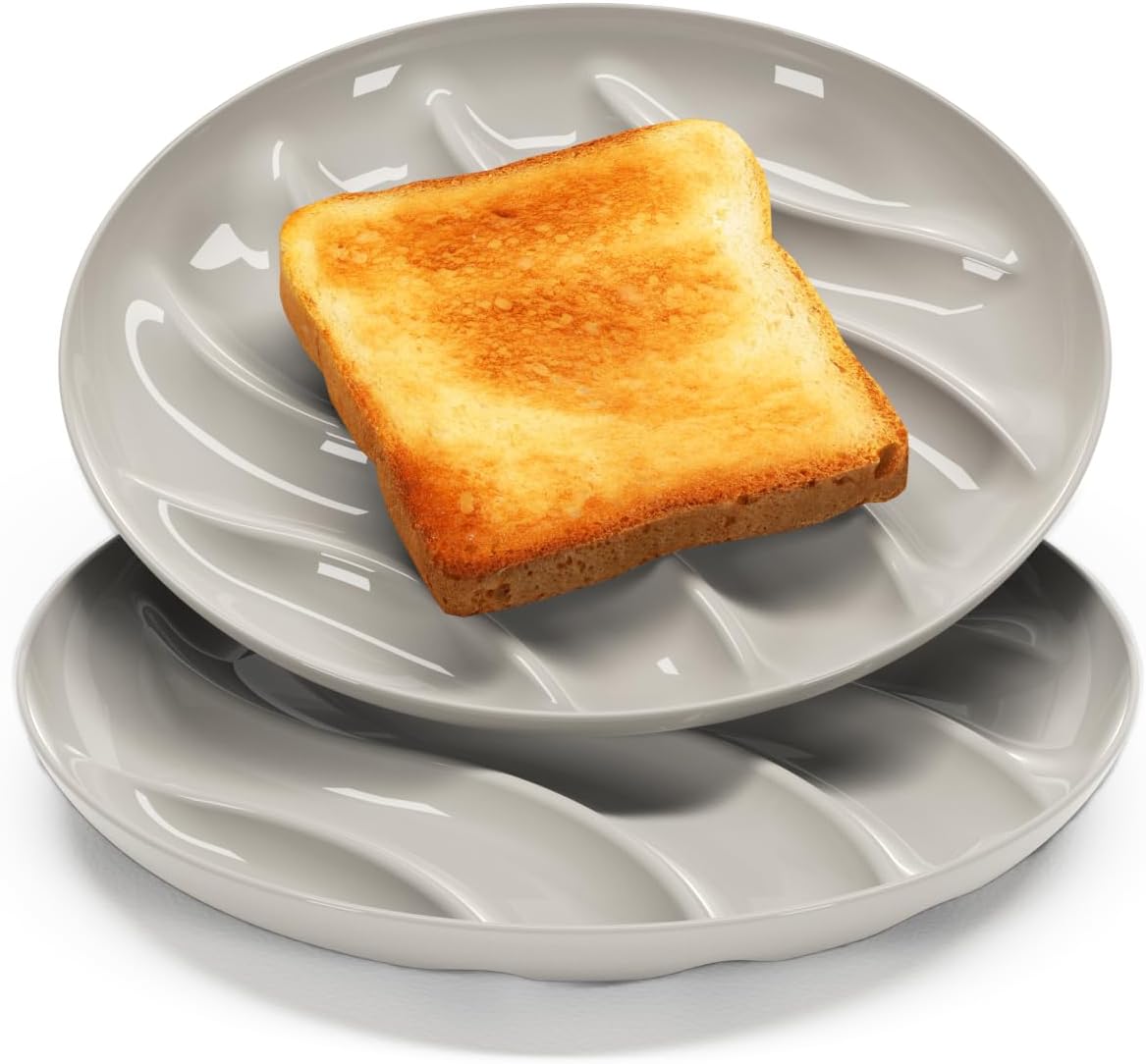
6. EVER TOAST Unbreakable Plates — Best Serving Plate for Poolside and Deck
Price: $14.99 (set of 2) | Role: serving without breakage | Key spec: 8.5 in, 100% recycled plastic, dishwasher and microwave safe, ridged surface
Two separate problems get solved by one of the cheapest backyard party essentials on the list. The first is breakage: ceramic near a pool, a stone patio or a deck full of bare feet is a genuinely bad idea, which is why public pool codes across the United States prohibit glass on the deck entirely, and it is the reason paper plates persist despite being terrible. These are 8.5-inch plates moulded from 100% recycled plastic — unbreakable in normal household use, dishwasher safe, microwave safe, and reusable for years rather than for one afternoon.
The second problem is the one they were actually designed for. The surface is a series of smooth wave-like ridges that hold food a few millimetres clear of the plate, so steam escapes downwards instead of condensing under whatever you have just cooked. On a flat plate a burger bun, a slice of pizza or a piece of toast goes soft at the base within two minutes. On these it does not. That sounds like a gimmick until you have served twelve people from a grill and watched the last four get a soggy bun because they were at the back of the queue.
The obvious limitation is quantity. A set of two is a household purchase, not a party purchase, so hosting means buying three or four sets — at $14.99 that is still less than a decent melamine service, but budget for it rather than being surprised. They are also unapologetically casual: moulded ridged plastic is not what you put a plated dinner on. For a barbecue, a poolside lunch or anything eaten standing up, they are the sensible choice, and of all the backyard party essentials on this list they are the cheapest way to remove an actual injury risk from a garden.
Best for: poolside, deck and barbecue serving where ceramic is a hazard, and for anyone tired of grilled food going soft on the plate.
Skip if: you need a full dinner service in one purchase, or you want something that reads as formal — these are ridged, casual and unashamedly plastic.
Read the full EVER TOAST plates review →
Where to Buy — EVER TOAST Unbreakable Plates
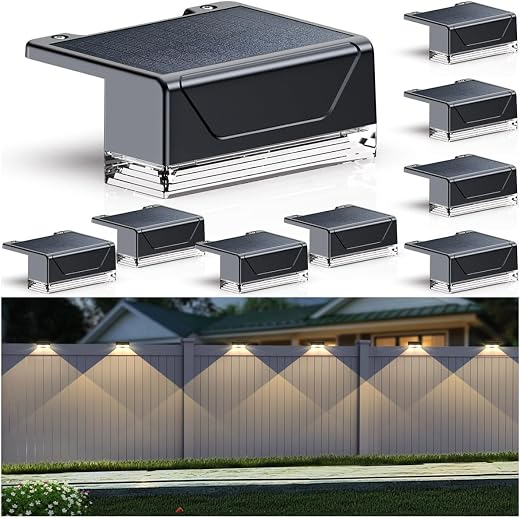
7. LIANGLOME Solar Fence Lights (8-Pack) — Best Cheap Lighting for Steps and Edges
Price: $27.05 (was $39.99) | Amazon rating: 4.5 from 667 ratings | Role: edge and step lighting | Key spec: 8-pack, 50 lm each, IP65, 3000/4000/6000 K selectable, dusk-to-dawn
Lighting is the cheapest of these backyard party essentials and the one that prevents the most accidents. The specific danger in a dark garden is not the middle of the lawn; it is the edges — the step down from the decking, the change of level at the patio, the corner of a raised bed. Eight lights at roughly $3.40 each will mark every one of those, and because they are solar and mount with either 3M adhesive pads or screws, doing it takes an afternoon and no electrician.
Each of these solar backyard party essentials puts out 50 lumens and offers three colour temperatures — 3000 K warm white, 4000 K neutral and 6000 K cool white — selected by touch. For a garden you want 3000 K almost always: warm light reads as ambient and flattering, while 6000 K reads as a security floodlight and will make your patio look like a loading bay. They are rated IP65, meaning protected against dust and low-pressure water jets from any direction, which is the right rating for something bolted to a fence in British rain, and they switch on and off automatically at dusk and dawn.
Be clear about what 50 lumens is. It is orientation lighting — enough to show you where an edge is, not enough to read by or to light a table. Anyone expecting these to illuminate a garden will be disappointed, and the honest answer is that no solar fence light in this price class does that. The other caveat is latitude. Solar step lights are charged by whatever daylight the panel received, and the further north you live the less that is in winter; British buyers should expect strong summer performance and noticeably shorter winter run-times than the marketing implies.
Best for: marking steps, level changes and path edges cheaply and without wiring, in warm 3000 K light that suits a garden.
Skip if: you need real illumination for a table or seating area, or your fence panels sit in shade for most of the day — a solar light that never charges is worse than no light at all.
Read the full LIANGLOME Solar Fence Lights review →
Where to Buy — LIANGLOME Solar Fence Lights (8-Pack)
Backyard Party Essentials — Buyer’s Guide: What to Look For
Very little of what follows about choosing backyard party essentials is about brands. Outdoor kit fails in predictable ways, and knowing the failure modes is worth more than knowing which model won a round-up. These are the five questions worth answering before you spend anything.
Backyard Party Essentials: Buy Heat, Cold and Light First
If your budget only stretches to three items, buy a heat source, a cold source and some lighting, in that order of impact on how long people stay. Everything else — seating, speakers, decoration, games — improves a party that is already working. Heat, cold and light are what stop it working. A garden with warm drinks, no light on the steps and a chill at nine o’clock empties by half past, no matter how good the food was. This is the single most useful principle in choosing backyard party essentials, and it is the one most shopping lists get backwards by starting with furniture.
Cooler Capacity, Ice Retention and the Wet-Versus-Dry Problem
Cooler marketing — and most backyard party essentials marketing — sells two numbers — capacity in quarts or litres and can count — and neither tells you what you need to know. Can counts assume the cooler is packed with cans and nothing else; add ice and the real figure drops by roughly a third. Ice retention claims assume a cooler filled to capacity, pre-chilled, opened rarely and kept in shade, which describes no actual party.
The number that matters more is whether there is any dry storage. Meltwater is what ruins food, not warmth, and a cooler that separates wet from dry (like the FrostVault) or one that only ever holds cans (like the Veradek) both solve it — a single undivided box does not. Pre-chill the cooler overnight, use block ice rather than cubes where you can, and keep drinks in a separate container from food so the lid that gets opened forty times is not the one protecting your chicken.
Powering Backyard Party Essentials: Propane, Solar and Mains
Three power sources appear across these backyard party essentials and each has a catch. Propane gives instant, controllable heat and no smoke, but you must store and refill a cylinder, and the fittings are not internationally interchangeable — a US regulator will not connect to a British patio-gas bottle. Solar is free and needs no wiring, but the light you get tonight is a function of the daylight the panel saw today, which makes it seasonal and latitude-dependent.
Mains power is the most capable and the most regulated: anything plugged in outdoors needs residual-current or ground-fault protection, and the rules for that differ by country. Choose the source that matches how often you will actually use the thing — solar for permanent fixtures, gas for occasional high output, mains only where you already have a protected outdoor socket.
Water, fire and glass: design the risks out
Three hazards account for most garden-party accidents, and the right backyard party essentials design all three out at the point of purchase rather than relying on vigilance. Water: inflatables are leisure products, not flotation devices, and a pool at a party needs a designated adult watching it who is not also cooking. Fire: a gas firebowl has no embers and turns off instantly, which is a meaningfully different risk profile from a wood fire in a garden with children and a fence.
Glass: ceramic and glass near a pool or a stone patio create the one injury that ends the evening and cannot be cleaned up properly if it lands in water — unbreakable plates and cans over bottles remove the risk entirely for a few dollars. Designing hazards out is more reliable than watching for them, because at your own party you will be distracted.
Storing Backyard Party Essentials Through the Off-Season
The question nobody asks in August is where all these backyard party essentials live in January. A 51-inch towel rack that does not fold, a 23-lb firebowl and a 30-lb cooler add up to real garage space, and kit left out uncovered ages fast: UV degrades vinyl and plastic, freeze-thaw cracks anything holding water, and rust starts at welds and screw heads. Look for powder coating rather than paint, covers included rather than sold separately, and things that pack flat. It is also worth checking warranty length as a proxy for expected life — five years on a cooler tells you more about the hinges than any review can.
US vs UK: What Changes When You Host Outdoors
Search results for backyard party essentials are overwhelmingly American, which leaves British readers with advice that is subtly wrong in half a dozen ways. The differences are not decorative — they cover the words you need to search with, the gas fitting on your fire pit, the socket you plug things into, how long food can sit out, and in 2026, whether you are legally allowed to fill a paddling pool with a hose. This section is the part of any guide to backyard party essentials that a UK reader most needs and least often gets.
The Vocabulary Gap That Hides Backyard Party Essentials from UK Shoppers
Americans host in the backyard; Britons host in the garden — and “backyard” in British English suggests a small paved area behind a terraced house, usually with no grass at all. That single word difference is why an American article on backyard party essentials is nearly invisible to a British searcher, who is typing “garden party essentials” instead.
The rest of the list matters at the point of purchase: a US cooler is a UK cool box; a grill is a barbecue (in Britain, to grill means to cook under an overhead element, which Americans call broiling); propane tank is gas bottle or patio gas; trash can is bin; flashlight is torch; faucet is tap; deck is decking; a popsicle is an ice lolly; and a cookout is just a barbecue. Search Amazon.co.uk for “cooler” and you will mostly be shown computer fans.
Space, pools and the scale of a typical party
The physical setting is different enough to change what you should buy. American residential lots are generally larger, backyard pools are common, and permanent outdoor kitchens and fire features are a mainstream category. The typical British garden is smaller, often narrow, frequently overlooked by neighbours on three sides, and a private swimming pool is genuinely rare.
The practical consequences for choosing backyard party essentials: compact and portable beats large and permanent in the UK; a 19-inch firebowl is proportionate to a British patio where a six-foot fire table is not; smoke and noise travel to neighbours a few metres away; and the water-related items on this list serve paddling pools, hot tubs and beach trips rather than a permanent pool. Storage is tighter too, which pushes British buyers hard towards things that fold, stack or pack flat.
Gas fittings and voltage: the two things you cannot adapt around
A US propane appliance ships with a regulator and hose sized for American cylinders and pressures. British patio gas runs at a nominal 37 mbar for propane through a clip-on or screw-fit connector, and butane at a lower pressure again — the appliance may be identical but the gas train is not, and this is not a job for an adapter bought on price. If you buy a US-market firebowl for use in Britain, budget for a correctly rated UK propane regulator and hose.
Electricity is the same story: the US runs 120 V at 60 Hz on Type A/B plugs, the UK runs 230 V at 50 Hz on fused Type G. Anything that charges from USB or carries a 100–240 V, 50/60 Hz label needs nothing more than a plug adapter; anything with a 120 V motor or heater should not cross the Atlantic at all. Solar products, being self-contained, are the one category of backyard party essentials that travels without a caveat.
Food safety: a two-hour clock versus a four-hour clock
This is the difference most likely to catch out a host who has read the wrong country’s advice. In the United States, the FDA’s guidance for eating outdoors is that perishable food should not sit at room temperature for more than two hours, dropping to one hour when the temperature is above 90°F (32°C), with cold food held at 40°F (4°C) or below.
In the United Kingdom, the Food Standards Agency frames it differently: keep chilled food out of the fridge for the shortest time possible, “a maximum of four hours”, with the fridge itself set between 0 and 5°C, cooked food cooled and refrigerated within one to two hours, and leftovers eaten within 48 hours or frozen. Neither is wrong; they are different regulatory framings of the same microbiology. If you are hosting, plan to the stricter number — two hours, one in real heat — and use the cooler as a fridge rather than as a drinks bin.
Fire, smoke and the British neighbour problem
Fire is where backyard party essentials meet the law most directly, and American fire pit rules are local: municipal burn bans, seasonal restrictions and homeowners’ association rules vary by county and by drought conditions. British rules are national and specific. Large parts of urban England, Scotland, Wales and Northern Ireland are designated smoke control areas, where you cannot emit smoke from a chimney and can only burn authorised or smokeless fuels in a non-exempt appliance; the penalty in England is up to £300 for chimney smoke and up to £1,000 for buying unauthorised fuel for use in a non-exempt appliance.
Usefully for hosts, GOV.UK is explicit that barbecues, chimineas and pizza ovens are permitted in smoke control areas, and that garden bonfires fall under separate nuisance rules rather than the smoke control regime. A propane firebowl sidesteps the whole question, since it produces no smoke at all — which is a much stronger argument for gas in a British garden than in an American one.
Water restrictions: a live issue in Britain in 2026
British readers planning to use any of the water-based backyard party essentials on this list should check their supplier first. Under Section 76 of the Water Industry Act 1991, as amended by the Flood and Water Management Act 2010 and defined by the Water Use (Temporary Bans) Order 2010, water companies can impose a Temporary Use Ban — a hosepipe ban.
Where one is in force it prohibits filling or maintaining a domestic swimming pool, paddling pool, hot tub or plunge pool with a hosepipe, along with watering gardens, cleaning patios and washing cars. Buckets and watering cans remain legal, as does rainwater from a water butt, and non-compliance can be prosecuted with a fine of up to £1,000 in a Magistrates’ Court. Several English suppliers had bans running through the summer of 2026. There is no equivalent national framework in the US; restrictions there are set locally by water districts, generally during drought.
Sun, Daylight and Why Solar Backyard Party Essentials Behave Differently
Two related differences change how outdoor lighting and shade work. The UK sits between roughly 50°N and 59°N — north of every part of the contiguous United States — so midsummer evenings stay light until well after 9 pm and solar lights barely switch on, while midwinter days are short enough that the same lights struggle to charge at all. The World Bank’s global photovoltaic assessment puts the spread between the best and worst-placed countries at slightly less than a factor of two, with Ireland at the bottom of the range and 93% of the world’s population living where average daily potential falls between 3.0 and 5.0 kWh/kWp; British gardens sit near the low end of that spread.
Sun intensity differs too: the Met Office notes that UK sunshine is strong enough to burn from around April to September, with a typical summer peak UV index of 7–8, whereas the EPA’s UV Index scale runs to 11+ (“extreme”), routinely reached across the southern United States. Shade is a bigger purchase in Phoenix than in Preston; light output matters more in Preston than in Phoenix.
Backyard Party Essentials — Which One Should You Buy?
Three budgets and three sensible sets of backyard party essentials. The tiers below assume you are starting from nothing; if you already own a decent cool box, skip forward a tier and spend the money on heat and light instead.
Under $75 — the Backyard Party Essentials That Fix the Most
Spend it on lighting and serving. The LIANGLOME solar fence lights at $27.05 mark every step and level change in the garden, and two sets of EVER TOAST unbreakable plates at $14.99 each remove breakable crockery from a stone patio. That is roughly $57 for the two changes guests notice most and the two that most reduce the chance of somebody getting hurt. Add a couple of Aqua Monterey hammock floats at $22.49 for the pair if there is any water involved and you are still under $80. Cheap backyard party essentials genuinely outperform expensive ones at this budget, because the cheap items address hazards and the expensive ones address comfort.
$75–$250 — the tier where a party changes character
This is the tier where backyard party essentials buy you an evening rather than an afternoon. The Outland Living Firebowl 893 Deluxe at $159.99 is the single highest-impact purchase on this list: it is the difference between guests leaving at nine and guests staying until eleven, and it does it without smoke, embers or a neighbour dispute. If your gatherings are daytime and drinks-led rather than evening and fire-led, spend the money instead on the Veradek Outdoor Cooler Side Table at $119.99, which puts 48 to 55 cold cans within arm’s reach of the seating and looks like furniture the rest of the week. Either one, plus the sub-$75 tier above, is a complete kit for most gardens.
$250 and up — the do-everything additions
At this level the backyard party essentials you are buying extend beyond the garden. The Ninja FrostVault 45 qt cooler at $299.95 is the piece that turns a party kit into a travel kit: 47.6 quarts, 68 cans, a sealed fridge-temperature dry drawer that keeps food out of meltwater, all-terrain wheels and a five-year warranty.
Pair it with the Yozoluck 6-bar towel rack at $59.97 if you have a pool or hot tub, and the household has both ends of the problem covered — cold food in and wet towels out. The complete set of seven backyard party essentials comes to roughly $705 at current prices, which is less than most patio dining sets and will change your summer considerably more.
Food, Fire, Water and Electricity: The Rules Worth Knowing
Most guides to backyard party essentials stop at the shopping. The part that actually determines whether an outdoor gathering goes well is a handful of numbers published by regulators on both sides of the Atlantic, and they are neither difficult nor widely known. What follows is sourced from the FDA, the Food Standards Agency, the CPSC, GOV.UK and the IET, with links at the end.
The food clock, and the cooler that keeps it honest
No list of backyard party essentials is much use without the food clock that governs them, and the FDA’s outdoor-eating guidance is unambiguous: perishable food left at room temperature for more than two hours should be discarded, and above 90°F (32°C) that window closes to one hour. Cold food should be held at 40°F (4°C) or below. The Food Standards Agency’s UK framing allows chilled food out of the fridge for a maximum of four hours during preparation, with the fridge itself at 0–5°C and cooked food chilled within one to two hours.
In practice both point at the same discipline. Keep drinks and food in separate containers, because the drinks lid gets opened constantly and every opening costs cold. Pack the cooler full — air is the enemy — and pre-chill it. Do not let food sit in meltwater: this is exactly the problem the FrostVault’s sealed dry drawer exists to solve, and the reason a cooler with a divided interior outperforms a bigger undivided one at a party. And use a thermometer rather than colour to judge whether meat is cooked; the FDA is explicit that colour and texture are unreliable indicators.
Water: the numbers that justify a designated watcher
The US Consumer Product Safety Commission’s most recent report on childhood drowning found an average of 376 fatal drownings a year among children under 15 in pools and spas across 2021–2023, with nearly 80% of victims under the age of five. The 2023 figure was 379, a six percent rise on the previous year’s 359. Over 70% of fatal drownings occurred in residential settings — the child’s own home, or a relative’s, friend’s or neighbour’s. Separately, an average of 5,900 non-fatal pool or spa drowning injuries were treated in emergency departments each year between 2023 and 2025.
The CPSC’s recommendations are layered rather than singular: never leave a child unattended near water, designate an adult Water Watcher, fit self-closing and self-latching gates, use door alarms and pool covers, remove or secure ladder access when the pool is not in use, and learn CPR. A party is precisely the situation where supervision quietly evaporates because everyone assumes somebody else is watching — which is why the recommendation is a named person, and why an inflatable hammock is a leisure product rather than a safety one.
Fire: siting, smoke and what the law actually says
Site any fire-based backyard party essentials on a level, non-combustible surface, well clear of fences, overhanging branches, awnings and anything with a fabric canopy, and keep the propane cylinder outside the seating circle — the 10-foot hose on the Outland exists for that reason. Never move a lit firebowl, never use one indoors, in a garage, in a tent or under a closed gazebo, and let it cool fully before covering it.
On the legal side, GOV.UK’s smoke control area rules confirm that barbecues, chimineas and pizza ovens are allowed in smoke control areas, while burning unauthorised fuel in a non-exempt appliance can attract a fine of up to £1,000, and emitting smoke from a chimney in a smoke control area up to £300 in England. Garden bonfires are covered by separate nuisance provisions rather than the smoke control regime — there is no blanket ban, but persistent smoke that affects neighbours can be actionable. A gas firebowl produces no smoke and therefore raises none of these questions, which is a real and underrated advantage in a dense neighbourhood.
Electricity Outdoors: GFCI in the US, 30 mA RCD in the UK
Anything mains-powered in a garden — string lights, a pump, a speaker, an extension lead — needs earth-fault protection, and both countries require it in slightly different language. In the US, NEC Section 210.8 requires GFCI protection for outdoor receptacles at dwellings, and the 2023 edition widened the scope from the old 15- and 20-ampere rule to 125-volt through 250-volt receptacles on single-phase branch circuits rated 150 volts or less to ground, with outdoor outlets addressed under 210.8(F) for circuits up to 50 amperes.
In the UK, BS 7671 Regulation 411.3.3 requires additional protection by a 30 mA RCD for socket-outlets rated up to 32 A that ordinary persons may use, and — the clause that matters here — specifically for mobile equipment rated at 32 A or less used outdoors. The practical translation is the same on both sides: never run an ordinary indoor extension lead out of a window to power something on wet grass. Use an outdoor-rated lead on a protected circuit, or use an RCD or GFCI adapter at the socket. This is the strongest argument for solar and battery items among backyard party essentials — no cable, no exposure, no question.
Cleaning and Storing Backyard Party Essentials
Two habits extend the life of every one of these backyard party essentials. First, rinse and dry before storing: coolers hold odours if a damp lid is closed on them, metal rusts at welds and screws, and vinyl mildews in a folded heap. Second, store out of UV.
Sunlight is what degrades plastic and vinyl fastest, so a cover or a shed does more for the lifespan of a firebowl, a float and a set of solar lights than any amount of careful use. Solar lights specifically benefit from an occasional wipe of the panel — a dusty or pollen-covered panel loses a surprising amount of charge, and it is the most common reason a set that worked well in June looks tired by August.
Backyard Party Essentials — Frequently Asked Questions
What are the most important backyard party essentials to buy first?
Buy backyard party essentials in this order: heat, cold and light, ranked by their impact on how long guests stay. A fire source keeps people outside after sunset, a cooler keeps food safe and drinks worth drinking, and step lighting stops the one accident that ends an evening early. Seating, speakers and decoration all improve a party that is already working; those three make it work at all. If you have $60 rather than $600, buy solar step lights and unbreakable plates and you will have addressed the two most common failures.
Are gas fire pits better backyard party essentials than wood-burning ones?
For most gardens, yes. A propane firebowl lights instantly, produces no smoke or embers, turns off with a knob, and leaves no ash. A wood fire gives more radiant heat and the smell people associate with a fire, but it needs tending, throws sparks near fences and fabric, and creates smoke that travels to neighbours. In the UK the smoke question also has a legal dimension in smoke control areas. Wood wins on atmosphere in a large rural garden; gas wins on almost every other axis in a suburban one.
How long does a 20 lb propane cylinder last on a fire pit?
It depends entirely on the burner rating and the setting. A 58,000 BTU firebowl run flat out will consume a 20 lb cylinder in roughly seven to eight hours of continuous burn; at a more typical half-output setting for ambience rather than heat, you can expect closer to twelve to sixteen hours. Buy a second cylinder before you need it — running out mid-evening is the standard rite of passage, and swapping in the dark is unpleasant.
How much ice does a cooler actually need?
Ice is the running cost behind half the backyard party essentials on this list, and the usual guidance is a two-to-one ratio of ice to contents by volume, which is far more than most people use. Block ice lasts substantially longer than cubes because it presents less surface area, so a mix of both — blocks at the bottom, cubes filling the gaps — works best. Pre-chill the cooler overnight with a sacrificial bag of ice, keep it in shade, and fill it completely, because empty space warms fast every time the lid opens.
Can I use these backyard party essentials in the UK?
Most of these backyard party essentials work in the UK, with two exceptions to check. Anything solar or battery-powered works anywhere. Anything that plugs in must be rated 100–240 V, 50/60 Hz to be safe on British 230 V mains — a US 120 V motor or heater is not adaptable. And any US-market propane appliance needs a correctly rated UK regulator and hose, because British patio gas runs at a nominal 37 mbar through different connectors. Plates, floats, towel racks and coolers cross over without issue; search the model names on Amazon.co.uk, remembering that “cooler” is “cool box” there.
Is it legal to fill a paddling pool during a hosepipe ban?
Not with a hosepipe. Where a Temporary Use Ban is in force under Section 76 of the Water Industry Act 1991, filling or maintaining a domestic swimming pool, paddling pool, hot tub or plunge pool with a hosepipe is prohibited, along with garden watering, patio cleaning and car washing. Filling by bucket or watering can remains legal, as does using stored rainwater from a water butt. Non-compliance can be prosecuted with a fine of up to £1,000 in a Magistrates’ Court, so check your own supplier’s current position before planning anything water-based.
How long can food sit out at a barbecue?
Two hours is the working answer in the United States, dropping to one hour when it is above 90°F (32°C), with cold food held at 40°F or below. The UK’s Food Standards Agency allows a maximum of four hours out of the fridge during preparation, with the fridge at 0–5°C. Plan to the stricter figure. In practice that means bringing food out in batches rather than laying everything on a table at the start, and treating the cooler as a fridge you keep going back to rather than a box you empty once.
Are solar lights bright enough to light a garden?
No, and solar backyard party essentials are not meant to be. A typical solar fence light produces around 50 lumens, which is orientation lighting — enough to show where a step or an edge is, not enough to light a table or read by. For comparison, a modest indoor bulb is 800 lumens. Use solar lights to mark hazards and boundaries, and use a mains or rechargeable lantern for the area where people are actually eating. Choose 3000 K warm white for a garden; 6000 K cool white makes a patio look like a car park.
Do I need special plates and glasses near a pool?
Near a pool or on a stone patio, unbreakable serveware belongs among your backyard party essentials as a genuine safety measure rather than a nicety. Public pool codes across the United States prohibit glass on the deck for exactly this reason: broken glass in or beside water cannot be reliably cleaned up, and bare feet are the norm. Reusable moulded plastic plates and cans or plastic tumblers instead of bottles and glasses eliminate the risk for a few dollars, and unlike paper plates they last for years.
How do I store backyard party essentials over winter?
Store backyard party essentials clean, dry, and out of sunlight. Rinse coolers with warm soapy water, dry them fully and store with the lid ajar so the foam does not hold odours. Deflate and dry floats before folding, because vinyl mildews where it is creased. Cover or shed anything metal, since rust starts at welds and screw heads. Bring solar lights indoors if you can — cold reduces battery capacity, and a lithium cell stored flat through a frost may not recover. Anything left out should be covered, since UV is what ages plastic and vinyl fastest.
Backyard Party Essentials — Final Thoughts
The pattern across these seven products is that the cheap ones solve problems and the expensive ones buy comfort. Eight solar lights at $27 and a pair of unbreakable plates at $15 remove two real hazards from a garden and cost less than a round of drinks. The firebowl at $160 and the cooler at $300 do not remove any hazard at all — they simply make the party longer and easier to host. Both kinds of spending are legitimate, but if a list of backyard party essentials tells you to start with the $300 item, it is selling rather than advising. Start at the edges of the patio and the surface of the plate, then work up.
The second thing worth carrying away is that the rules genuinely differ depending on where you are standing. A British host in 2026 may not legally fill a paddling pool from a hose, is subject to national smoke control rules that most American hosts have no equivalent of, works to a four-hour food guideline rather than a two-hour one, and needs a different regulator on the same fire pit. An American host has bigger gardens, more pools, stronger sun and a drowning statistic worth taking seriously. Buy for the garden you actually have and the rules that actually apply to it, and the seven items above will cover almost everything a summer can throw at them.
Sources and Further Reading
- US Food and Drug Administration — Handling Food Safely While Eating Outdoors
- Food Standards Agency — How to chill, freeze and defrost food safely
- US Consumer Product Safety Commission — Report Highlights Persistent Risk of Childhood Drowning
- GOV.UK — Smoke control areas: the rules
- Cambridge Water — Temporary hosepipe ban: frequently asked questions
- Thames Water — Temporary use ban legal notice
- IET Wiring Matters — Socket-outlets and 30 mA RCD protection (BS 7671 Regulation 411.3.3)
- World Bank — Global Photovoltaic Power Potential by Country
- Met Office — UV levels in the UK
- US Environmental Protection Agency — A Guide to the UV Index (PDF)
Disclosure: this article contains affiliate links. If you buy through them we may earn a commission at no additional cost to you. Product links point to Amazon.com and carry the associate tag blueraystec0c-20; UK readers can search the same model names on Amazon.co.uk, where prices, plugs and gas fittings differ. Prices and ratings were accurate at the time of writing and change frequently. Nothing here is legal, electrical or safety advice — check current rules with your local authority, water supplier and a qualified electrician where relevant.