
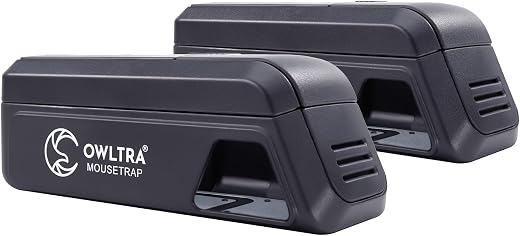
Electric Mouse Trap Review — OWLTRA OW-2 Two Pack
A two-pack of indoor electric mouse traps with dual infrared sensors, a 6,000 to 9,000 volt discharge, magnetic latches for no-touch emptying and automatic deactivation when the lid is removed. Around sixty catches per set of four AA batteries, poison-free and reusable; it is mouse-sized, indoor-only and it kills rather than releases.
$37.99
OWLTRA OW-2 Review (2026) — Is an Electric Mouse Trap Better Than Poison?
Nobody buys a mouse trap because they want one. They buy it at eleven at night, having heard something in a kitchen cupboard, and the decision they are really making is what they are willing to have in the house afterwards.
This electric mouse trap is the answer for people who do not want poison and do not want to look at a snap trap. Two chambers, dual infrared sensors, a 6,000 to 9,000 volt discharge and magnetic latches so the mouse is tipped into a bin without being seen or touched. The strength is that it is fast, poison-free and reusable. The compromise is that it is indoor only, mouse sized rather than rat sized, and it kills rather than relocates.
In short: the electric mouse trap earns 8.3/10 from the Blue Rays Technologies team. The rest of this electric mouse trap review sets out exactly how that score was reached.
What is in this electric mouse trap review
- Key Specifications
- Why an Electric Mouse Trap Instead of Bait
- The Dual Infrared Sensor Is the Safety Feature That Matters
- Placement, Bait and the No-Touch Disposal
- Limitations and Compromises
- Placement, Cleaning and Battery Routine
- Who Should Buy It?
- The Verdict
- Frequently Asked Questions
- Related Reviews
Key Specifications
Published specifications for the electric mouse trap, taken from the manufacturer listing.
| Reviewed model | electric mouse trap |
| Brand | OWLTRA |
| Model | OW-2 (EMZ30-2P) |
| Pack | 2 traps |
| Target species | Mice and smaller rodents |
| Voltage | 6,000 to 9,000 volts |
| Sensors | Dual infrared, one at the entrance and one at the back |
| Power | 4 x AA batteries, around 60 catches per set |
| Disposal | Magnetic latch lid, no-touch emptying |
| Safety | Deactivates automatically when the lid is removed |
| Dimensions | 8 in L x 3 in W x 3 in H |
| Material | Plastic |
| Use | Indoor only |
| Amazon rating | 4.4 from 4,939 ratings |
| Price at review | $37.99 for two |
Why an Electric Mouse Trap Instead of Bait
Rodenticide is effective and it has consequences that do not stop at the mouse. A poisoned rodent takes days to die, it dies somewhere you cannot reach, and anything that eats it afterwards — a cat, a dog, an owl — receives the dose second-hand. That is why bait products carry the restrictions they do.
An electric trap removes the whole chain. The discharge is immediate, the animal is inside a sealed chamber, and there is nothing left in the house that a child or a pet could find and eat. For a household with either, that is not a preference, it is the deciding factor.
It is also reusable in a way bait never is. Four AA batteries cover roughly sixty catches, which for a domestic infestation is several seasons rather than several nights.
The Dual Infrared Sensor Is the Safety Feature That Matters
A single-sensor trap fires when something breaks a beam. That includes a curious cat’s paw, a toddler’s finger and a dropped tea towel, which is why cheap electric traps have a bad reputation.
This one places sensors at the entrance and at the back of the chamber and only fires when both agree that a rodent is fully inside. The geometry does the rest: the chamber is eight inches long and three inches square, which is a corridor a mouse walks down and a cat cannot get into.
The lid adds a second layer. Pull it off and the trap deactivates automatically, so emptying and cleaning happen with the electronics dead rather than live. That is a design decision, not a warning label, and it is the reason this model is worth twice what the cheapest zappers cost.
Placement, Bait and the No-Touch Disposal
Placement decides everything. Mice run along walls and behind objects rather than across open floor, so a trap in the middle of a kitchen catches nothing while the same trap flush against a skirting board catches on the first night.
Bait sparingly and use something sticky rather than something a mouse can carry away. A smear of peanut butter at the back of the chamber works because the animal must go all the way in and stay long enough for both sensors to agree.
Disposal is the feature people underrate until they need it. The magnetic latches release the lid and the contents tip straight into a bin bag with nothing seen and nothing touched, which is the difference between a trap that gets emptied and reset and one that sits full behind the fridge.
Limitations and Compromises
No product is without cost, and the electric mouse trap has a clear set of them.
Indoor use only, and the manufacturer says so explicitly. Damp will destroy the electronics and an outdoor trap catches things you did not intend to catch.
It is sized for mice. The manufacturer directs anyone with rats to the larger OW-1, and using the wrong size is how you get a trap that injures rather than kills.
It kills. That is the point of it, and anyone looking for a humane live-catch and release trap should buy a different product entirely.
Four AA batteries and around sixty catches means checking the batteries at the start of every season rather than assuming.
Placement, Cleaning and Battery Routine
Getting the best out of the electric mouse trap comes down to a handful of habits.
Set traps flush against a wall with the entrance facing along the run, and give it three nights before moving it. Mice are wary of new objects and an unsprung trap on night one means nothing.
Empty promptly and wipe the chamber with warm soapy water once the lid is off and the unit is dead. A trap that smells of a previous catch is less attractive to the next mouse, not more.
Change all four batteries together at the start of an infestation rather than mid-way. A weak discharge is the one failure mode with a genuinely unpleasant outcome.
Who Should Buy It?
The electric mouse trap suits some households far better than others.
- You want rodent control without poison in the house
- You have children or pets and need a sealed chamber
- You want a reusable trap rather than a consumable
- You do not want to see or touch a dead mouse
- You have mice rather than rats
- You want two traps so you can cover two runs at once
Look elsewhere if any of the following describes you.
- You need to trap rats or larger rodents
- You want a live-catch and release trap
- You need outdoor or garage-in-winter placement
- You have a large infestation that needs professional treatment
- You want the cheapest possible one-off solution
The Verdict
This is the right design for a domestic problem. The dual sensors solve the safety objection that makes people distrust electric traps, the automatic deactivation on lid removal solves the second one, and the no-touch disposal solves the reason traps go unemptied.
It scores 8.3 because it is well thought out and clearly bounded: mice, indoors, killed rather than relocated. Four point four stars from nearly five thousand buyers is a strong consensus for a product category where failures are memorable. At twenty-eight dollars for two, with sixty catches per battery set, the running cost is close to nothing.
Review score for the electric mouse trap: 8.3/10. Strong on safety design, speed, no-touch disposal and reusability; the compromises are indoor-only use, mouse-only sizing, a kill rather than catch method and an AA battery routine. Blue Rays Technologies researches independently and earns a commission from qualifying purchases, which never affects the score.
If you want to see the current price, the pack sizes and the latest buyer feedback, it is listed as the OWLTRA OW-2 Indoor Electric Mouse Trap two pack on Amazon. If you are weighing this against bait, the restrictions are worth reading, and the US Environmental Protection Agency guidance on using rodent bait products safely.
Frequently Asked Questions
The questions buyers ask most often about the electric mouse trap, answered plainly.
Is an electric mouse trap safe around pets and children?
This one uses two infrared sensors and only fires when a rodent is fully inside the eight-inch chamber, and it deactivates as soon as the lid is removed. A paw or a finger cannot reach the plate.
How many mice will one set of batteries catch?
The manufacturer quotes around sixty catches from four AA batteries, which for a household infestation is several seasons of use.
Can it be used outdoors or in a garage?
No. It is explicitly indoor only. Damp will damage the electronics and an outdoor trap catches wildlife you did not intend to catch.
Will it work on rats?
No. This model is sized for mice and smaller rodents, and the manufacturer points rat problems at its larger OW-1 trap instead.
Related Reviews
If the electric mouse trap is not quite the right fit, these Blue Rays Technologies reviews cover the nearest alternatives.
- NewPos lead test kit review — the other thing worth checking in an old kitchen
- OUTUXED organizer box review — for keeping the batteries with the trap
- Devoko resin deck box review — from today’s batch
Last updated: 7 September 2026. Pricing and availability for the electric mouse trap change frequently; check the retailer listing for the current figure.



There are no reviews yet.