
A wet palette is three things in a stack: a watertight tray, a layer that holds water, and a semi-permeable sheet that lets moisture up to the paint without letting paint down into the pad. Every product here is that idea, and every one sells it on a promise — paint stays usable for days, even weeks. Not one publishes how long, at what temperature or at what humidity. Our top pick, the Redgrass Everlasting Painter Lite, wins because it alone names the component that decides the answer.
We compared five palettes between $9.99 and $33.84: the two wargaming brands most painters know, the fine-art reference that quietly undercuts both, the only tray combining wet and dry surfaces, and the cheapest credible budget option. Links go to Amazon.com — UK readers can search the same models on Amazon.co.uk, where availability and price differ.
Four things decided the ranking: how the lid seals, what the water-holding layer is and how many you get, what consumables cost over a year, and how much of it the maker will put in writing. The last separated the shelf most. This comparison is research-based. We did not physically test these products; specifications, ratings and prices come from the live listings on the date shown.
Wet Palette — Quick Comparison
| # | Product | Role | Key spec | Price | Score |
|---|---|---|---|---|---|
| 1 | Redgrass Painter Lite | Best Overall | Moulded TPE seal, 50 sheets, 2 foams | $29.99 | 8.8 |
| 2 | The Army Painter Wet Palette | Best for Storing Brushes Too | Stores up to 16 brushes in the tray | $33.84 | 8.6 |
| 3 | Masterson Sta-Wet Handy | Best Value | Sponge-and-paper system, 1 in deep | $17.97 | 8.3 |
| 4 | Nicpro Triple Tray | Best Wet-and-Dry Combination | Wet lid and base plus 16-well dry tray | $23.99 | 7.9 |
| 5 | Jucoci WP01 | Best Budget Pick | 8.98 x 5.51 in area, washable foam | $9.99 | 7.5 |
On this page
- Wet palette — quick comparison
- The 5 best wet palette picks in 2026
- Wet palette — buyer’s guide
- What actually keeps paint wet, and what grows in it
- US vs UK: one preservative, two legal identities
- Wet palette — which one should you buy?
- Wet palette — frequently asked questions
- Wet palette — final thoughts
- Sources and further reading
The 5 Best Wet Palette Picks in 2026
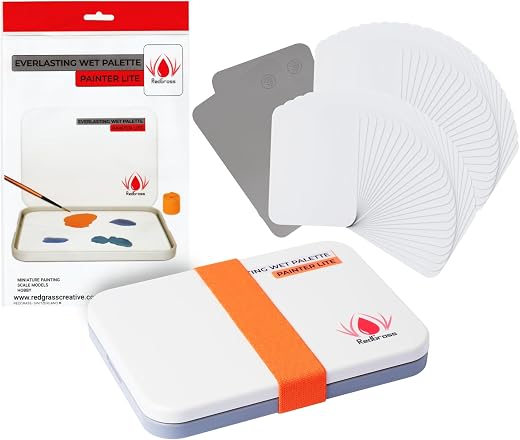
1. Redgrass Everlasting Wet Palette Painter Lite — Best Overall
Price: $29.99 | Amazon rating: 4.8 from 2,807 | Role: Best overall | Key spec: 7.87 x 5.91 in ABS tray, TPE seal, 50 sheets, 2 foams
The only product of the five that names the part doing the work. Redgrass specifies a thermoplastic elastomer seal moulded into the lid, plus a strap to hold the halves together. The seal decides whether a mix is usable tomorrow, because paint dries between sessions rather than during them. Everything else here ships a press-fit lid and hopes.
You pay in area and money: $29.99 for the second-smallest surface here, with sheets only Redgrass sells. Against that, an ABS tray that survives a dishwasher, two foams, and 4.8 stars from 2,807 unmerged ratings. The one claim we would not lean on is “naturally mold resistant,” made with no active substance named.
Best for: painters working in sessions days apart, who need a mix to survive the gap.
Skip if: you mix large volumes or want a dry mixing area in the same box.
Read the full Redgrass Painter Lite review →
Where to Buy — Redgrass Painter Lite
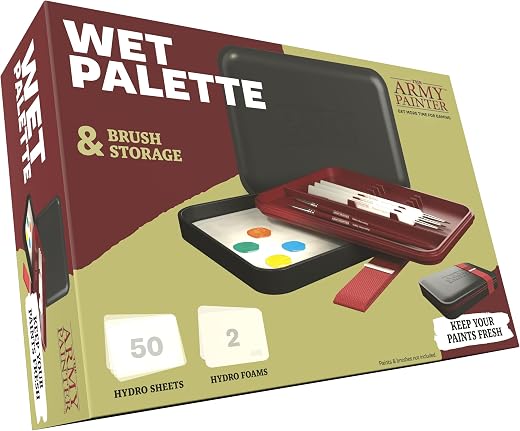
2. The Army Painter Wet Palette — Best for Storing Brushes Too
Price: $33.84 | Amazon rating: 4.8 from 9,166 | Role: Most owned | Key spec: 13.8 x 19.8 cm tray, stores 16 brushes
Nine thousand one hundred and sixty-six ratings at 4.8 is three times the next largest sample here, and where no maker publishes a performance figure that is the best evidence available. The second reason is unique: an inner layer taking six Wargamer and ten Hobby brushes, so palette and brushes become one strapped object.
It is also the dearest at $33.84, the tallest at 1.18 inches, and its spec table is a mess: Size claims 20 x 30 cm while the description and dimensions say roughly 13.8 x 19.8 cm, and the age-range field holds ad copy. It is the only listing to state a warranty position, and that position is “No Warranty.”
Best for: anyone whose brushes, paper and tray live in three places and should live in one.
Skip if: you need the tightest seal or a slim tray for a drawer.
Read the full The Army Painter Wet Palette review →
Where to Buy — The Army Painter Wet Palette
3. Masterson Sta-Wet Handy Palette — Best Value
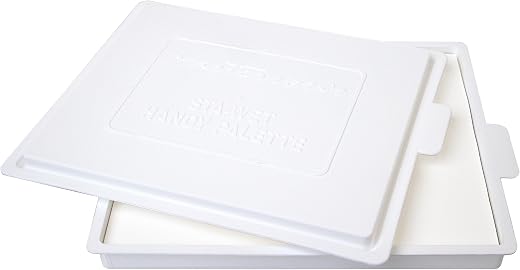
Price: $17.97 | Amazon rating: 4.7 from 7,587 | Role: Best value | Key spec: 8.5 x 7 x 1 in, sponge and paper, made in USA
The reference design, and the surprise of the shelf. Masterson’s Sta-Wet was built for acrylic painters on canvas long before miniatures were a mass hobby, and at $17.97 it undercuts both wargaming brands by twelve and sixteen dollars. It uses a sponge rather than open-celled foam, which holds more water per millimetre and releases it more slowly — hence the one-inch tray.
What you give up is everything added since: one sponge and no spare, no named seal, no strap, and — alone among the five — no published sheet count. The spec table also claims it weighs 18.14 g, about three sheets of A4, and names New Wave, LLC as manufacturer.
Best for: painters who also work on canvas, or want the cheapest design with a track record.
Skip if: you need a spare sponge, a sealed lid, or a published sheet count.
Read the full Masterson Sta-Wet Handy review →
Where to Buy — Masterson Sta-Wet Handy
4. Nicpro Stay Wet Palette Triple Tray — Best Wet-and-Dry Combination
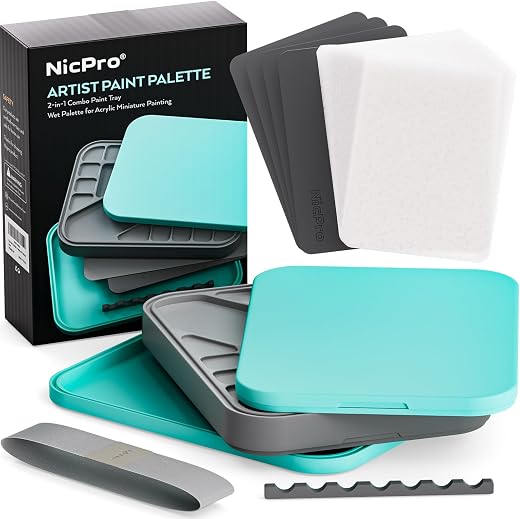
Price: $23.99 | Amazon rating: 4.5 from 1,617 | Role: Wet and dry in one | Key spec: Lid and base run wet; 16-well dry middle tray
The only product here that solves a problem every painter has. You need a damp surface for thinned colour and a dry one for neat paint and washes; the others make you choose or buy twice. Lid and base both take a sponge and a paper, the middle tray holds sixteen deep wells, and the box includes a hundred papers and four sponges.
The grey pad is the only piece of colour reasoning anyone here offers: thinned acrylic over white reads lighter than it will look on the model, over grey closer to true. Against that, 2.56 inches deep, 620 g empty, no seal named, two contradictory footprints, and a piece count of 50 on a product holding a hundred sheets.
Best for: a fixed desk where bulk is irrelevant and you would otherwise own two trays.
Skip if: you carry your kit anywhere, or the seal matters more than the parts count.
Read the full Nicpro Triple Tray review →
Where to Buy — Nicpro Triple Tray
5. Jucoci Wet Palette — Best Budget Pick
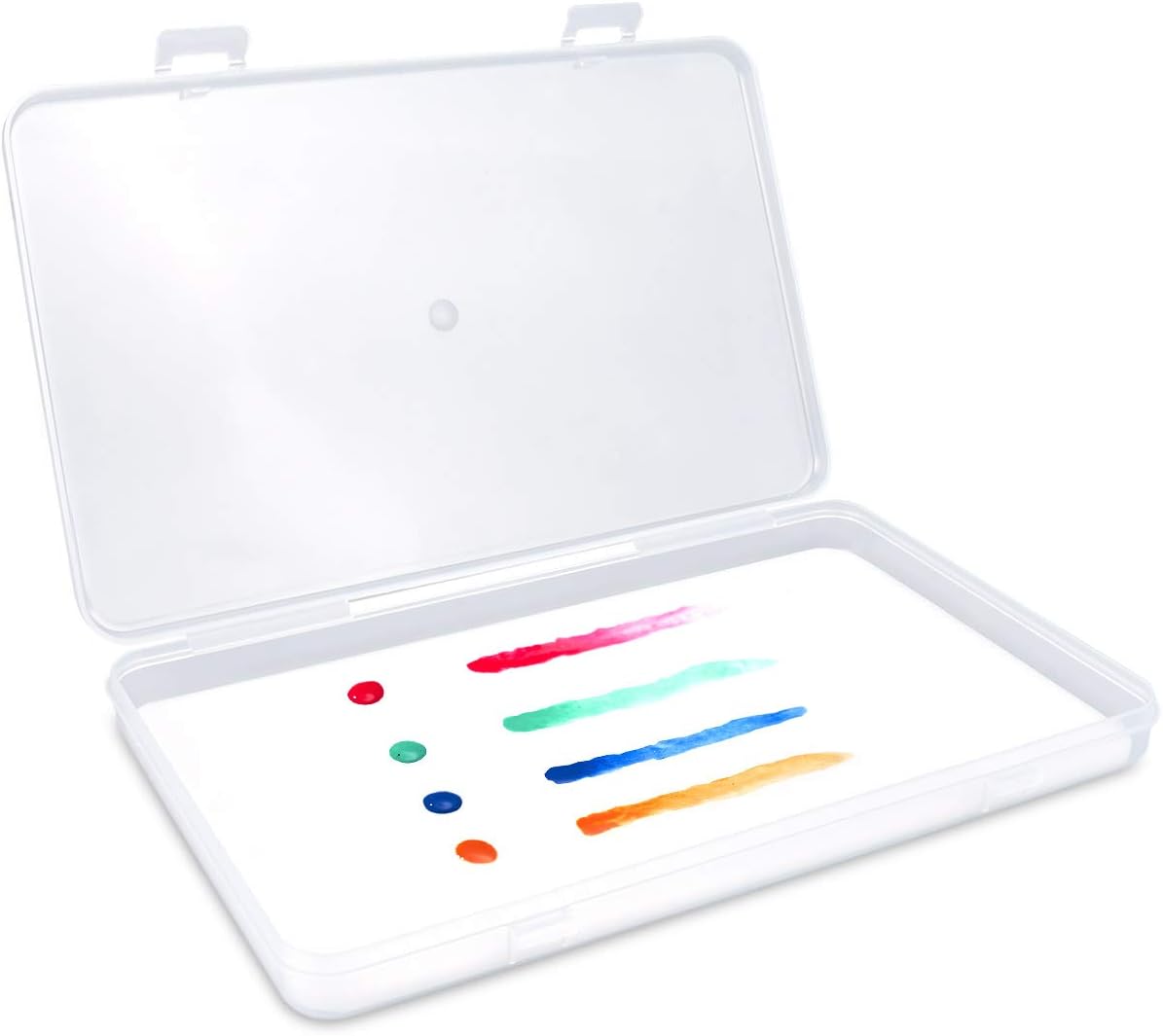
Price: $9.99 | Amazon rating: 4.5 from 2,125 | Role: Budget | Key spec: 8.98 x 5.51 in area, washable foam, 240 g
Ten dollars, 2,125 ratings at 4.5, and a working area larger than the $29.99 Redgrass tray. The three-layer idea is not complicated, and this is the proof: a plain box with foam and paper does the session-length job for a third of the price.
It publishes less than any rival: no sheet count, no tray height, no material for the tray, and no mention of a lid, seal or strap on a product whose premise is a box that holds humidity. One point in its favour: it makes no mould claim at all, where the premium trays make absolute ones.
Best for: trying the format, or a second tray so skin and metals never share a sheet.
Skip if: you want a named seal, a sheet count, or a tray whose material is on the label.
Read the full Jucoci WP01 review →
Where to Buy — Jucoci WP01
Wet Palette — Buyer’s Guide: What to Look For
The Seal, Not the Tray
Paint does not dry while you use it. It dries in the eight hours between sittings, and the only thing between a usable mix and coloured crust is how well the lid holds humidity. One palette here names the material that does it: a moulded thermoplastic elastomer gasket, the class used for appliance door seals because it stays compliant through thousands of closures. The other four ship a press-fit lid and say nothing about it.
Sponge or Foam, and How Many You Get
The water-holding layer comes in two forms. Open-celled foam, which the hobby brands use, wets and dries quickly and needs a deeper tray. A dense sponge, used by the fine-art reference, holds more water per millimetre and releases it more slowly — hence its one-inch tray.
Count the pads before comparing prices: one palette ships a single sponge, two ship two foams, one ships four. A pad wet for a fortnight needs drying right through, and with one pad, washing it costs you a day. Three of the five supply a strap too, a quiet admission about the lid.
The Paper Is the Subscription
Every maker cuts sheets for its own tray, no two sizes are interchangeable, and not one listing publishes a price per sheet. Counts run from a hundred down to none stated at all. The tray is the cheap part of this purchase and the paper the recurring one, so price a refill pack first.
The sheets are coated — silicone on one product, unspecified on the rest — so water passes up from the pad while the paint film does not bond to the surface. That is why a dried bead peels cleanly instead of tearing, and why baking parchment behaves differently.
What the Numbers on the Box Are Not
These listings publish dimensions, weight, piece counts, materials and colour. None publishes how long paint stays usable, under what conditions, or how airtight the closed tray is. The headline function of the category is unspecified on every product in it — the fifth consecutive shelf where the deciding specification is missing from every listing, which means the industry has never agreed a way to measure it.
What Actually Keeps Paint Wet, and What Grows In It
Acrylic paint dries by losing water: the polymer particles touch and coalesce into a film that will not go back. A damp pad under a permeable sheet slows that one step, which is also why an open tray in a warm room fails — nothing is adding water, the lid only holds humidity in.
Which brings us to where every forum thread ends up: mould. Two listings claim resistance to it, one promising you “will never encounter any issue, or bad smell,” and neither names an active substance or a standard. The cheapest tray makes no such claim, which is the more defensible position.
Mould is not an exotic risk. The US Centers for Disease Control states that mould “will grow where there is moisture” and lists what it grows in, including “dust, paints, wallpaper, insulation, drywall, carpet, fabric, and upholstery.” A sealed tray of standing water under a pigment film is, from a spore’s point of view, an opportunity. The CDC notes mould can cause “a stuffy nose, sore throat, coughing or wheezing, burning eyes, or skin rash,” and that people with asthma or a mould allergy “may have severe reactions.”
The reason paint in a pot does not go mouldy is that somebody put a biocide in it. In the US those additives are regulated as pesticides: the Environmental Protection Agency defines an antimicrobial pesticide as a product intended to “disinfect, sanitize, reduce, or mitigate growth or development of microbiological organisms,” and runs a category of materials preservatives — “antimicrobial chemicals added during industrial processes to prevent the growth of microorganisms” — with paints among them. What protects your paint between sessions is a registered pesticide in the can, not the tray.
There is a wrinkle in how the agency classifies them. A preservative protecting a material is “non-public health”: it bears “a label claim to control microorganisms of economic or aesthetic significance, where the presence of the microorganism would not normally lead to infection or disease in humans.” The mould in a neglected wet palette is, in regulatory language, an aesthetic problem — a fair call for a sealed can, a less comfortable fit for a tray you open twice a week and lean over.
None of this requires anxiety, only a habit: wash the pad weekly, dry it through before closing the lid, and change the sheet rather than reviving it. That does more for the smell than any claim on these boxes.
US vs UK: One Preservative, Two Legal Identities
Both countries regulate the additive that stops paint spoiling, and each classifies it differently. In the US it is a pesticide registered with the EPA; in Great Britain the same chemistry is a biocidal product, and the Health and Safety Executive is explicit: “A biocidal product/biocidal product family must be authorised to be made available on the market in Great Britain (GB).” Authorisation depends on the active substance being approved “for the relevant product type” — and in-can preservatives are product-type 6, “Preservatives for products during storage,” covering preservation of manufactured products “by the control of microbial deterioration to ensure their shelf life.”
Same molecule, same job, two legal identities: an American pesticide registration and a British numbered product-type authorisation. The divergence is in the instrument, not the hazard — the opposite of the usual pattern.
The consumer-facing side diverges the other way. On art materials the US leans on a voluntary industry scheme: the Art and Creative Materials Institute certifies products “non-injurious to humans when used as intended” under its AP seal, or “not hazardous to humans when used as instructed” under its CL seal, after evaluation “by board-certified toxicologists.” It is a seal you look for, not a rule a maker must meet, and none of these trays has one. The paints going onto the sheet are the regulated half; the box under them is not regulated at all.
For a UK buyer, one practical warning: these listings mix units to the point of uselessness — inches, centimetres, grams, ounces and kilograms across five trays, one in two contradictory measurements at once. Convert before comparing, and trust the inch figures — they are what the warehouse measured.
Wet Palette — Which One Should You Buy?
Under $20: the honest basics
The Jucoci tray at $9.99 is the one to buy if you are unsure you want to paint this way, and the one to buy twice so skin tones and metallics never share a sheet. At $17.97 the Masterson Sta-Wet Handy Palette is better made, made in the USA, and the cheapest design with decades behind it — but ships one sponge and no sheet count.
$20 to $30: where most people should land
The Nicpro triple tray at $23.99 is the most generous box here — a hundred papers, four grey sponges and a sixteen-well dry palette between two wet surfaces — if it lives permanently on a desk. The Redgrass Everlasting Painter Lite at $29.99 is our best overall, and the pick if your complaint is that mixes do not survive overnight, because it is the only one engineered for that.
Over $30: the complete box
At $33.84 The Army Painter Wet Palette is the dearest here and the most owned by a factor of three, and the brush layer is why: palette, paper, foams and sixteen brushes in one strapped box. If your kit is spread across a desk, this is the upgrade.
On where this guide sits beside our others: we covered the brushes that go with these trays in our best miniature paint brushes guide and the machine end of the same hobby in our best filament dryer comparison; neither shares a product or a source with this one. Brushes are sold by a size number that measures nothing; a wet palette on a duration nobody publishes. Our desk setup essentials guide covers the surface it all sits on.
Wet Palette — Frequently Asked Questions
How does a wet palette work?
A damp pad sits in a sealed tray with a semi-permeable sheet on top. Water moves up through the sheet and keeps the air just above your paint near saturation, so the water in the paint leaves far more slowly. The lid holds that humidity between sittings, which is why the seal matters more than the tray does.
How wet should it be, and how much water goes in?
Saturate the pad, then press it till it stops dripping. A pad carrying free water floods the sheet, the paint beads and runs together, and most people blame the paper. If paint beads, squeeze the pad again; if the sheet dries and curls within the hour, add water a teaspoon at a time.
Is wet palette paper just parchment paper?
No, though parchment is the usual substitute and half works. Manufactured sheets are coated — one specifies double-sided silicone — so water passes up while the dried paint film does not bond to it. Parchment is coated for food release, not water transmission, so it tends to bead the paint or let it sink and tear.
Why does my palette smell, and do these trays go mouldy?
Because a pad left wet in a closed box is the environment mould wants, and the CDC notes mould grows wherever there is moisture, listing paints among the materials it grows in. Two listings claim resistance without naming an active substance, so read those claims as structural rather than chemical. Washing the pad weekly and drying it fully before closing the lid is the fix.
Can I leave paint on it overnight, or for a week?
Overnight is the normal case and every product here manages it with the lid shut. A week is a question about your room and your seal, not the brand, and no maker publishes a comparable figure. In a cool room with a gasket and strap, several days is plausible; on a warm desk under a lamp, expect one night.
Wet palette or dry palette — do I need both?
Most painters use both in one session: thinned colour on the damp side, neat paint or washes on a dry surface where they will not spread. Only one product here gives both in one box; with the others you buy a second tray or use a ceramic tile, which costs nothing and works.
Wet Palette — Final Thoughts
This is a category where the deciding number does not exist. Nobody publishes how long paint stays usable, so the ranking is built from what makers will put in writing: a named seal material, a pad count, a sheet count. On those terms the Redgrass Everlasting Painter Lite takes first as the only one describing how it keeps the lid shut, and The Army Painter tray second because 9,166 owners are the next best evidence available.
The money argument is simpler. At $9.99 the Jucoci tray delivers the function with nothing written on the box, and at $17.97 the Masterson Sta-Wet undercuts both hobby brands. Buy for the seal and pad count, not the outside dimensions — and wash the pad weekly. That habit decides more about owning a wet palette than the twenty-four dollars between cheapest and dearest.
Sources and Further Reading
- US EPA — Pesticide Registration Manual, Chapter 4: antimicrobial pesticides and materials preservatives
- US CDC — About mould: moisture, materials and health effects
- UK Health and Safety Executive — GB Biocidal Products Regulation: product authorisation overview
- legislation.gov.uk — Biocidal Products Regulation, Annex V: product-type 6
- Art and Creative Materials Institute — what the AP and CL seals certify
Affiliate disclosure: this guide contains affiliate links, and we earn a commission on qualifying purchases made through them at no extra cost to you. Prices, ratings and specifications were read from the live Amazon listings on 4 October 2026 and change without notice.