
Everything in a car boot is insurance against a stationary car. Every item in there is worth
exactly nothing on every day but one — and on that one day you are at the side of a road,
probably in the dark, possibly with no signal, and you cannot go and buy it. That is what makes
choosing car boot essentials a different exercise from choosing anything else you
own. You are not buying for performance. You are buying for the single hour in which the car has
stopped and you have to deal with it yourself.
The boot is also the only storage in your life that is never inventoried. Things go in and
nothing comes out, and most people find out what is actually in there on precisely the wrong
afternoon. The seven car boot essentials below are arranged in the order that roadside hour
actually runs: the warning you should have had, the soft tyre, the dead battery, the dark, the
job you did not plan for, the paperwork, and the wait. Each one is a product this site has
reviewed in full, and each entry links to that review.
We judged them on four things: whether the item still works after twelve months untouched,
whether it tolerates a temperature range no indoor product ever sees, whether it reads in both
PSI and bar, and whether it does something a phone cannot already do. Prices and links go to
Amazon.com and carry our affiliate tag; UK readers can search the same model names on
Amazon.co.uk, and where a specification differs by market — and with tyre and electrical
kit it often does — we say so in the entry. Four things we deliberately refuse to
recommend are set out in the buyer’s guide.
Car Boot Essentials — Quick Comparison
All seven car boot essentials at a glance, in the order the roadside hour runs. Scores are our
own out of ten; prices and ratings were read on the day of publication.
| # | Product | Role | Key spec | Best for | Price | Score |
|---|---|---|---|---|---|---|
| 1 | ANKIA Valve Caps | The warning | 8 caps, green/amber/red at 32 PSI (2.2 bar) | Never checking pressure by hand | $10.99 | 7.9 |
| 2 | CRAFTSMAN Tyre Inflator | The soft tyre | 6000 mAh battery, 150 PSI max, PSI/kPa/bar/kg⋅cm², 1.28 lb | The commonest failure of all | $37.00 | 8.4 |
| 3 | GOOLOO A3 Jump Starter | The dead battery | 3000 A peak, 12 V, 150 PSI compressor, rated −4 °F to 140 °F | No second car, no second driver | around $110 | 8.6 |
| 4 | ZF8313 Magnetic Torch | The dark | 2000 lumens, 144 m beam, magnetic base, USB-C, IPX6 | Two-handed jobs after dark | $23.99 | 8.4 |
| 5 | Gerber Suspension NXT | The hands | 15 tools, 8.48 oz, 4.25 in closed, limited lifetime warranty | The problem you did not plan for | around $41 | 8.7 |
| 6 | DocSafe Document Box | The paperwork | 15.5 × 11.5 × 3 in, 28 compartments, UL94 V-0/5VA, lockable | US drivers who must carry documents | $42.98 | 8.4 |
| 7 | Berkshire Wearable Blanket | The wait | 300 GSM Primalush, 58 × 64 in cape, pockets, machine washable | The wait for the recovery truck | $29.99 | 8.5 |
- Car Boot Essentials — Quick Comparison
- The 7 Best Car Boot Essentials in 2026
- Car Boot Essentials — Buyer’s Guide: What to Look For
- US vs UK: What Changes for Car Boot Essentials When a Boot Is a Trunk
- Car Boot Essentials — Which One Should You Buy?
- Tyres, Batteries and the Law Behind Your Car Boot Essentials
- Car Boot Essentials — Frequently Asked Questions
- Car Boot Essentials — Final Thoughts
- Sources and Further Reading
The 7 Best Car Boot Essentials in 2026
Each of the seven car boot essentials below has its own full review on this site; the links take you there. Expert Scores are ours and are carried over from those reviews unchanged.
1. ANKIA Tyre Pressure Monitor Valve Caps — Best Car Boot Essentials Pick for the Ten-Second Check
Price: $10.99 | Amazon rating: 4.2 / 4,681 | Role: The warning | Key spec: 8 caps, green/amber/red at 32 PSI (2.2 bar)
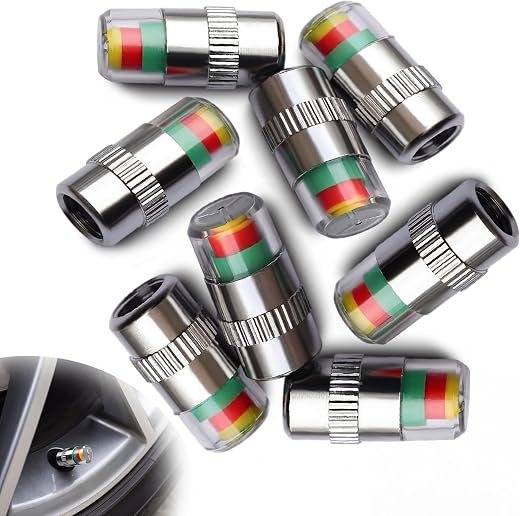
Start with the cheapest thing in the boot and the only one that does its job while you are asleep. These are chromed metal caps with a spring and a coloured sleeve inside. Screw one onto each valve and it sits flush at the correct pressure showing green; as air leaks out it rises and shows amber at roughly ten per cent below the set figure and red at about twenty-five per cent below. The set is calibrated for 32 PSI, which is 2.2 bar, and that is the single most important number on the listing, because it is a fixed calibration and not an adjustable one.
The reason they earn a place among car boot essentials is timing. Every other tyre item on this page is something you reach for after the problem has announced itself — a dashboard light, a flapping noise, a car that pulls. A coloured cap announces it while the car is parked on the drive and you are walking past with the shopping. NHTSA’s own advice is to check pressure “at least once a month when the tires are ‘cold,’ meaning that the car hasn’t been driven for at least three hours”, and the honest truth is that almost nobody does it. A cap that changes colour is a monthly check you cannot forget to perform.
Be clear about what it is not. It is not a tyre pressure monitoring system, it does not talk to the car, and it will not tell you the pressure in numbers — it tells you one of three things, and only against its own factory calibration. If your car’s door-jamb placard asks for 38 PSI, a 32 PSI cap will sit green when you are meaningfully soft. Check the placard first.
At 4.2 stars from 4,681 ratings this is also the weakest evidence base of the seven, and the recurring complaint in the reviews — a small black washer that falls out when the cap is removed — is repeated in the manufacturer’s own description, which is unusually candid of them.
Best for: Anyone who knows they will never kneel down with a gauge once a month, and whose car asks for something close to 32 PSI.
Skip if: Your placard pressure is well above 32 PSI, you already have a working factory TPMS you trust, or you want an actual number rather than a colour.
Read the full ANKIA Tyre Pressure Valve Caps review →
Where to Buy — ANKIA Tyre Pressure Valve Caps
2. CRAFTSMAN Cordless Tyre Inflator — Best Car Boot Essentials Pick for a Soft Tyre
Price: $37.00 | Amazon rating: 4.5 / 1,502 | Role: The soft tyre | Key spec: 6000 mAh battery, 150 PSI max, PSI/kPa/bar/kg⋅cm², 1.28 lb
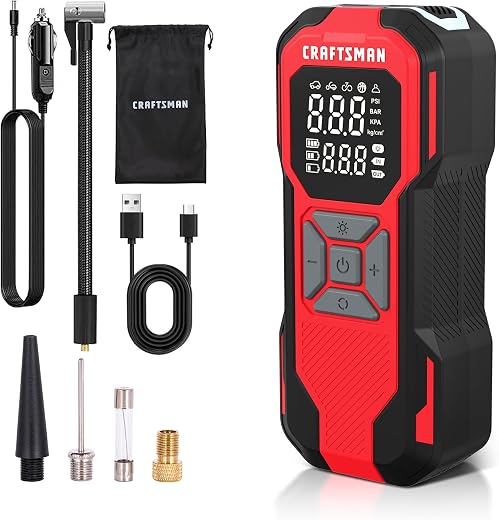
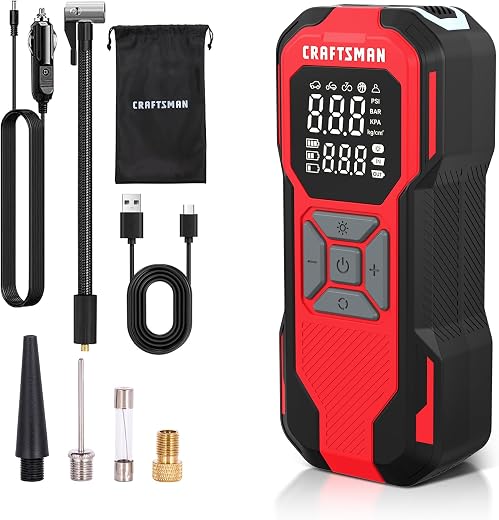
A slow puncture is the commonest roadside failure there is, and it is also the one most likely to be survivable without a recovery truck. A tyre that is losing air over hours rather than seconds can usually be pumped back up and driven to a garage. That is the entire job this does. CRAFTSMAN quotes four car tyres (195/55 R15) taken from 30 to 36 PSI in forty-five seconds each on the built-in 6000 mAh battery, with a 150 PSI ceiling and preset modes for car, motorcycle, bicycle and ball.
Two details matter more than the headline figures. The first is that it reads in PSI, kPa, bar and kg⋅cm², which is precisely the feature a dual-market list of car boot essentials should be looking for: American placards are in PSI, British and European ones are usually printed in bar, and a pump that only speaks one of them turns a two-minute job into arithmetic at the side of a road. The second is that it runs cordless or from the 12 V socket on a ten-foot lead, so a flat internal battery after a winter in the boot does not make it useless — it makes it slower.
It weighs 1.28 lb and the listing itself files it under “road trip essentials”, which is fair. The compromises are noise at 78 dB, a duty cycle that wants a rest between tyres, and the fact that it will not save a tyre with a sidewall tear or a hole you can hear. Set against that, it is the single item here most likely to convert a ruined afternoon into a twenty-minute detour, and at $37 it is the best value on the page.
Best for: Almost everyone. If you buy one thing from this list, and you already have breakdown cover for the big failures, buy the pump.
Skip if: You would rather carry one device than two — in which case skip to the GOOLOO A3 below, which inflates as well as jump-starts — or your car has no spare and no repair kit at all.
Read the full CRAFTSMAN Portable Tyre Inflator review →
Where to Buy — CRAFTSMAN Portable Tyre Inflator
3. GOOLOO A3 Jump Starter with Air Compressor — Best Car Boot Essentials Pick for a Dead Battery
Price: around $110 | Amazon rating: 4.4 / 4,469 | Role: The dead battery | Key spec: 3000 A peak, 12 V, 150 PSI compressor, rated −4 °F to 140 °F
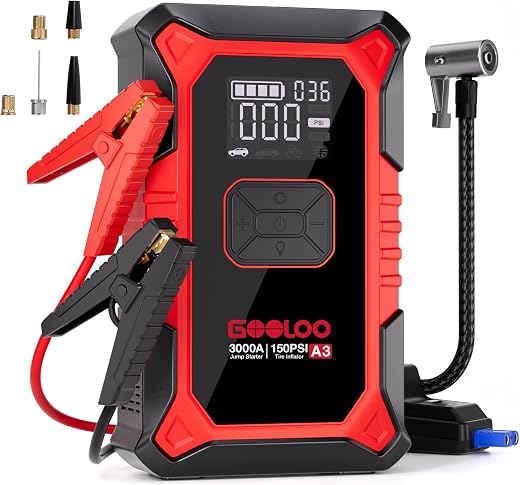
Jump leads have a design flaw that nobody mentions: they require a second car, a second driver willing to stop, and enough room to park the two nose to nose. In a supermarket car park that is a mild inconvenience. On a lay-by at half past ten at night it is a problem you cannot solve by owning better leads. A lithium jump pack removes the second car from the equation entirely, and that is why it sits at the expensive end of any list of car boot essentials rather than the cheap end.
The A3 is rated at 3000 A peak for 12 V engines up to 9.0 L petrol and 6.5 L diesel, with a BOOST button for the case where the battery is too flat for the pack to detect it at all. It also carries a 150 PSI air compressor with five nozzles and five modes, which is why it earns a place alongside the CRAFTSMAN rather than instead of it — one is a dedicated pump you will actually use monthly, the other is an emergency device that happens to inflate.
The specification that matters most for something living in a boot is buried in the listing: over 1,000 charge cycles and an operating range of −4 °F to 140 °F, which is −20 °C to 60 °C. That upper figure is not marketing padding. NHTSA’s heatstroke campaign notes flatly that “rolling windows down or parking in the shade does little to change the interior temperature of the vehicle”, and a closed boot in a July car park gets there. A lithium pack that is not rated for it is a pack that ages in a single summer, which is why the temperature line matters more than the amp figure when you are choosing car boot essentials.
Best for: Anyone who parks on a street rather than a drive, does short journeys in winter, or has a battery over four years old.
Skip if: You only ever drive a modern car with stop-start and a battery under two years old, you have comprehensive recovery cover you are happy to wait for, or you want the cheapest possible way to deal with a soft tyre — in which case the CRAFTSMAN above is a third of the price.
Read the full GOOLOO A3 Jump Starter review →
Where to Buy — GOOLOO A3 Jump Starter
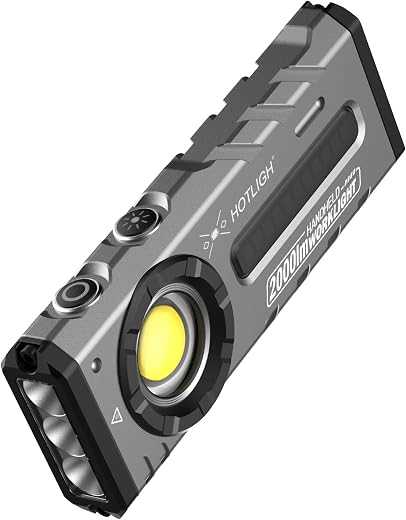
4. ZF8313 Magnetic EDC Torch — Best Car Boot Essentials Pick for Working in the Dark
Price: $23.99 | Amazon rating: 4.6 / 1,017 | Role: The dark | Key spec: 2000 lumens, 144 m beam, magnetic base, USB-C, IPX6
Every job in the first three entries is a two-handed job, and the roadside version of it happens after dark far more often than the daytime version, because that is when people are driving home. A phone torch fails here for one reason: it occupies a hand, and it is the same hand you need for the wheel brace, the jump clamp or the valve. That is why a magnetic base is the specification that matters and 2000 lumens is the specification that sells.
The base is strong enough to hold the body on a wheel arch, a door sill or the underside of a raised bonnet, which puts the light where the work is instead of where you are. Brightness is steplessly adjustable from 120 to 2000 lumens with a beam quoted at 144 metres, it charges over USB-C in about two hours from a 2000 mAh cell, and it carries an IPX6 rating — which, for something you will use in the rain because you are only using it at all when something has gone wrong, is the difference between a torch and a paperweight.
The extras are a mixed bag and should be read honestly. The RGB side light is atmosphere lighting, not a warning beacon, and nobody should treat it as a substitute for hazard lights or a warning triangle. The UV mode is a novelty. What justifies the entry among car boot essentials is the magnet, the fifteen-hour quoted runtime at low output and the USB-C port, because a torch you can top up from the same cable as your phone is a torch that will be charged when the moment arrives.
Best for: Anybody at all. This is the least conditional recommendation on the page, and at $23.99 it is also close to the cheapest.
Skip if: You want a dedicated warning beacon or a headlamp — different products, both worth owning — or you genuinely keep a charged head torch in the glovebox already.
Read the full ZF8313 Magnetic EDC Torch review →
Where to Buy — ZF8313 Magnetic EDC Torch
5. Gerber Suspension NXT Multitool — Best Car Boot Essentials Pick for the Jobs You Did Not Plan For
Price: around $41 | Amazon rating: 4.6 / 23,797 | Role: The hands | Key spec: 15 tools, 8.48 oz, 4.25 in closed, limited lifetime warranty
The previous four items each solve a named problem. This one exists because the boot’s real job is the unnamed problem: a number plate hanging off, a trim clip that has worked loose, a jubilee clip on a hose, a cable tie that needs cutting, a screw in a child seat that has backed out over three hundred miles. None of those is worth a call-out and all of them are worth five minutes if you have pliers, which is the whole case for keeping a multitool among your car boot essentials.
The Suspension NXT gives you fifteen implements in 8.48 ounces: needle-nose pliers with a wire stripper, three flathead drivers, two cross drivers, an awl, scissors, a can and bottle opener, a 2.25-inch partially serrated blade, a nail file, a pocket clip and — the detail that separates it from supermarket multitools — a tool lock, so the implement you are leaning on does not fold back onto your fingers. The butterfly opening means the pliers deploy in one motion, and the open-frame stainless build sheds grit rather than trapping it, which matters for a tool that lives in a boot rather than a drawer.
It carries a limited lifetime warranty, and at roughly $41 that is the argument. Against a Leatherman Wingman it undercuts on price and gives up some blade steel and jaw hardness; against a $15 no-name it is not a contest, because the lock, the spring and the pivot tolerances are in a different class. Its 4.6-star average across more than 23,700 ratings is by a wide margin the largest evidence base of the seven car boot essentials on this page.
Best for: Anyone who has ever wished for pliers and had none, and anyone buying a single gift for a new driver.
Skip if: You want a serious cutting edge — buy a dedicated folding knife instead — or you live in Britain and intend to carry it on your person rather than in the vehicle, for the legal reason set out in the buyer’s guide below.
Read the full Gerber Suspension NXT review →
Where to Buy — Gerber Suspension NXT

6. DocSafe Fireproof Document Organiser — Best Car Boot Essentials Pick for Paperwork (With One Big Caveat)
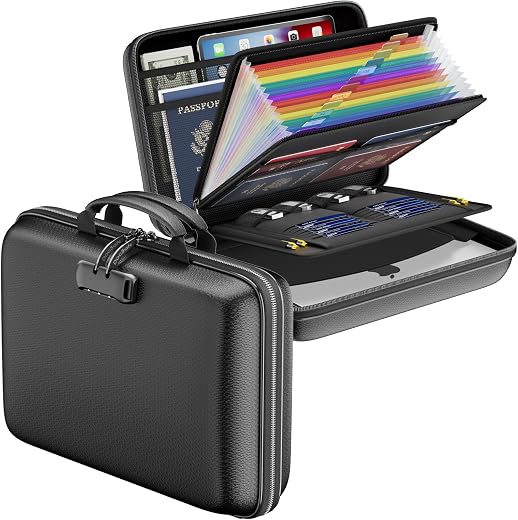
Price: $42.98 | Amazon rating: 4.5 / 2,065 | Role: The paperwork | Key spec: 15.5 × 11.5 × 3 in, 28 compartments, UL94 V-0/5VA, lockable
This is the entry that splits the audience down the middle, and it is the most interesting of the seven for exactly that reason. The box itself is straightforward and good: a hard shell over silicone-coated fire-insulating cotton that has passed the UL94 V-0/5VA flame-retardancy test, water resistant, lockable, 15.5 by 11.5 by 3 inches, with a thirteen-pocket accordion folder inside taking both Letter and legal, and twenty-eight compartments in total.
For an American driver it belongs in the car. Most states require the registration and proof of insurance to be in the vehicle and produced on demand; Washington’s wording is typical, making it “unlawful for any person to operate or be in possession of a vehicle without carrying a registration certificate for the vehicle” and making failure to produce proof of insurance on an officer’s request a traffic infraction. If the paperwork has to live in the car anyway, it may as well live in something that survives a fire and keeps the service history, the warranty book and the spare key fob in one findable place.
For a British driver the advice is the opposite, and it is not our opinion — it is the Highway Code’s. Annex 6 says plainly: “never leave vehicle documents in the car.” You are not required to carry them. If you are stopped, you have seven days to produce them at a police station.
So in Britain this box is an excellent cupboard box, not a boot box, and a V5C sitting in the boot of a stolen car is a gift to whoever took it. We have left it in the list because half our readers should buy it and put it in the car, and half should buy it and leave it at home — and nobody else tells you which half you are in.
Best for: US drivers who must carry registration and insurance anyway, and anyone on either side of the Atlantic who wants one fireproof place for documents at home.
Skip if: You are in the UK and were planning to keep it in the boot. Buy it for the house instead — the Highway Code explicitly tells you not to leave vehicle documents in the car.
Read the full DocSafe Fireproof Document Box review →
Where to Buy — DocSafe Fireproof Document Box
7. Berkshire Primalush Wearable Blanket — Best Car Boot Essentials Pick for the Wait
Price: $29.99 | Amazon rating: 4.6 / 1,169 | Role: The wait | Key spec: 300 GSM Primalush, 58 × 64 in cape, pockets, machine washable
The last of the car boot essentials is the one nobody puts on a list, because it solves the part of a breakdown that is not mechanical. Once the call is made, the recovery truck has a window and the window is usually measured in hours. If the car will not start it will not run the heater either, and if you have been told to get out and stand clear of the vehicle — which on a motorway you will be — then the problem stops being your alternator and starts being your core temperature.
A 300 GSM plush cape of 58 by 64 inches is a better answer than a coat you are not wearing, for a reason that sounds trivial and is not: it goes on over whatever you already have on, in a driver’s seat, without taking off a seatbelt or a jacket, and it has pockets, so your hands stay covered while you hold a phone. It is machine washable, it is not electrical, and it does not care that it has been in a boot since March.
That last point is the whole argument. Every other item here has a battery to keep charged or a calibration to check. This one has neither, which makes it the only thing on the page with a genuinely infinite shelf life. It is also the item most likely to be borrowed and never returned to the car, so if you buy one for the boot, buy it in a colour you do not like.
Best for: Anyone who drives at night, drives in winter, or carries passengers who are not the driver — children and older relatives feel a cold wait long before the driver admits to it.
Skip if: You already keep a proper insulated coat and a foil blanket in the car, or you want something that also produces heat, in which case a rechargeable hand warmer is a different and cheaper answer.
Read the full Berkshire Primalush Wearable Blanket review →
Where to Buy — Berkshire Primalush Wearable Blanket

Car Boot Essentials — Buyer’s Guide: What to Look For
The criteria that decide a good boot item are not the criteria that sell one. Run time, peak
output and feature count are what the listings shout about; none of the three is what matters
here. What matters is whether the thing works the first time you touch it after a year of being
ignored. Judge car boot essentials on that and the shortlist shortens quickly.
Car Boot Essentials and the Twelve-Month Test: Buy for Charge Retention, Not Run Time
Anything that lives in a boot has to survive a year of self-discharge and still work first
time. That single sentence reorders every spec sheet. A jump pack with enormous peak amps and a
cell chemistry that sheds charge in storage is worse than a modest one that holds it. A torch
with a fifteen-hour runtime is only useful if it still has charge in month eleven.
This is why USB-C matters more than lumens on the torch, why the GOOLOO’s quoted 1,000-plus
charge cycles matter more than its 3000 A headline, and why the only item on this page with
a genuinely unlimited shelf life is the one with no battery at all. Set a reminder for twice a
year, top everything up, and treat that as the real cost of ownership.
Car Boot Essentials and the Temperature Range No Indoor Product Ever Sees
A boot in a British January and a boot in an American July are two different environments and
your kit has to survive both. NHTSA’s heatstroke campaign is blunt that “rolling windows
down or parking in the shade does little to change the interior temperature of the
vehicle”, and a sealed boot is worse than a cabin. Check the operating range on the box:
the GOOLOO A3 quotes −4 °F to 140 °F, which is −20 °C to
60 °C, and that is the standard to hold any lithium product to.
Heat is also a safety question, not only a longevity one. The EPA’s guidance on lithium-ion
batteries warns that “even used batteries can have enough energy to injure or start
fires”, and that damaged or crushed cells are the hazard. Do not let a jump pack rattle
loose under a floor panel where a tool can land on it.
Why Dual-Market Car Boot Essentials Must Read Both PSI and Bar
American tyre placards are in PSI. British and European ones are usually printed in bar, and
frequently in both. A pump with a single-unit display turns a two-minute job into mental
arithmetic at the side of a road in the rain, and 32 PSI being 2.2 bar is not a
conversion most people carry in their heads.
The same applies to the pressure indicator caps, which are calibrated in both on the packet
for exactly this reason. Before buying either, read the placard in your own door jamb —
the US Department of Energy notes it is “usually found on a sticker in the driver’s
side door jamb or the glove box and in your owner’s manual” — and buy to that
number rather than to a generic one.
What These Car Boot Essentials Cannot Do: Four Things We Refuse to Recommend
A spare wheel is not a purchase. It is either what the car came with or it is
not, and if your car shipped with a sealant kit instead, buying a wheel, a jack and a brace to
match it is a project rather than a product. Check which you have, today, in daylight.
A dashcam is a good thing to own and it does not belong here, because it
lives on the windscreen and is powered by the car. A full socket set is for a
garage; nothing you can safely do at a roadside needs one. And a petrol can
carried full is a fire risk you are choosing to drive around with every day of the year in order
to solve a problem that happens to almost nobody.
One more, and it is the important one: do not keep a spare key anywhere in or on the
car. Not in the boot, not in a magnetic box under the wheel arch, not taped inside the
fuel flap. It converts a broken window into a stolen vehicle, and every insurer knows every
hiding place.
The Legal Corner: Blades and Car Boot Essentials in Britain
The multitool carries a 2.25-inch partially serrated locking blade, and that is a lawful thing
to own and to keep in a vehicle for a purpose. British readers should understand the distinction
the law draws between having it in the car as part of your car boot essentials and carrying it on
your person in public without good reason, because a locking blade is treated differently from a
non-locking folding knife under 3 inches. If you buy it, leave it in the boot with the rest of
the kit rather than in a coat pocket.
US vs UK: What Changes for Car Boot Essentials When a Boot Is a Trunk
Boot vs Trunk: Why Car Boot Essentials Is the Winnable Phrase
Start with the word. Americans call it a trunk; the British call it a boot. That is a
vocabulary note in most articles and here it is a finding, because the two words behave
completely differently. Search for the American phrasing and you meet a wall of national
publishers who have all written the same list. Search for car boot essentials
and you get breakdown firms, motor factors and a scrap dealer in Yorkshire.
The same object, the same article, two names — one saturated and one empty. It is the
cleanest live demonstration of the transatlantic vocabulary split this site has come across, and
it is worth knowing as a reader too: if you are British and your searches keep returning American
results, put “boot” in the query rather than “trunk” and the whole
internet changes nationality.
One warning for anyone searching. In Britain a car boot sale is a weekend flea market
held in a field, and it has nothing to do with any of this. If your results fill up with trestle
tables, add the word “kit” or “emergency” to the query.
The Vocabulary of Car Boot Essentials, Translated
Trunk is boot, hood is bonnet, gas is
petrol, flashlight is torch, wrench is spanner,
tires are tyres, windshield is windscreen, jumper cables are
jump leads, a parking lot is a car park, a highway is a
motorway, a rest stop is the services, and the shoulder is the
hard shoulder.
Two have no clean equivalent at all. A British lay-by is a widened strip
beside an ordinary road to pull into, which is not quite an American pull-off and not at all a
rest area. And the MOT — the annual roadworthiness test — has no
counterpart in most American states, which is the single biggest structural difference in how the
two countries keep cars safe.
America Legislated a Way Out of the Boot. Britain Never Did.
This is the most surprising difference on the page and almost nobody on either side knows it.
Federal Motor Vehicle Safety Standard No. 401, at 49 CFR 571.401, requires that
“each passenger car with a trunk compartment must have an automatic or manual release
mechanism inside the trunk compartment that unlatches the trunk lid”. The compliance date
was “September 1, 2001”, with certain front trunk compartments given until
“September 1, 2002”, and actuating it “must completely release the trunk lid
from all latching positions of the trunk lid latch”.
The standard applies to passenger cars with a trunk compartment and expressly excludes
“passenger cars with a back door” — so hatchbacks and estates sit outside it.
There is no British or European equivalent. The glow-in-the-dark handle an American driver can
see inside the boot lid is there because a regulator put it there; a British car has one only if
its manufacturer decided to fit the same part worldwide. Go and look inside your own boot lid
tonight. It costs nothing and you will learn something about the car you already own.
Documents Among Your Car Boot Essentials: One Country Says Carry Them, the Other Says Do Not
American practice is to keep the paperwork in the car. Most states require it, and Washington
is typical: it is “unlawful for any person to operate or be in possession of a vehicle
without carrying a registration certificate for the vehicle”, the certificate must be
“carried in the vehicle for which it is issued” and “provided to law enforcement
and the department by the operator of the vehicle upon demand”. Proof of insurance
“must be provided on the request of a law enforcement officer”, and failing to do so
“is a traffic infraction”.
British practice is the exact opposite, and it is written into the Highway Code. Annex 6’s
security advice says to “take all contents with you, or lock them in the boot” and
then, unambiguously, “never leave vehicle documents in the car”.
The reason you can
follow that advice is that you do not have to carry them: if the police stop you they can ask to
see your “driving licence, insurance certificate, MOT certificate”, and “if you
do not have these documents with you, you have 7 days to take them to a police station”.
So the same box of car boot essentials is a boot item in Ohio and a cupboard item in Oxford.
It is one of the very few cases where an honest product recommendation has to fork by nationality
rather than by budget.
Car Boot Essentials and the Annual Test That Only One Country Has
Britain checks the things in this article once a year whether you like it or not. The MOT is a
statutory roadworthiness test carried out against a published inspection manual, and tyres are
section 5 of it. Most American states have no equivalent: there is no national roadworthiness
inspection, and in much of the country nobody will ever look at your tyres unless you are
stopped.
That difference changes what your car boot essentials are for. In Britain they are a bridge
between annual inspections. In America they are, for many drivers, the only inspection regime
their car will ever have — which is an argument for the colour-changing valve caps at
number one being a more serious purchase in Texas than in Tyneside.
Car Boot Essentials — Which One Should You Buy?
Under $40: The Car Boot Essentials Starter Set
Buy the CRAFTSMAN portable tyre inflator and the
ZF8313 magnetic torch, and add the
ANKIA pressure indicator caps if your placard pressure is near
32 PSI. That is roughly $72 for the three, or $37 if you buy only the pump, and it covers
the most common roadside failure and the condition — darkness — that makes every
other failure worse. If you buy nothing else from this list of car boot essentials, buy the
pump.
What lives in the boot depends on the journey. For long drives our road trip essentials guide covers the cabin as well as the load space, and for winter the snow day essentials guide adds the few items that matter when the car will not move.
$40 to $80: Car Boot Essentials for the Jobs You Did Not Plan For
Add the Gerber Suspension NXT at around $41 and the
Berkshire Primalush wearable blanket at $29.99. The multitool covers
the loose trim, the hose clip and the number plate; the blanket covers the ninety minutes between
the phone call and the truck. Neither has a battery to maintain, which makes this the tier with
the lowest ongoing cost of any car boot essentials you can buy.
Over $100: The Full Set of Car Boot Essentials
Add the GOOLOO A3 jump starter at around $110 — the single most
expensive item here and the only one that removes another human being from the equation —
and, if you are American, the DocSafe fireproof document organiser at
$42.98 for the registration and insurance you have to carry anyway. British readers should buy
the same box and keep it in a cupboard. The complete set of car boot essentials on this page
comes to roughly $296, and the honest ranking within it is: pump, torch, jump pack, multitool,
blanket, caps, box.
Tyres, Batteries and the Law Behind Your Car Boot Essentials
Three of the seven items above are about tyres, which looks like an odd weighting until you
notice that tyres are the only part of a car that is guaranteed to be getting worse every single
day you own it. This section is the part of this guide to car boot essentials that sells nothing.
The Same Legal Minimum, to Within Two Hundredths of a Millimetre
Britain’s requirement is in the MOT inspection manual: “the primary grooves of the tread
pattern must be at least 1.6mm deep within the central three-quarters of the breadth of tread and
around the entire outer circumference of the tyre”. The Highway Code puts the same duty in
plain language — cars, light vans and light trailers “MUST have a tread depth of at
least 1.6 mm across the central three-quarters of the breadth of the tread”.
America’s number is NHTSA’s: tyres “are not safe and should be replaced when the tread is
worn down to 2/32 of an inch”. Two thirty-seconds of an inch is 1.5875 mm. The two
countries have, to within two hundredths of a millimetre, the same legal minimum —
and then diverge completely on who checks it. Britain checks it annually at the MOT against a
published defect manual. America, in most states, hands you a coin: “you can also check your
tread by placing a penny in the tread with Lincoln’s head upside down and facing you. If you can
see the top of Lincoln’s head, replace your tires.”
TPMS: America Mandates the Sensor, Britain Mandates That It Still Works
Federal Motor Vehicle Safety Standard No. 138 “specifies performance requirements for
tire pressure monitoring systems (TPMSs) to warn drivers of significant under-inflation of tires
and the resulting safety problems”. It applies to passenger cars, multipurpose passenger
vehicles, trucks and buses at or under “4,536 kilograms (10,000 pounds)”, and
“all vehicles manufactured on or after September 1, 2007 must comply with all requirements
of this standard”. The warning must appear when pressure falls to 25 per cent below the
manufacturer’s recommended cold figure.
Britain never mandated the device. What Britain did instead is make a broken one a failure: a
“tyre pressure monitoring system malfunctioning or obviously not working” is a
Major defect at the MOT for M1 vehicles first used on or after 1 January 2012.
The manual is careful about this — low pressure on the day is not the defect; the system
having stopped working is.
Put the two together and you get a genuine mirror image. An American car has carried a sensor
since 2007 and, in most states, nobody will ever check that it still works; a British car may
never have had one, but if it does and it has died, the car fails its test. That is also the
honest case against the valve caps at number one: they are not a TPMS, and in America they are a
backup to a system you already have, while in Britain they may be the only system in the car.
Under-Inflation Costs Money Long Before It Costs You a Tyre
The safety argument is well worn, so here is the financial one. The US Department of Energy
states that “you can improve your gas mileage by 0.6% on average—up to 3% in some
cases—by keeping your tires inflated to the proper pressure”, and that
“under-inflated tires can lower gas mileage by about 0.2% for every 1 psi drop in the
average pressure of all tires”.
NHTSA’s own tyre brochure is blunter about the end state: “underinflated tires and
overloaded vehicles are a major cause of tire failure”. NHTSA also records that
“in 2024, a total of 511 people died on the road in tire-related crashes”. A $37 pump
and a $10.99 set of caps against that is not a close call.
The Spare Is the One Tyre No Set of Car Boot Essentials Covers
If your car still has a spare, it has been sitting under the boot floor deflating quietly since
the day it was built. NHTSA’s instruction is explicit and almost never followed: “check tire
pressure regularly (at least once a month), including the spare”. Age matters as much as
pressure — “some vehicle and tire manufacturers recommend replacing tires that are six
to 10 years old, regardless of treadwear”.
That is an unglamorous five minutes that belongs alongside any set of car boot essentials,
because the spare is the one component whose entire purpose is to be in perfect condition on a day
you did not choose. The Highway Code’s advice on the live tyres applies equally: “check
weekly. Do this before your journey, when tyres are cold.”
Lithium Car Boot Essentials: Heat, Damage and Disposal
Two of the seven are lithium devices and they need a paragraph of their own. The EPA’s guidance
is that “even used batteries can have enough energy to injure or start fires”, and
that the danger comes from cells that are “damaged or crushed in transport or from
processing and sorting equipment”. In a boot, the crushing hazard is your own luggage.
Two practical rules follow. Keep the jump pack in its case rather than loose under a floor
panel, and when either device reaches the end of its life do not put it in the bin: the EPA asks
that you “place each battery, or device containing a battery, in a separate plastic
bag” and “place non-conductive tape (e.g., electrical tape) over the battery’s
terminals” before taking it to a proper collection point. Britain requires larger retailers
to take batteries back free of charge; America mostly expects you to go and find a recycler.
Car Boot Essentials According to the Regulator: NHTSA’s Own List
NHTSA publishes its own roadside list, and it is reassuringly close to the one above. Its
recommended kit includes a “cell phone and charger”, a “first aid kit, including
tourniquet”, a “flashlight”, “jumper cables”, a “jack (and
ground mat) for changing a tire”, and “basic repair tools and some duct tape (for
temporarily repairing a hose leak)”, plus “flares and a white flag”.
Read that list against this one and the gaps are instructive: we have replaced jumper cables
with a jump pack because the cables need a second car, and we have added warmth because the wait
is the part nobody plans for. A first aid kit and a warning triangle are both worth adding to your
own car boot essentials, and neither is a product we have reviewed, which is why they are named
here rather than sold above.
Car Boot Essentials — Frequently Asked Questions
What are the most important car boot essentials if I can only buy one thing?
A cordless tyre inflator. A slow puncture is the most common roadside failure, it is usually
survivable without a recovery truck, and a pump turns it into a twenty-minute detour. The
CRAFTSMAN above is $37 and reads in PSI, kPa, bar and kg⋅cm², which matters if you
drive in more than one country.
Is a lithium jump pack safe to leave in a car all year?
Yes, if it is rated for it. Check the operating temperature range on the box — the GOOLOO
A3 quotes −4 °F to 140 °F, or −20 °C to 60 °C
— and keep it in its case so nothing can crush it. Top it up twice a year. A pack that has
been flat for eighteen months is not a jump pack, it is ballast.
Do tyre pressure indicator valve caps actually work?
They work as a coarse warning, not as a gauge. They show green, amber or red against their own
factory calibration — here, 32 PSI or 2.2 bar — so they only tell you the
truth if your car’s placard pressure is close to that figure. They are not a TPMS and will not
talk to the car.
Can I be fined for a worn tyre in the UK?
Worn tyres are an offence and the MOT is where most drivers find out. The inspection manual
requires at least 1.6 mm of tread “within the central three-quarters of the breadth of
tread and around the entire outer circumference of the tyre”, and a defective tyre is a
failure. The penalties are set by the courts and vary by case, so check the current position with
DVSA rather than with a tyre retailer’s blog.
Does my American car really have a release handle inside the boot?
If it is a car with a separate trunk compartment built to comply from 1 September 2001, yes.
FMVSS No. 401 requires “an automatic or manual release mechanism inside the trunk
compartment that unlatches the trunk lid”. Hatchbacks and estates — anything with a
back door — are excluded from the standard. There is no British or EU equivalent rule.
Should I keep my V5C or registration document in the car?
It depends entirely on which country you are in, and this is the one place where the right
answer flips. In the US, most states require registration and proof of insurance to be carried in
the vehicle. In the UK, the Highway Code says “never leave vehicle documents in the
car”, and if you are stopped you have seven days to produce them at a police station.
How often should I check my tyre pressures?
NHTSA says at least monthly, when the tyres are cold, meaning at least three hours after
driving. The Highway Code says weekly, before your journey, also cold. Either is better than what
most people do, which is to check when the dashboard complains.
Are car boot essentials different for an electric car?
Mostly no, and in one respect emphatically yes. Tyres, torch, multitool, warmth and paperwork
are identical. The 12 V jump pack is still useful, because an EV has a small 12 V
auxiliary battery that runs the locks and the computers and that can go flat exactly like a petrol
car’s — but you never connect a jump pack to the traction battery. Check the handbook for
the 12 V terminals before you need them.
Is it legal to keep a multitool with a blade in my car in the UK?
Keeping a tool in a vehicle as part of your kit is different from carrying a locking blade on
your person in public without good reason, which is where the law becomes strict. The practical
advice is to leave it in the boot with the rest of your car boot essentials rather than in a coat
pocket, and not to take it out and about.
What should I do first if I break down on a motorway?
Get the people out before you get the tools out. Leave the vehicle by the nearside doors where
it is safe to do so, get behind a barrier if there is one, and call for help before you start
investigating anything. Every item on this page is for after that, not instead of it —
which is also why the last of these car boot essentials is a blanket rather than a spanner.
Car Boot Essentials — Final Thoughts
The strange thing about buying car boot essentials is that success looks exactly like waste.
You spend two or three hundred dollars, you put it all in the back, and if everything goes well
you will never touch most of it. That is the correct outcome and it makes the purchase hard to
justify on any normal basis, which is why most boots contain an ice scraper, a carrier bag and
somebody’s football.
The two arguments that survive that are these. First, the cheap end of this list is not
insurance at all — a pump and a set of indicator caps pay for themselves in fuel and tyre
life, and the US Department of Energy will tell you so in percentages. Second, the expensive end
buys you something money does not usually buy, which is not needing a stranger to stop. Set a
reminder twice a year, charge the two lithium items, check the spare while you are there, and go
back to forgetting about all of it.
Sources and Further Reading
- NHTSA — FMVSS No. 401, Interior Trunk Release (final rule, 17 August 2001)
- DVSA — MOT inspection manual, section 5: axles, wheels, tyres and suspension
- The Highway Code — Annex 6: vehicle maintenance, safety and security
- GOV.UK — Being stopped by the police while driving
- NHTSA TireWise — tyre safety ratings and awareness
- NHTSA — Tire Safety: Everything Rides On It (PDF)
- eCFR — 49 CFR 571.138, FMVSS No. 138: tyre pressure monitoring systems
- NHTSA — summer driving tips and recommended emergency roadside kit
- NHTSA — child heatstroke prevention (vehicle interior temperature)
- Washington State Legislature — RCW 46.16A.180, vehicle registration to be carried
- Washington State Legislature — RCW 46.30.020, proof of financial responsibility
- US Department of Energy / EPA — fuel economy and tyre pressure
- US EPA — lithium-ion batteries fact sheet (PDF)
Disclosure: this article contains affiliate links. If you buy through them we may earn a
commission at no extra cost to you, and that is how the site is funded. Prices and Amazon ratings
were read on the day of publication and change frequently — check the current figure before
buying.
Links go to Amazon.com; UK readers can search the same model names on Amazon.co.uk, and
should note that electrical kit sold in the US is built for 120 V/60 Hz and that tyre
placards differ by market. Two market-specific points are repeated here because they matter: a
US-market pump should be checked for a bar display before you rely on it in Europe, and British
readers should follow the Highway Code’s advice never to leave vehicle documents in the car. This
article is general information, not legal or mechanical advice.