
Cuisinart Vertical Waffle Maker Review — Best Belgian Waffle Iron for Even Batter?
A genuine engineering answer to the two things wrong with flat Belgian irons: batter that overflows the seam and a waffle that is thinner at the edge than the middle. The measured pour cup and the enclosed vertical cavity fix both, and the stainless shell and three-year warranty back it up. It is held back by a price two to three times that of a flat iron, a one-waffle-at-a-time cycle and a 12-inch height that rules out counters under wall cabinets.
$93.62
Cuisinart Vertical Waffle Maker Review (2026) — Does Pouring Sideways Actually Help?
A flat waffle iron asks you to pour batter onto a hot plate and guess. Pour too little and the waffle has bald patches at the edge; pour too much and it squeezes out of the seam and burns onto the hinge. Almost everyone who owns a Belgian iron has scraped that seam with a wooden spoon at some point, and almost everyone has thrown away a waffle with one thin corner.
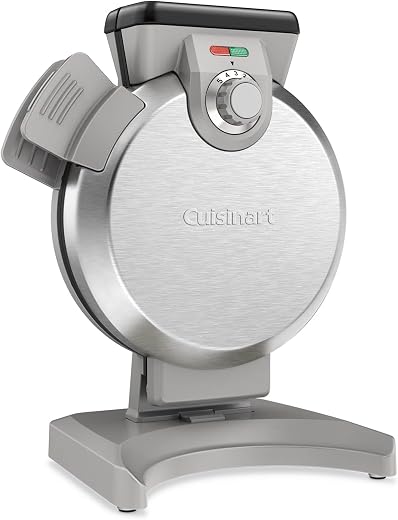
Cuisinart’s answer is to stand the iron on its end. The vertical waffle maker is filled through a spout at the top with a supplied measuring cup, so the batter flows down into a sealed cavity instead of spreading across an open plate. It costs noticeably more than a flat iron and takes up a narrower but taller footprint, which is the trade the rest of this review is about.
In short: the vertical waffle maker earns 8.5/10 from the Blue Rays Technologies team. The rest of this review sets out exactly how that score was reached.
What is in this vertical waffle maker review
Key Specifications
Published specifications for the vertical waffle maker, taken from the manufacturer listing.
| Reviewed model | vertical waffle maker |
| Brand | Cuisinart |
| Model number | WAF-V100P1 |
| Style | Round vertical Belgian |
| Browning settings | 5 |
| Wattage | 120 watts |
| Voltage | 120 V (US) |
| Dimensions | 7″D x 9″W x 12″H |
| Weight | 3.18 kg |
| Cover material | Brushed stainless steel |
| Non-stick plates | Yes |
| Included | Batter measuring cup and recipes |
| Indicators | Ready-to-bake and ready-to-eat lights plus audible beeps |
| Warranty | Limited 3-year |
| Amazon rating | 4.5 / 5 from 6,032+ ratings |
Everything that follows is based on those published figures for the vertical waffle maker, together with aggregated owner feedback from verified buyers.
How a Vertical Waffle Maker Changes the Pour
The measuring cup is the part people underestimate. It holds exactly one waffle’s worth of batter, so the guesswork disappears entirely on the first attempt rather than after a box of ruined mix. You fill the cup, tip it into the spout, and the iron does the distributing.
Because the cavity is enclosed and stood on its end, batter reaches the edges under its own weight instead of being squashed outward by a closing lid. The practical result is a waffle with a consistent depth from the middle to the rim, and pockets that are the same size at the edge as they are in the centre. On a flat iron the outer ring is almost always shallower.
There is a second, quieter benefit: nothing drips. A flat iron sheds batter down its front edge onto the counter every few waffles, and that batter carbonises on the outside of the casing where it is awkward to reach. The vertical design puts the only opening at the top, above the cooking surface, so spills land in the cup rather than on the worktop.
Browning Control, Indicator Lights and Timing
Five browning settings is the right number. One and two produce a pale, soft waffle that suits a child’s breakfast or anything going under ice cream; four and five produce the crisp shell that holds up under syrup without collapsing. Three is the everyday setting and is where most owners appear to leave it.
The indicator system is the feature that stops the machine needing supervision. A ready-to-bake light tells you the plates have reached temperature, and a ready-to-eat light plus an audible beep tells you the cycle is done. That matters more on a vertical iron than a flat one, because you cannot peek at the colour without tipping the whole unit over.
Cycle time in practice is roughly four to six minutes depending on the setting, which is ordinary for a 120-watt Belgian iron. This is not a machine that keeps up with a table of six in real time; it is a machine that produces one very good waffle at a time. If you are cooking for a crowd, warm the finished waffles in a low oven rather than trying to rush the setting.
Build Quality, Footprint and Storage
The brushed stainless cover is the reason the machine looks like a small appliance rather than a novelty. It is a genuine metal shell rather than a chrome-effect plastic, and it stays clean with a wipe. At 3.18 kg it is heavy enough to stay put while you tip batter into it, which is not a given with taller appliances.
The footprint is the interesting part. At 7 by 9 inches it takes up less counter area than most flat Belgian irons, but it needs 12 inches of vertical clearance, so it will not slide under a wall cabinet with the lid closed. If your counter space is under a cupboard run, measure before you buy — that single dimension is the most common regret in owner feedback.
Storage is a wash. A flat iron stores on its edge in a cupboard; this one stores upright, occupying the same sort of volume. There is no cord wrap on the base, which is a small omission on a machine at this price.
Limitations and Compromises
No product is right for everyone, and these are the places where the vertical waffle maker asks something back from the buyer.
The price is the headline compromise. This costs roughly two to three times what a competent flat Belgian iron costs, and it makes one waffle at a time while doing it. The engineering is real, but so is the arithmetic: if you make waffles four times a year, a thirty-dollar iron will not disappoint you.
The plates are fixed and non-removable, so the cavity is cleaned in place with a damp cloth and a brush rather than in the sink. That is the standard arrangement for waffle irons, but it does mean anything that leaks past a full cup has to be reached with a skewer and a cloth.
It is a single-waffle machine with no rotation and no second cavity. There is no way to shorten the queue, and at four to six minutes a waffle a family breakfast is a twenty-minute exercise. A twin flat iron is faster for the same money.
The 12-inch height matters twice over: once for counter clearance and once for the pour. Filling the spout on a machine that is already 12 inches tall means lifting the measuring cup to roughly chest height, which is awkward for anyone working from a seated position or a lowered worktop.
Cleaning, Seasoning and First Use
Getting the best out of the vertical waffle maker over a long life comes down to a few simple habits.
Run the first cycle empty with the setting at three, with a window open. Every new non-stick appliance has a manufacturing residue that burns off on the first heat, and doing it without batter means the first waffle is not the one that tastes of factory.
Clean the cavity while it is warm rather than cold or hot. A folded paper towel run around the pockets lifts the crumbs before they set; a cloth dampened with warm water takes the rest. Never use a metal implement or an abrasive pad, because a scratch in the non-stick coating is where every subsequent waffle will stick.
Wipe the stainless cover with the grain, not across it. Brushed stainless holds fingerprints and shows circular marks if you polish it in circles, which is cosmetic rather than functional but is easy to avoid.
Do not store it with the plates pressed shut on a damp cloth or a paper towel. Trapped moisture against a warm non-stick plate is the one habit that shortens the coating’s life, and the cavity should simply be left to air.
Who Should Buy It?
The vertical waffle maker suits some households far better than others. It is a clear buy if you recognise yourself here:
- You make waffles often enough that consistency matters more than the purchase price
- You are tired of batter overflowing the seam and burning onto a hinge
- You want edge-to-edge pockets rather than a thin outer ring
- You have 12 inches of vertical clearance on the counter you plan to use
- You want a metal-bodied appliance with a three-year warranty rather than a plastic one
The vertical waffle maker is the wrong purchase if any of the following apply:
- You make waffles a handful of times a year, where a thirty-dollar flat iron is the honest answer
- You need to feed four or more people at once and cannot warm waffles in the oven
- Your counter sits under a wall cabinet with less than a foot of headroom
- You want removable, dishwasher-safe plates, which this design cannot offer
The Verdict
This is a real engineering answer to a real annoyance rather than a gimmick with a novel shape. Standing the iron on its end and filling it through a measured spout removes overflow, removes the thin outer ring, and removes the guesswork about how much batter a cavity takes. Everything downstream of that — the browning range, the indicator lights, the metal shell — is competent rather than remarkable, and it does not need to be more than competent because the pour is the thing that was broken.
The score is held below nine by price and throughput. It costs what two flat irons cost and makes half as many waffles per hour as a twin, and the 12-inch height rules out a meaningful number of kitchens before the box is even opened. A 4.5 average across more than six thousand ratings suggests owners who cleared those two hurdles are happy.
Review score for the vertical waffle maker: 8.5/10. Strong on consistency, build and mess control; the compromise is price, a one-at-a-time cycle and a footprint that needs vertical room. Blue Rays Technologies researches independently and earns a commission from qualifying purchases, which never affects the score.
If you want to see the current price, the full options and the latest buyer feedback, it is listed as the Cuisinart WAF-V100P1 Belgian Waffle Maker on Amazon. For the food-safety side of any batter containing raw egg, the federal guidance on cooking to a safe minimum internal temperature is set out by FoodSafety.gov.
Frequently Asked Questions
The questions buyers ask most often about the vertical waffle maker, answered plainly.
Does a vertical waffle maker really stop batter overflowing?
Largely, yes, and for a structural reason rather than a marketing one. The batter enters a closed cavity through a spout above the cooking surface, so there is no seam being squeezed shut on a puddle. Overflow is still possible if you ignore the supplied measuring cup and pour freehand, which is the one way to defeat the design.
How long does one waffle take?
Roughly four to six minutes from the ready-to-bake light, depending on which of the five browning settings you use. The audible beep and the ready-to-eat light mean you do not have to stand over it, but there is no way to run two waffles at once.
Can the plates be removed for washing?
No. The cavity is fixed and is cleaned in place with a damp cloth while still warm. That is normal for waffle irons at every price, but it is worth knowing before you buy if you were expecting dishwasher-safe plates.
Will it fit under a kitchen wall cabinet?
Only if you have more than 12 inches of clearance. The machine is 12 inches tall, and you also need room above that to tip a measuring cup into the spout. Measure the gap between worktop and cupboard before ordering — it is the most common complaint from otherwise satisfied owners.
Related Reviews
If the vertical waffle maker is not quite the right fit, these Blue Rays Technologies reviews cover the nearest alternatives.
- Cuisinart Fondue Set review — the same brand’s other table appliance
- Philips 3300 Espresso Machine review — a bigger breakfast-counter investment
- Bamboo Cutting Board review — prep space for everything that goes alongside
Last updated: 29 August 2026. Pricing and availability for the vertical waffle maker change frequently; check the retailer listing for the current figure.
User Reviews
Be the first to review “Cuisinart Vertical Waffle Maker Review — Best Belgian Waffle Iron for Even Batter?”
Related Products

$93.62

There are no reviews yet.