
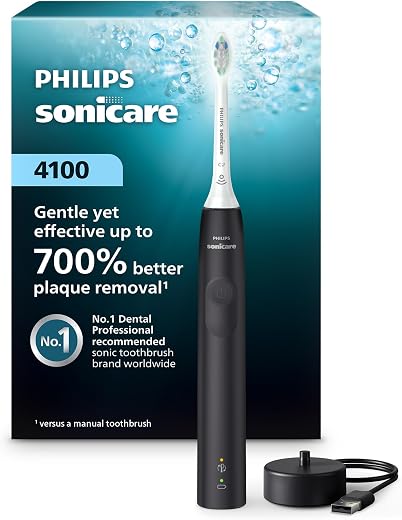
Philips Sonicare 4100 Review — Best Entry Sonic Toothbrush Under $40?
Philips Sonicare 4100 Review (2026) — Is the Cheapest Sonicare the Right One?
Electric toothbrush ranges are built to make you buy up. The entry model is deliberately stripped, the flagship carries an app, a travel case, five modes and a price four times higher, and the marketing implies the gap between them is the gap between clean teeth and dirty ones. Dental evidence does not support that. What has been repeatedly shown to matter is brushing for two minutes, twice a day, without pressing hard.
That is a useful lens for this brush, because the Philips Sonicare 4100 does exactly those three things and stops. It has one cleaning mode, two intensity levels, a timer that paces you around the mouth, a pressure sensor that warns you when you push, and roughly a fortnight of battery. It costs around $40, sits at 4.4 stars across nearly 23,000 Amazon ratings, and the question worth answering is what you actually lose by not spending more.
In short: the Philips Sonicare 4100 earns 8.9/10 from the Blue Rays Technologies team. The rest of this review sets out exactly how that score was reached.
What is in this Philips Sonicare 4100 review
- Key Specifications
- What the Philips Sonicare 4100 Actually Does Differently
- The Timer, the Battery and Everyday Use
- What You Give Up Against the 5100, 6500 and DiamondClean
- Limitations and Compromises
- Brush Head Changes, Charging and Cleaning
- Who Should Buy It?
- The Verdict
- Frequently Asked Questions
- Related Reviews
Key Specifications
Published specifications for the Philips Sonicare 4100, taken from the manufacturer listing.
| Reviewed model | Philips Sonicare 4100 |
| Brand | Philips |
| Range | Sonicare 4100 Series |
| Technology | Advanced Sonic, fluid-driven cleaning |
| Cleaning modes | 1 (Clean) |
| Intensity settings | 2 |
| Pressure sensor | Yes, vibration alert |
| Timer | SmarTimer 2 minutes with QuadPacer 30-second intervals |
| EasyStart | Ramps power over the first 14 uses |
| Battery life | Up to 14 days on a full charge |
| Charging | Charging base included |
| Brush head | 1 x C2 Optimal Plaque Control |
| Replacement reminder | Yes, tracks time and pressure |
| Claimed performance | Up to 700% better plaque removal than a manual brush |
| Colour | Black |
| Amazon rating | 4.4 / 5 from 22,820+ ratings |
Everything that follows is based on those published figures for the Philips Sonicare 4100, together with aggregated owner feedback from verified buyers.
What the Philips Sonicare 4100 Actually Does Differently
Sonic brushing is not the same mechanism as an oscillating-rotating brush. The head vibrates at high frequency along its length rather than spinning, and the claim Philips makes for it is fluid dynamics: the vibration drives toothpaste and saliva between the teeth and along the gumline, so some cleaning happens slightly beyond where the bristles physically touch. In use it feels less aggressive than a rotating head and produces noticeably more foam.
The pressure sensor is the feature that most justifies the purchase, and it is the one most people ignore in the specification list. Pressing too hard is the single most common brushing fault, it abrades enamel and recedes gums over years, and almost nobody can tell they are doing it. When you push, the brush changes its vibration to tell you, and after about a fortnight you stop doing it. That is a real long-term benefit rather than a feature.
EasyStart is a smaller idea done well: for the first fourteen uses the brush runs below full power and steps up gradually. It exists because people who move from a manual brush find full sonic power unpleasant and abandon the brush in the first week. Fourteen uses is enough to acclimatise, and it turns itself off afterwards without any input.
The Timer, the Battery and Everyday Use
SmarTimer runs for two minutes and stops; QuadPacer pulses every thirty seconds so you move to the next quadrant of the mouth. The two together produce the behaviour dentists actually ask for, which is even time across all four quadrants rather than ninety seconds on the front teeth and thirty seconds on everything else. It takes about a week to stop resenting it.
Battery life is quoted at fourteen days on two two-minute brushes a day, and owner reports broadly agree, with three weeks common at the lower intensity setting. That is a fortnight of not thinking about it, which is the practical difference between a rechargeable brush that gets used and one that ends up flat in a drawer. There is no travel case and no USB charging, so the charging base has to travel with it.
The handle is slim, matte and unfussy, and it is the same physical size as more expensive models in the range, which means every Sonicare click-on head fits it. That compatibility matters more than it sounds, because head price rather than handle price is what determines the real cost of owning an electric toothbrush.
What You Give Up Against the 5100, 6500 and DiamondClean
Modes. The 4100 has one cleaning mode where the 6500 has three and the DiamondClean has four or five depending on the bundle. Gum Care and Whitening modes are variations in intensity and duration rather than different mechanisms, and the clinical case for them over a well-executed two-minute clean is thin. If you have specific gum sensitivity, they are worth having; otherwise they are the definition of a feature you use twice.
App connectivity. The premium models pair by Bluetooth and map where you have brushed. It is genuinely interesting for a fortnight and genuinely useful for children learning technique, and after that most adults stop opening the app. It is also the feature that most inflates the price.
Accessories. Higher models come with a travel case, sometimes a charging glass, and more heads in the box. Those are real conveniences and they are worth roughly what they cost, but none of them changes how clean your teeth are. A second brush head bought separately costs less than the price step to the next model.
Limitations and Compromises
No product is without compromise, and the Philips Sonicare 4100 has a few worth knowing before you buy.
One brush head in the box is stingy at this price, and Sonicare heads are not cheap — a genuine C2 replacement runs $8 to $12 depending on the pack size, and they are meant to be changed every three months. Budget for heads as a running cost of about $40 a year, because that, not the handle, is where the money goes.
There is no travel case and no USB or magnetic charging, so a weekend away means either packing the plastic charging base or trusting the remaining battery. With a fortnight of runtime that is usually fine, but it is the most obvious corner cut.
The single intensity step down helps sensitive users but does not go very low, and people with genuinely sensitive gums sometimes find even the reduced setting uncomfortable for the first fortnight. EasyStart mitigates this at the start, but it is a one-time ramp rather than a permanent gentle mode.
Brush Head Changes, Charging and Cleaning
Getting the best out of the Philips Sonicare 4100 over a long life comes down to a few simple habits.
Change the head every three months, or sooner if the bristles splay. The built-in reminder tracks both time and how hard you brush, and it is worth obeying — a worn head cleans measurably worse and the bristle flaring is usually visible before the reminder triggers.
Rinse the head and the metal shaft after every use and shake the water off before the handle goes back on the base. Toothpaste sludge collecting where the head meets the handle is the single most common cause of a brush that starts to smell, and it takes ten seconds a day to avoid.
Run the battery down fully every few months rather than leaving it permanently docked. Lithium cells in toothbrushes tolerate constant charging well, but a full discharge cycle occasionally keeps the charge indicator honest, and it is also how you find out what your real battery life is.
Who Should Buy It?
The Philips Sonicare 4100 suits some households far better than others. It is a clear buy if you recognise yourself here:
- You are moving from a manual brush and want the features that are clinically supported
- You or someone in the household presses too hard and does not know it
- You want a fortnight of battery rather than a nightly charge
- You would rather spend the difference on replacement heads than on app connectivity
- You want a handle that takes every Sonicare click-on head
The Philips Sonicare 4100 is the wrong purchase if any of the following apply:
- You specifically want gum-care or whitening modes for a diagnosed problem
- You travel constantly and need a case and USB charging in the box
- You want app-based coaching, which only the higher models provide
- You prefer the feel of an oscillating-rotating brush, which is a different mechanism entirely
The Verdict
This is the model in the range that makes the most sense for the most people. Everything with evidence behind it is present — two-minute timing, quadrant pacing, a pressure sensor and a head that gets replaced on schedule — and everything that is present mainly to justify a higher price is absent. That is an unusually honest place for a manufacturer to draw a line.
It loses marks for a single head in the box, no travel case and no USB charging, all of which are real omissions rather than imagined ones. But the running cost is the same as the flagship, the cleaning is not meaningfully different, and 4.4 stars across nearly 23,000 ratings suggests that is exactly how owners have found it.
Review score for the Philips Sonicare 4100: 8.9/10. The features that matter, none of the ones that do not, at the price where the range starts. Blue Rays Technologies researches independently and earns a commission from qualifying purchases, which never affects the score.
Current pricing, the colour options and bundle variations are on the listing for the Philips Sonicare 4100 at Amazon. For the underlying advice this brush is designed around — two minutes, twice a day, and easing off the pressure — the NHS guidance on keeping your teeth clean is the plainest free reference available.
Frequently Asked Questions
The questions buyers ask most often about the Philips Sonicare 4100, answered plainly.
Is the Philips Sonicare 4100 good enough, or should I buy the 5100 or 6500?
For most adults it is good enough. The step up buys extra cleaning modes, a travel case and, higher in the range, app connectivity. None of those changes the mechanism. If you have a specific gum condition your dentist is treating, the gum-care mode on the higher models is the one feature worth the money.
How often do the brush heads need replacing and what do they cost?
Every three months, or when the bristles splay. Genuine C2 Optimal Plaque Control heads cost roughly $8 to $12 each in multipacks, so about $40 a year. Third-party heads fit and cost less, but bristle quality and the replacement-reminder chip vary considerably.
Does it really remove 700% more plaque than a manual brush?
That is the manufacturer figure and it comes from a controlled comparison against a manual brush used to a set protocol, which is not the same as your everyday brushing. The honest summary is that a powered brush with a timer and a pressure sensor reliably outperforms most people’s manual technique, which is the claim that matters.
Can I use it with braces, implants or sensitive gums?
Sonic brushes are generally suitable for all three, and the lower intensity setting plus EasyStart makes the transition gentler. If you have recent dental work or diagnosed gum recession, ask your dentist first — that is standard advice for any powered brush rather than a caution about this one.
Related Reviews
If the Philips Sonicare 4100 is not quite the right fit, these Blue Rays Technologies reviews cover the nearest alternatives.
- Ufree Beard Trimmer review — the other rechargeable in the bathroom
- INIA Red Light Therapy Mask review — a pricier bathroom device tested
- LED Rain Shower Head review — from the same batch of bathroom picks
Last updated: 28 August 2026. Pricing and availability for the Philips Sonicare 4100 change frequently; check the retailer listing for the current figure.


There are no reviews yet.