
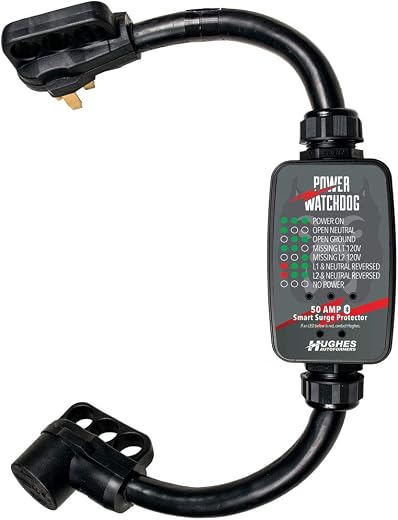
Bluetooth RV Surge Protector Review — Power Watchdog PWD50
The only unit of the five that puts live voltage, amperage and wattage on a phone, with a replaceable surge module and IP65 sealing — at $205 and a three-year warranty. Expert Score 8.2/10. Full bluetooth rv surge protector review below.
$205.00
Bluetooth RV Surge Protector Review — Power Watchdog PWD50
The only unit of the five that puts live voltage, amperage and wattage on a phone, with a replaceable surge module and IP65 sealing — at $205 and a three-year warranty. We score this bluetooth rv surge protector 8.2 out of 10.
This review is research-based. We did not physically test these products; specifications, ratings and prices are taken from the live listings on the date shown. This bluetooth rv surge protector is one of five compared in our best 50 amp rv surge protector guide.
- Bluetooth RV Surge Protector — Key Specifications
- What a Bluetooth RV Surge Protector Actually Buys You
- The Replaceable Module Cuts Both Ways
- Read the Spec Table Twice
- Bluetooth RV Surge Protector — Limitations
- Setting Up This Bluetooth RV Surge Protector
- Who Should Buy This Bluetooth RV Surge Protector?
- The Verdict
- Bluetooth RV Surge Protector — Frequently Asked Questions
Bluetooth RV Surge Protector — Key Specifications
| Specification | Detail |
|---|---|
| Reviewed model | bluetooth rv surge protector |
| Surge protection rating | 6,100 joules |
| Service rating | 50 A |
| Declared voltage (listing) | 120 |
| Weather rating | IP65 water-resistant |
| Weight | 3 pounds |
| Monitoring | Bluetooth: voltage, amperage, wattage, customisable alerts |
| Optional extra | RVWhisper add-on for Wi-Fi or cellular monitoring |
| Surge module | Replaceable after a spike |
| Warranty | 3 year manufacturer |
| Price at time of writing | $205.00 |
| Amazon rating | 4.8 out of 5 from 1,336 ratings |
| Expert Score | 8.2 / 10 |
Two further models share this one’s name and should not be confused with it. The PWD50EPO at $350.13 and the Wi-Fi-equipped PWD50EPOW at $384 both add Emergency Power Off, a manual kill switch that isolates the coach without unplugging anything. The $205 unit reviewed here does not have it, and nothing in its feature bullets draws attention to the omission.
The pricing of that single switch is worth sitting with. It is $145 to $179 for a mechanical disconnect, on a shelf where a complete electrical management system from another maker — one that opens the circuit automatically on a dozen fault conditions — costs $132.48 in total. Whether live telemetry or automatic disconnection is the better use of the same money is the real decision this category asks of a buyer.
What a Bluetooth RV Surge Protector Actually Buys You
Every other unit on this shelf shows a fault after it has happened. This one shows a number before it becomes a fault. Voltage, amperage and wattage stream to a phone over Bluetooth, and the alert thresholds are set by the owner rather than by the manufacturer.
That changes what the device is for. A protector with LEDs answers the question “is this pedestal safe to plug into?” once, at the moment of connection. A monitored unit answers “what is this pedestal doing to me right now?” continuously, which is the question that matters at a full park on a hot evening.
The reason is in the code. The National Electrical Code requires a minimum calculated load of 9,600 volt-amperes for each site with a 50-amp supply, and then applies demand factors across the park. A NEMA 14-50 socket can deliver 12,000 volt-amperes. The pedestal is permitted to offer more than the park was ever required to be able to supply to everybody at once, and the result is sag — which a number on a phone catches and a green LED does not.
The Replaceable Module Cuts Both Ways
Power Watchdog’s headline convenience is that the surge module is a serviceable part: after a spike you swap the module rather than the protector. The listing frames this as saving “time and money” and calls it a sustainable choice, and on its own terms that is fair.
Read it as an engineering statement, though, and it says something else: the sacrificial components in this device are expected to expire, and the manufacturer has designed for that eventuality rather than pretending otherwise. Every metal-oxide varistor in every product on this shelf behaves the same way. This is the only maker of the five that has built the consequence into the product.
Which makes the three-year warranty harder to accept rather than easier. At $205 this is the second most expensive unit here, and the $84.97 category reference carries a lifetime warranty on a device whose modules are not replaceable at all.
Read the Spec Table Twice
The declared voltage is 120. A 50-amp recreational vehicle supply is 125/250 volts in the code’s own words — two hot legs and a shared neutral — and the two competing units from Progressive both declare 240 volts. One field on this listing is simply describing one leg and calling it the service.
Two further fields read “One”. The colour is “One” and the entry for other special features is also “One”. These are placeholders that were never filled in, on the most expensive product in the group.
The omission that costs real money is elsewhere. Emergency Power Off — a manual kill switch — is not on this model. It is on the PWD50EPO at $350.13 and the Wi-Fi PWD50EPOW at $384. That is $145 to $179 more for one switch, and the base model’s listing does not say it is missing.
Bluetooth RV Surge Protector — Limitations
The warranty is the limitation that drives the score. Three years at $205 is the weakest warranty-to-price position of the five, and it sits beside a lifetime warranty at $84.97 from a maker whose product has 4,526 ratings to this one’s 1,336.
Bluetooth has a range. The monitoring that justifies the premium works from inside the coach and not from a restaurant in town, unless the optional RVWhisper add-on is bought as well — another purchase on top of an already high one.
Emergency Power Off is absent from this model and present on two dearer ones, and nothing in the base listing’s feature bullets says so.
Setting Up This Bluetooth RV Surge Protector
Pair the phone before the first trip, not at the pedestal in the rain. The app is where the entire value of this unit lives, and a unit whose app has never been opened is a $205 version of a $56.99 analyser.
Set the alert thresholds deliberately. The useful pair is a low-voltage alarm somewhere around 108 volts, which is where motor damage starts to be a real risk, and a wattage alarm a little under the capacity of whatever the pedestal is actually delivering.
Keep the surge module’s part number written down somewhere that is not the coach. The module is the consumable, and the time to find out how to order one is not the week after a storm.
Who Should Buy This Bluetooth RV Surge Protector?
Buy this if the monitoring is the point: long stays, hot climates, a park whose voltage you do not trust, or a coach full of equipment whose failure would cost more than the protector. The data this unit produces is genuinely unavailable from anything else here.
Do not buy it for the protection alone. At $205 with a three-year warranty you are paying a premium for telemetry, and if nobody is going to read the telemetry, the lifetime-warranty unit at $84.97 or the hardwired electrical management system at $132.48 are both better purchases.
The Verdict
8.2Expert Score
This is the most informative device on the shelf and the only one that answers the question that actually destroys appliances — what is the voltage doing over hours, not at the moment of plugging in. The replaceable module is a real piece of engineering honesty and the 4.8 rating from 1,336 owners is the best on the page.
It is held back by its commercial terms rather than its hardware: three years of warranty at $205, Emergency Power Off reserved for a $350 sibling, and a spec table with placeholder text in it. Score: 8.2 out of 10.
Best for: Live monitoring — Live voltage, amperage and wattage readable on a phone, with customisable alert thresholds.
Skip if: Three-year warranty at $205, against a lifetime warranty at $84.97 from the category reference.
Bluetooth RV Surge Protector — Frequently Asked Questions
Is a Bluetooth RV surge protector worth the extra money?
It is worth it if the numbers get read. Continuous voltage and wattage data catches the slow sag at a crowded park, which is the fault most likely to damage a compressor and the one a fault LED never reports. If the app will not be opened, the money is better spent on warranty.
Does the PWD50 have an Emergency Power Off switch?
No. Emergency Power Off is on the PWD50EPO at $350.13 and the PWD50EPOW at $384. The base PWD50 at $205 does not have it, and the feature bullets do not mention the omission.
What happens after a surge — does the whole unit need replacing?
No, and that is the design’s main advantage. The surge module is a replaceable part, so a spike costs a module rather than a protector.
How far does the Bluetooth reach?
Far enough to read from inside the coach, not far enough to read from town. The optional RVWhisper add-on moves monitoring onto Wi-Fi or cellular for owners who need it remotely.
Where to Buy
Where to Buy — Power Watchdog PWD50
Disclosure: this page contains affiliate links. If you buy through them we may earn a commission at no extra cost to you. Prices and ratings were read from the live Amazon listing on 1 October 2026 and change without notice.



There are no reviews yet.