
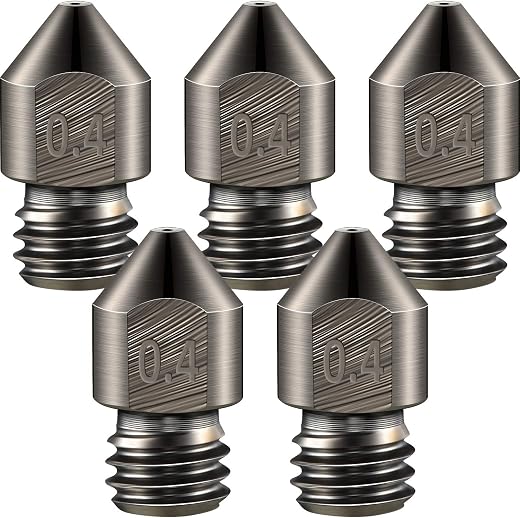
Choosing a 3d printer nozzle looks like the simplest decision in consumer 3D printing and is one of the few that quietly ruins prints for months. The number on the box is a nominal diameter, not a measurement, and the material it is cut from decides how long it stays that diameter. Our top pick is the Mudder hardened steel five-pack at $8.49, because it is the cheapest item here and the only one that publishes a tolerance.
The five below cover the whole shelf, from $8.49 to $28.00, and all but the FLASHFORGE assembly are MK8-pattern parts.
This comparison is research-based. We did not physically test these products; specifications, ratings and prices are taken from the live listings on the date shown. Links go to Amazon.com; UK readers can search the same models on Amazon.co.uk, where the British trade usually calls the part a hot end tip rather than a 3d printer nozzle. Forty-two listings were gathered for this guide and exactly one publishes a material property, which turned out to be the story.
3D Printer Nozzle — Quick Comparison
| # | Product | Role | Key spec | Best for | Price | Score |
|---|---|---|---|---|---|---|
| 1 | Mudder Hardened Steel 5-Pack | Best overall | Hardened tool steel, 0.4 mm, stated error under 0.02 mm | Best Overall | $8.49 | 8.6 |
| 2 | Dawnblade Tungsten Carbide | Abrasive-filament specialist | Tungsten carbide, 9 Mohs, 550 C, 130 W/m.K | Best for Abrasive Filament | $26.39 | 8.4 |
| 3 | Creality Official Brass 24-Piece | Best budget and size sampler | Brass, seven diameters 0.2 to 1.0 mm, size engraved | Best Budget | $8.79 | 8.2 |
| 4 | FLASHFORGE Adventurer 5M High-Flow Assembly | Printer-specific premium | Complete assembly, 32 mm3/s, 280 C, 3-second change | Best for Speed | $28.00 | 7.9 |
| 5 | Axeyil 45-Piece Three-Alloy Set | Starter set | Brass, stainless and hardened, nine diameters, plus tools | Best Starter Kit | $17.99 | 7.3 |
What is in this 3d printer nozzle guide
- 3D Printer Nozzle — Quick Comparison
- The 5 Best 3D Printer Nozzle Picks in 2026
- 3D Printer Nozzle — Buyer’s Guide
- What the Shelf Will Not Tell You About 3D Printer Nozzle Alloys
- US vs UK: The Same Brass, Three Different 3D Printer Nozzle Limits
- 3D Printer Nozzle — Which One Should You Buy?
- 3D Printer Nozzle — Frequently Asked Questions
- 3D Printer Nozzle — Final Thoughts
- Sources and Further Reading
The 5 Best 3D Printer Nozzle Picks in 2026
1. Mudder Hardened Steel 5-Pack — Best Overall
Price: $8.49 | Amazon rating: 4.4 from 2,186 ratings | Role: Best overall | Key spec: Hardened tool steel, 0.4 mm, stated error under 0.02 mm
Five hardened tool steel MK8 nozzles for $8.49 is the cheapest entry here and answers the category’s actual problem. Brass opens up under abrasive filament; hardened steel does not, and the listing names carbon fibre and fibreglass. It also publishes the only tolerance figure on the shelf, a stated error under 0.02 mm, because a slicer derives every extrusion width from it.
With 2,186 ratings since June 2020 it carries more buyer feedback than anything else gathered here. The gap is what the page omits: no hardness value, no maximum temperature, no expected life, and an unexplained black finish.
Best for: You print carbon-fibre or glass-filled filament on an MK8 machine and want spares on the shelf.
Skip if: Your printer uses a proprietary hotend, or you print only PLA, where brass conducts heat better.
Read the full Mudder Hardened Steel 5-Pack review →
Where to Buy — Mudder Hardened Steel 5-Pack
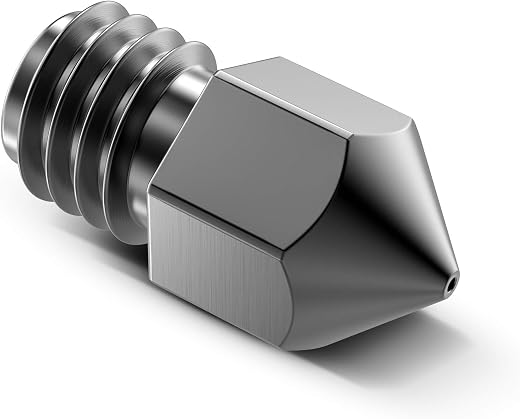
2. Dawnblade Tungsten Carbide — Best for Abrasive Filament
Price: $26.39 | Amazon rating: 4.3 from 81 ratings | Role: Abrasive-filament specialist | Key spec: Tungsten carbide, 9 Mohs, 550 C, 130 W/m.K
Of forty-two listings here, only this one publishes a material property, and it publishes four: hardness of 9 Mohs, temperature resistance to 550 degrees Celsius, thermal conductivity of 130 W/m.K and an expansion coefficient of 4.5 micrometres per metre per degree. It also gives rivals’ figures: ruby 45 W/m.K, hardened steel 26.
The price is the objection: $26.39 buys one, where the same money buys three hardened five-packs. The case is narrow — continuous abrasive printing, or PEEK where the 550-degree headroom is the point. Against that, 81 ratings is the thinnest evidence base here for a part sold on lasting, and its specification fields describe it as plumbing.
Best for: You print carbon fibre or PEEK continuously and want published numbers rather than adjectives.
Skip if: You print PLA and PETG, or you change nozzles often and occasionally clumsily.
Read the full Dawnblade Tungsten Carbide review →
Where to Buy — Dawnblade Tungsten Carbide
3. Creality Official Brass 24-Piece — Best Budget
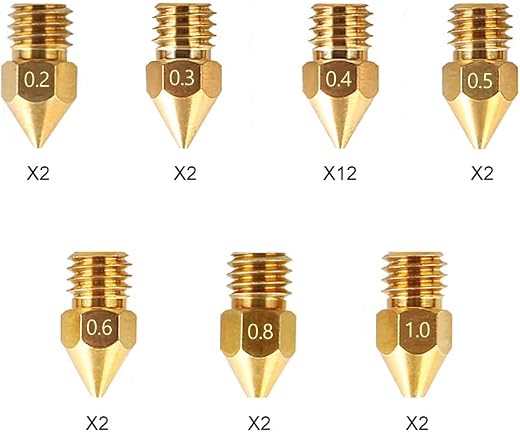
Price: $8.79 | Amazon rating: 4.7 from 1,102 ratings | Role: Best budget and size sampler | Key spec: Brass, seven diameters 0.2 to 1.0 mm, size engraved
Twenty-four brass nozzles in seven diameters for $8.79 turns orifice size into a setting. Two each at 0.2, 0.3, 0.5, 0.6, 0.8 and 1.0 mm, twelve at 0.4 mm, and — uniquely here — the diameter engraved on every body. A 0.2 mm resolves detail a 0.4 cannot; a 0.8 mm turns a nine-hour bracket into three.
It also carries the only warranty statement in the group, a stated one-year limited cover plus lifetime technical assistance. Brass conducts heat better than anything else here. What it will not do is survive abrasive filament, and the listing is honest by omission: it names only PLA and ABS.
Best for: You print mostly PLA, PETG or ABS and have never tried a diameter other than 0.4 mm.
Skip if: You run carbon-fibre or glass-filled filament, where brass wears within a few spools.
Read the full Creality Official Brass 24-Piece review →
Where to Buy — Creality Official Brass 24-Piece
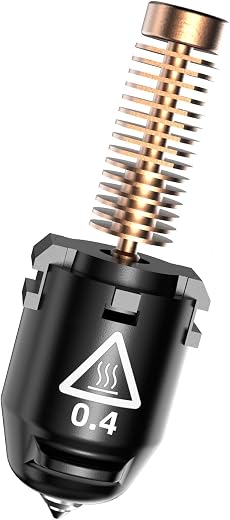
4. FLASHFORGE Adventurer 5M High-Flow Assembly — Best for Speed
Price: $28.00 | Amazon rating: 4.3 from 760 ratings | Role: Printer-specific premium | Key spec: Complete assembly, 32 mm3/s, 280 C, 3-second change
This is the only listing here that publishes the figure actually capping print speed on a modern machine: 32 cubic millimetres of molten plastic per second. A printer at 300 mm a second with a 0.2 mm layer demands roughly 24, so a hotend rated below that cannot reach its advertised speed. Being a complete assembly, it replaces the heater and thermistor with the tip.
Two things hold it to fourth. It fits only the Adventurer 5M and 5M Pro. And the durability paragraph — “The 0.6/0.8mm nozzles, constructed from high-strength materials, can withstand abrasive filaments such as carbon fiber” — is written for the two sizes you are not buying, while the 0.4 mm on sale here names no material.
Best for: You own an Adventurer 5M or 5M Pro and have hit a flow limit on a high-speed profile.
Skip if: You have any other printer, or you need the orifice material stated before you buy.
Read the full FLASHFORGE Adventurer 5M High-Flow Assembly review →
Where to Buy — FLASHFORGE Adventurer 5M High-Flow Assembly
5. Axeyil 45-Piece Three-Alloy Set — Best Starter Kit
Price: $17.99 | Amazon rating: 4.6 from 167 ratings | Role: Starter set | Key spec: Brass, stainless and hardened, nine diameters, plus tools
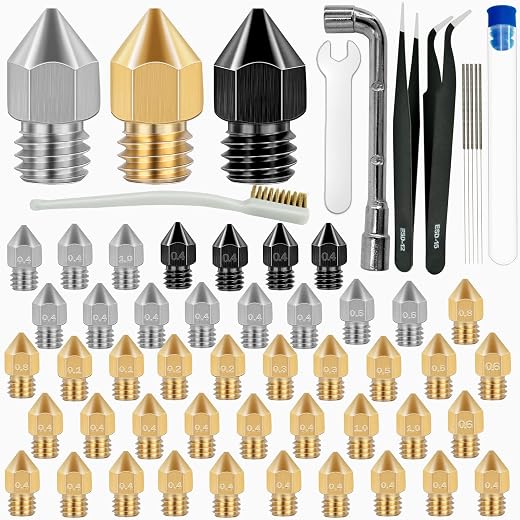
Forty-five nozzles across brass, stainless steel and hardened stainless steel, in nine diameters from 0.1 mm to 1.0 mm, with tweezers, two wrenches, five 0.15 mm needles and a brush, for $17.99. For a first printer nothing else covers as much ground, and the two wrenches matter: one holds the heater block while the other turns the orifice.
It loses marks for the thing the category turns on. Three alloys arrive with no guidance on which filament each belongs to, and nothing on the bodies identifies the material, so the four hardened nozzles become indistinguishable from the eight stainless ones. The stated item weight of 0.317 ounces is impossible for this contents list, and appears verbatim on the unrelated Mudder five-pack above.
Best for: You are setting up a first printer, own no tools, and will sort and label the contents yourself.
Skip if: You print abrasive filament and need more than four hardened nozzles, or you already own the tools.
Read the full Axeyil 45-Piece Three-Alloy Set review →
Where to Buy — Axeyil 45-Piece Three-Alloy Set
3D Printer Nozzle — Buyer’s Guide
Match the 3d printer nozzle Alloy to the Filament, Not to the Price
This decision runs the opposite way to intuition. Brass is cheapest and the best heat conductor, which is why printers ship with it. Hardened steel is dearer and conducts heat considerably worse, at 26 W/m.K by the carbide listing’s figure, but it survives the abrasive particles in filled filaments. Tungsten carbide is dearest, hardest at a stated 9 Mohs, and conducts better than steel at 130 W/m.K.
Buying steel for PLA makes prints slightly worse, not better, because the melt rate drops at the same set temperature.
3D Printer Nozzle Diameter Is a Setting, and Most Owners Never Change It
0.4 mm is the default because it balances resolution against duration, and a twenty-four-piece kit covering seven diameters costs under nine dollars. Two rules: set the diameter in the slicer to match the part fitted, and keep layer height under about three-quarters of the orifice.
What the 3D Printer Nozzle Specification Should Say and Almost Never Does
Four figures would let a buyer choose rationally: hardness on a named scale, maximum temperature, orifice tolerance, and expected life in hours or kilograms of abrasive filament. One listing of forty-two publishes the first two. One publishes a tolerance. Not one publishes a life.
Two secondary checks. Confirm the fitting: MK8 with an M6 thread covers Creality, Prusa, Anet and RepRap, while Bambu Lab and FlashForge Adventurer use proprietary assemblies no MK8 part will fit. And check whether a multipack marks its nozzles at all.
Read the 3D Printer Nozzle Rating Count Twice Before Trusting It
Amazon pools ratings across merged variations; sellers also split identical parts across fitment pages. Both distortions sit on this shelf. Two FLASHFORGE assemblies report 4.5 from exactly 585 ratings each while naming different materials and sitting $10.10 apart. In the other direction, seven tungsten carbide listings all at exactly $27.92 carry 40, 35, 32, 20, 18, 11 and 9 ratings, and an eighth at $39.77 shares a count of exactly 35 — one product presented as eight, each too thin to judge.
What the Shelf Will Not Tell You About 3D Printer Nozzle Alloys
Brass is copper and zinc. Free-machining brass, the grade used for small turned parts with fine internal features, has historically included lead to cut cleanly — and not one of the forty-two listings states an alloy designation or a lead content. Unremarkable for a bracket; less comfortable for a part heated to 250 degrees Celsius with molten polymer pushed through it, when that polymer sometimes becomes a cup or a toy.
Three regulatory regimes have put a number on lead in brass, and they disagree. In the United States, section 1417 of the Safe Drinking Water Act, as amended by the Reduction of Lead in Drinking Water Act of 2011, defines lead free as a weighted average of 0.25% lead calculated across the wetted surfaces of a pipe, pipe fitting, plumbing fitting, and fixture and 0.2% lead for solder and flux
, in force since 1 September 2020.
In Great Britain and the EU the instrument is entry 63 of Annex XVII to REACH, amended by Commission Regulation (EU) 2015/628. It restricts articles where the concentration of lead (expressed as metal) in those articles or accessible parts thereof is equal to or greater than 0,05 % by weight
, where the article may, during normal or reasonably foreseeable conditions of use, be placed in the mouth by children
— smaller than 5 cm in one dimension, which covers every nozzle here. But the same entry exempts brass alloys, if the concentration of lead (expressed as metal) in the brass alloy does not exceed 0,5 % by weight
. Ten times the general limit, and twice the American plumbing figure.
The third number is strictest and belongs to the output, not the tool. The US Consumer Product Safety Commission, under section 101 of the CPSIA, applies a total lead content limit of 100 parts per million — 0.01 per cent — to products designed or primarily intended for children 12 and younger
, in force since 14 August 2011 and down from 300 ppm. A printed toy is a children’s product; the brass that shaped it is not covered by anything.
One standard addresses desktop printing directly, and it is about air, not metal. ANSI/CAN/UL 2904, published on 5 February 2019, is a Standard Method for Testing and Assessing Particle and Chemical Emissions from 3D Printers
, written for freestanding 3D printers that are typically found in schools, offices, libraries, homes
. The research behind it identified ultrafine particles and more than 200 volatile organic compounds as emissions of concern. It is voluntary, and requires no nozzle to disclose its material.
None of this makes a brass nozzle dangerous. The finding is narrower and stranger: four different limits apply to this one metal and its output, and the part itself sits outside all four. A buyer wanting a known alloy in the melt path must buy steel or carbide.
US vs UK: The Same Brass, Three Different 3D Printer Nozzle Limits
The divergence is not about the hazard: both regimes agree lead is the hazard and regulate it by concentration. It is about the threshold, and which article it attaches to. The American figure, 0.25 per cent as a weighted average, attaches to wetted surfaces in a drinking-water system: a plumbing rule, and the one governing the brass stock a nozzle is most likely turned from. The British and European figure, 0.05 per cent by weight, attaches to any small article a child might put in its mouth — then lifts to 0.5 per cent for brass alloys, the one material this category is built from.
Two practical consequences for a UK reader buying from a US listing. Units are the obvious one: diameters are metric everywhere, but connection sizes are inches converted to millimetres. Vocabulary is the other: the part is a nozzle on both sides of the Atlantic, but the assembly it screws into is a hot end in British usage and a hotend or extruder in American.
3D Printer Nozzle — Which One Should You Buy?
Under $10 — the two that cover most owners. For PLA, PETG or ABS the Creality official brass twenty-four-piece kit at $8.79 is the best value here: seven diameters, twelve 0.4 mm spares, sizes engraved, and the only stated warranty term. The moment a spool says carbon fibre, the Mudder hardened steel five-pack at $8.49 is the upgrade, and it is cheaper.
$17 to $28 — the specialists. A first printer with no spares is best served by the Axeyil forty-five-piece three-alloy set at $17.99, if you label it on day one. An Adventurer 5M owner should buy the FLASHFORGE high-flow assembly at $28.00, the only part here publishing a flow rate, and accept that it fits nothing else.
The specialist purchase. If abrasive filament is a weekly habit, or you print PEEK, the Dawnblade tungsten carbide nozzle at $26.39 is the only product here saying what it is made of and how hard, hot and conductive that is. It costs three times the hardened steel five-pack and suits a narrow group.
This is the second guide on this site covering 3D printing consumables, and does not overlap the first. Our best filament dryer guide covers what moisture does to a spool before it reaches the extruder; this one covers what the extruder does to the orifice. No product and no source is shared: moisture is a storage problem, wear a consumable one. For power hardware, our LiPo battery charger comparison covers the same kind of unpublished-specification problem in a different workshop category.
3D Printer Nozzle — Frequently Asked Questions
What is the best 3d printer nozzle material?
It depends entirely on the filament. Brass for PLA, PETG and ABS because it conducts heat best; hardened steel the moment you print carbon-fibre or glass-filled filament; tungsten carbide if abrasive filament is a weekly habit or you need headroom above 300 degrees Celsius.
How often should you change a 3d printer nozzle?
No listing in this comparison publishes an expected life, which is the honest answer. In practice, brass on plain PLA lasts a long time, brass on carbon fibre opens measurably within a few spools, and the first symptom is dimensional drift rather than a failure.
What size 3d printer nozzle should I use?
0.4 mm as the default, because it balances detail against print duration. Go to 0.2 mm for fine detail and expect roughly four times the duration; go to 0.6 or 0.8 mm for functional parts you want finished quickly. Always set the same figure in the slicer.
Is a hardened steel 3d printer nozzle better than brass?
For abrasive filament yes, because the orifice holds its stated diameter far longer. For plain PLA it is slightly worse, because steel conducts heat considerably less well — 26 W/m.K by the figure one listing here publishes — so the melt rate drops at the same temperature.
How do you clean a 3d printer nozzle?
Heat the hot end to printing temperature and clear a partial blockage with a needle smaller than the orifice, which is why the kits here include 0.15 mm needles for a 0.4 mm hole. A needle larger than the orifice will widen it permanently. A cold pull removes degraded filament from the melt zone itself.
Will an MK8 3d printer nozzle fit my printer?
MK8 with an M6 thread covers Creality Ender and CR series, Prusa i3, Anet and RepRap machines. Bambu Lab and the FlashForge Adventurer series use proprietary nozzle or hot end assemblies, so check the fitting before ordering anything in this guide.
Is brass safe for printing food containers?
No listing here publishes an alloy composition or a lead content, so the material in the melt path is undisclosed. The regulatory section above sets out the three lead thresholds applying to brass in the US and Great Britain, and none covers this part.
3D Printer Nozzle — Final Thoughts
The buying rule for this shelf is short: buy for the alloy and the tolerance, not for the diameter on the box. Diameter is a slicer setting. Alloy decides whether the number on the box is still true in six months, and it is what the shelf is least willing to discuss.
Forty-two listings showed how little has to be published to sell a precision part. One gives four material properties and a comparison against its rivals, and it is a $26.39 specialist. One gives a tolerance, one a flow rate, one a warranty. Nobody gives a life, nobody an alloy, and a forty-five-piece kit of steel and brass claims to weigh nine grams. Against that, the hardened steel five-pack at $8.49 is the pick: cheapest here, the right material, and the only one of the five committing to a number a slicer uses.
Sources and Further Reading
- US EPA — Use of Lead Free Pipes, Fittings, Fixtures, Solder and Flux for Drinking Water: the 0.25 per cent weighted-average definition under section 1417 of the Safe Drinking Water Act, as amended in 2011.
- Commission Regulation (EU) 2015/628 — REACH Annex XVII entry 63 on lead and its compounds: the 0,05 per cent threshold for articles that may be placed in the mouth by children, and the 0,5 per cent brass-alloy exemption.
- US CPSC — New Lower Limit for Lead Content in Children’s Products: the 100 ppm total lead content limit under the CPSIA, effective 14 August 2011.
- UL — ANSI/CAN/UL 2904, Standard Method for Testing and Assessing Particle and Chemical Emissions from 3D Printers: published 5 February 2019 for printers in schools, offices, libraries and homes.
Affiliate disclosure: Blue Rays Technologies earns a commission from qualifying purchases made through links on this page. It costs nothing extra and never affects a score. Prices and ratings were read from the live listings on 7 October 2026.