
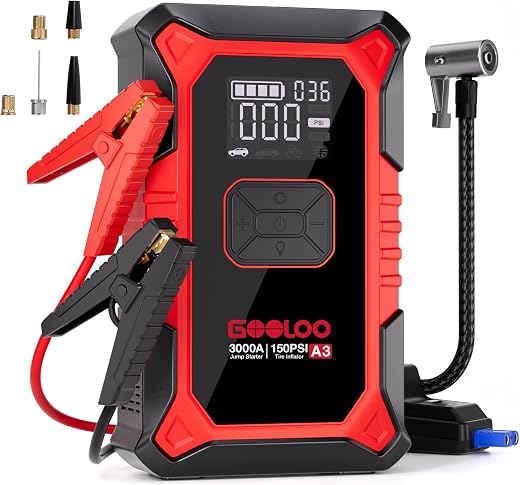
Car Jump Starter Review — GOOLOO A3 3000A With Air Compressor
A 3000-amp lithium jump pack with a built-in 150 PSI air compressor, LED light and USB output, covering the two most common roadside failures from one box. Manual BOOST handles a completely flat battery. It costs three times a basic pack and must be recharged every three months.
GOOLOO A3 3000A Review (2026) — Is a Car Jump Starter With an Air Compressor Worth $110?
Jump leads have one fatal design flaw: they require a second car, a second driver willing to stop, and enough room to park nose to nose. On a supermarket roof, in a narrow street or at six in the morning in a hotel car park, at least one of those is missing.
A car jump starter removes the other car from the equation. The GOOLOO A3 is a 3000-amp lithium pack with a built-in 150 PSI air compressor, an LED work light and USB output, which makes it the two most likely roadside failures — a dead battery and a soft tyre — answered by one object in the boot. The compromise is that it is a battery, and batteries need managing.
In short: the car jump starter earns 8.6/10 from the Blue Rays Technologies team. The rest of this car jump starter review sets out exactly how that score was reached.
What is in this car jump starter review
Key Specifications
Published specifications for the car jump starter, taken from the manufacturer listing.
| Reviewed model | car jump starter |
| Brand | GOOLOO |
| Model | A3 |
| Peak current | 3000 A |
| Battery chemistry | Lithium polymer |
| System voltage | 12 V |
| Engine limit | Up to 9.0 L petrol, 6.5 L diesel |
| Boost function | Manual BOOST button for very low battery voltage |
| Air compressor | 150 PSI maximum, 35 L/min, up to 45 minutes cordless |
| Inflation modes | SUV, car, bike, ball, custom, with 5 nozzles |
| Operating range | -4 °F to 140 °F (-20 °C to 60 °C) |
| Cycle life | 1,000+ charge cycles |
| Protections | 10, including reverse polarity, short circuit and overheat |
| Dimensions | 5.87 in W x 4.96 in D x 2.3 in H |
| Warranty | 18 months |
| Amazon rating | 4.4 / 5 from 4,487+ ratings |
Everything that follows is based on those published figures for the car jump starter, together with aggregated owner feedback from verified buyers.
What 3000 Amps Buys You
Peak amperage is the headline number on every jump pack and it is the one most often misread. It is a brief peak, not a sustained output, and what it really describes is how large an engine the pack can turn over when the vehicle’s own battery contributes nothing.
Three thousand amps covers up to a 9.0 litre petrol engine and a 6.5 litre diesel, which is far more than any car and comfortably enough for a van, a pickup or a small tractor. For a family hatchback it is substantial headroom, and headroom is what you want in February.
The BOOST button is the feature that separates a usable pack from a frustrating one. Many jump starters refuse to deliver current if they detect almost no voltage at the clamps, which is exactly the state a battery left with the lights on ends up in. BOOST overrides that check manually.
The Air Compressor Is Not a Gimmick
Combining a jump pack with a pump looks like specification padding until you consider what actually strands people. Roadside assistance data across both markets consistently puts battery failure and tyre problems at the top, and this addresses both from the same box.
The pump is a real one: 150 PSI maximum, 35 litres per minute, a digital gauge with automatic shut-off, and around forty-five minutes of continuous cordless running. The manufacturer quotes a Tesla Model 3 or Y tyre from 30 to 36 PSI in about a minute.
It also inflates bicycles, footballs and air beds with the five supplied nozzles, which means the thing you bought for an emergency earns its space in the boot on ordinary weekends too.
Cold Weather, Storage and the Honest Limits of a Car Jump Starter
The rated operating range is -4 °F to 140 °F, which covers a British winter comfortably and most American ones. Lithium cells still deliver less at the bottom of that range, so a pack stored in a freezing boot will start a car but will do it with less margin than the same pack kept indoors.
The real risk is not cold, it is neglect. A jump pack that has sat in a boot for two years without a top-up is a brick, and the manufacturer says plainly to recharge at least once every three months. That instruction is the difference between a working tool and an expensive paperweight.
It is also worth being clear that a jump pack does not fix a battery. It gets you home or to a garage. A car that needs jumping twice in a week needs a new battery or an alternator diagnosis, not a bigger pack.
Limitations and Compromises
No product is without compromise, and the car jump starter has a clear set of them.
At 110 dollars it is roughly three times the price of a basic jump pack with no pump. If you already own a good inflator, most of the premium here is redundant and a cheaper 2000-amp pack does the starting job perfectly well.
It needs quarterly attention. Lithium packs self-discharge, and the single most common failure reported for every product in this category is a pack that was flat when it was finally needed. Three months is the manufacturer’s own interval and it is not conservative.
The listing carries only five structured specification fields, so most of the detail comes from the description rather than the data sheet. For a 12 V product with clamps that is less than ideal, and the 4.4 rating reflects a small but persistent minority reporting clamp and cable quality issues.
Charging, Clamping and Using It Safely
Charge it fully before it goes in the car, and set a reminder for every three months. Storage between roughly 40 and 80 percent is kindest to a lithium pack, but a full charge you actually maintain beats a perfect regime you forget.
Connect red to the positive terminal and black to an unpainted metal earth point on the engine rather than the negative terminal where possible. Reverse-polarity protection means a mistake will not destroy the pack, but good practice keeps any spark away from the battery itself.
Let the engine run for at least twenty minutes after a successful start, or drive it. A jump gets the engine turning; only the alternator puts charge back, and switching off after two minutes puts you exactly where you started.
Who Should Buy It?
The car jump starter suits some households far better than others.
- You park where nobody can pull up nose to nose with you
- You drive an older car, or one that sits unused for weeks
- You want a pump and a jump pack in one object rather than two
- You want enough headroom for a van, a pickup or a diesel
- You want a manual boost mode for a completely flat battery
- You will actually remember to recharge it every few months
Look elsewhere if any of the following describes you.
- You already own a good tyre inflator and only need starting capacity
- You want the cheapest possible jump pack
- You will put it in the boot and never think about it again
- Your car needs jumping regularly and really needs a new battery
- You need to start a large commercial diesel above 6.5 litres
The Verdict
This is a well-judged combination. The two most common roadside failures are a flat battery and a soft tyre, and one box that answers both, with a work light and a phone charger attached, is a better use of boot space than any single-purpose alternative. Three thousand amps is generous headroom, and BOOST covers the case where cheaper packs give up.
It scores 8.6 because the price premium over a plain jump pack is real and because the whole product depends on an owner who recharges it quarterly. Neither is a design fault. Both are worth knowing before you buy, and neither changes the fact that this is the most useful single object you can leave in a car boot.
Review score for the car jump starter: 8.6/10. Strong on starting headroom, the built-in 150 PSI compressor, the manual boost mode, protections and warranty; the compromises are the price against a plain jump pack, a mandatory quarterly recharge and a thin specification listing. Blue Rays Technologies researches independently and earns a commission from qualifying purchases, which never affects the score.
If you want to see the current price, the full options and the latest buyer feedback, it is listed as the GOOLOO A3 3000A Car Jump Starter with Air Compressor on Amazon. What else belongs in the boot beside it is worth a look, and the Ready.gov guidance on car safety and vehicle emergency supplies lists the rest of a sensible kit.
Frequently Asked Questions
The questions buyers ask most often about the car jump starter, answered plainly.
How big an engine will this car jump starter handle?
Up to a 9.0 litre petrol engine or a 6.5 litre diesel, which is far more than any passenger car needs and enough for vans, pickups and small tractors.
How often does it need recharging in storage?
At least once every three months. Lithium packs self-discharge, and a pack found flat at the roadside is by far the most common complaint about every product in this category.
Does it work in cold weather?
It is rated from -4 °F to 140 °F. It will start a car at the bottom of that range, though a cold pack delivers less margin than one that has been kept indoors.
What does the BOOST button do?
It overrides the safety check that stops the pack delivering current when it detects almost no voltage at the clamps — which is exactly the state a completely flat battery is in.
Related Reviews
If the car jump starter is not quite the right fit, these Blue Rays Technologies reviews cover the nearest alternatives.
- ANKIA tire pressure valve caps review — the cheapest early warning there is
- DocSafe fireproof document box review — the other thing worth keeping safe
- CRAFTSMAN portable tire inflator review — from today’s batch
Last updated: 6 September 2026. Pricing and availability for the car jump starter change frequently; check the retailer listing for the current figure.


There are no reviews yet.