
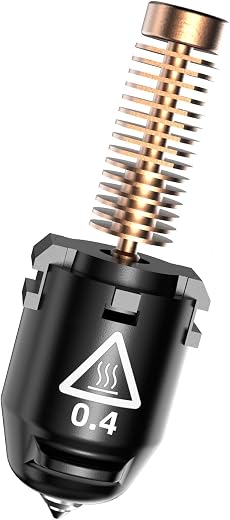
FLASHFORGE High Flow Nozzle Review (2026): Worth It?
A complete quick-release nozzle assembly for the FLASHFORGE Adventurer 5M at $28.00, rated at 32 cubic millimetres a second and 280 degrees Celsius, reaching 200 degrees in 35 seconds and changeable in three seconds without tools – and the only listing here that publishes a flow rate.
$28.00
FLASHFORGE Adventurer 5M High Flow Nozzle Review (2026): 32 Cubic Millimetres a Second
On a modern fast printer the limit is almost never how quickly the gantry can move. It is how much molten plastic the hotend can push through the hole each second, and almost nobody publishes that number.
This FLASHFORGE assembly does: 32 cubic millimetres a second, a 280 degree ceiling, 200 degrees reached in 35 seconds, and a tool-free change in three. It costs $28.00, it fits the Adventurer 5M and 5M Pro and nothing else, and it declines to say what the 0.4 mm orifice is made of.
In short: this high flow nozzle earns 7.9/10 from the Blue Rays Technologies team. The rest of this high flow nozzle review sets out exactly how that score was reached.
This review is research-based. We did not physically test these products; specifications, ratings and prices are taken from the live listings on the date shown. The full group comparison is in our Best 3D Printer Nozzle (2026): 5 Picks Compared guide.
What is in this high flow nozzle review
- Key Specifications
- What a High Flow Nozzle Assembly Changes
- The Abrasive Claim Belongs to the Sizes You Are Not Buying
- Three Assemblies, One Rating Pool, Ten Dollars Apart
- Limitations and Compromises
- Setting Up This High Flow Nozzle
- Who Should Buy This High Flow Nozzle?
- The Verdict
- High Flow Nozzle — Frequently Asked Questions
- Related Reviews
Key Specifications
Published specifications for this high flow nozzle, taken from the manufacturer listing.
| Reviewed model | high flow nozzle |
| Brand | FLASHFORGE |
| Type | Complete quick-release nozzle assembly |
| Stated flow rate | 32 cubic millimetres per second |
| Stated maximum temperature | 280 degrees Celsius |
| Stated heat-up time | 200 degrees Celsius in 35 seconds |
| Stated change time | 3 seconds, tool-free |
| Orifice diameter | 0.4 mm |
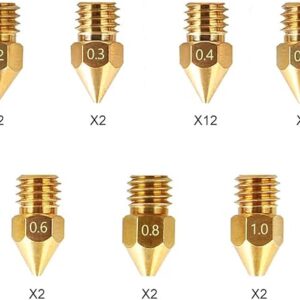
| Sizes in the range | 0.25, 0.4, 0.6 and 0.8 mm |
| Fitment | Adventurer 5M and Adventurer 5M Pro |
| Package dimensions | 3.98 x 2.87 x 2.24 in |
| Stated item weight | 1.76 oz |
| Manufacturer | Zhejiang Flashforge 3D Technology Co., Ltd. |
| Nozzle material | Not stated for the 0.4 mm size |
| First listed | 7 September 2023 |
| Amazon rating | 4.3 from 760 ratings |
| Price at review | $28.00 |
What a High Flow Nozzle Assembly Changes
A bare nozzle is a brass or steel tip you screw into an existing hotend. This is the whole front end: tip, heater and thermistor in one cartridge that releases at the press of a button in a stated three seconds. The practical consequence is that the two components that actually fail on a fast printer, the heater cartridge and the thermistor, get replaced along with the orifice, and the change happens without a hex key or a hot-tighten.
The flow figure is the reason the part exists. Thirty-two cubic millimetres per second is a volumetric rate, and it is the number that caps print speed on a modern machine far more often than motion does. A printer moving at 300 mm a second with a 0.4 mm nozzle and a 0.2 mm layer demands roughly 24 cubic millimetres a second of molten plastic, so a hotend rated below that cannot deliver the speed the machine advertises regardless of how fast the gantry moves.
The Abrasive Claim Belongs to the Sizes You Are Not Buying
This is the sharpest thing on the page, and it is easy to miss. The listing’s durability paragraph reads: “The 0.6/0.8mm nozzles, constructed from high-strength materials, can withstand abrasive filaments such as carbon fiber. They offer increased durability and broader material compatibility, capable of handling abrasive filaments for extended periods while maintaining dimensional precision.” Every word of that is about the 0.6 mm and 0.8 mm sizes.
The product on sale at this address is the 0.4 mm. It is described in its own paragraph as “a balance of versatility and performance” and “a widely used and common nozzle size”, with no material named and no durability claim made. The manufacturer has written an abrasive-filament specification for two sizes in its range and, by precise omission, declined to extend it to the third. A buyer who reads the bullet points as a block will come away believing the part they are buying is rated for carbon fibre. It is not.
Three Assemblies, One Rating Pool, Ten Dollars Apart
The same family appears three times in the forty-two listings gathered for this comparison. This one, at $28.00, carries 760 ratings. Two others carry 4.5 from exactly 585 ratings each: a 0.4 mm described as “Copper Steel” at $21.10 and a 0.6 mm described as “Hardened Steel” at $31.20. Identical rating count, identical average, two different stated materials and a $10.10 price gap.
Both of those listings have an entirely empty description field, so the only material information available is the four words in each title. A buyer comparing the three pages sees a 585-rating product at $21.10 and a 760-rating product at $28.00 and has no basis on which to choose, because the cheaper one names a material the dearer one does not and the dearer one publishes a flow rate the cheaper one does not.
Limitations and Compromises
Fitment is the hard limit. This assembly works on the Adventurer 5M and 5M Pro and nothing else. The MK8 nozzles elsewhere in this comparison fit dozens of machines across four manufacturers; this one fits two models from one. That is the trade made by every printer that moved to a proprietary quick-change front end.
No material is stated for the 0.4 mm size anywhere on the page. Given that a sibling listing in the same family explicitly names “Copper Steel” for its 0.4 mm and “Hardened Steel” for its 0.6 mm, the silence here is a genuine gap rather than an oversight, and it means the buyer cannot tell whether the part will cope with anything beyond plain filament.
At $28.00 this is the most expensive single item in the comparison, and the economics are different from a bare nozzle. A $1.70 brass tip is a consumable; a $28.00 assembly containing a heater and a thermistor is a repair part. On a machine printing abrasive filament the cost of ownership is set by how often the orifice wears, and with no material published that cannot be estimated.
Setting Up This High Flow Nozzle
There is no hot-tighten and no hex key. The assembly releases with a button and seats with a push, and the listing states the change takes three seconds. Let the hotend cool to a safe temperature before touching it regardless of what the mechanism allows.
Set the correct diameter in the slicer after a change. The range covers 0.25, 0.4, 0.6 and 0.8 mm, and the whole point of a three-second swap is that changing size becomes routine, which makes mismatched slicer settings the most likely error rather than a rare one.
Raise the volumetric limit in the slicer if you want the flow rate you paid for. Most profiles ship with a conservative maximum volumetric speed, and a hotend rated at 32 cubic millimetres a second will sit idle behind a 12 cubic millimetre profile limit. The figure to change is maximum volumetric speed, not print speed.
Who Should Buy This High Flow Nozzle?
This one suits some workshops far better than others.
- You own a FLASHFORGE Adventurer 5M or 5M Pro
- You want the published flow rate rather than an implied one
- You change nozzle diameter often and want it to take seconds
- You would rather replace heater and thermistor with the tip
- You print ABS, ASA or PETG and want the 280 degree ceiling
- You run high-speed profiles and have hit a flow limit
Look elsewhere if any of the following describes you.
- You have any printer other than the Adventurer 5M family
- You want the lowest cost per orifice
- You print carbon fibre, for which this size makes no claim
- You need a stated nozzle material before buying
- You are happy at moderate speeds with a bare brass tip
The Verdict
For an Adventurer 5M owner this is the part the machine was designed around, and it is the only product in the comparison that publishes the figure most buyers should care about: how much molten plastic it can actually deliver per second. The three-second tool-free change and the 35-second heat-up are real conveniences, not marketing.
It scores 7.9 on three counts: it fits two printers, it is the most expensive item here, and it declines to say what the 0.4 mm orifice is made of while making an abrasive-filament claim for the two sizes next to it on the same page. The hardware looks right; the page does not quite tell you what you are buying.
Review score for this high flow nozzle: 7.9/10. Strong on published flow rate, heat-up time, change mechanism and temperature ceiling; the compromises are a single-family fitment, the highest price in the group, no stated orifice material and an abrasive-filament claim written for the other sizes. Blue Rays Technologies researches independently and earns a commission from qualifying purchases, which never affects the score.
If you want the current price and the latest buyer feedback, it is listed as the FLASHFORGE high flow nozzle on Amazon. For the regulatory background on nozzle alloys, the EPA definition of lead free under the Safe Drinking Water Act sets the American figure at a weighted average of 0.25 per cent.
High Flow Nozzle — Frequently Asked Questions
The questions buyers ask most often about this high flow nozzle, answered plainly.
What does a high flow nozzle actually do?
It raises the volume of molten plastic the hotend can deliver per second, which is the limit that caps print speed on a fast machine more often than motion does. This one is rated at 32 cubic millimetres a second.
Will this fit any other printer?
No. It is a proprietary assembly for the FLASHFORGE Adventurer 5M and 5M Pro. The MK8 nozzles elsewhere in this comparison fit a much wider range of machines.
Can I print carbon fibre with it?
The listing makes its abrasive-filament claim for the 0.6 mm and 0.8 mm sizes in the range, not for the 0.4 mm sold here, and names no material for this size. On the page as written, the answer is that it does not say.
Is it worth $28 when a brass nozzle costs under a dollar?
It is a different part. This replaces the heater and thermistor as well as the orifice, and it publishes a flow rate and a temperature ceiling. For a bare tip on an MK8 machine, the brass or hardened steel picks here cost a fraction as much.
Related Reviews
If this high flow nozzle is not quite the right fit, these Blue Rays Technologies reviews cover the nearest alternatives.
- Mudder hardened steel nozzle review — best overall in this group
- Dawnblade tungsten carbide nozzle review — abrasive-filament specialist in this group
- Sovol SH01 filament dryer box review — the other half of keeping an extruder working
Last updated: 7 October 2026. Pricing and availability for this nozzle change frequently; check the retailer listing for the current figure.



There are no reviews yet.