Mudder Hardened Steel Nozzle Review (2026): Worth It?
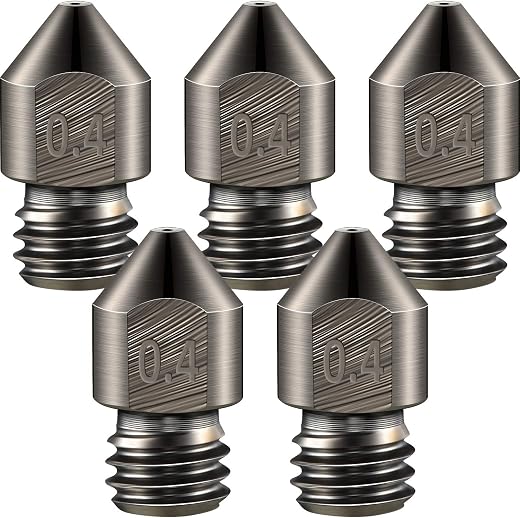
Five hardened tool steel MK8 nozzles at 0.4 mm for $8.49, with a stated diameter error under 0.02 mm, rated for abrasive filaments including carbon fibre and fibreglass, and carrying the largest rating count of any nozzle listing in this comparison at 2,186.
$8.49
Mudder Hardened Steel Nozzle Review (2026): Five MK8 Nozzles for $8.49
Every consumer 3D printer ships with a brass nozzle, and brass is soft. The moment a spool of carbon-fibre-filled filament goes through it, the 0.4 mm hole starts becoming a 0.45 mm hole, and nothing on the machine tells you.
This listing answers that with five hardened tool steel MK8 nozzles for $8.49, rated by its own copy for carbon fibre and fibreglass, with a stated diameter error under 0.02 mm. It is the cheapest of the five products in this group and it carries 2,186 ratings, more buyer feedback than any other nozzle listing gathered for the comparison.
In short: this hardened steel nozzle earns 8.6/10 from the Blue Rays Technologies team. The rest of this hardened steel nozzle review sets out exactly how that score was reached.
This review is research-based. We did not physically test these products; specifications, ratings and prices are taken from the live listings on the date shown. The full group comparison is in our Best 3D Printer Nozzle (2026): 5 Picks Compared guide.
What is in this hardened steel nozzle review
- Key Specifications
- What a Hardened Steel Nozzle Actually Buys You
- The One Number This Listing Publishes, and the Ones It Does Not
- The Rating Pool Is the Strongest Evidence on This Shelf
- Limitations and Compromises
- Setting Up This Hardened Steel Nozzle
- Who Should Buy This Hardened Steel Nozzle?
- The Verdict
- Hardened Steel Nozzle — Frequently Asked Questions
- Related Reviews
Key Specifications
Published specifications for this hardened steel nozzle, taken from the manufacturer listing.
| Reviewed model | hardened steel nozzle |
| Brand | Mudder |
| Material | Hardened tool steel |
| Orifice diameter | 0.4 mm |
| Filament inlet | 1.75 mm |
| Stated diameter error | Less than 0.02 mm |
| Fitting standard | MK8 |
| Quantity | 5 pieces |
| Finish | Black |
| Product dimensions | 2.68 x 2.05 x 0.43 in |
| Stated item weight | 0.317 oz |
| Manufacturer | Mudder |
| Model number | YL-Mudder-0225 |
| Stated compatibility | MK8 hotends: Ender-2, Ender-3, Ender-3 Pro, Ender-5, CR-10 all-metal hotend, Prusa i3, Anet A8, RepRap |
| Stated filaments | 1.75 mm filaments including carbon fibre and fibreglass |
| First listed | 10 June 2020 |
| Amazon rating | 4.4 from 2,186 ratings |
| Price at review | $8.49 |
What a Hardened Steel Nozzle Actually Buys You
Brass is the default because it conducts heat well and machines to a clean orifice cheaply. It is also soft. Carbon-fibre, glass-filled and metal-filled filaments carry abrasive particles through a 0.4 mm hole under pressure, and the hole grows. A nozzle that has opened from 0.4 mm to 0.5 mm does not announce itself; it quietly widens extrusion lines, loses dimensional accuracy on small features and starts producing walls that are thicker than the slicer intended.
This listing is made of hardened tool steel and says so in its first line, together with the claim of “good abrasion resistance, heat resistance and corrosion resistance” and the statement that the material “has higher toughness and hardness” than the standard alternative. It names the filaments that justify the upgrade: “filaments of carbon fiber, fiberglass, etc.” That is the correct reason to buy this part, and it is the reason the listing gives.
The One Number This Listing Publishes, and the Ones It Does Not
The listing states that the “extruder nozzle diameter error less than 0.02 mm”. On a 0.4 mm orifice that is a five per cent tolerance, and it is the only dimensional commitment on the page. It matters more than it sounds: a slicer is told the nozzle is 0.4 mm and calculates every extrusion width from that figure, so a nozzle 0.02 mm out is a five per cent error applied to every line in the print.
What is absent is everything that would let a buyer compare one hardened nozzle with another. There is no hardness value on any scale. There is no maximum temperature, which is the figure that decides whether the part can run PEEK or polycarbonate at all. There is no expected life in printing hours or kilograms of abrasive filament. The listing also describes the pieces as “black MK8 nozzles” without explaining what makes them black, and a surface treatment that is not named cannot be assessed.
The Rating Pool Is the Strongest Evidence on This Shelf
Across the forty-two nozzle listings gathered for this comparison, this one holds the largest rating count at 2,186, and it has been on sale since 10 June 2020. Five and a half years of buyer feedback on a consumable part is a different quality of evidence from a six-month-old listing with thirty reviews, because a nozzle’s only real failure mode is slow wear and slow wear takes months to show up in a review.
The average is 4.4, the joint-lowest of the five picks here, and that is worth stating plainly rather than hiding. On a part this cheap, sold in fives, a proportion of one-star reviews is what a large honest sample looks like. A 4.8 average from forty buyers tells you considerably less.
Limitations and Compromises
The word hardened is doing a lot of work. Tool steel covers a wide range of alloys and hardnesses, and without a figure a buyer cannot tell whether this is a genuine abrasive-filament part or a mild improvement on brass. The listing’s own comparison is relative: “higher toughness and hardness” than brass, which is a low bar.
Steel conducts heat far worse than brass. The tungsten carbide listing in this comparison publishes the figures for all three materials and puts hardened steel at 26 W/m·K against brass at a far higher value, which means a steel nozzle melts filament more slowly at the same set temperature. Nothing on this listing mentions that trade-off, and buyers moving from brass should expect to raise the nozzle temperature slightly or slow down.
The stated item weight of 0.317 ounces, about nine grams, appears verbatim on a completely unrelated fifty-piece nozzle kit from a different manufacturer in this same comparison. One of the two figures is wrong, and there is no way to tell which from the listing alone.
Setting Up This Hardened Steel Nozzle
Replacing a nozzle is a hot operation. The filament inside the melt zone has to be molten for the old nozzle to come free without tearing the thread, so the standard sequence is to heat the hotend to printing temperature, retract the filament, then loosen the nozzle while it is hot using a socket or spanner on the hex flats rather than pliers on the body.
These are MK8 nozzles with an M6 thread, which is the most common fitting in consumer printing and is listed here as compatible with Ender-2, Ender-3, Ender-3 Pro, Ender-5, the CR-10 all-metal hotend, Prusa i3, Anet A8 and RepRap machines. Check that your hotend is MK8 before ordering: Bambu Lab, FlashForge Adventurer and most 2024-onward machines use proprietary assemblies that this part will not fit.
After fitting, re-level the bed and re-run the first-layer calibration. A new nozzle is almost never seated at exactly the same height as the one it replaced, and the difference is larger than the first layer.
Who Should Buy This Hardened Steel Nozzle?
This one suits some workshops far better than others.
- You print carbon-fibre, glass-filled or wood-filled filament
- You have a Creality, Prusa, Anet or RepRap machine with an MK8 hotend
- You want spares on the shelf rather than one nozzle and a cleaning needle
- You would rather replace a worn nozzle than try to recover it
- You want the largest body of buyer evidence available on this shelf
- You accept a slightly slower melt in exchange for a hole that stays 0.4 mm
Look elsewhere if any of the following describes you.
- Your printer uses a proprietary hotend assembly rather than MK8
- You only print PLA and PETG, where brass is the better-conducting choice
- You need a published hardness or temperature rating for a documented process
- You print at above 280 degrees, where no figure here covers you
- You want one premium nozzle rather than five mid-priced ones
The Verdict
This is the pick that makes the least sense to argue with. It is the cheapest of the five products in this comparison at $8.49, it is made of the material that solves the problem the category exists to solve, it publishes the one tolerance figure that affects every line of every print, and it carries more buyer feedback than any other listing gathered here.
It scores 8.6 rather than higher because of what the listing does not say. A hardness value, a maximum temperature and an expected life would turn a good buy into a documented one, and all three are missing. The score reflects a part that is almost certainly right for most buyers and a page that does not prove it.
Review score for this hardened steel nozzle: 8.6/10. Strong on material, price, tolerance and evidence; the compromises are an unquantified hardness claim, no stated temperature ceiling, no published service life and slower heat transfer than brass. Blue Rays Technologies researches independently and earns a commission from qualifying purchases, which never affects the score.
If you want the current price and the latest buyer feedback, it is listed as the Mudder hardened steel nozzle on Amazon. For the regulatory background on nozzle alloys, the EPA definition of lead free under the Safe Drinking Water Act sets the American figure at a weighted average of 0.25 per cent.
Hardened Steel Nozzle — Frequently Asked Questions
The questions buyers ask most often about this hardened steel nozzle, answered plainly.
Is a hardened steel nozzle better than brass?
For abrasive filament, yes, because the orifice stays at its stated diameter far longer. For plain PLA and PETG, brass conducts heat better and is the sensible default. The honest answer is that the material should follow the filament.
How long does a hardened steel nozzle last?
This listing does not say, and neither does any other listing in this comparison. The absence is the finding: no manufacturer on this shelf publishes an expected life in hours or kilograms.
Will these fit a Bambu Lab or FlashForge printer?
No. These are MK8 nozzles with an M6 thread, listed for Creality, Prusa, Anet and RepRap machines. Bambu Lab and the FlashForge Adventurer series use proprietary nozzle assemblies.
Do I need to change my slicer settings after fitting one?
Keep the nozzle diameter at 0.4 mm, but expect to re-level the bed and recalibrate the first layer, and consider a small temperature increase because steel conducts heat less readily than brass.
Related Reviews
If this nozzle is not quite the right fit, these Blue Rays Technologies reviews cover the nearest alternatives.
- Dawnblade tungsten carbide nozzle review — abrasive-filament specialist in this group
- Creality brass nozzle review — best budget and size sampler in this group
- Creality Space Pi X4 filament dryer review — the other half of keeping an extruder working
Last updated: 7 October 2026. Pricing and availability for this nozzle change frequently; check the retailer listing for the current figure.


There are no reviews yet.