
Tire Pressure Valve Caps Review — Do 3-Colour Indicator Caps Actually Help?
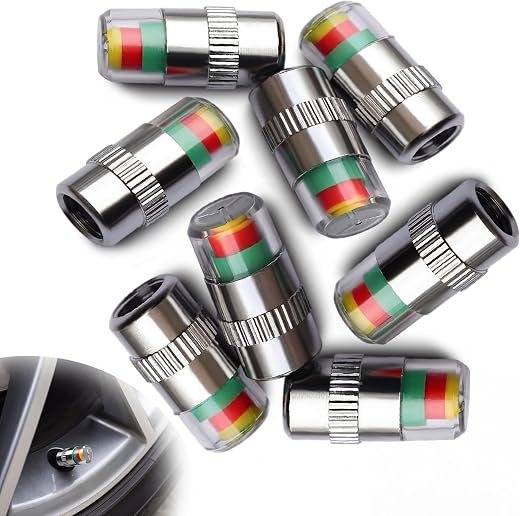
A mechanical early-warning device rather than an instrument. Eight chromed caps replace the dust caps on standard valves and show green, yellow or red against a fixed 32 PSI reference, turning an occasional chore into something you notice in passing. The fixed calibration rules out any vehicle running a different pressure, and the small sealing washer must not be lost.
$10.99
ANKIA Tire Pressure Valve Caps Review (2026) — A $10 Warning Light for Any Car
Under-inflated tyres are the most common maintenance fault on the road and the least noticed. A tyre can lose a quarter of its pressure and still look completely normal to the eye, and the consequences arrive as worse braking, uneven wear, higher fuel consumption and, at the far end, a blowout. Almost nobody checks pressures monthly, which is what every manufacturer asks for.
These tire pressure valve caps replace the plastic dust caps on your existing valves with a chromed metal cap containing a small spring-loaded indicator. Green means the pressure is at the rated figure, yellow means roughly ten per cent low, red means about twenty-five per cent low. The strength is that you get a visual check every time you walk past the car. The compromise is that they are calibrated to one fixed pressure and are not a substitute for a gauge.
In short: the tire pressure valve caps earns 7.9/10 from the Blue Rays Technologies team. The rest of this review sets out exactly how that score was reached.
What is in this tire pressure valve caps review
- Key Specifications
- What Tire Pressure Valve Caps Do and Do Not Measure
- The Pressure Rating Is the Whole Purchase Decision
- Fitting, the Washer Warning and Everyday Care
- Limitations and Compromises
- Fitting, Checking and Winter Care
- Who Should Buy It?
- The Verdict
- Frequently Asked Questions
- Related Reviews
Key Specifications
Published specifications for the tire pressure valve caps, taken from the manufacturer listing.
| Reviewed model | tire pressure valve caps |
| Brand | ANKIA |
| Model | AAT000001PN |
| Pack | 8 caps |
| Rated pressure | 32 PSI / 2.2 bar |
| Alert bands | Green normal, yellow ~10% low, red ~25% low |
| Size | Approximately 1 cm x 2.5 cm |
| Material | Chromed metal and polycarbonate |
| Fitment | Universal Schrader valve — car, motorcycle, bicycle |
| Diameter | 10 mm |
| Weight | 70 g for the set |
| Warranty | 1 year |
| Power | None — mechanical indicator |
| Amazon rating | 4.2 / 5 from 4,678+ ratings |
Everything that follows is based on those published figures for the tire pressure valve caps, together with aggregated owner feedback from verified buyers.
What Tire Pressure Valve Caps Do and Do Not Measure
The mechanism is a small piston held against a spring by the air pressure in the tyre. At the rated pressure the piston sits high and a green band shows in the window. As pressure falls the piston descends and yellow, then red, appears. There is no electronics, no battery and no calibration to maintain.
What it gives you is a comparison against one fixed reference, not a reading. It cannot tell you that a tyre is at 29 PSI; it can tell you that a tyre is meaningfully below 32 PSI, which is a different and simpler question. That distinction is the whole product.
The value is frequency. A gauge is more accurate but only gets used when someone decides to use it, and the honest answer for most drivers is a few times a year. A coloured window that is visible whenever you walk to the driver’s door converts an occasional task into a passive one.
The Pressure Rating Is the Whole Purchase Decision
This set is rated at 32 PSI, or 2.2 bar. Sets rated at 36 PSI, 2.4 bar and several other figures exist, and buying the wrong one makes the caps worse than useless because they will show a permanent false warning or a permanent false all-clear.
Your correct pressure is on the placard inside the driver’s door frame, in the fuel filler flap or in the handbook. It is not the number moulded into the tyre sidewall, which is the tyre’s maximum rather than the vehicle’s recommendation, and front and rear figures often differ.
If your vehicle’s recommended pressures do not match an available cap rating, these are not the right product for that car. That is a real limitation and it rules out a substantial number of vehicles, particularly loaded vans and larger SUVs.
Fitting, the Washer Warning and Everyday Care
The manufacturer’s own listing carries the most useful warning on the page: when removing a cap, do not lose the black washer, which tends to fall out and is very difficult to find again. It also suggests removing the caps before a garage service and before an automatic car wash.
That washer is what makes the seal. Without it the cap will read wrongly and can leak slowly, which turns a monitoring device into the cause of the problem it exists to detect.
Metal caps on metal valve stems can seize over time, particularly where roads are salted. A smear of silicone grease on the thread at fitting is the standard preventive measure and takes about a minute for the whole set.
Limitations and Compromises
No product is right for everyone, and these are the places where the tire pressure valve caps asks something back from the buyer.
They are calibrated to a single pressure. If your car’s placard says anything other than 32 PSI, this particular set is the wrong one and there is no adjustment.
They are an alert, not a gauge. Nothing about them removes the need for a proper pressure check with a real gauge at sensible intervals.
They do not replace a legally required TPMS. On vehicles fitted with a factory monitoring system, these are an addition to it, not a substitute.
A 4.2 average from around four and a half thousand ratings is decent but not outstanding, and the recurring complaints in this category are slow leaks from lost washers and windows that fog over time.
Fitting, Checking and Winter Care
Getting the best out of the tire pressure valve caps over a long life comes down to a few simple habits.
Find your vehicle’s recommended pressure before buying, on the door-frame placard or in the handbook, and buy the rating that matches. Never use the maximum figure printed on the tyre sidewall.
Set the tyres correctly with a proper gauge first, then fit the caps. They indicate deviation from a reference, so they are only meaningful if the starting point was right.
Keep the black sealing washers. Remove caps over a cloth or a hand rather than over a gutter, and check they are still seated when you refit.
Remember that cold weather lowers pressure by roughly one PSI for every ten degrees Fahrenheit drop. A yellow window on the first frost of the season is usually physics rather than a puncture, and should still be corrected.
Who Should Buy It?
The tire pressure valve caps suits some households far better than others. It is a clear buy if you recognise yourself here:
- Your vehicle’s recommended pressure is 32 PSI or 2.2 bar
- You want a passive daily reminder rather than a task you forget
- You have an older car with no factory pressure monitoring
- You want to cover a car plus a motorcycle or bicycles from one pack
- You want something with no battery to replace
The tire pressure valve caps is the wrong purchase if any of the following apply:
- Your recommended pressure is not close to 32 PSI
- You want an actual numeric reading rather than a warning colour
- You already check pressures with a gauge every month
- You do not want to think about a small sealing washer ever again
The Verdict
Judged as what it is — a passive early-warning device, not an instrument — this is a sensible ten-dollar purchase. There is no battery, nothing to pair, nothing to fail, and the colour bands are wide enough to be read from standing height without bending down. Eight caps cover a car and a bicycle or a motorcycle from a single pack.
What holds it back is the fixed calibration and the washer. A device that only works at one pressure will not suit every vehicle, and a small rubber component that falls out and causes a slow leak is a genuine failure mode rather than a theoretical one. A 4.2 average from roughly four and a half thousand buyers reflects a product that works well for the people it fits and poorly for the ones it does not.
Review score for the tire pressure valve caps: 7.9/10. Strong on price, simplicity and passive monitoring; the compromise is a single fixed pressure rating, no numeric reading and a small washer that must not be lost. Blue Rays Technologies researches independently and earns a commission from qualifying purchases, which never affects the score.
If you want to see the current price, the full options and the latest buyer feedback, it is listed as the ANKIA 8-Piece Tire Pressure Monitor Valve Stem Caps on Amazon. For why under-inflation is treated as a safety issue rather than a fuel-economy one, the reference material is published by the US National Highway Traffic Safety Administration.
Frequently Asked Questions
The questions buyers ask most often about the tire pressure valve caps, answered plainly.
Are tire pressure valve caps accurate enough to rely on?
They are indicators, not gauges. They reliably show a meaningful drop below their rated pressure through green, yellow and red bands, but they give no number. Use them as a prompt to check with a proper gauge, not as a replacement for one.
How do I know whether to buy the 32 PSI or 36 PSI version?
Check the placard inside the driver’s door frame or the fuel filler flap, or the handbook. That is the vehicle’s recommended cold pressure. Never use the maximum pressure moulded into the tyre sidewall, which is a different figure entirely.
Will they cause a slow puncture?
Only if the black sealing washer is lost or badly seated. The manufacturer warns about this directly. Fit them carefully, check them after a week, and remove them before a garage service or an automatic car wash.
Do they work on bicycles and motorcycles?
They fit any standard Schrader valve, so most motorcycles and many bicycles. Bicycle tyres usually run far higher pressures than 32 PSI, and Presta valves are not compatible at all.
Related Reviews
If the tire pressure valve caps is not quite the right fit, these Blue Rays Technologies reviews cover the nearest alternatives.
- ZF8313 EDC Flashlight review — the other thing that lives in the car
- Gerber Suspension NXT review — roadside kit worth carrying
- Magnetic Cable Clips review — keeping the charging lead off the footwell
Last updated: 4 September 2026. Pricing and availability for the tire pressure valve caps change frequently; check the retailer listing for the current figure.
User Reviews
Be the first to review “Tire Pressure Valve Caps Review — Do 3-Colour Indicator Caps Actually Help?”
Related Products



$10.99

There are no reviews yet.