
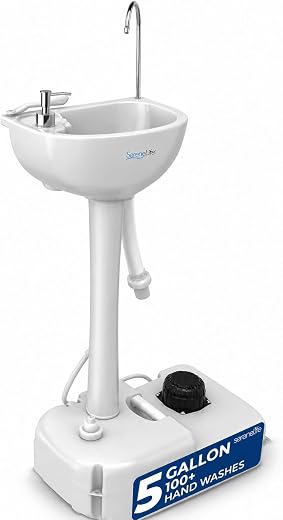
Portable Hand Washing Station Review — SereneLife 19L Foot Pump Sink
SereneLife Portable Hand Washing Station Review (2026) — Running Water With No Plumbing?
Hand hygiene away from plumbing is usually solved badly. A bottle of sanitiser does nothing about visible dirt or grease, a water jug needs someone to pour while somebody else washes, and a jerrycan with a tap runs continuously and empties itself in an afternoon. None of those is running water, and for anything involving food they are not a substitute for it.
A portable hand washing station is the actual answer: a freestanding unit with a tank in the base, a tap on top and a foot pump that delivers water only while you press. The SereneLife holds 19 litres, delivers 180 ml per step for more than a hundred washes, and comes with a soap dispenser and towel holder. It costs around $75 and carries 4.4 stars from more than 3,600 ratings.
In short: the portable hand washing station earns 7.9/10 from the Blue Rays Technologies team. The rest of this review sets out exactly how that score was reached.
What is in this portable hand washing station review
- Key Specifications
- Why a Foot Pump Changes What a Portable Hand Washing Station Can Do
- Capacity, Height and Everyday Use
- Where It Earns Its Place, and What It Is Not
- Limitations and Compromises
- Filling, Draining and Keeping the Water Clean
- Who Should Buy It?
- The Verdict
- Frequently Asked Questions
- Related Reviews
Key Specifications
Published specifications for the portable hand washing station, taken from the manufacturer listing.
| Reviewed model | portable hand washing station |
| Brand | SereneLife |
| Model | SLCASN18 |
| Manufacturer | Sound Around |
| Fresh water capacity | 19 litres / 5+ US gallons |
| Washes per fill | 100+ |
| Delivery | 180 ml per foot-pump step |
| Operation | Hands-free foot pump |
| Soap dispenser | 3 litre integrated |
| Towel holder | Stainless steel, included |
| Material | High-density engineered polyethylene |
| Dimensions | 13 x 19.7 x 40.1 inches |
| Weight | 7.7 lb empty |
| Drainage | Flexible drain hose included |
| Assembly | Minimal tools required |
| Warranty | 1 year limited |
| Amazon rating | 4.4 / 5 from 3,679 ratings |
Everything that follows is based on those published figures for the portable hand washing station, together with aggregated owner feedback from verified buyers.
Why a Foot Pump Changes What a Portable Hand Washing Station Can Do
The foot pump is the feature that makes the category work, and it does two separate things. It keeps both hands free and out of contact with any tap, which is the point of hands-free washing in the first place, and it delivers water only while the pedal is down, which is what turns 19 litres into more than a hundred washes rather than a dozen.
A gravity tap on a jerrycan runs at whatever rate the tap is opened to and, in practice, runs while people soap up. Metered delivery of 180 ml per step means the water goes on wetting and rinsing and nowhere else. That is the difference between refilling once a day and refilling three times.
It is also purely mechanical. There is no pump motor, no battery and no charging, so there is nothing to fail at the point where the unit is furthest from a socket. For a market stall, a campsite or a building site, that reliability is worth more than convenience features.
Capacity, Height and Everyday Use
Nineteen litres is around 42 pounds of water when full, which is worth thinking about before purchase: the unit weighs 7.7 lb empty and roughly 50 lb full, so it is filled in position rather than carried full. Filling from a hose or several trips with a jug is the normal routine.
At just over 40 inches tall it is a standing-height sink for an adult, which is the correct height for washing but too tall for young children without a step. Anyone buying for a family campsite or a nursery setting should factor that in — a low step solves it entirely and costs almost nothing.
The integrated three-litre soap dispenser and the stainless towel holder are the details that make it a station rather than a tap. Soap and a towel being physically attached to the sink is exactly what makes people actually wash rather than rinse, and both are the sort of thing that gets forgotten when equipment is assembled from parts.
Where It Earns Its Place, and What It Is Not
The natural buyers are outdoor caterers and market traders, campsites and caravanners, allotment holders, dog groomers and anyone running an event where a proper hand wash is expected and no plumbing exists. In several of those settings hot water and a dedicated wash basin are a regulatory requirement rather than a nicety, and it is worth checking local rules before assuming any portable unit satisfies them.
It is not a warm-water sink. There is no heater, so the water is whatever temperature you put in — which is fine for hand washing, since thorough scrubbing with soap matters far more than temperature, but it is not a dishwashing station and it will not feel pleasant in January.
Nor is it a substitute for a proper waste connection. Grey water drains through a flexible hose into whatever container you provide, and disposing of that responsibly is your problem rather than the product’s. On a campsite that means a designated point rather than the nearest hedge.
Limitations and Compromises
No product is without compromise, and the portable hand washing station has a few worth knowing before you buy.
It is bulky. Forty inches tall with a nineteen-litre base is a substantial object to store and to transport, and it does not collapse. If it is going to live in a garage between three uses a year, that footprint is the main argument against.
The polyethylene construction is durable but plainly built to a price, and the recurring complaint across this category is the pump foot pedal and its tubing rather than the tank. A spare length of food-grade tubing costs very little and is worth having if the unit is doing commercial duty.
And there is no heating, no filtration and no waste tank. Everything about greywater and water quality is left to the user, which keeps the price down and means it cannot be treated as a self-contained plumbing solution.
Filling, Draining and Keeping the Water Clean
Getting the best out of the portable hand washing station over a long life comes down to a few simple habits.
Drain it completely after every use and leave the lid off to dry. Standing water in a warm plastic tank grows biofilm quickly, and biofilm in a hand-washing tank defeats the point of the exercise. Draining takes two minutes and prevents almost every hygiene problem this type of unit can develop.
Sanitise the tank periodically with a dilute unscented bleach solution, run it through the pump and lines, then flush thoroughly with fresh water until no smell remains. Doing that at the start and end of a season is enough for domestic use; commercial use wants it far more often.
Fill from a potable source and treat the tank as a potable container even if the water is only for washing. It is also worth carrying a spare pedal tube if the unit is being used commercially, since that is the part most likely to interrupt a day’s trading.
Who Should Buy It?
The portable hand washing station suits some households far better than others. It is a clear buy if you recognise yourself here:
- You trade at markets or events where hand washing is expected or required
- You camp, caravan or work on sites with no water supply
- You want metered, hands-free water rather than a jerrycan that pours continuously
- You want soap and a towel attached to the sink rather than lying somewhere nearby
- You need something mechanical that cannot run out of charge
The portable hand washing station is the wrong purchase if any of the following apply:
- You need hot water — there is no heater and none can be added easily
- You have nowhere to store a rigid 40-inch unit between uses
- You want to wash dishes rather than hands, where a twin-bowl camp sink is better
- You need a self-contained waste system rather than a drain hose
The Verdict
This solves a specific problem properly. The foot pump is the correct mechanism, the metered delivery is what makes 19 litres last a full day, and including the soap dispenser and towel holder turns it into a complete station rather than a tap on a box. For traders, campsites and anyone who needs a genuine hand wash away from plumbing, it is the sensible purchase.
The score is held back by size, by a build that matches its price rather than exceeding it, and by the absence of heating, filtration or waste storage. Those are the honest boundaries of a $75 product, and within them it does everything it claims.
Review score for the portable hand washing station: 7.9/10. A well-judged solution to an awkward problem, provided you have somewhere to keep it. Blue Rays Technologies researches independently and earns a commission from qualifying purchases, which never affects the score.
Current pricing and the larger capacity variants are on the listing for the SereneLife Portable Hand Washing Station at Amazon. For what a proper hand wash actually requires — and why soap and friction matter more than water temperature — the CDC guidance on handwashing is the reference this kind of equipment is designed around.
Frequently Asked Questions
The questions buyers ask most often about the portable hand washing station, answered plainly.
How many washes does a portable hand washing station give per fill?
The manufacturer quotes more than a hundred from the 19-litre tank, based on 180 ml delivered per foot-pump step. That figure holds up in practice precisely because the pump is metered — a continuously running gravity tap empties the same tank far faster.
Does it supply hot water?
No. There is no heater, so the water is whatever temperature you fill it with. For hand washing that is not a problem — soap and twenty seconds of scrubbing do the work — but it is not suitable as a dishwashing station in cold weather.
Where does the waste water go?
Out through a flexible drain hose into a container you provide. There is no built-in waste tank, so disposing of grey water responsibly is down to you, which on a campsite means a designated disposal point.
Is it approved for commercial food trading?
That depends entirely on your local environmental health rules, which commonly specify a dedicated hand-wash basin with hot and cold water. Check with your local authority before assuming any portable unit satisfies the requirement.
Related Reviews
If the portable hand washing station is not quite the right fit, these Blue Rays Technologies reviews cover the nearest alternatives.
- Ninja FrostVault Cooler review — the cold half of an outdoor setup
- Veradek Cooler Side Table review — outdoor furniture that works harder
- UCO Stormproof Matches review — from the same batch of outdoor picks
Last updated: 28 August 2026. Pricing and availability for the portable hand washing station change frequently; check the retailer listing for the current figure.


There are no reviews yet.